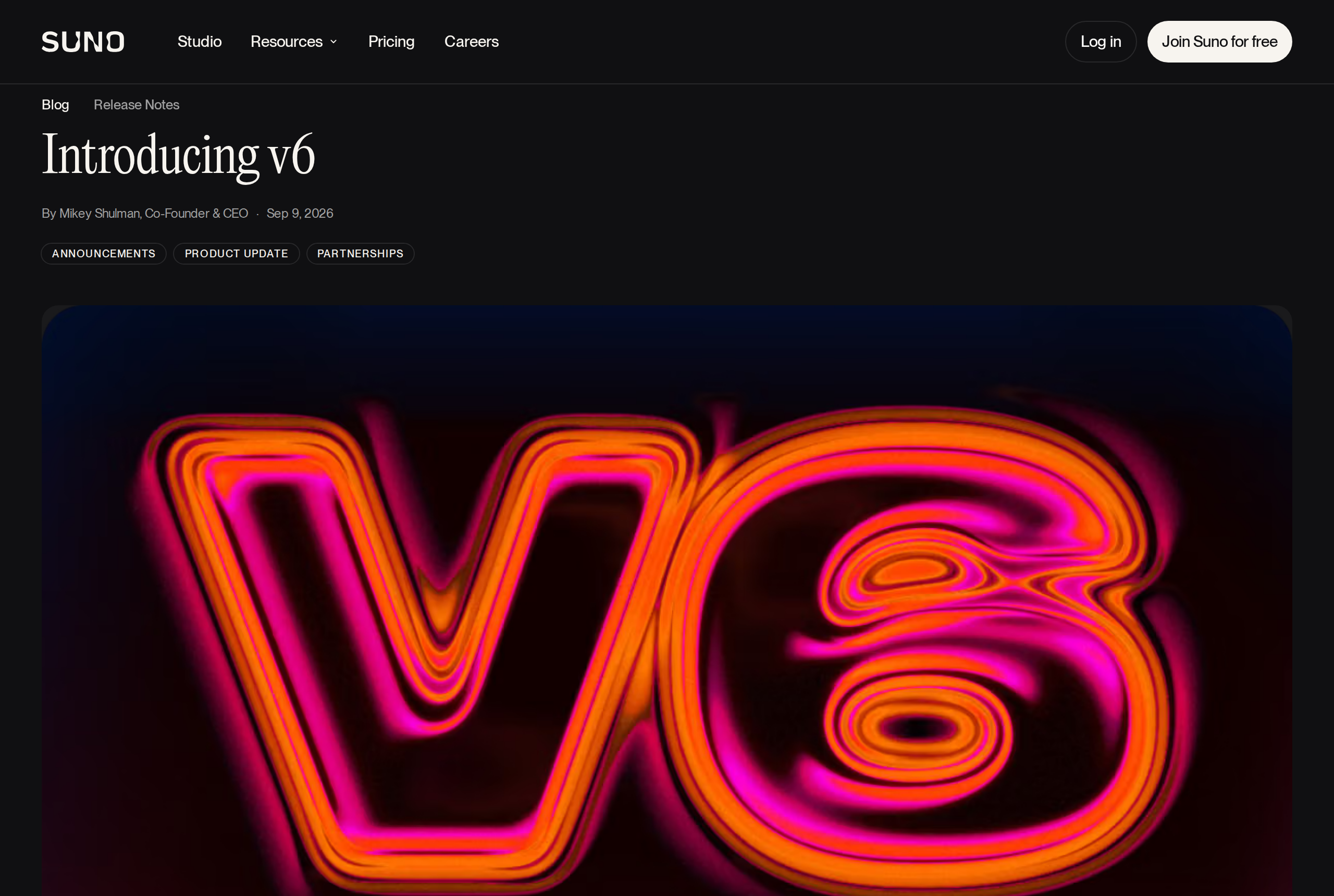
Suno on Tuesday, September 9, 2026 unveiled Suno v6, a completely new generation of its AI music models — and this release breaks with the startup's controversial past in the most consequential way possible: the new models were developed in partnership with the music industry itself, using licensed data from Warner Music Group, BMG, and Believe. For video creators, marketers, and short-form content teams that have been wary of AI-generated soundtracks, this is the moment the legal ground finally starts to firm up. Weeks after settling licensing, Suno kept expanding with the Speech beta that generates voice and music together in one track.

What Suno actually announced
Co-founder and CEO Mikey Shulman described v6 as the company's "biggest step yet" toward letting anyone make music. The new generation is faster, more expressive, and higher quality than its predecessors, with deeper creator control. Crucially, the company confirmed that v6 models were not trained on the data used for previous versions — a clean break from the training corpus that landed Suno in court — and that older models will gradually be retired.
The timing matters. Suno settled with Warner Music Group last year, signed a deal with BMG in August, and announced a partnership with Believe and TuneCore just yesterday, September 8. A day before the launch, the company also admitted it had trained earlier models on YouTube videos. The lawsuits from Sony, Universal Music Group, and artists like Jason Isbell are still pending — but v6 is the visible fruit of those settlements: the first model generation built with labels rather than against them.
Three models instead of one
The most practical change in v6 is structural. Instead of a single model, you now get a family of three, each aimed at a different kind of creator:
- v6 — the flagship, exclusive to Pro and Premier subscribers. Reliable, precise, and consistent across every genre and style. When you know exactly what you want, this is the model that gets you there.
- v6-wild — the exploration model, also for Pro and Premier. Less predictable and more varied, it produces unexpected, textured, ambitious results — a creative spark you can bring back into v6 for refinement.
- v6-mini — the faster, more efficient version, available to everyone for free. Suno claims it delivers better, faster results than any free model on any music creation platform.
The new editing features: word-level control over your tracks
This is where v6 genuinely changes a creator's workflow. Instead of regenerating an entire song because one section felt wrong, you can now surgically edit what exists:
- Partial editing in plain language — change one section while everything else stays untouched. Suno's own example: "Change the chorus so it's sung by a gospel choir."
- Mashups from multiple sources in a single request — "Take the vocals from x, drums from y, and add new lyrics about losing control, make it 80s synthwave."
- Sampling, isolation, and beat-building in one workflow — "Sample the riff at 0:45, isolate the guitar, build a beat around it." What used to require separate stem-separation tools now happens in place.
- Creation from a vibe or reference — v6 understands the feeling behind a reference: "Make a song that feels like midnight on a rooftop."
- Creation from text, audio, images, or video — start from a written idea, a voice memo, a visual, or a video clip and turn it into a track.
Under the hood, Suno says v6 better understands the building blocks musicians actually use — vocals, instrumentation, structure, mood, references, and overall feel — which makes communicating a complex vision easier than in any previous version.
What this means for you as a content creator
- Lower legal risk for background music. The biggest fear for anyone publishing Reels, TikToks, YouTube videos, or ads has been a rights claim freezing the account. A model trained on licensed data from three major industry partners addresses that risk at the platform level.
- Massive time savings from partial edits. Fixing a chorus no longer means losing the verses you loved. This is the difference between generating assets and editing them.
- A genuinely usable free tier. v6-mini gives free users a fast, modern model — ideal for testing an idea before committing to a subscription.
Music is only one piece of the content pipeline, of course. Once the soundtrack is settled, you still need copy, visuals, and a publishing calendar — which is where multilingual workspaces like ARWriter come in, handling writing, design, and scheduling from a single dashboard.
Quick comparison: which plan fits you?
| Plan | Monthly price | Models | Commercial rights | Monthly downloads |
|---|---|---|---|---|
| Free | $0 | v6-mini | No | None |
| Pro | $8 | v6, v6-wild, v6-mini | Yes, for new songs | 20 songs |
| Premier | $24 | v6, v6-wild, v6-mini | Yes, for new songs | 60 songs |
Prices as listed on Suno's pricing page on launch day; annual billing is cheaper. Pro includes 2,500 monthly credits (up to ~500 songs), Premier includes 10,000 (up to ~2,000 songs) plus priority generation.
For context on the broader market, we've previously covered Google's Lyria 3.5 music model inside Gemini and Suno's own Studio 2.0 browser DAW — competition in this space is accelerating fast, and creators are the beneficiaries.
Honest limitations you should know
- The lawsuits aren't over. Despite the new licenses, cases from Sony, Universal, and Jason Isbell remain unresolved, and the full legal picture is still settling.
- Legacy models are going away. If you have work built on older versions, export your files now and watch for retirement notices.
- Download limits are real. The tier-based download caps Suno introduced in August remain in effect, and free users cannot download files at all.
- Watermarking is coming. Suno announced in August that watermarks will be added to generated songs — expect them on v6 output.
- Remixing real artists' songs is opt-in only. The upcoming remix feature depends on artists and labels enrolling their catalogs; it won't be a free-for-all.
Frequently asked questions
Is Suno v6 free?
The v6-mini model is free for everyone. The flagship v6 and the experimental v6-wild require a paid subscription — Pro at $8/month or Premier at $24/month.
Can I use Suno v6 songs in commercial content?
Commercial rights in Suno are plan-based: Pro and Premier include commercial use rights for new songs you create, while the free plan does not. Licensed training reduces platform-level rights claims, but read the current terms of service before building a client campaign on it.
What's the difference between v6, v6-wild, and v6-mini?
v6 is the precision flagship for polished output, v6-wild is the unpredictable exploration model for inspiration, and v6-mini is the fast free version. The first two are paid-tier only.
Will older models like v4.5 and v5.5 be shut down?
Suno has stated it plans to retire older models after the v6 rollout. If you have favorite tracks generated on a legacy model, export them sooner rather than later.
Does v6 work for non-English music?
Suno has supported songs in many languages since earlier releases, but the v6 announcement doesn't claim specific language improvements — the stated focus is quality, control, and licensing.
The bottom line
Suno v6 is less a model upgrade than a reset of the relationship between AI music tools and the recording industry: licensed training, label partnerships, and editing features that rival dedicated DAWs. For creators, the message is straightforward — there is now a free model worth testing and a professional tier at $8/month with materially lower legal risk than a year ago. Try v6-mini with your next video idea, and for the rest of the pipeline — scripts, captions, visuals, and scheduling — explore ARWriter's prompt library and keep your whole content operation in one place.