Last updated: October 2026
AI referral traffic used to be a rounding error. In 2024, AI assistants accounted for 0.02% of all site visits. By 2026 that share reached 0.32% — a 16x rise, roughly 1 in every 312 visits — while total referral traffic from AI platforms grew 73% in under a year, according to BrightEdge's September 2026 data. Those clicks exist because Claude, ChatGPT and Perplexity cited a page of yours and someone clicked the link. The problem is twofold: most analytics setups bury this traffic inside a generic Referral row, and most advice about getting cited is folklore repeated without evidence. This piece fixes both. You get the referral math converted to your site size, a 30-minute measurement stack built on GA4 and server logs, the documented citation mechanics of the three assistants that matter, an editing system that makes your passages quotable, and an evidence-based verdict on llms.txt. No enterprise dashboard required.
The short answer: AI referral traffic is visitors who click a link inside an AI assistant's answer and land on your site. Track it in GA4 with a custom channel group matching chatgpt.com|claude.ai|perplexity.ai|gemini.google.com|copilot.microsoft.com, then earn it by publishing dated, self-contained, quotable passages the engines can lift and cite.
The referral math: what 0.32% of all visits means for your site
A 0.32% share sounds ignorable until you convert it into sessions for your own site, project it forward at the measured growth rate, and price the extra engagement those visitors bring. Here is the conversion, using SE Ranking's study of 101,574 websites across 250 countries over 16 months (January 2025 to April 2026) and BrightEdge's 73% year-over-year growth in AI referral traffic.
The baseline: AI assistants went from 0.02% of visits in 2024 to 0.24% in 2025 to 0.32% in 2026. Organic search still carries 42.75% of visits, so nobody is abandoning Google — but the AI line is the only one compounding this fast.
Apply the numbers to three site sizes, then two larger ones for perspective:
| Monthly sessions | AI visits/month now (0.32% share) | In 12 months (+73%/year) | Engaged-minute equivalent (1 AI visit ≈ 1.7 organic-visit minutes) |
|---|---|---|---|
| 5,000 | 16 | 28 | 27 |
| 10,000 | 32 | 55 | 54 |
| 50,000 | 160 | 277 | 272 |
| 250,000 | 800 | 1,384 | 1,360 |
| 1,000,000 | 3,200 | 5,536 | 5,440 |
Two things make the raw counts understate the value. First, engagement: SE Ranking measured AI-referred visitors staying 67.7% longer on site — an average of 9:19 versus 5:33 for other visitors, with medians of 2:24 versus 1:53. Someone who clicked a citation arrived mid-task, already curious. Second, the compounding: a share that multiplied 16x in two years, plus 73% platform growth in the last year, turns "ignore it" into an expensive default within one budget cycle.
The honest caveat: 55 monthly visits will not save a 10,000-session site. But 55 highly engaged visits that cost nothing beyond editing discipline, growing 73% a year on a base that started at zero two years ago, is the cheapest channel you are not measuring yet.
How a Leeds marketer turned 32 buried referrals into a monthly system
Daniel Roe runs a one-person content consultancy in Leeds, England, with a B2B blog doing about 10,000 sessions a month. In spring 2026 he noticed something odd in his GA4 Referral report: a handful of sessions from chatgpt.com, mixed in with the usual link directories. At his traffic level, the model above says that is roughly 32 AI visits a month — invisible unless you go looking.
What made him look twice was the engagement row. Those sessions mirrored the study data almost exactly: visitors from assistant citations read for around nine minutes while his average visitor stayed closer to five and a half. He was not getting traffic; he was getting the most interested readers on the site.
Daniel spent half an hour on the GA4 setup below, then treated it as an editing problem rather than a tracking problem. He rewrote the opening 40-60 words of every H2 on his highest-traffic pages so each one answered its question standalone. He converted dense paragraphs into bulleted lists. He added publish dates to statistics-heavy posts and started writing "SE Ranking's study of 101,574 websites found..." style sentences — claim, number, source, same sentence.
By summer 2026 the pattern had a shape: citations clustered on exactly the pages he had rewritten, and the visits arrived from more than one assistant. Nothing about his Google traffic changed. He now reviews one report on the first Monday of each month — AI Assistants channel in GA4, server-log bot hits beside it — and credits the channel in client reports.
The 30-minute measurement stack: GA4 custom channel groups plus server logs
You do not need Profound's enterprise dashboard or any paid tool to see this traffic. You need one GA4 custom channel group, one report on a calendar, and occasional log checks. Here is the full stack, in order.
- Open the config. In GA4, go to Admin, then Data settings, then Data display, and click Define custom channel groups.
- Create a group named "AI Assistants". This becomes its own row in your standard reports — no segments or explorations required to see it weekly.
- Add one rule. Condition: Session source, matches regex, with this exact hostname list:
chatgpt.com|claude.ai|perplexity.ai|gemini.google.com|copilot.microsoft.com
- Mind the rule order. Within a custom channel group, rules are evaluated top-down and the first match wins. If you already have custom channels with broad conditions, place the AI Assistants rule above them, or broader rules will claim the sessions first.
- Understand why this is needed. Custom channel groups are evaluated before GA4's default channel group. Without the custom rule, assistant clicks arrive as referrals with no campaign medium, so GA4 files them under Referral — and when apps strip referrer data, under Direct. That is how a 16x growth channel stays invisible for a year.
- Verify the ChatGPT signature. Clicked links from ChatGPT arrive with chatgpt.com as the referrer and utm_source=chatgpt.com appended — you can confirm both in the Traffic acquisition report with Session source as a secondary dimension. Claude and Perplexity visits show up as plain referrals from claude.ai and perplexity.ai.
- Cross-check with server logs, monthly. Count hits from GPTBot, ClaudeBot, PerplexityBot and GPTBot-User in your access logs and put the number next to your GA4 sessions. The three never mix: bots crawling is not the engine citing you, and being cited is not a human clicking. Log hits tell you what the engines have read; GA4 tells you what humans acted on. If GPTBot fetches a page weekly but no chatgpt.com session ever lands, the engine knows you and chooses not to cite you — that is an editing problem, not a tracking one.
For a deeper walkthrough of reports, segments and attribution limits, see the companion guide to measuring AI traffic in GA4.
Three citation machines: how Claude, ChatGPT and Perplexity pick sources
The three assistants that send meaningful referral traffic do not share a brain. Each has documented, different citation mechanics — and each rewards a different kind of page.
Claude searches the web server-side only when it judges the information is current, changing, or missing from its training data — stable evergreen facts may be answered with no search at all. Per Anthropic's developer documentation, Claude typically runs 1-3 searches per query, and 10+ for comparison questions (at a cost of $10 per 1,000 searches in the API, which is why it economizes). Each citation returns a structured object: url, title, and a cited_text excerpt capped at roughly 150 characters. Developers can constrain search with allowed_domains and blocked_domains filters, and user_location shapes localization — so being cited in one Claude deployment does not guarantee citation everywhere.
ChatGPT browses on demand, then synthesizes with inline citations plus a Sources side panel, and distinguishes internally between pages it fetched, cited, or merely mentioned. The ground truth for you: outbound clicks arrive in your analytics attributed to chatgpt.com with utm_source=chatgpt.com — verifiable in your own GA4 the day it happens. For a focused playbook on that engine, see how to appear in ChatGPT's search answers.
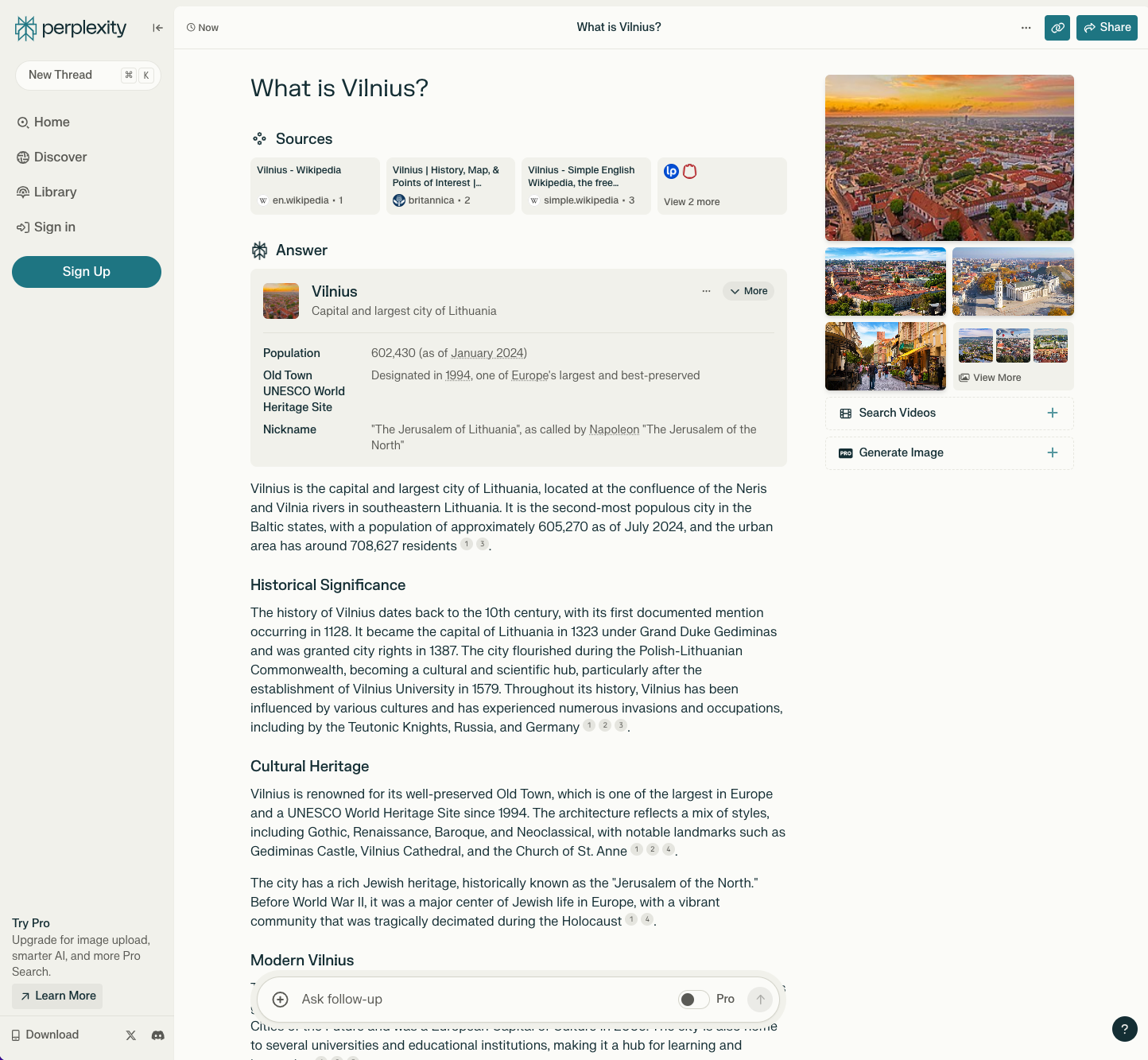
Perplexity runs retrieval-and-synthesis on every query in real time, with sentence-level citations and a source panel users actually click. Its documented bias is the strongest of the three: Discovered Labs (January 2026, data published via aidev.com) found Reddit alone supplies 46.7% of Perplexity's top citations, versus roughly 12% for ChatGPT and about 7.8% of ChatGPT citations coming from Wikipedia.
| Dimension | Claude | ChatGPT | Perplexity |
|---|---|---|---|
| When it searches | Only if info seems current, changing, or missing; 1-3 searches typical, 10+ for comparisons | Browses on demand when a query needs fresh pages | Every query, real-time retrieval |
| How citations surface | url + title + cited_text excerpt capped near 150 characters | Inline citations plus Sources side panel | Sentence-level citations, clickable source panel |
| What lands in your GA4 | Referral from claude.ai | Referral from chatgpt.com with utm_source=chatgpt.com | Referral from perplexity.ai |
| Documented source bias | Domain allowlists/blocklists per deployment; user_location affects results | Wikipedia ≈7.8% of citations; Reddit ≈12% | Reddit 46.7% of top citations |
| Developer controls | allowed_domains / blocked_domains filters | — | — |
| What it rewards most | Dated, self-contained passages whose first 150 characters answer alone | Pages that answer the exact question, quotable opening lines | Fresh pages plus active community threads |
This article is strictly about assistants as a referral source. If your question is Google's own AI answers inside Search — Gemini and AI Mode — that is a separate system covered in the companion guide to getting cited in Google's AI Mode.
By the way, if you produce content in Arabic or need bilingual workflows, ArWriter gives you an Arabic-first AI editor and prompt library — starts at $4.99/month.
The quotable-passage rewrite system
Every H2 on this page opens with a 40-60 word paragraph that answers the heading on its own. That is not a style preference — it is engineered to fit Claude's citation object, whose cited_text field carries about 150 characters. An opening that answers in two sentences fits that window several times over; a meandering intro that "sets up context" fits zero times. The research basis is older than the 2026 numbers but still the methodological anchor: the Generative Engine Optimization paper (KDD 2024) found that restructuring content with citations, quotations and statistics lifted visibility by up to 40%.
The system has four moves and a checklist:
- Answer-first openings. The first sentence under every H2 and H3 states the conclusion. A retrieval system sampling your page should be able to quote only your opening paragraphs and still serve a correct answer.
- Stat-plus-source sentences. Write claims as "SE Ranking's study of 101,574 websites found AI assistants send 0.32% of visits" — fact, number, named source in one sentence. Engines lift attributable sentences far more readily than unattributed assertions.
- Bulleted lists over dense paragraphs. Discovered Labs measured bulleted content as roughly 30% more likely to be cited by Claude. Lists also force you to decompose arguments into liftable single lines.
- Speed as a citation signal. The same research found pages with First Contentful Paint under 0.4 seconds average 6.7 citations versus 2.1 for slower pages. Whatever the causal direction, fast pages get cited more.
Run this 10-point check before every publish:
- Every H2 opens with a 40-60 word answer that stands alone.
- Every statistic carries its source in the same sentence.
- Each major section contains at least one bulleted list.
- The first 150 characters of key paragraphs work as a standalone quote.
- A publish or update date is visible on the page.
- First Contentful Paint on the page is under 0.4 seconds.
- Headings are phrased as the real questions your buyers type.
- GPTBot, ClaudeBot and PerplexityBot are allowed in robots.txt.
- Nothing load-bearing is locked inside screenshots or embedded media.
- The GA4 AI Assistants channel group is live, so measurement starts on day one.
If you draft with Claude, pair this system with a professional prompt structure for AI-assisted writing, and if you are doing this at volume, the AI content pipeline guide covers batching the rewrite across a whole site.
llms.txt and robots.txt: what the evidence says
llms.txt is a markdown file proposal by Jeremy Howard of Answer.AI, first published September 3, 2024, with version 2 updated August 10, 2026 after what the spec itself calls two years of adoption. The format is simple: an H1 site name, a blockquote summary, and H2 sections listing markdown links to your key content. OtterlyAI data puts it on 10.13% of domains, Mintlify auto-generates it, Wix, GitBook, Yoast and AIOSEO support it, and OpenAI, Anthropic and Google each publish one for their own developer docs.
Here is the part most guides skip: the spec itself claims no ranking, visibility, or citation benefit. It describes files "used on demand, when an agent needs information" — an inference-time convenience for agents, not a signal that makes an engine cite you. The verdict writes itself: publish llms.txt for your documentation and product pages because agents can navigate them more easily; do not expect it to make Claude or ChatGPT cite you, and do not buy anything sold on that promise.
The lever that actually gates eligibility is robots.txt. If you want your pages retrievable, explicitly allow the crawler user-agents: GPTBot (OpenAI), ClaudeBot (Anthropic), and PerplexityBot. Blocking them is the one documented way to guarantee invisibility in an assistant's answers; allowing them is necessary but nowhere near sufficient — the engines still choose what to cite, which is why the editing system above exists.
One engine or all three: the concentration trap and the overlap gap
How concentrated is AI referral traffic? Two 2026 datasets give different answers, and the difference is the whole story.
BrightEdge reported ChatGPT hitting 95.1% of AI-generated referrals in August 2026 — its 2026 high, after a low of 89.5% in April — with ChatGPT referral traffic up 101% from January to August and 36% in August alone. Its August shares: Gemini 2.4%, Perplexity 1.1%, Claude 0.8%. ChatGPT sent roughly 22x their combined traffic.
SE Ranking's study measured ChatGPT at 74.78% of AI referral traffic in 2026, down from 79.74% in 2025, with Gemini at 11.56%, Perplexity at 7.23%, Copilot at 3.51% and Claude at 2.62%.
Both are correct, because they measure different webs. BrightEdge tracks referrals landing on its customer base — large enterprise sites, where ChatGPT's consumer scale dominates. SE Ranking samples 101,574 websites weighted toward small and mid-sized businesses, where the long tail of engines shows up. If you run an enterprise property, plan for ChatGPT near-monopoly concentration. If you run a smaller site, the realistic mix is closer to three quarters ChatGPT with a meaningful Perplexity and Gemini tail.
The strategic kicker is the overlap gap: per Discovered Labs, only about 11% of sites cited by ChatGPT are also cited by Perplexity. The engines do not share a citation graph — Reddit-heavy Perplexity and excerpt-quoting Claude reward different pages. Multi-engine coverage is the cheap arbitrage here: the same bulleted, answer-first editing pass that wins Claude excerpts also feeds ChatGPT's Sources panel, at zero marginal cost.
And the timing argument is Claude. It is the smallest meaningful sender — 2.62% share — but the fastest-growing: up 320% year over year (from 0.0021% to 0.0084% of total traffic), including a 159% single-month jump in March 2026. Getting cited by Claude today means competing on a channel where the citation graph is still thin. The same logic feeds a longer-horizon AI-ready search plan for 2027.
What if you publish in a language other than English?
The assistants retrieve live, so they are not locked to English-only indexes — but run a query in Spanish, German or Arabic and the source panels still surface English-heavy domains, because that is where the citable, answer-first content currently is. Three practical consequences: anchor bilingual terminology (state the English term and its equivalent together, so either query can match you), connect your language versions properly with hreflang, and phrase headings as real questions in the target language rather than translated headlines. Non-English answer-first content is scarce, which makes it disproportionately citable.
Frequently asked questions
What is AI referral traffic?
Visitors who click a link inside an AI assistant's answer and land on your site. SE Ranking measured it at 0.32% of all site visits in 2026, up from 0.02% in 2024 — about 1 in 312 visits — with ChatGPT sending roughly three quarters of it across the study's 101,574-site sample.
How do I track AI referral traffic in GA4?
Create a custom channel group named AI Assistants with one rule: session source matches the regex chatgpt.com|claude.ai|perplexity.ai|gemini.google.com|copilot.microsoft.com. Custom groups are evaluated before the default grouping, so those sessions stop hiding inside Referral and get their own row in the Traffic acquisition report.
Are ChatGPT referrals real visits or bots?
Mostly real people. Crawling arrives from GPTBot, not chatgpt.com; clicked citation links carry chatgpt.com as referrer with utm_source=chatgpt.com appended, which separates human clicks from crawls. Engagement agrees: AI-referred visitors average 9:19 on site versus 5:33 for other visitors in SE Ranking's study.
How does Claude choose which sources to cite?
Claude searches only when it judges information is current, changing, or missing — typically 1-3 searches per query, 10+ for comparisons. Citations return a url, a title, and a cited_text excerpt capped at roughly 150 characters, so passages whose opening answers the question are the ones that get lifted.
Does Perplexity cite the same sources as ChatGPT?
Largely no. Discovered Labs found only about 11% overlap between the two engines' cited sites, and Reddit alone supplies 46.7% of Perplexity's top citations versus roughly 12% for ChatGPT. Optimizing for one engine does not optimize for the other — cover both.
Do I need llms.txt to get cited by AI assistants?
No. The spec itself, updated August 10, 2026, claims no citation or visibility benefit — it describes files agents read on demand when they need information. Publish llms.txt for developer docs, as OpenAI, Anthropic and Google do for their own, but citations come from your pages.
Should I allow GPTBot and ClaudeBot in robots.txt?
Yes, if you want pages eligible for retrieval. Allow GPTBot, ClaudeBot and PerplexityBot explicitly, then keep crawling and referrals separate in measurement: server logs show bots fetching pages, while GA4 referrals show humans clicking citations. The two never mix in analytics.
How much traffic can AI assistants actually send a small website?
Apply the 0.32% share to your sessions: a 10,000-session month is about 32 AI visits now, roughly 55 in twelve months if the 73% annual growth holds. Those visitors stay 67.7% longer, so the engaged-minute value runs higher than the raw session count suggests.
Where to start tomorrow morning
Run the sequence in this order, and the whole thing fits inside one focused morning:
- Build the GA4 AI Assistants channel group with the hostname regex — 30 minutes, including verification.
- Allow GPTBot, ClaudeBot and PerplexityBot in robots.txt.
- Rewrite the openings of the H2s on your three highest-traffic pages as 40-60 word standalone answers.
- Add one bulleted, stat-plus-source section to each of those pages.
- Book a recurring first-Monday review: AI Assistants channel beside server-log bot hits.
From the second month, the report tells you which pages the engines cite, and you point your editing system at those pages' siblings. That loop — measure, rewrite, re-measure — is the entire discipline.
And if part of your publishing happens in Arabic, or you run bilingual workflows for clients, ArWriter gives you an Arabic-first AI editor with a prompt library built for exactly this kind of answer-first content, starting at $4.99/month.
Sources
- SE Ranking AI traffic study — 101,574 websites, 16 months: the 0.32% share, engine splits, and engagement data.
- BrightEdge press release, Sep 24 2026 — ChatGPT 95.1% referral share peak and +73% annual platform growth.
- Anthropic web search tool docs — primary source for Claude's search behavior and 150-character citation excerpts.
- llms.txt spec v2 — the proposal by Jeremy Howard (Answer.AI), updated Aug 10, 2026.
- GEO: Generative Engine Optimization (KDD 2024) — the research basis for citation, quotation and statistics structuring.
Image credits: cover image from Anthropic (official). Perplexity answer screenshot and chatbot interaction photo via Wikimedia Commons (public domain).