The music industry's war on generative AI just quietly ended with a signing ceremony. On September 10, 2026, Universal Music Group — the world's largest music company — and ElevenLabs, the leading AI audio company, announced a multi-year strategic agreement to build a licensed AI music creation platform. It's ElevenLabs' first deal with a major label, and it arrives one day after Suno shipped the first AI music model trained on officially licensed songs. Two years of lawsuits are giving way to something more interesting: licensed co-creation between fans, artists, and machines.

Official announcement cover from ElevenLabs' blog, September 10, 2026.
What the deal actually covers
According to the official press release issued from Santa Monica and New York, the agreement spans two tracks that usually stay separate: content licensing and joint product development. The first product will be a new AI-powered music platform built on licensed music with artist participation. Now in development, it will let fans co-create with music from participating artists and songwriters — through remixes, mashups, new interpretations of tracks, and personalized vocal experiences.
Two words carry the whole story: "licensed" and "participating." Artists decide whether their music joins the platform at all, and the agreement's stated principles include sharing the created value back with artists and songwriters. That's a structural break from the first generation of AI music tools, which trained first and asked permission never.
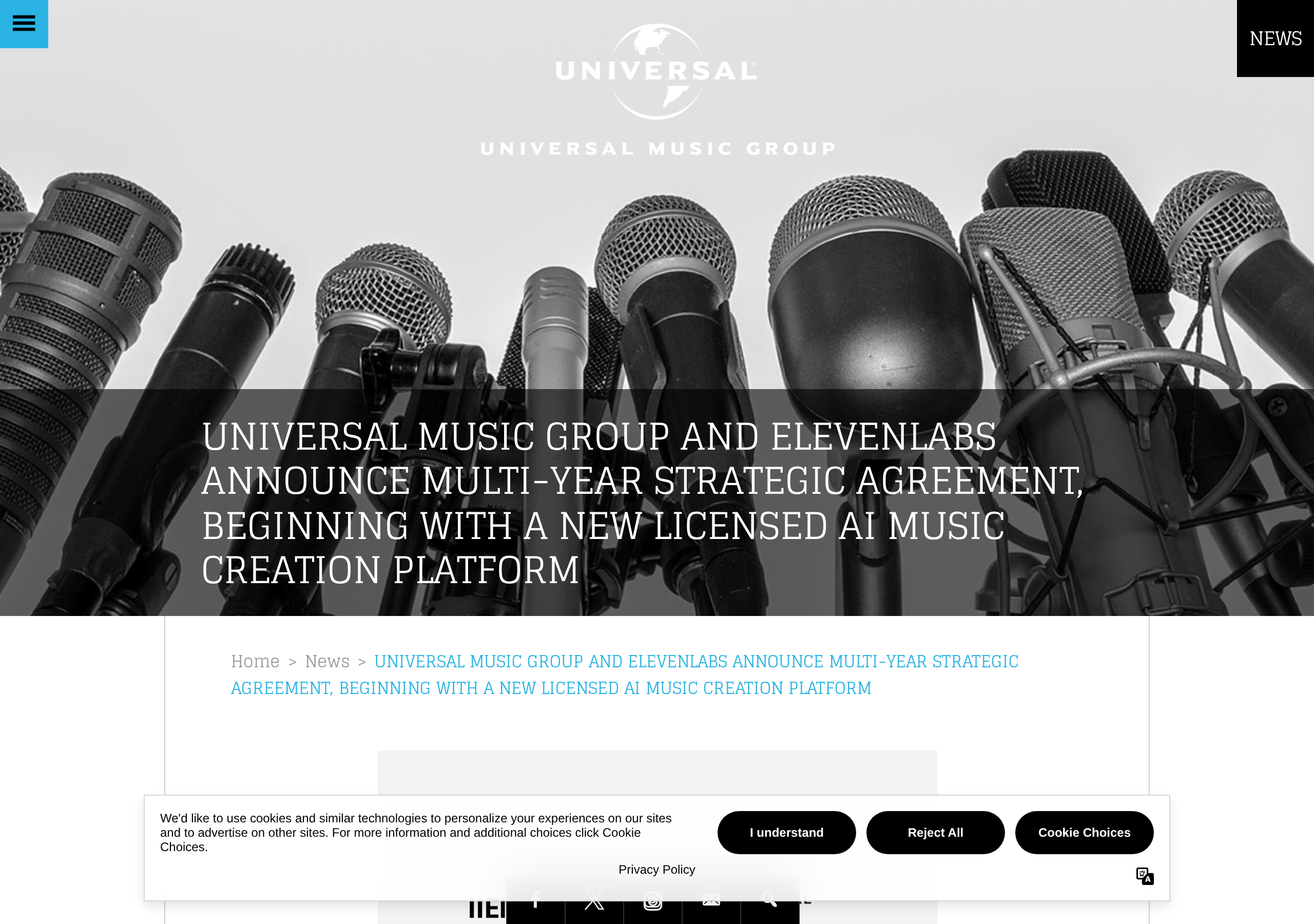
The official press release as published on Universal Music's site.
What both CEOs said
Sir Lucian Grainge, UMG's Chairman and CEO, framed the deal around putting artists first: the most exciting AI-and-music possibilities are those that put "artists, songwriters, and fans at the center," with responsible AI inspiring discovery, deepening artist-fan engagement, and unlocking new revenue for the creative community. Mati Staniszewski, ElevenLabs' co-founder and CEO, described combining UMG's global community and rights-management expertise with ElevenLabs' AI models to "create powerful new experiences for fans and ensure artists are fairly compensated." The release also promises additional products and fan experiences "in the months and years to come" — with no further specifics.
The context that makes this week historic
Zoom out and the pattern is unmistakable. The day before this announcement, Suno released its first AI music model made with record industry help — trained on licensed songs from Warner Music Group, BMG, and industry partners, as we covered in our piece on Suno v6's licensed models. UMG itself already has AI agreements spanning a platform in development with Udio and deals with Spotify, Nvidia, and others. Google built its Lyria generator on industry licensing with watermarking from day one — our coverage of Lyria 3.5 traced that shift. The industry hasn't just stopped fighting AI music; it's now competing to own the licensed version of it.
What it means for content creators
If you put music behind reels, YouTube videos, podcasts, or ad campaigns, this transition matters to your bottom line:
- Legal options are about to get much richer. Today's choice is tired royalty-free libraries versus popular tracks that trigger copyright claims within hours. A platform built on real, licensed catalog with artist opt-in changes the menu entirely.
- Distinctive audio instead of generic filler. Licensed co-creation means content that sounds like actual music people recognize — remixes and interpretations with provenance, not anonymous loop soup.
- For musicians and songwriters: a new potential revenue channel. Participation is optional and compensation is built into the structure, not bolted on after lawsuits.
- For agencies and brand marketers: clients will increasingly demand rights-clean audio with real musical identity. Being fluent in the licensed AI tools early is a genuine differentiator as this market opens.
One practical move today: audit the audio in your existing content. Sort what's licensed, what's royalty-free, and what's unclear — then start migrating the gray zone toward licensed tools available now. When the new platforms arrive, you'll swap in the richer options without scrambling.
The current AI music landscape at a glance
| Tool | What it does | Licensing status |
|---|---|---|
| UMG × ElevenLabs platform | Fan co-creation: remixes, mashups, interpretations | Fully licensed — in development, no launch date |
| Suno (licensed models) | Full song generation from text prompts | First licensed-trained model shipped this week |
| ElevenMusic | ElevenLabs' standalone music generator | Separate from the new UMG platform |
| Google Lyria | Music generation inside Gemini | Industry-licensed with content watermarking |
Why the labels finally flipped
Follow the incentives and the reversal makes sense. Streaming growth has plateaued in mature markets, and labels are hunting for new revenue per fan. AI co-creation — where a listener pays to remix a favorite artist's track or generate a personalized version for a birthday — is exactly that kind of superfan monetization. Meanwhile, the lawsuit-only strategy was failing on a technicality of reality: the tools kept improving regardless of court outcomes, and each unlicensed hit trained another generation of users to expect AI music for free. Licensing flips the economics — every viral remix becomes a royalty event instead of a piracy event. Expect the remaining majors to announce comparable deals soon; being the last label without a licensed AI partner is now a worse position than being first was two years ago.
There's also a quiet message to platforms like TikTok and Instagram in this deal: the content-identification systems that today flag AI music as a problem will need to learn to distinguish licensed co-creation from infringement. How smoothly that integration goes will determine how usable these platforms actually feel for everyday creators.
The honest limits of this announcement
Discipline about what's confirmed: the platform is announced, not launched. The press release says it is "now in development" — no launch date, no pricing, no artist roster. Participation is opt-in, so the full UMG catalog will not necessarily be there on day one. Reporting also confirms the new platform stays separate from ElevenLabs' existing Music API and ElevenMusic generator, so don't expect automatic integration with today's tools. Any dates or prices circulating right now are speculation, not information.
Is the new platform available now?
No. It was announced September 10, 2026 and is currently in development, with no announced launch date.
Will it be free to use?
No pricing has been announced. Given the licensing and artist-compensation structure, a paid model is plausible — but that's analysis, not an official statement.
How is this different from existing AI music generators?
Current tools generate new music from scratch or text prompts. This platform enables co-creation on top of real tracks from participating artists — remixes, mashups, and new interpretations — inside an officially licensed framework.
Can any artist join the platform?
Participation is voluntary and decided artist by artist; the platform will launch with music from participating artists and songwriters specifically.
What should creators do in the meantime?
Clean up your audio rights situation now and get comfortable with today's licensed tools. The shift toward rights-safe AI music is clearly directional — early movers benefit when the catalog-backed platforms open up.
Bottom line
The UMG–ElevenLabs deal is the moment licensed AI music stopped being a niche experiment and became the industry's official direction of travel. For creators, the smart play is preparation: rights-clean libraries today, fluency in licensed generators, and a production stack that's ready to absorb richer audio options as they land. Your writing, visuals, and scheduling still need to ship today — ArWriter handles that side in one Arabic-first platform, free to start.
Sources
- Official press release — Universal Music Group — September 10, 2026
- The Verge: Universal Music is launching an AI music platform with ElevenLabs — full context coverage