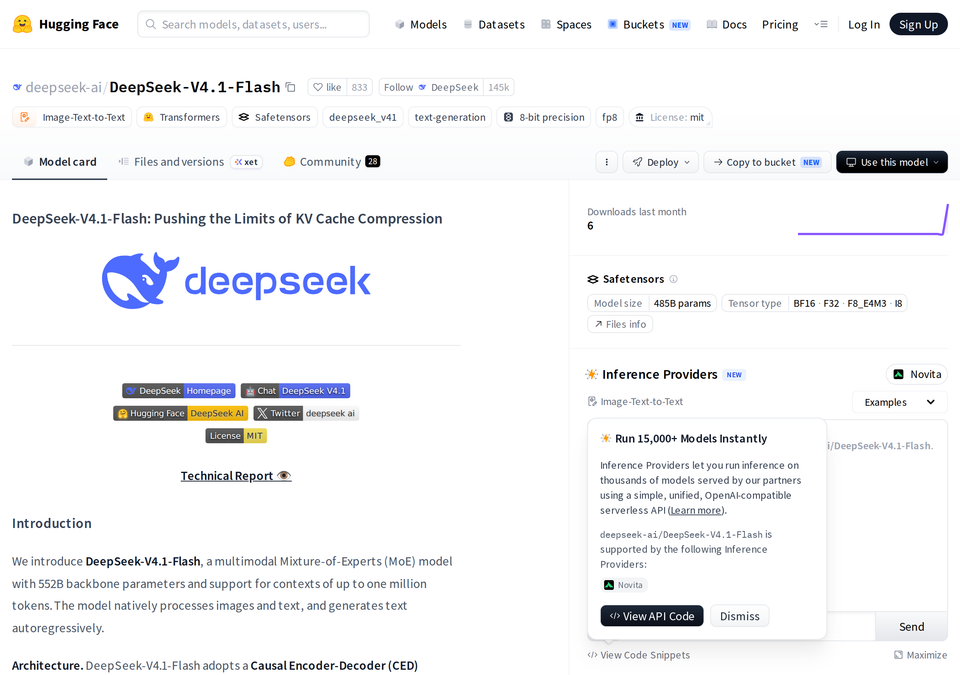
When a lab releases a new model and announces in the same breath that it is retiring its more expensive one, that is worth your attention. On September 10, 2026, DeepSeek published V4.1 Flash to HuggingFace under the open MIT license — and its official developer documentation states that the new model "has comprehensively surpassed V4 Pro in performance, cost, speed, and total time," with all deepseek-v4-pro API requests being routed to V4.1 Flash from 12:00 Beijing time on September 14, 2026. Four days' notice. If any part of your content stack calls the DeepSeek API, the model serving your requests — and your invoice — changes this week.
The essential facts: V4.1 Flash is a 552B-parameter system that activates only 8-16B per token, offers a 1M-token context window with up to 384K tokens of output, accepts images as well as text, and is priced officially at $0.15 per million input tokens off-peak (cache miss) and $0.60 per million output tokens off-peak — roughly a quarter to a sixth of what V4 Pro cost, depending on the bucket.
The technical story, translated for people who ship content
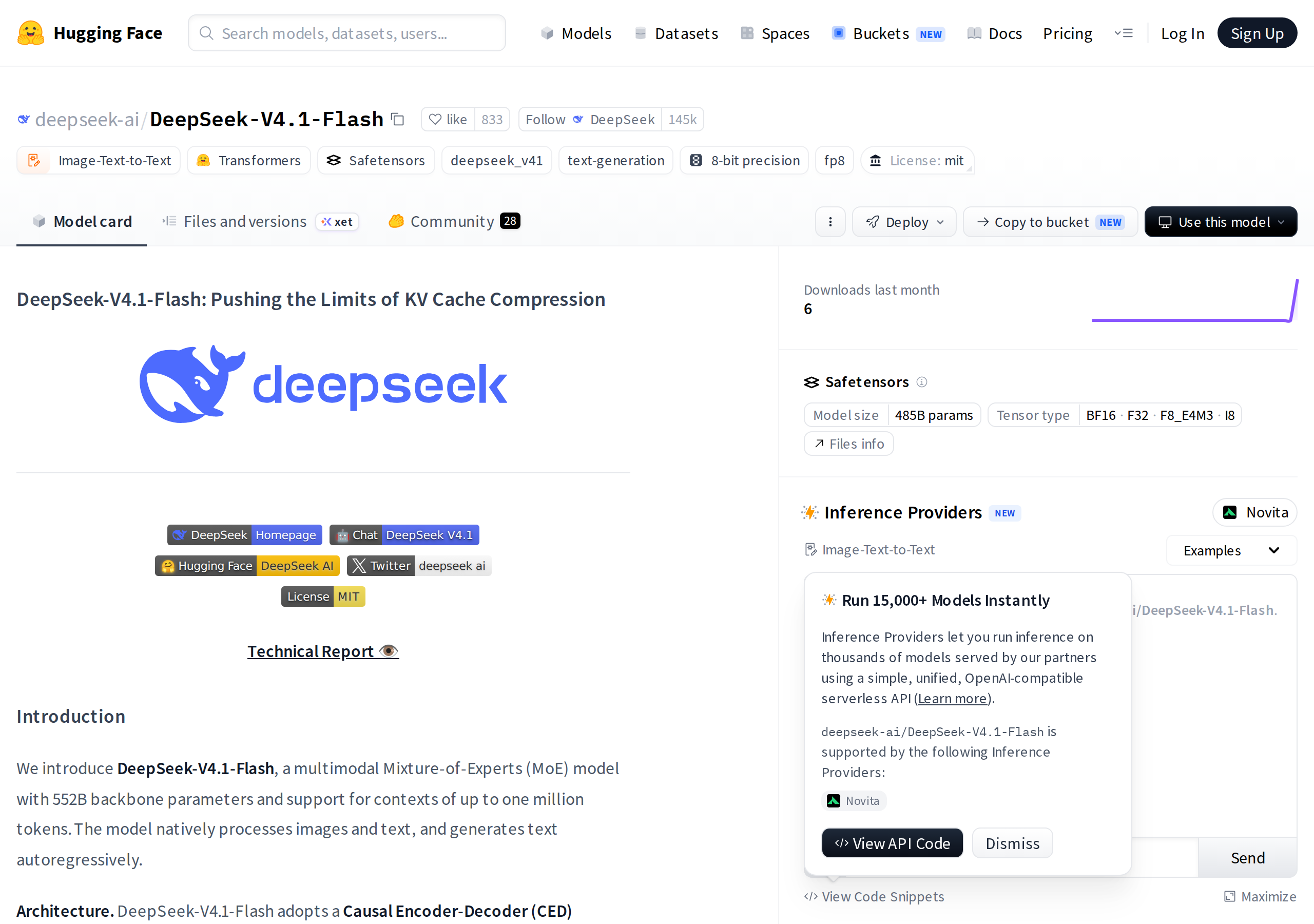
The engineering centerpiece is KV cache compression — and its practical translation is simple: the longer the document a model works over, the more memory and money inference burns. DeepSeek claims V4.1 Flash shrinks the persistent cache to roughly one-eighth of what V4-Flash needed, compressing the global cache to 890 bytes per token through a rebuilt architecture: a causal encoder-decoder structure, a second-generation sparse attention mechanism (CSA2), and FP4-precision cache storage. For you, that means enormous context at trivial cost — which is exactly why the pricing table below looks the way it does.
Three capabilities matter for professional use. The model is multimodal: it processes images and text together, so scanned documents and screenshots are fair game. It supports both thinking and non-thinking modes — deep reasoning when you need it, fast responses when you don't, with a user-controllable reasoning-effort dial from 1 to 100. And DeepSeek's documentation explicitly lists it as a drop-in backend for popular agent and coding assistants — Claude Code, GitHub Copilot, OpenCode — with OpenAI- and Anthropic-compatible API formats and a 2,500 concurrent-request limit. The target audience is unambiguous: people running always-on production pipelines.
The official numbers, without the gloss
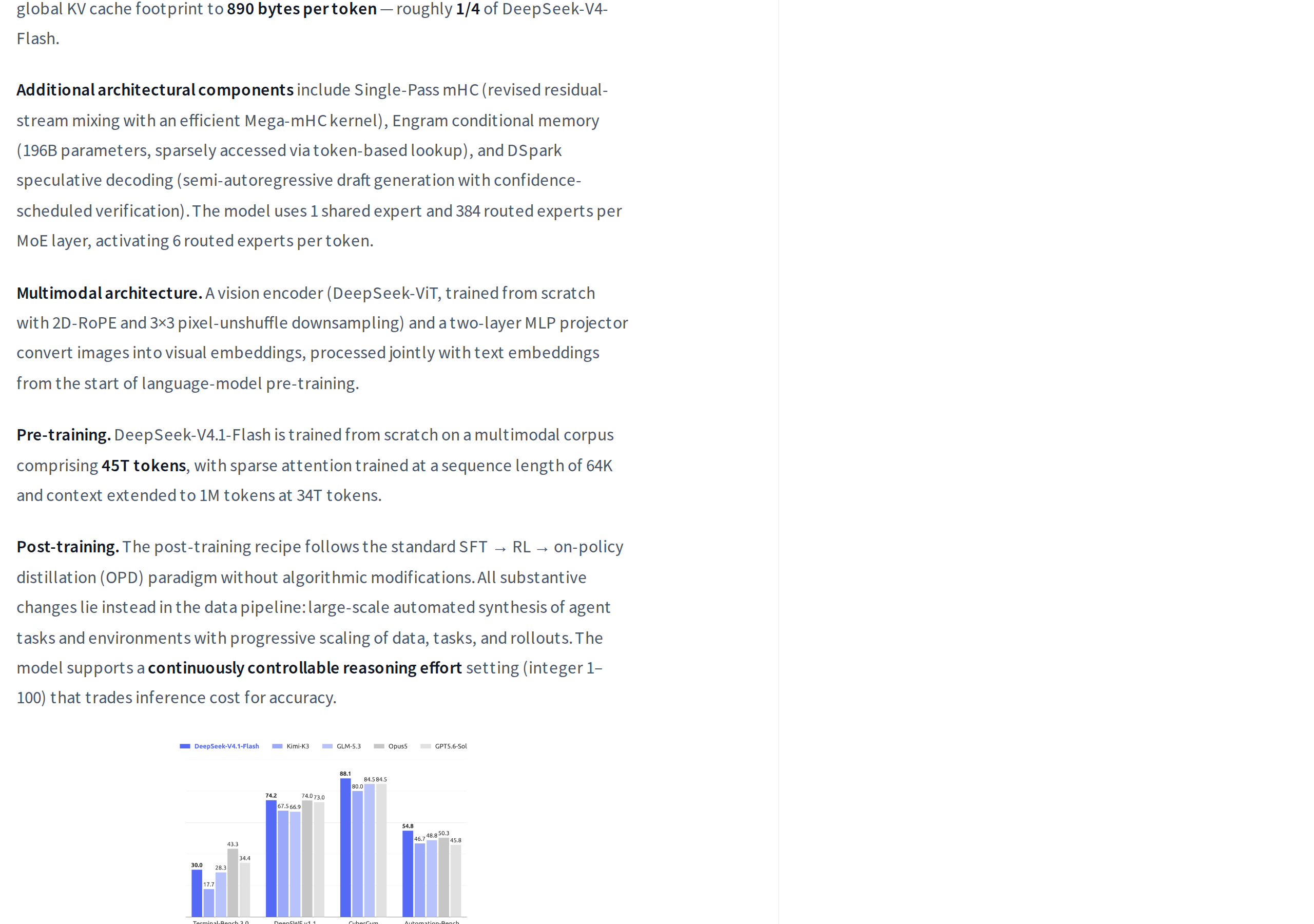
In DeepSeek's published tables, V4.1 Flash tops most comparisons against GPT-5.6 Sol and Opus-5.0 in the categories measured: 3471 on Codeforces, 90.6 on Terminal-Bench 2.1, 74.2 on DeepSWE, 90.9 on GPQA Diamond, and on the visual side 95.6 on DocVQA and 56.5 on MMMU-Pro. Now read what those numbers do not say: the card contains no creative-writing or prose-quality benchmark at all. Nearly every published metric is code, agentic, or document-comprehension oriented. The model was built for input-heavy, long-running workloads — a fact that should calibrate your expectations precisely.
| Spec / price | DeepSeek V4.1 Flash | DeepSeek V4 Pro (outgoing) |
|---|---|---|
| Total / activated parameters | 552B / 8-16B per token | Higher activation cost |
| Context window | 1M tokens | Smaller |
| Max output | 384K tokens | Lower |
| Vision (image input) | Supported | Not supported per pricing page |
| Input per 1M tokens — cache hit, off-peak/peak | $0.003 / $0.006 | — |
| Input per 1M tokens — cache miss, off-peak/peak | $0.15 / $0.30 | $0.66 / $1.32 |
| Output per 1M tokens — off-peak/peak | $0.60 / $1.20 | $1.98 / $3.96 |
| Concurrency limit | 2,500 | 500 |
| License | MIT (open weights) | Platform-bound |
The V4 Pro retirement: what it means if you build on DeepSeek
The forced migration on September 14 is not an administrative footnote; it is a statement. Technically, DeepSeek is betting its "cheap" model beats its premium one at everything — a bet it backs by raising the concurrency ceiling to 2,500 simultaneous requests versus 500. Practically, if your scripts or tools call deepseek-v4-pro, you will silently start receiving V4.1 Flash outputs billed at Flash prices from Sunday — a lower invoice with zero code changes, but also different model behavior that deserves a prompt review (the card recommends temperature 1.0 and the adjustable reasoning-effort setting).
This is the third time this year DeepSeek has redrawn the budget-model map: we covered the general-availability launch of V4 Pro for content creators, then the experimental vision-capable V4-Flash-Vision — and per the current docs, both legacy endpoints are now served by V4.1 Flash at Flash pricing. The product line has collapsed into a single sentence: one economical model that attempts everything.
What this means for you as a creator
If you consume AI tools rather than build them, the direct effect is cost pressure flowing upstream: the platforms you pay for just saw their marginal model costs drop dramatically, and the price war between labs shows no sign of cooling — good for your subscription math. If you build your own tooling or run automations on an API, the calculus is explicit: a million-token context means you can throw an entire book, a full content archive, or a complete client documentation set into a single request and ask for a restructuring or deep analysis, and re-processing the static parts costs $0.003 per million tokens on cache hits — which finally makes a continuous review loop over one long-running project economically rational.
Two honest framing notes. First, cheap tokens do not equal finished copy: published benchmarks say nothing about prose quality, and production writing still benefits from tooling tuned for output polish rather than raw throughput. Second, for English specifically, this model's measured strengths are document comprehension and agentic reliability — drafting from a 900-page source stack is its home turf; the final edited voice is better left to a dedicated writing platform. Teams that split the work that way — heavy analysis on the cheap model, final drafting in a purpose-built workspace like ArWriter's Auto-Writer — get the best of both price points.
Quick comparison: V4.1 Flash against what creators actually use
| Option | Standout strength | Typical cost | Best suited for |
|---|---|---|---|
| DeepSeek V4.1 Flash (API) | 1M context + vision at rock-bottom pricing | $0.15-0.30 in / $0.60-1.20 out per 1M | Automation, bulk analysis, tool builders |
| GPT-5.6 Sol | Leads scientific reasoning (GPQA 94.1) | Multiple times the Flash tier | Critical reasoning workloads |
| Opus-5.0 | Best on newest terminal benchmarks | Highest in the official table | Complex software engineering |
| Dedicated writing platforms | Publish-ready drafts, editing, scheduling | Flat monthly subscription | Final-copy production at volume |
| HuggingChat (same model, free) | Trial V4.1 Flash with no card, no code | Free with limits | The first test before any commitment |
By the way: when your pipeline needs bilingual, publish-ready drafts rather than raw model output, ArWriter handles the writing end to end — leaving the cheap API to do what it does best: the heavy lifting behind the scenes.
Honest limits before you get carried away
Start with the benchmark gap: no published creative-writing evaluation exists for this release, so any claim that it is "the best writing model" is padding, not data. The model is developer-flavored by design — the HuggingFace card devotes entire sections to self-hosting via vLLM and SGLang, ships no standard Jinja chat template, and points to reference tooling instead, meaning casual chat access requires a host platform like HuggingChat or an intermediary provider. Pricing splits into peak and off-peak buckets, so your bill varies by when your automation runs — schedule accordingly. And "comprehensively surpassed V4 Pro" is the company's own claim about its own internal testing; independent verification will accumulate over the coming weeks, and the model is hours old at the time of writing.
Frequently Asked Questions
Is DeepSeek V4.1 Flash free?
The official API is paid at the published rates, but the weights carry an MIT license, so anyone can download and run the model themselves at no charge, and free trial access is available through platforms like HuggingChat listed on the model card.
What happens to my V4 Pro API calls after September 14?
Per DeepSeek's official documentation, all deepseek-v4-pro requests are routed to V4.1 Flash and billed at Flash pricing from 12:00 Beijing time on September 14, 2026, continuing until a future V4.1 Pro release.
Is it good for long-form creative writing?
There are no published benchmarks for creative or prose quality, so the sane approach is testing it against your own samples. Its measured strengths are document comprehension and long-context processing rather than literary polish.
What does a 1M-token context mean practically?
You can fit roughly a full book or an entire archive of articles into one request and process it as a unit, instead of chunking the text and losing cross-section context — the exact workload the cache-compression architecture was built for.
How do I try it today?
Fastest zero-commitment path: open the model page on HuggingFace and use it via HuggingChat. For builders, a DeepSeek developer account provides an API key compatible with OpenAI and Anthropic SDK formats.
Your move
A three-step plan. If anything you run calls deepseek-v4-pro, update and re-test your prompts this week — before Sunday's automatic switch. If you automate long-document processing, spend an hour pushing a real sample through the 1M context window and measure actual cost at peak and off-peak times. And if your deliverable is polished content, use the new model for analysis and first-pass synthesis while a dedicated writing workspace — ArWriter starts at $4.99/month — produces the copy you actually publish. Falling prices are a rising tide for the whole industry; knowing which model to use for which job is what turns that tide into output.
Sources
- Official model card: DeepSeek-V4.1-Flash on HuggingFace — official deepseek-ai organization, September 10, 2026
- Pricing and V4 Pro retirement: DeepSeek API Pricing — official developer documentation
- API quick start and agent integrations: DeepSeek API Docs — OpenAI/Anthropic compatibility
- Related reading on ARWriter: DeepSeek V4 Pro general availability and V4-Flash-Vision experimental release