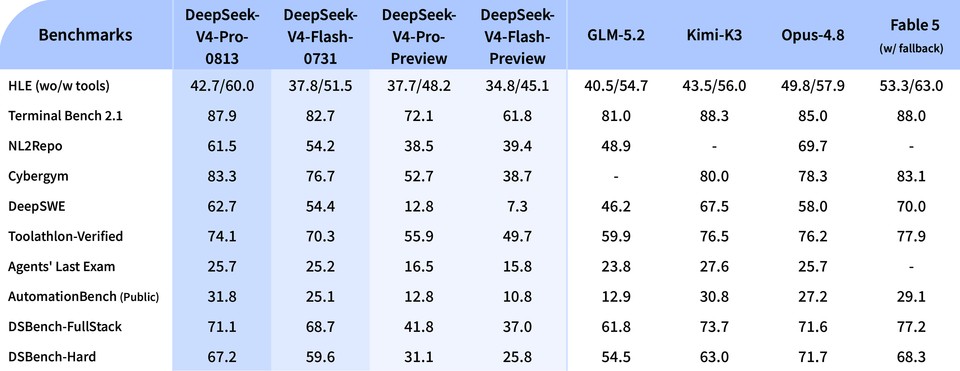
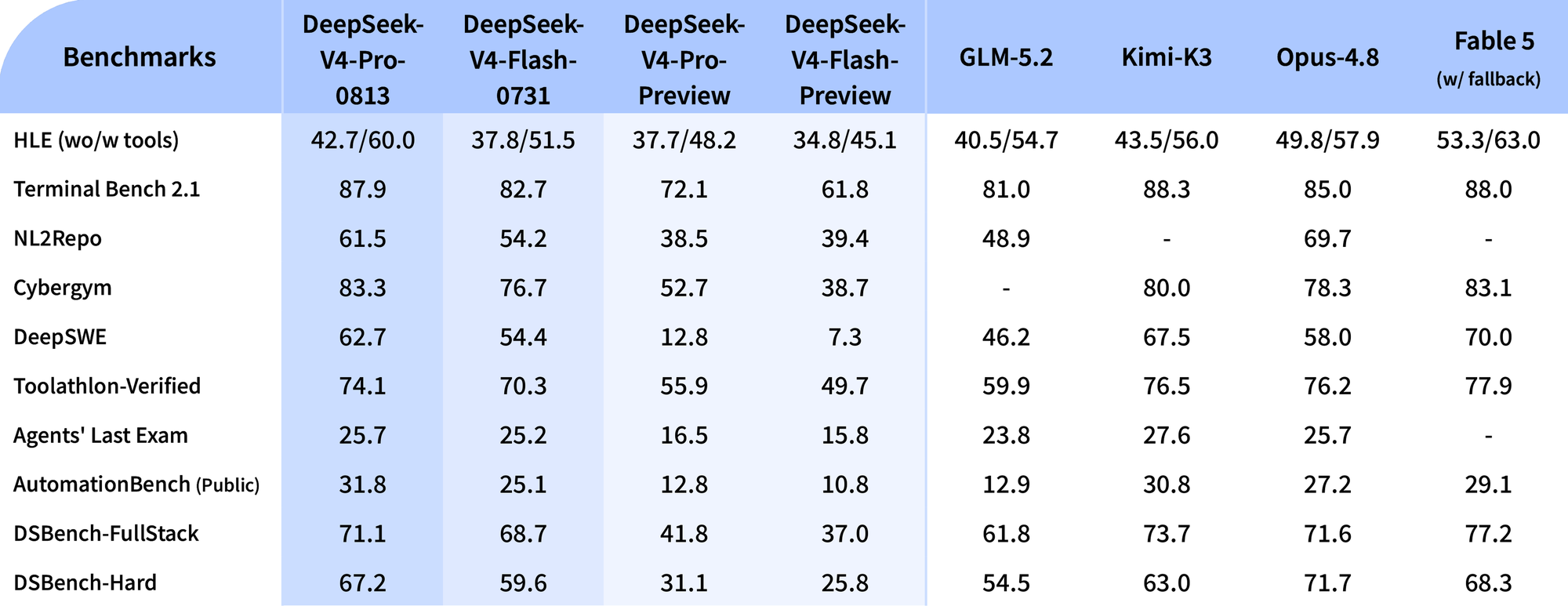
DeepSeek announced the General Availability of DeepSeek-V4-Pro-0813 on August 13, 2026, bringing flexible reasoning levels, peak/off-peak pricing at half the cost, and native OpenAI Responses API support. The model offers frontier-tier intelligence at a fraction of what competitors charge — but comes with notable hallucination risks. Z.ai's new GLM-5.3 plays the same off-peak game with half-rate credits on its Coding Plan; our GLM 5.3 access breakdown compares the two models' entry costs in plain numbers.
What Changed in V4 Pro GA
The GA release succeeds April's V4 Preview and arrives just two weeks after V4-Flash. The headline changes are practical rather than architectural:
- Adjustable reasoning effort: Three levels — Low for simple tasks, High for daily agent workflows, and Max for complex problems. You control how much compute each request uses.
- Native OpenAI Responses API support: Full compatibility means tools built for GPT can switch to DeepSeek with minimal code changes.
- Codex integration: One-click setup for Codex, plus compatibility with Claude Code, GitHub Copilot, and OpenCode.
- Agent upgrades: The announcement cites "major Agent upgrades with strong production gains" for long-running automated workflows.
Under the hood, the model uses a Mixture of Experts architecture with 1,600 billion total parameters and 49 billion active per token. The context window is 1 million tokens, with a maximum output of 384K tokens — both competitive with or exceeding Western alternatives.
Pricing: Peak vs Off-Peak
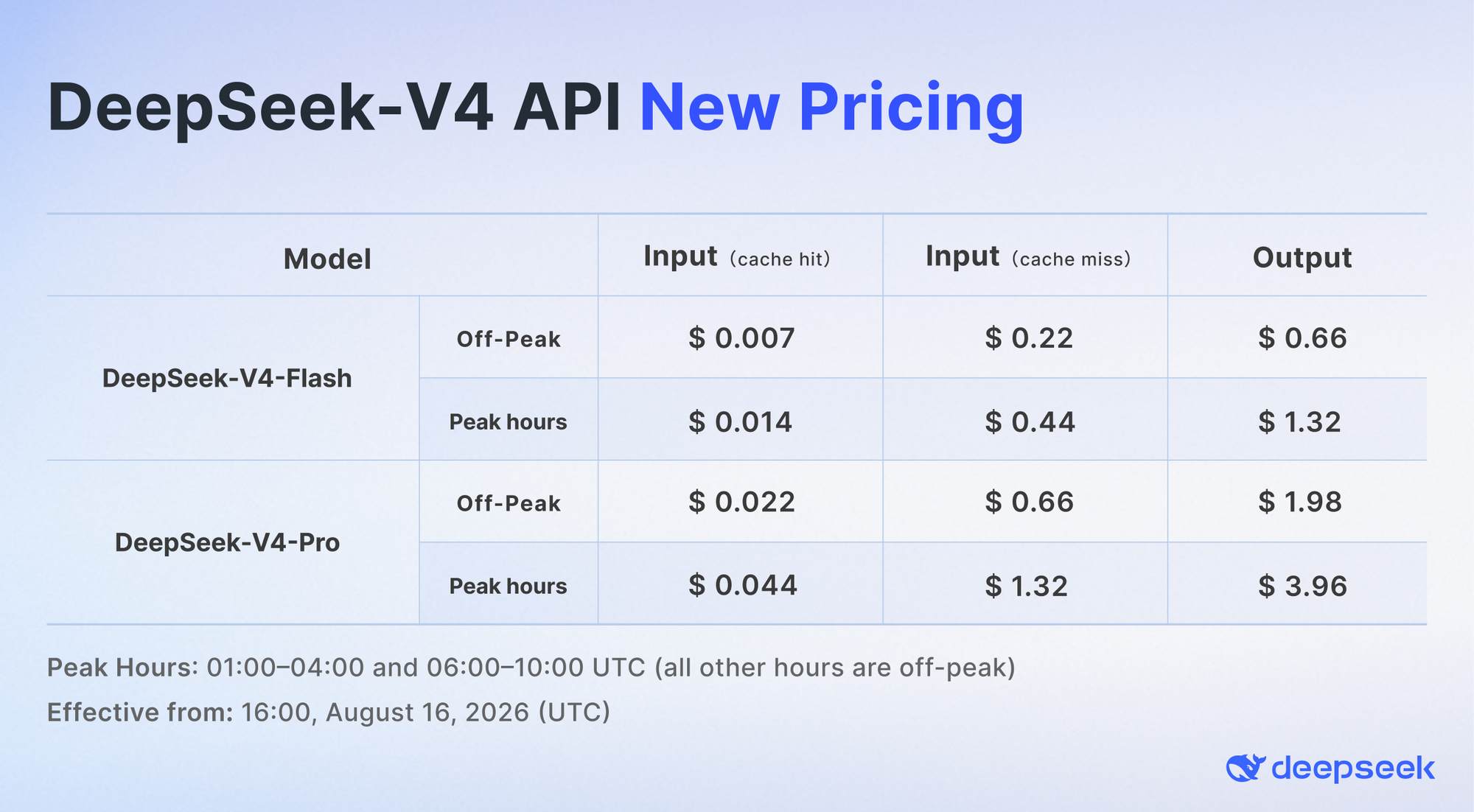
The most practically impactful change is the new tiered pricing, effective August 16 at 16:00 UTC. DeepSeek splits the day into peak and off-peak hours, with off-peak rates at exactly half the peak price:
| Model | Period | Input (Cache Hit) per 1M | Input (Cache Miss) per 1M | Output per 1M |
|---|---|---|---|---|
| V4 Pro | Off-Peak | $0.022 | $0.66 | $1.98 |
| V4 Pro | Peak | $0.044 | $1.32 | $3.96 |
| V4 Flash | Off-Peak | $0.007 | $0.22 | $0.66 |
| V4 Flash | Peak | $0.014 | $0.44 | $1.32 |
Peak hours are 01:00–04:00 and 06:00–10:00 UTC. If you're working from North America, evening hours are off-peak. The 99% cache discount on repeated context is also worth noting — for workloads that reuse system prompts or reference material, effective input costs drop to near zero.
Performance: Strong Value, Not Top-Tier
On the Artificial Analysis Intelligence Index, V4 Pro scores 53.0 — ranking 7th overall but 2nd among open-weight models. The gap to frontier models is real:
| Model | Intelligence Index | Cost per Task |
|---|---|---|
| Claude Opus 5 (max) | 63.1 | $2.34 |
| Claude Fable 5 | 62.1 | $1.45 |
| GPT-5.6 Sol (max) | 60.9 | $1.23 |
| Grok 4.6 (high) | 60.9 | $0.84 |
| DeepSeek V4 Pro (max) | 53.0 | $0.056 |
| Gemini 3.6 Flash | 51.6 | — |
V4 Pro is 10 intelligence points behind Opus 5 — but at 1/42nd the cost per task. For content workflows that process hundreds of articles monthly, that tradeoff may be well worth it.
What This Means for Content Creators
1. Volume work becomes affordable: If you're generating 5–10 articles daily via API, V4 Pro costs cents where Claude or GPT cost dollars. The quality gap exists but may be acceptable for first drafts or bulk content.
2. Reasoning levels save money: Use Low for quick summaries or translations, High for article writing, and Max for complex analysis. This prevents overspending compute on simple tasks.
3. Easy migration from OpenAI: If your content tool uses the OpenAI SDK, switching to DeepSeek means changing the base URL and model name. Most existing code works unchanged.
4. Multilingual with caveats: DeepSeek supports multiple languages, but it was built primarily for Chinese and English. Quality in other languages may lag behind GPT or Claude.
For a unified writing platform that supports multiple AI models without touching APIs directly, check out ARWriter.
Quick Comparison: V4 Pro vs Alternatives
| Criteria | DeepSeek V4 Pro | GPT-5.6 Sol | Grok 4.6 |
|---|---|---|---|
| Intelligence | 53 | 61 | 61 |
| Cost per task | $0.056 | $1.23 | $0.84 |
| Context window | 1M | — | 500K |
| Output speed | 83 t/s | — | 66 t/s |
| Best for | Bulk tasks at low cost | Maximum quality | Balanced cost/performance |
Honest Limitations
- Hallucination risk: V4 Pro scores only 0.83 on the Omniscience Index — dramatically lower than Claude Fable 5 (43.3) or Grok 4.6 (30.5). The model confidently generates incorrect claims. Fact-check every assertion.
- Text-only input: No image or video input support. If your workflow involves visual analysis, look elsewhere.
- Slower than V4 Flash: V4 Flash generates 115 tokens/sec versus 83 for V4 Pro. For fast tasks, Flash may be the better choice at a quarter of the price.
- Server location: API servers are in China, which may add latency for users in North America or Europe, especially during peak hours.
For tasks requiring maximum accuracy and low hallucination, GPT-5.6 or Claude remain safer choices. V4 Pro excels in cost-efficiency for high-volume, reviewed workflows.
The Bottom Line
DeepSeek V4 Pro isn't the smartest model available — it's the smartest value. At $0.056 per task with adjustable reasoning and a 1M context window, it opens the door for content creators to produce more at lower cost. The hallucination weakness means you should never trust its output blindly, but for draft generation, bulk content, and cost-sensitive projects, it's a compelling option.
If you want a single tool that balances quality and cost across multiple AI models for content creation, try the ARWriter Auto-Writer — one interface, multiple models, no API management.
Frequently Asked Questions
When did DeepSeek V4 Pro become generally available?
The GA release was announced on August 13, 2026. The model is available via the DeepSeek app and website in "Expert Mode," and via API as deepseek-v4-pro.
What's the difference between V4 Pro and V4 Flash?
V4 Pro is slightly smarter (53 vs 51.8 intelligence points) but slower and more expensive. V4 Flash activates 13B parameters (vs 49B) and generates 115 tokens/sec (vs 83). Flash is roughly 4x cheaper. Use Flash for speed, Pro for accuracy.
What are the peak hours for pricing?
Peak hours are 01:00–04:00 and 06:00–10:00 UTC. During these hours, rates are doubled. All other hours are off-peak at 50% off. The new pricing takes effect August 16, 2026 at 16:00 UTC.
Can I replace GPT with DeepSeek in my existing tools?
Yes. DeepSeek is compatible with both OpenAI and Anthropic API formats. If your tool uses the OpenAI SDK, change the base URL to api.deepseek.com and the model name to deepseek-v4-pro. Most code works without modification.
Getting Started with V4 Pro
If you want to try DeepSeek V4 Pro for your content workflow, here are three practical paths:
Path 1 — The Official App: Visit deepseek.com, enable Expert Mode, and start chatting. This is the simplest option for quick experiments. You'll get access to the three reasoning levels (Low, High, Max) directly in the interface.
Path 2 — Via API: If you have a tool or script that uses the OpenAI SDK, migration takes minutes. Change the base URL to https://api.deepseek.com and the model name to deepseek-v4-pro. API keys are available through the DeepSeek platform and can be topped up with a credit card.
Path 3 — Aggregator Platforms: If you don't want to manage APIs directly, DeepSeek is available through platforms like OpenRouter that combine dozens of models in one interface. You can also read our earlier coverage of DeepSeek V4 Flash for a comparison of the two tiers.
Practical tip: Start with the High reasoning level for most writing tasks. If outputs feel shallow, switch to Max. For speed-only tasks like translation or summarization, Low is sufficient and much cheaper.
On hallucination: The model's 0.83 Omniscience Index score is a real concern. This means V4 Pro confidently generates incorrect information, especially for factual claims like dates, statistics, and names. The best practice is to use it for draft generation, marketing copy, and creative writing where you review and fact-check the output — not as a primary research tool. For factual content, cross-reference every claim with a reliable source.
Cache strategy: The 99% cache discount is enormous. If your workflow reuses the same system prompt or reference document across multiple requests (e.g., a brand style guide or topic brief), structure your API calls to reuse that context. The first call caches it; subsequent calls with the same prefix cost near-zero for input. This alone can cut your API bill by 80%+ for batch content generation.