The news, precisely
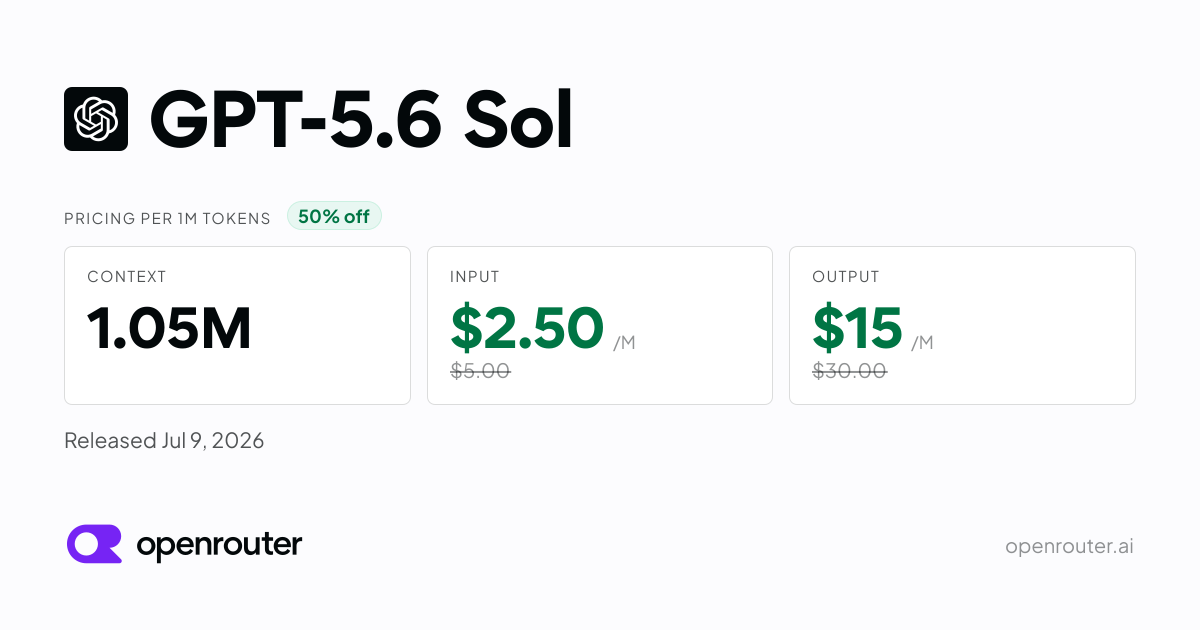
On the evening of August 17, 2026, OpenRouter — the API gateway that brokers access to hundreds of AI models behind one interface — cut the price of GPT-5.6 Sol from OpenAI by half on its platform. The model's official page now lists $2.50 per million input tokens and $15.00 per million output tokens, down from $5.00 and $30.00. For anyone generating written content at scale through an API, that is a straight 50% cut on one of the strongest frontier models available.
Source: OpenRouter's official account on X, August 17, 2026.
The detail that changes everything
Here is the catch, and it matters: the discount lives on OpenRouter. OpenAI's own model documentation still lists the old pricing — $5.00 input / $30.00 output per million tokens — unchanged as of publication. In plain terms, buying directly from OpenAI saves you nothing today; routing the same model through OpenRouter halves your bill. Neither company has published an end date for the promotion, so the only honest way to treat it is as a live offer that can move — not as a permanent line item in an annual budget.
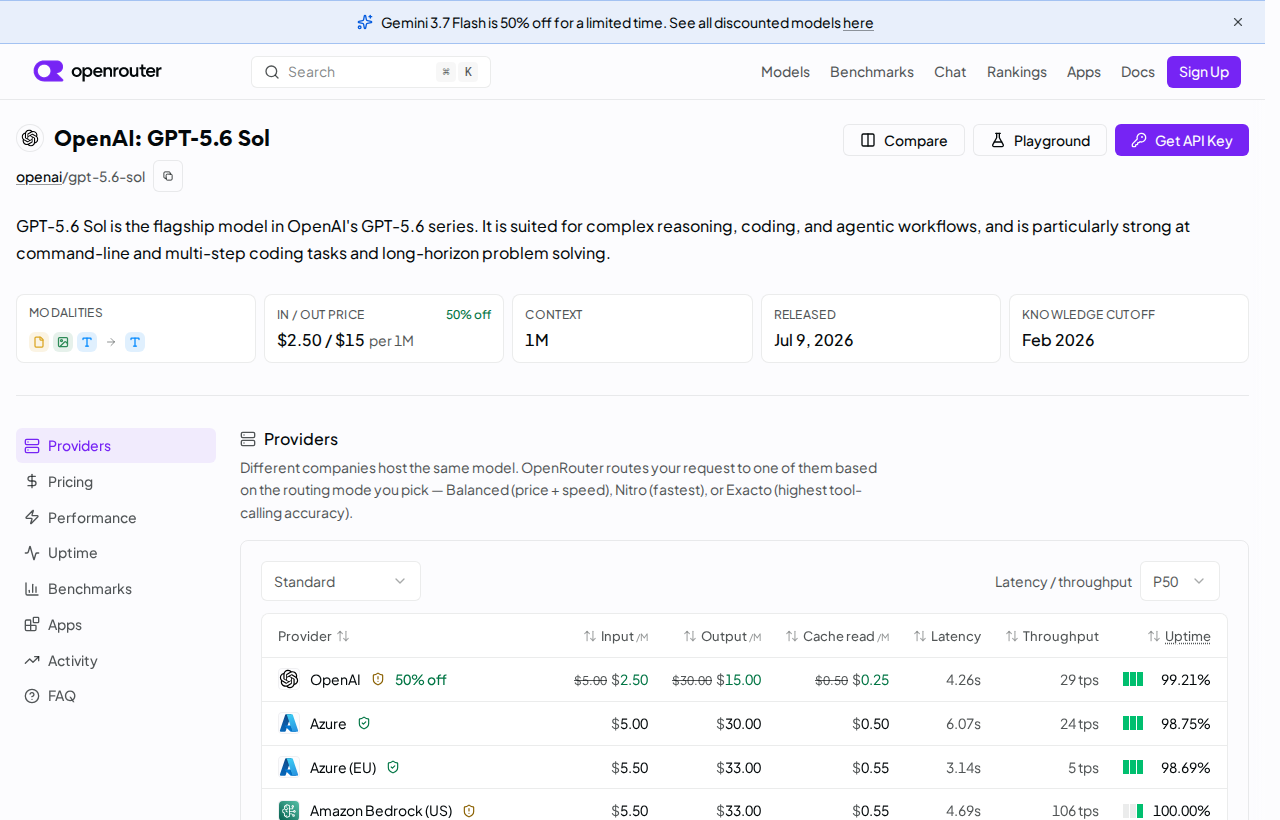
The story spread quickly through developer communities yesterday, with sharp-eyed commenters noting exactly this split — the discount appears on OpenRouter while OpenAI's native listing stands still. We verified both sources side by side before publishing.
Why content teams should care
If articles, product descriptions, ad copy, or support replies flow out of your stack through an LLM API, token price is your first operating cost. Quick math: a 2,000-word article typically consumes about 2,500 input tokens (instructions plus source material) and 3,000 output tokens. At the discounted rate that is roughly five cents per article; at OpenAI's native rate, about ten. Per piece the gap looks small. At e-commerce scale — say 10,000 product descriptions a month — it is the difference between roughly $500 and $250, doubling your output for the same money.
OpenRouter also carries a further discounted batch tier at about $1.25 / $7.50 per million tokens, aimed at non-urgent workloads like generating an entire catalog of descriptions overnight.
What you actually get: the GPT-5.6 Sol card
According to OpenAI's official model page, Sol is the flagship of the GPT-5.6 family, and the plain gpt-5.6 alias routes to it automatically. The published specs:
- A massive 1,050,000-token context window with up to 128,000 output tokens — room to feed a full report and generate a coordinated series of pieces in one session.
- Text and image inputs, so you can generate a product description straight from its photo.
- Adjustable reasoning effort from none up to max (medium is the default), giving fine control over the quality-latency-cost tradeoff.
- Knowledge cutoff of February 16, 2026.
- Two pricing footnotes on the native side: requests above 272K input tokens bill at 2x input and 1.5x output, and cache writes bill at 1.25x the uncached input rate.
Quick comparison: a million tokens today
| Model / channel | Input / 1M | Output / 1M | Note |
|---|---|---|---|
| GPT-5.6 Sol via OpenRouter | $2.50 | $15.00 | 50% off — live at publication |
| GPT-5.6 Sol batch via OpenRouter | $1.25 | $7.50 | For non-urgent bulk jobs |
| GPT-5.6 Sol direct from OpenAI | $5.00 | $30.00 | Unchanged at publication |
| Grok 4.6 (xAI) | $2.00 | $6.00 | Cheapest output — see our launch coverage |
| GPT-5.4 (older) | $2.50 | — | For in-family generational comparison |
At the discounted rate, Sol enters direct price competition with the cheapest frontier options, though its output price still sits above Grok 4.6, which we covered in depth when it launched. If raw speed matters more to you than cost, our hands-on breakdown of Sol Ultrafast running on Cerebras hardware is the companion read.
A worked example: one content-driven store
To make the discount concrete, take a mid-sized e-commerce operation producing content programmatically: 300 long product descriptions a month (roughly 4,000 input tokens of product data per item, 3,000 output), 500 short social ad captions (1,000 in / 500 out each), and 100 blog articles (2,500 in / 3,000 out). Adding it up:
| Workload | Monthly input (tokens) | Monthly output (tokens) |
|---|---|---|
| 300 long descriptions | 1,200,000 | 900,000 |
| 500 ad captions | 500,000 | 250,000 |
| 100 blog articles | 250,000 | 300,000 |
| Total | 1,950,000 | 1,450,000 |
At OpenAI's native rates: 1.95M × $5.00 plus 1.45M × $30.00 works out to about $53 per month. At the discounted OpenRouter rates: 1.95 × $2.50 plus 1.45 × $15.00 lands near $27 per month. On the overnight batch tier, under $14. Annualized, that is over $300 saved for a single store — before counting agencies running dozens of them.
One more operational detail: because Sol accepts images as input, feeding a product photo directly into the prompt uses the same token accounting, which is a genuine advantage for stores whose product data starts life as pictures rather than text.
Honest caveats
First, no announced end date means no guarantees — budget conservatively. Second, routing through a broker adds a third party: a separate invoice, an extra hop in the chain, and potentially different data-handling terms; check both companies' privacy policies if your content is sensitive. Third, the canonical documentation remains OpenAI's — pricing quirks like the long-context multiplier and cache-write surcharge come from the native page, not the broker's listing. Fourth, teams regularly pushing past 272K input tokens will find the 2x multiplier eats into part of the savings.
What to do this week
If you currently buy Sol directly from OpenAI, shift a slice of your traffic through OpenRouter and watch quality and latency for a full week before committing. If your workloads are batchy — store descriptions, translations, bulk summaries — start with the batch tier immediately, since it stacks with the promotion. And keep a small script that pulls live pricing from OpenRouter's public models endpoint into your reporting, because any article on this — including this one — can be stale before the month ends.
One final operational habit: set a weekly reminder to check both official pages together. The gap between the two prices is your live indicator for whether the promotion still exists — if the 50% badge disappears from OpenRouter's listing or OpenAI's native price moves, you will know before the invoice does. When you build next quarter's budget, model costs on the undiscounted rate and treat the savings as an unbudgeted bonus; that way a sudden withdrawal of the offer never wrecks your plan.
Bottom line
A 50% cut on a frontier model is the biggest quick pricing move in months, and it is particularly attractive for programmatic content production. Enjoy the price, assume nothing about its permanence, and verify both official sources before locking a budget. And if you would rather skip the API plumbing entirely and just produce polished content today, ARWriter was built for exactly that — writing, publishing and scheduling from one place.
Frequently asked questions
Did OpenAI officially cut GPT-5.6 Sol pricing?
The discount is listed on OpenRouter, which attributes the promotion to OpenAI. OpenAI's own model page still shows $5/$30 per million tokens, so direct OpenAI customers see no change as of publication.
What is the new exact price?
$2.50 per million input tokens and $15.00 per million output tokens on OpenRouter, with a further batch tier at $1.25/$7.50.
Is there a known end date?
No. Neither official source publishes an expiry, so treat it as a live, changeable promotion.
What is the difference between buying direct and via OpenRouter?
Direct purchase ties you to one provider with its official docs; OpenRouter is a broker layer that lets you switch between hundreds of models on one account, with prices that can differ from native ones — as in this promotion.
Is it good for Arabic content generation?
Yes in principle — Sol accepts Arabic like any frontier model — but test on your own samples before full adoption, and its huge context window gives it an edge on long, multi-source Arabic tasks.