OpenAI announced on August 13, 2026 a preview of a new generation mode it calls Ultrafast for its GPT-5.6 Sol model — with speeds of up to 14x standard generation, per the official announcement's own headline. The twist: this speed doesn't come from OpenAI's usual datacenters, but from a partnership with Cerebras, the company whose wafer-sized chips keep the entire model's weights on the processor itself.
The official announcement post from OpenAI's X account.
What "Ultrafast" means in practice
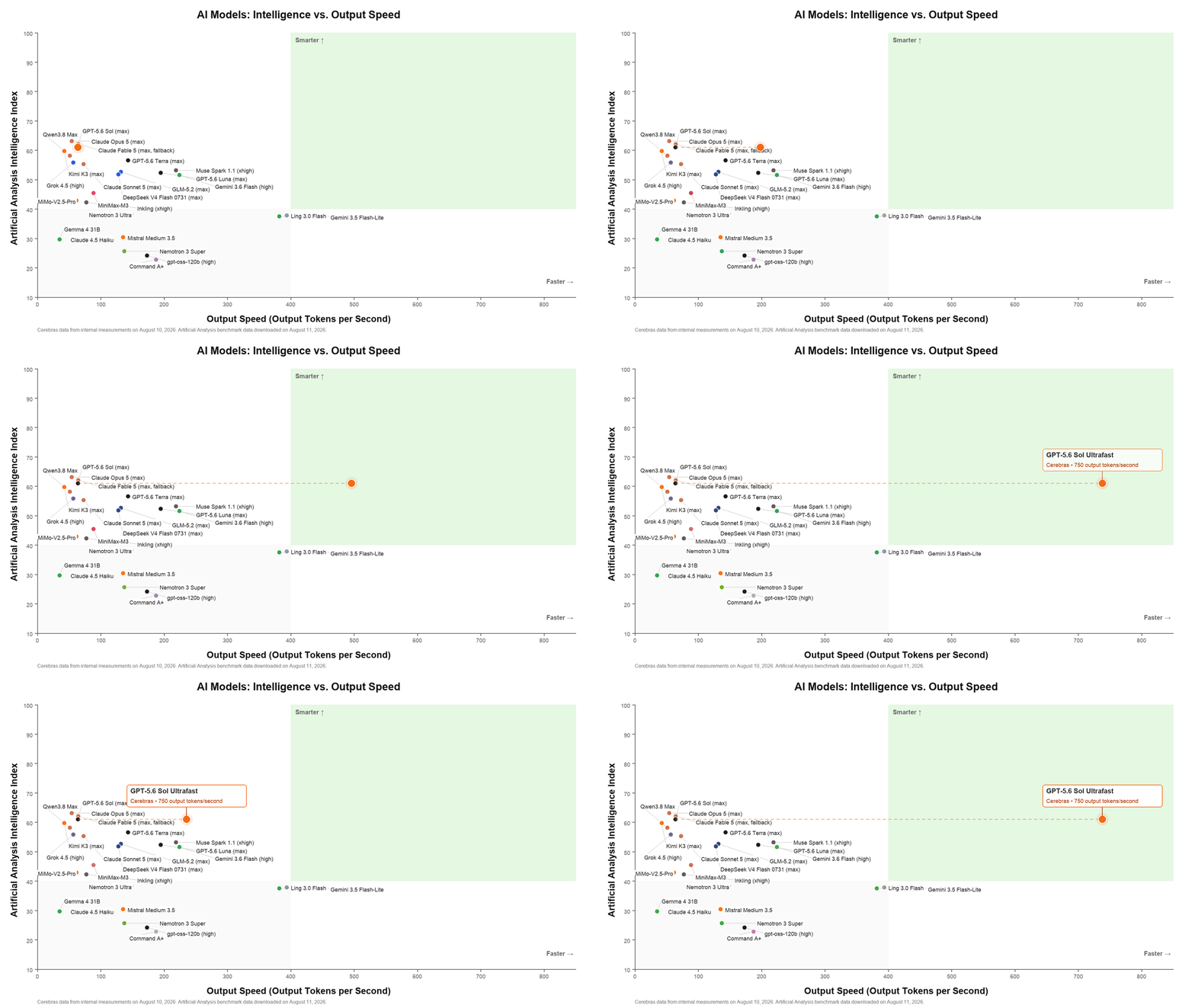
The new mode delivers up to 750 output tokens per second with no quality compromise, according to the partnership details published the same day. A thousand-word draft that used to trickle out over a minute or more can now complete in seconds. Per measurements cited from Artificial Analysis, that makes it roughly 11x faster than Claude Fable 5 and 5x faster than Opus 4.8 in Fast mode.
To make the numbers tangible: on Humanity's Last Exam — a 2,500-question suite of PhD-level problems — GPT-5.6 Sol Ultrafast finished the entire set in 11 hours and 11 minutes, versus 78 hours and 27 minutes for Claude Fable 5. That's about seven times faster at comparable accuracy. On GDP-Val, a benchmark of real-world work tasks, it logged a 5.6x end-to-end speedup with no quality drop.
The secret is hardware. Cerebras's Wafer-Scale Engine chips carry 44 GB of on-chip SRAM, so model weights stay resident on the processor instead of shuttling between memory banks — the exact bottleneck that slows conventional GPU-based serving.
Why content creators should care
Bulk production changes shape entirely
If you generate content at volume — product descriptions for a large store, ad copy variants for every campaign, or daily article drafts — speed here isn't a luxury. When a draft completes in seconds, the rhythm of your workday changes: instead of waiting on output, you get a genuine conversation where you generate, edit, and regenerate instantly. It's the loop modern auto-writer tools already provide — just at a radically faster tempo.
Whole-task agents become time-feasible
A job that takes twenty minutes of continuous generation collapses into two. That unlocks workflows that were technically possible but practically painful: converting a full report into a series of social posts, or building an entire page from a reference file, within a single sitting.
But note: this is a limited preview, not a public launch
Ultrafast is currently available through the OpenAI API only, to a select group of customers, expanding as capacity allows. There's no announced arrival in the consumer ChatGPT app, and no pricing has been published. Any tool claiming to run "Ultrafast" for regular users today is overselling.
Quick comparison: where it stands
| Option | Typical speed | Availability | Best for |
|---|---|---|---|
| GPT-5.6 Sol Ultrafast (preview) | up to 750 tokens/sec | API — selected customers | Bulk production and fast agents |
| Standard GPT-5.6 Sol | standard rate | ChatGPT + API for everyone | Everyday individual use |
| Economy models (e.g. Gemini 3.7 Flash) | moderate | General API | Lowest cost at high volume |
Notice how the buying equation shifts with your bottleneck: if your constraint is time, the new mode is worth the preview waitlist; if it's budget, economy models — as we saw when covering the GPT-5.6 Sol, Terra, and Luna price cuts — remain the smarter pick.
What does the speed feel like in daily practice?
Absolute numbers mean little on their own — the honest comparison is with your current experience. At 750 tokens per second, a draft that used to take a full minute of waiting completes in under five seconds. In a typical editing session — generate, read, adjust the prompt, regenerate — you can fit ten cycles into the time two used to take. That changes the relationship with the tool from "request, then wait" into a continuous dialogue, closer to brainstorming with a fast-thinking colleague.
There's also a subtler effect that matters for small teams: plenty of workflows get postponed because they "take too long" — generating ten ad variants per platform, or summarizing a hundred customer comments and drafting individual replies. Those become feasible inside a single meeting. Speed doesn't automatically produce better ideas, but it widens the set of options you can realistically test in the same available time — and that alone tends to raise the quality of what finally ships.
One thing deserves plain language: these gains are conditional on access. While the mode remains a closed API preview, what you're reading about is a level of performance that will reach the tools you use gradually — through those tools' developers first — before it reaches you directly.
Why is OpenAI betting on unconventional hardware?
The Cerebras partnership isn't a marketing accident. The conventional way of serving models — copying weights between memory and processors repeatedly for every generated token — leaves a "waiting tax" that compounds on long-reasoning models like Sol, which produce chains of reasoning before their final answer. Cerebras's chips flip the equation: 44 GB of ultra-fast on-chip SRAM means the weights never leave their place at all, and tokens flow through the model's layers pipelined across multiple wafers. That's where the numbers above come from. The implicit message to the market: in an era of near-parity in model intelligence, advantage is now being built in the serving layer, not just in training.
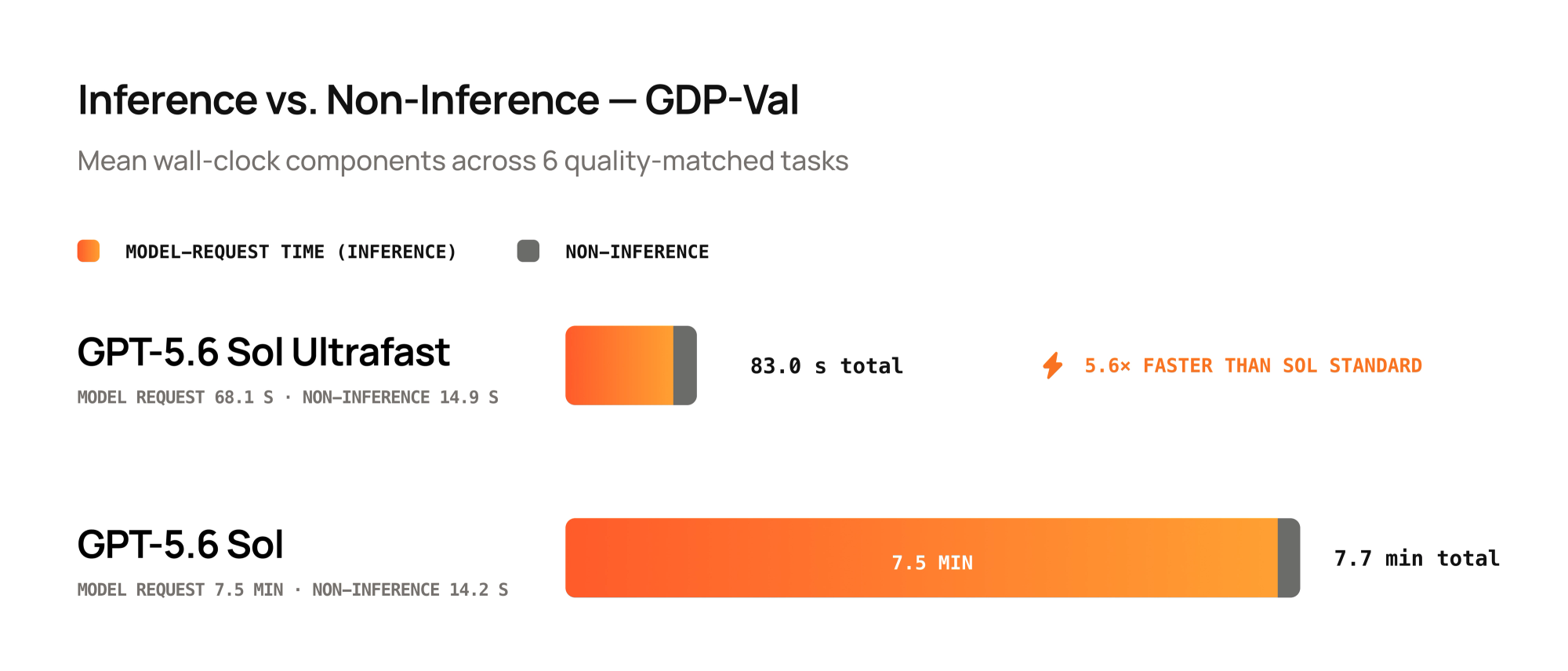
The chart above — from the partner's official blog — makes the gap visual: Ultrafast's curve completes tasks in a fraction of the time competing models need at comparable accuracy levels, which explains why OpenAI chose this route specifically for its flagship reasoning model.
Honest limits and caveats
- Closed preview: access is limited, via Cerebras's signup page, with no guaranteed timeline for when you'd get in.
- No pricing announced: nothing has been published about what Ultrafast will cost. The reasonable assumption is a premium over standard rates — specialized hardware is scarce.
- "No quality compromise" is the partner's claim: the published numbers come from Cerebras and OpenAI; independent verification at scale will take time after general availability.
- Speed doesn't replace craft: faster output accelerates production, but strategy, editing, and judgment remain your job — the difference between fast content and good content.
What to do now
- If you build on the API: join the waitlist via the Cerebras signup page linked from the partnership announcement, and prepare one well-defined use case to benchmark when you get access.
- If you're a regular user: nothing changes today — standard GPT-5.6 Sol works as before, and our coverage of the recent free-tier ChatGPT improvements is more relevant to you right now.
- If you're budgeting: wait for the pricing announcement before committing; the mode only enters the spreadsheet if the time savings justify the rate.
Frequently asked questions
What is GPT-5.6 Sol Ultrafast?
A new generation mode from OpenAI that accelerates GPT-5.6 Sol by up to 14x (per the official announcement title) using Cerebras hardware, reaching up to 750 output tokens per second.
Is Ultrafast available in ChatGPT?
No. The initial announcement covers the OpenAI API only, for a selected group of preview customers, with no announced date for the consumer ChatGPT app.
How much does GPT-5.6 Sol Ultrafast cost?
Neither OpenAI nor Cerebras has published pricing for the new mode yet. Any number circulating today is speculation.
How is it different from standard GPT-5.6 Sol?
Same model at its announced intelligence level, but with much faster generation (up to 750 tokens/sec vs standard rates) by running on Cerebras wafer-scale chips instead of conventional hardware.
Does speed matter for individual creators?
The real value shows in bulk production and multi-step workflows. A solo writer producing one article per session likely finds current speeds sufficient.
The bottom line
The Ultrafast preview confirms a clear trend: the frontier-lab race has moved from "who is smartest" to "who is fastest without losing quality." For working creators, that's good medium-term news — the waiting cost inside every tool built on these models will fall. Today, though, it's a closed preview with no prices, so don't restructure your plans around it. We're tracking it, and we'll report when it opens up.
Meanwhile, you can produce your content at a full day's pace today with ARWriter — writing, design, and scheduling in one workspace.
Sources: Official Cerebras–OpenAI partnership announcement (August 13, 2026) · OpenAI's official X post · OpenAI preview page: openai.com/index/previewing-ultrafast/