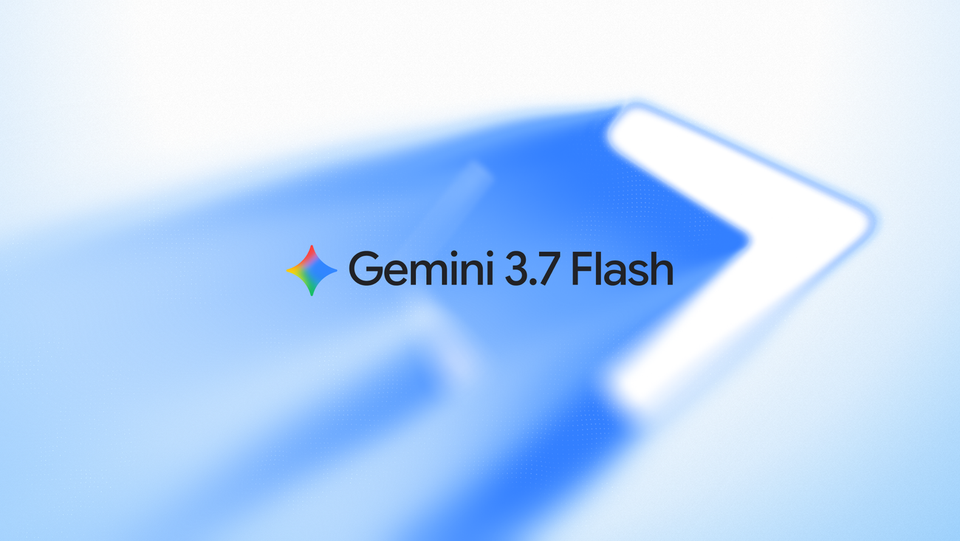
Google announced Gemini 3.7 Flash on August 13, 2026 — the newest member of the Flash family that quietly powers millions of everyday AI interactions in the Gemini app. For content creators, the headline is not a benchmark chart but two practical facts: an introductory API price at half the cost of the previous 3.6 Flash, and immediate integration into Gemini Spark, Google's always-on personal assistant for paid subscribers in more than 160 countries.
The release landed just three weeks after Gemini 3.6 Flash — which we covered in detail at launch — continuing a pace that has become normal in 2026: frontier labs shipping meaningful upgrades monthly, competing on price-per-intelligence rather than raw capability alone. If you write product descriptions, draft newsletters, or build content tools on top of these APIs, that competition is directly your gain.
What Google actually announced
Google describes 3.7 Flash as its "most intelligent workhorse model yet," with substantial gains in software engineering, knowledge work, and web development. Three details matter most for anyone producing content professionally:
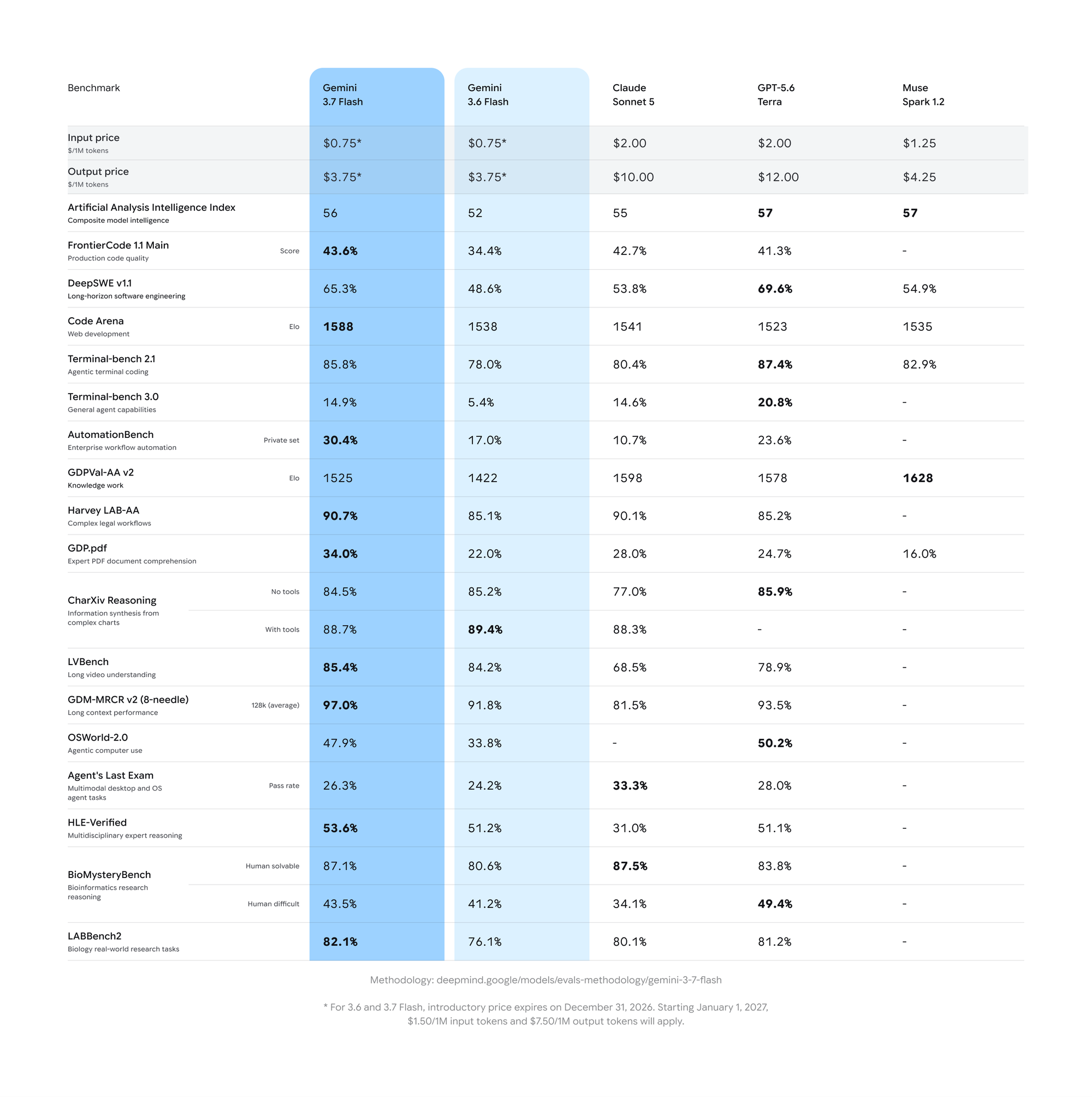
- Half-price introductory API rates through the end of 2026: $0.75 per million input tokens and $3.75 per million output tokens — literally half of what 3.6 Flash cost. From January 1, 2027, pricing moves to $1.50 and $7.50 respectively.
- Gemini Spark upgraded on day one: Google's 24/7 personal agent, available to AI Pro and Ultra subscribers in 160+ countries, now runs on 3.7 Flash, with improved drafting of emails, file consolidation, and multi-step workflows across Google Workspace.
- Stronger document understanding: 3.7 Flash clearly beats its predecessor on the GDP.pdf benchmark for complex document processing (34.0% vs 22.0%) and on AutomationBench for real-world business workflows (30.4% vs 17.0%).
Why this matters if you create content for a living
1. Your API bill for text generation can drop by half
If you run scripts or tools that generate article drafts, product copy, or automated replies through the Gemini API, halved pricing effectively doubles your monthly output budget. It's the same trend we tracked when DeepSeek launched peak/off-peak pricing at a 50% discount — the labs are fighting for your workloads, and small publishers are the natural beneficiaries.
2. UI generation that respects a reference design
Google highlighted that 3.7 Flash generates functional web layouts with "high design adherence" based on a visual reference — a screenshot, an image, or an entire design system — and improved its WebDev Arena Elo score to 1588, up from 1538. For solo founders and marketers building landing pages without a designer on staff, the gap between the mockup in your head and a working first draft keeps shrinking.
3. Characters and visual assets generated alongside your text
In one official demo, Google turned a plain text prompt into a fully playable 3D game, using Nano Banana (its popular image model) to generate characters, items, and textures in real time. Pairing a fast, cheap text model with an advanced image model is exactly the architecture modern content tools are converging on — a pattern we examined in depth in our coverage of Qwen Image 3 Pro and its multilingual generation.
There's also a quieter upgrade relevant to anyone repurposing long documents: the announcement showcased turning a static annual-report PDF into an interactive data story with live charts. That's now a stated capability, not marketing vapor.
Quick comparison: where 3.7 Flash sits
| Model | Input per 1M tokens | Output per 1M tokens | Best for |
|---|---|---|---|
| Gemini 3.7 Flash (intro) | $0.75 | $3.75 | High-volume production: drafts, descriptions, replies |
| Gemini 3.6 Flash | 2× the intro price | 2× the intro price | Still available, but newer is better and cheaper |
| Gemini 3.7 Flash (from Jan 1, 2027) | $1.50 | $7.50 | The number to use for 2027 budget planning |
Note the fine print: the introductory pricing expires December 31, 2026. Anyone building a paid service on top of it today should model costs against the permanent rate.
Honest limits to know before you commit
- This launch is developer-first: Google's own framing centers on coding, agents, and knowledge work. Long-form creative writing improves as a side effect of general gains, but no one promised a literary leap.
- Gemini Spark is a paid feature: the in-app benefits arrive via AI Pro and Ultra subscriptions — it's not a free-tier upgrade for every Gemini user.
- The intro price is temporary: after December 31, 2026, rates double. Plan accordingly.
- No language-specific numbers: Google published no dedicated quality scores for specific languages in this announcement. If you produce content in Arabic, Spanish, or any non-English language at scale, run your own side-by-side test on real copy before switching tools.
- All published comparisons are against 3.6 Flash: Google did not publish head-to-head writing benchmarks against OpenAI or Anthropic models in this post. Treat any outside claim of "absolute superiority" with caution.
How to try it today
- Via Gemini Spark: if you subscribe to Google AI Pro or Ultra in a supported country, you've been on 3.7 Flash since launch day — try assigning it a draft email or a project summary.
- Via Google AI Studio: developers and tool builders can call the model directly through the Gemini API, and enterprises get it in the Gemini Enterprise app and Agent Platform.
- Inside your existing tools: if your writing platform uses Gemini under the hood, ask the vendor about their upgrade timeline — most migrate within days of a Flash release.
And if you'd rather not stitch together APIs yourself, the ARWriter toolset covers writing, image creation, and publishing in one Arabic-first workspace — we track these model waves so your workflow stays current without the plumbing.
Frequently asked questions
How much does Gemini 3.7 Flash cost?
The introductory rate is $0.75 per million input tokens and $3.75 per million output tokens until December 31, 2026. From January 1, 2027, it becomes $1.50 and $7.50.
Is Gemini 3.7 Flash free to use?
It's available via the paid Gemini API, and inside the Gemini app through Gemini Spark for Google AI Pro and Ultra subscribers in 160+ countries. Google has not announced a dedicated free tier for 3.7 Flash specifically.
Does Gemini 3.7 Flash support Arabic?
The Gemini family broadly supports Arabic in Google's apps, but this announcement included no language-specific evaluations. Testing it on your own real content is the reliable way to judge quality.
What's the difference between 3.7 Flash and 3.6 Flash?
Better first-pass accuracy, stronger complex-document processing (34.0% vs 22.0% on GDP.pdf), better real-world workflow completion (30.4% vs 17.0% on AutomationBench), improved UI generation — all at half the introductory price.
Is it worth switching for a small creator business?
If your tools use Gemini in the background, the upgrade reaches you automatically. If you build directly on the API, halved costs alone justify a trial this week.
The bottom line
Gemini 3.7 Flash isn't a revolution — it's a signal of a maturing market where capable models arrive faster and cheaper every month. The biggest winners are people who build real work on top of them: stores that write their own product pages, founders who turn screenshots into landing pages, analysts whose PDFs become interactive stories. Start with a small experiment on content you already produce, measure the difference yourself, and let the results decide.
Want to skip the experimentation phase? ARWriter lets you write, design, and schedule your content from a single workspace — and we absorb the model churn for you.
Sources: Google's official Gemini 3.7 Flash announcement — Google blog, August 13, 2026.