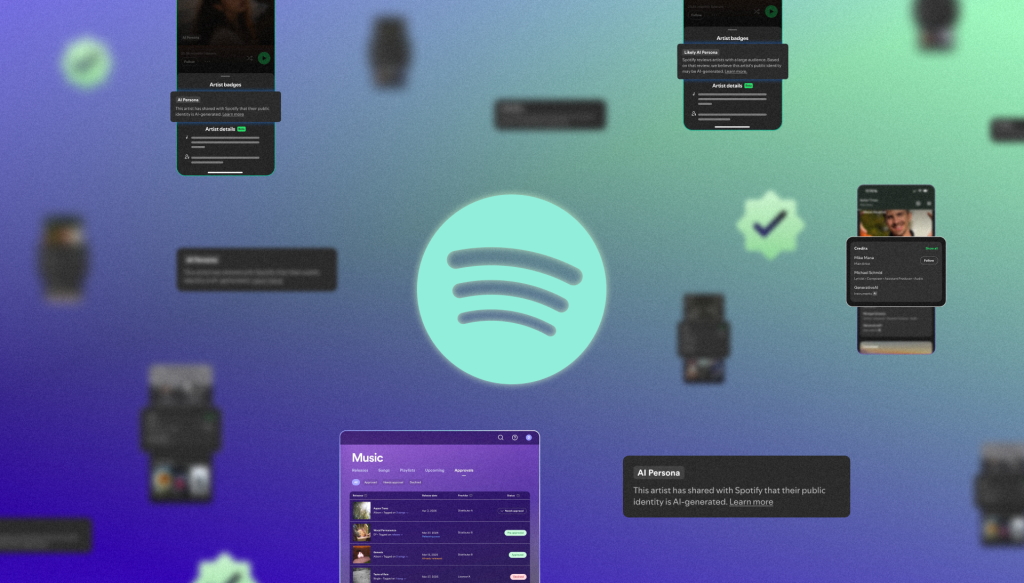
On October 20, 2026, Spotify published an official newsroom report titled "One Year In: Putting Human Artistry First," and the numbers inside it redraw the map for anyone publishing audio today: more than 50 million tracks flagged as AI slop or spam were pulled out of its recommendation systems during 2026 alone, and more than 75 million spammy tracks were removed from the platform entirely for serious or repeated rule violations. If you upload music, run a podcast, or market a brand through audio, the message is blunt: the era of mass-uploading machine-generated tracks and collecting micro-royalties is over.
This guide breaks down exactly what changed, how the detection actually works, the full year of policies that led here, and — most importantly — what a creator in each situation should do next.
Primary source: Spotify's official newsroom announcement — "One Year In: Putting Human Artistry First", October 20, 2026.
What exactly happened? The two official numbers
The primary source here is Spotify's own newsroom post dated October 20, 2026 — a policy document, not a leaked memo or a press paraphrase. Two figures anchor it:
- Over 50 million tracks removed from recommendations (Autoplay, radio chains, personalized playlists) during 2026 because listening analysis showed listeners consistently skipped or ignored them — the exact profile Spotify classifies as slop or spam.
- Over 75 million tracks deleted from the platform altogether for serious or repeated violations of the rules, such as metadata manipulation or bulk duplicate uploads.
The distinction matters more than the raw totals. Being pulled from recommendations does not delete your track; it isolates it so it no longer reaches new listeners unless they search for it directly. Full removal is a punishment for breaking the rules themselves — not for using AI.
Spotify also confirmed the recommendation updates rolled out over the previous six months, and that the decision was grounded in measured behavior: the tracks people skipped most were the same ones its classifiers scored as slop or spam. In other words, classification is no longer a pure model opinion — it is anchored to real, measurable listening behavior.
How Spotify detects slop and spam
The company does not publish its algorithms, but its own announcement lists four families of signals working together:
- Listener engagement: skip rates, completion rates, and reports — the strongest ground-truth signal of whether a track deserves a recommendation slot.
- Upload patterns: accounts pushing dozens or hundreds of tracks a day, or artificially short tracks engineered to farm a few seconds of playtime at scale.
- Metadata: name and description tricks that impersonate popular songs or ride trending search terms.
- Third-party AI detection tools: Spotify says it runs several external detectors together — and openly admits detection "has limitations," a caveat that matters to you and that we examine in the weaknesses section below.
The crackdown also reaches beyond the music itself: spammy playlist networks that sold placement in large follow-count playlists, and artificial optimization designed to game search results, are now explicit removal targets.
A full year of policy: how we got here
October 2026 is the peak, not the starting point. Spotify has been assembling this system for over a year, and knowing the sequence helps you predict what comes next:
- September 2025: the first artist-protection announcement — the anniversary this new report celebrates.
- April 2026 — AI Credits: a disclosure mechanism where artists declare which roles or instruments involved AI on each work. Spotify says tens of thousands of credits are submitted daily, and they are surfaced to listeners in the song credits view on mobile.
- April 30, 2026 — Verified by Spotify: more than 300,000 verified artists covering over 99 percent of listener searches, with over 70 percent of them independents.
- August 11, 2026 — AI Persona badges: fully AI-generated artist identities now carry a visible badge and are excluded from editorial and algorithmic recommendations by default unless a listener explicitly follows them. We covered this step in detail in our earlier AI Persona badges explainer.
- October 2026: the mass purge, plus the expansion of Artist Profile Protection — currently in beta with thousands of artists, letting them review any release credited to them before it lands on their profile — opening to all artists by the end of the year.
One financial detail cuts deeper than any badge: the 1,000-stream royalty threshold in place since 2024. Spotify states that tracks with high-probability AI indicators are ten times more likely to fall below it. The economic penalty arrives before any removal does.
What this means for you as a creator
If you release AI-generated music
The rules are now enforced, not advisory. Disclosure through AI Credits is the price of staying in the system, and pretending a full AI Persona is a human artist will not pass. More fundamentally, quality alone no longer saves you: generated tracks are blocked from the most important discovery channels by default, and your reach now depends on direct search and explicit follows — an audience you have to build yourself, outside the platform. If your model was "upload a large library and let volume win," that model is precisely what the 50-million purge was aimed at.
If you are a human musician or podcaster
This is the best discovery news in years. Millions of junk competitors just left the recommendation pool, tilting the algorithmic playing field back toward real work. Act on it: get verified, turn on Artist Profile Protection the moment it opens to everyone, and use AI Credits even when AI only touched mastering or arrangement — partial disclosure protects you from misclassification.
If you are a marketer or brand using audio
Branded audio and programmatic ad music fall under the same umbrella. Anything your tools generate for Spotify campaigns should go through the same disclosure logic, or it loses reach by the same mechanism. And if you have been buying placement in big follow-count playlists, know that the playlist networks themselves are removal targets now.
If you write content or scripts
The wider lesson travels far beyond music: LinkedIn has been demoting low-effort AI posts, Google is reweighting sources, and now Spotify is purging recommendations. Volume-based content production is being repriced to zero on every major platform, while edited, human-quality work compounds. That is exactly the workflow tools like ARWriter's auto-writer are built for — long-form drafts in Arabic or English that a human then shapes, rather than raw machine spam.
Quick comparison: Spotify vs the other platforms
| Platform | Stance on low-quality AI content | Disclosure | Penalty |
|---|---|---|---|
| Spotify | 50M tracks out of recommendations, 75M removed; AI Persona identities excluded by default | AI Credits shown to listeners | Recommendation ban, then removal; 10x harder royalty threshold |
| YouTube (music + video) | Mandatory realistic-disclosure labeling; demotes duplicated and mass-produced content | Upload-time disclosure toggle | Reduced reach and monetization loss |
| Deezer | Manual reporting and takedown flows, no comparable public badge system | No unified disclosure system | Removal upon report |
| Apple Music | Editorial-first curation limits slop exposure by design | No public system | Editorial rejection |
Per Spotify's own claim, it is currently the only major streaming service excluding fully generated artist identities from recommendations by default — which makes it the strictest platform in this file, and the one whose policies others tend to copy within a year.
Honest limits and weaknesses you should know
- Detection is fallible: Spotify itself admits AI detection tools "have limitations." Practically, that means misclassification can go both ways — human tracks flagged incorrectly, generated tracks slipping through. An indie artist wrongly demoted has one real recourse: the support and appeal path through their distributor.
- No published thresholds: the company does not disclose the exact skip-rate or engagement cutoff that triggers demotion, so staying in recommendations is more of a black box than before.
- Behavior judged, not origin: much of the system measures listener behavior rather than a track's provenance, so weak human tracks can pay the price of a system built for machine spam — and clever spam can survive.
- The disclosure gap outside the West: independent artists in emerging markets adopt disclosure tools more slowly, which can invite reverse discrimination versus competitors who disclose cleanly. If you publish internationally, treat AI Credits as competitive armor, not bureaucracy.
How the listener journey actually changes
To grasp what the numbers do to discovery, follow one listener's morning. Before the purge: they start a short seed-radio chain, and the chain keeps crossing machine-generated tracks impersonating famous artists with near-identical names — copied covers with synthetic vocals, or short noise clips engineered to farm seconds. The listener skips, and every skip pollutes the recommendation math, making it worse at suggesting real artists similar to their taste.
With 50 million such tracks out of these channels, two things happen that matter directly to you as a creator. First, the noise floor drops, so a genuinely well-produced track has a better shot at reaching the right listener. Second, the skip signals themselves get cleaner — the system learns from real behavior instead of reactions to misleading content. The whole machinery gains precision, and precision is what turns a passing listener into a durable follower of your work.
There is a third, quieter effect: platform trust. Every time a listener hit junk behind a "discover" button, they lost a little faith in autoplay and retreated to names they already knew. Restoring that trust means listeners return to exploration — which is the only space where a new independent artist ever appears in front of strangers.
What this signals for audio publishing everywhere
The Arabic catalog on Spotify is one of the fastest-growing worldwide, and generated content grew in parallel: entire libraries of "generated emotional songs" and synthetic soundtracks uploaded industrially to catch trending Arabic search terms. The October 2026 crackdown puts that model directly in the beam, because most of that content reached humans exclusively through recommendations — the exact door that just closed.
Genuine regional artists and podcasters, meanwhile, stand in front of an open window: cleaner competition, mature verification and disclosure tools, and protection programs reaching everyone by year's end. The difference will be made by who moves first — verify, disclose, and publish consistently — versus who waits for the easy days that are not coming back.
For podcasters specifically, the signal is blunt: if your episodes use generated voice or AI background music, clean your sources, document their origin, and lean on licensed or owned audio — a road that genuinely opened with Universal's licensed AI music deal with ElevenLabs — and if podcast production is your lane, our guide to Threads' new toolkit for podcast creators covers the publishing side. Arabic podcasting is still in its trust-building decade, and one careless association with slop costs more than any time saved.
Practical steps to start this week
- Verify your artist profile and enable Profile Protection as soon as it opens to all artists by end of 2026.
- Start using AI Credits on every release, even for partial AI use (mastering, arrangement, artwork).
- Audit your back catalog: delete or consolidate artificially short and duplicate tracks before the classifiers do it for you.
- Build an audience that does not depend on recommendations — a mailing list, behind-the-scenes storytelling, social presence — because explicit follows are the one exception to AI Persona exclusion.
- If you use AI writing and design tools in your campaigns, keep a human editing pass before publishing. Raw unreviewed output is exactly the pattern platforms are now hunting. Draft with a tool like ARWriter's ARWriter platform, then edit it into something with your voice.
Frequently asked questions
Is Spotify banning AI-made music completely?
No. The ban targets violations and junk, not the tool. You can release music made with AI assistance if you disclose it through AI Credits; fully generated artist identities get an AI Persona badge and are excluded from recommendations unless a listener follows them directly.
What is the difference between removal from recommendations and removal from the platform?
Recommendation removal keeps the track on Spotify but hidden from Autoplay, radio, and personalized playlists. Full removal deletes it entirely for serious or repeated rule violations.
I am a fully human artist — will my reach shrink?
The net effect favors you: millions of competing junk tracks left the pool. Watch for possible misclassification, and keep your metadata clean of trending-name tricks, since those are targeting signals.
When does Artist Profile Protection open to everyone?
Per the October 20, 2026 announcement, it is in beta with thousands of artists and opens to all artists by the end of the year. Follow the trusted-platform hub on Spotify for Artists.
Will I lose royalties if my tracks hover near the 1,000-stream threshold?
The threshold applies to everyone since 2024, but tracks with high AI-indicator probability are ten times more likely to fall below it, according to Spotify's own figures. Accurate disclosure and a clean catalog are your first line of defense.
The bottom line
Fifty million is a striking number, but it is a snapshot. The trend is what you should plan around: distribution platforms now pay a real price for anything that erodes listener trust, disclosure has become the new currency of that trust, and human-grade work — or AI work responsibly signed by a clear human name — is regaining ground. Verify your profile this week, audit your catalog, and shift your production goal from volume to follow-worthy quality. That is the one asset no recommendation algorithm can confiscate.
If part of your workflow is producing polished written content, try drafting your next piece with ARWriter's writing tools and then adding your editorial pass — that balance of machine speed and human judgment is exactly what platforms are now rewarding.