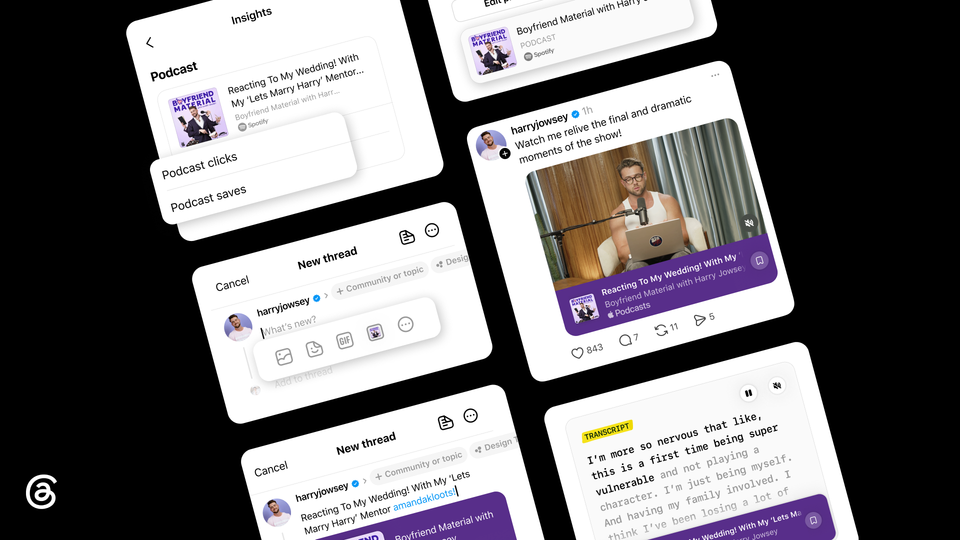
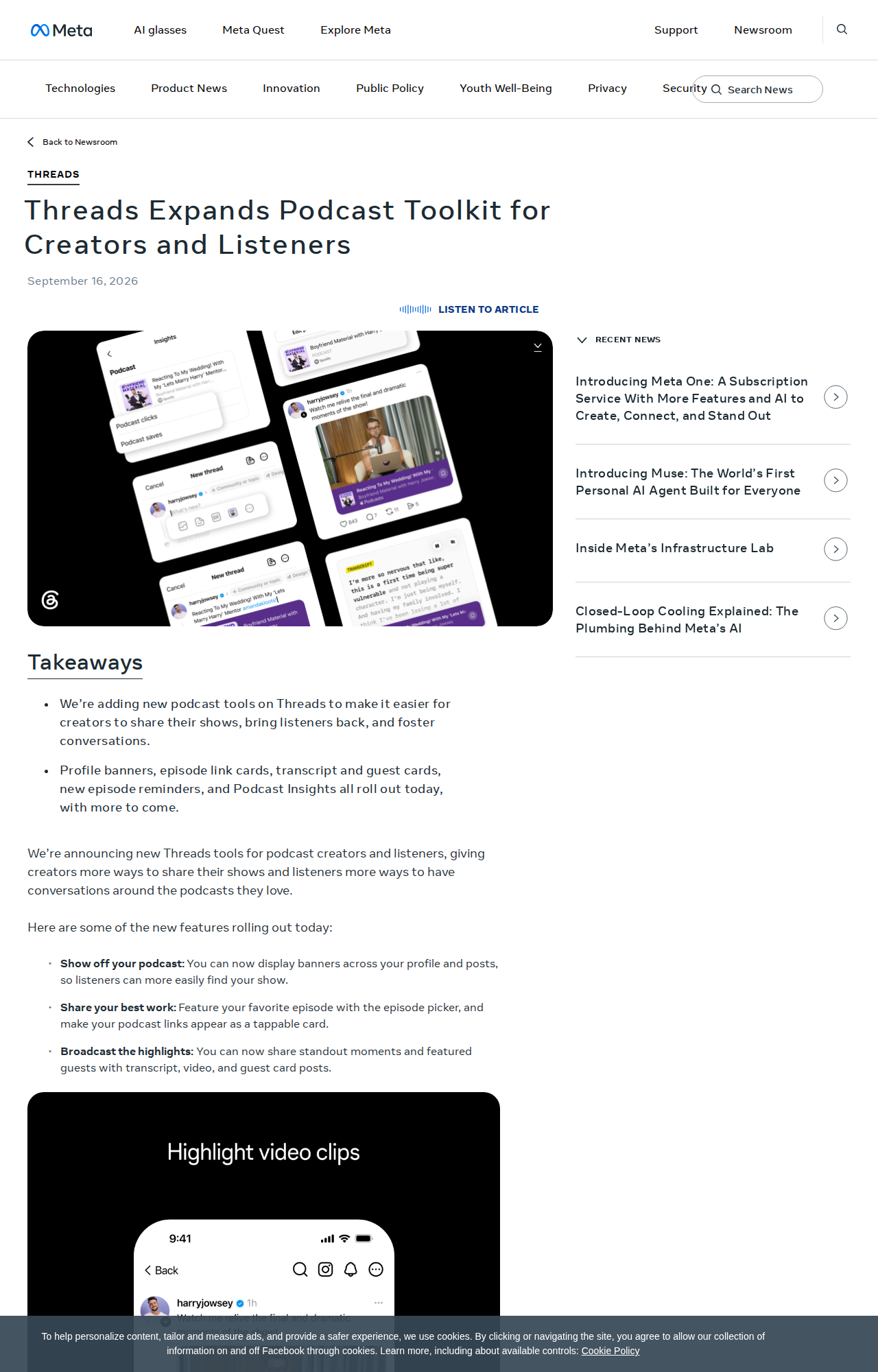
Podcasters just got a dedicated promotion toolkit inside Threads. On September 16, 2026, Meta announced a bundle of podcast features rolling out across the app — profile banners, rich episode cards, highlight posts with transcripts and guest cards, a save feature for listeners, automated sharing reminders, and, notably, an insights panel that finally shows what Threads actually drives for a show. For an industry where marketing has always been harder than recording, that is a meaningful upgrade.
What Meta announced
The update, published on Meta's official newsroom under "Threads Expands Podcast Toolkit for Creators and Listeners," splits cleanly into two tracks: tools that showcase your show, and tools that enrich listening. Meta framed the goal as giving creators "more ways to share their shows" and listeners "more ways to have conversations around the podcasts they love." Independent coverage from TechCrunch confirms the features are live in the Threads app and surfacing to users now.
The creator side: five tools that change your workflow
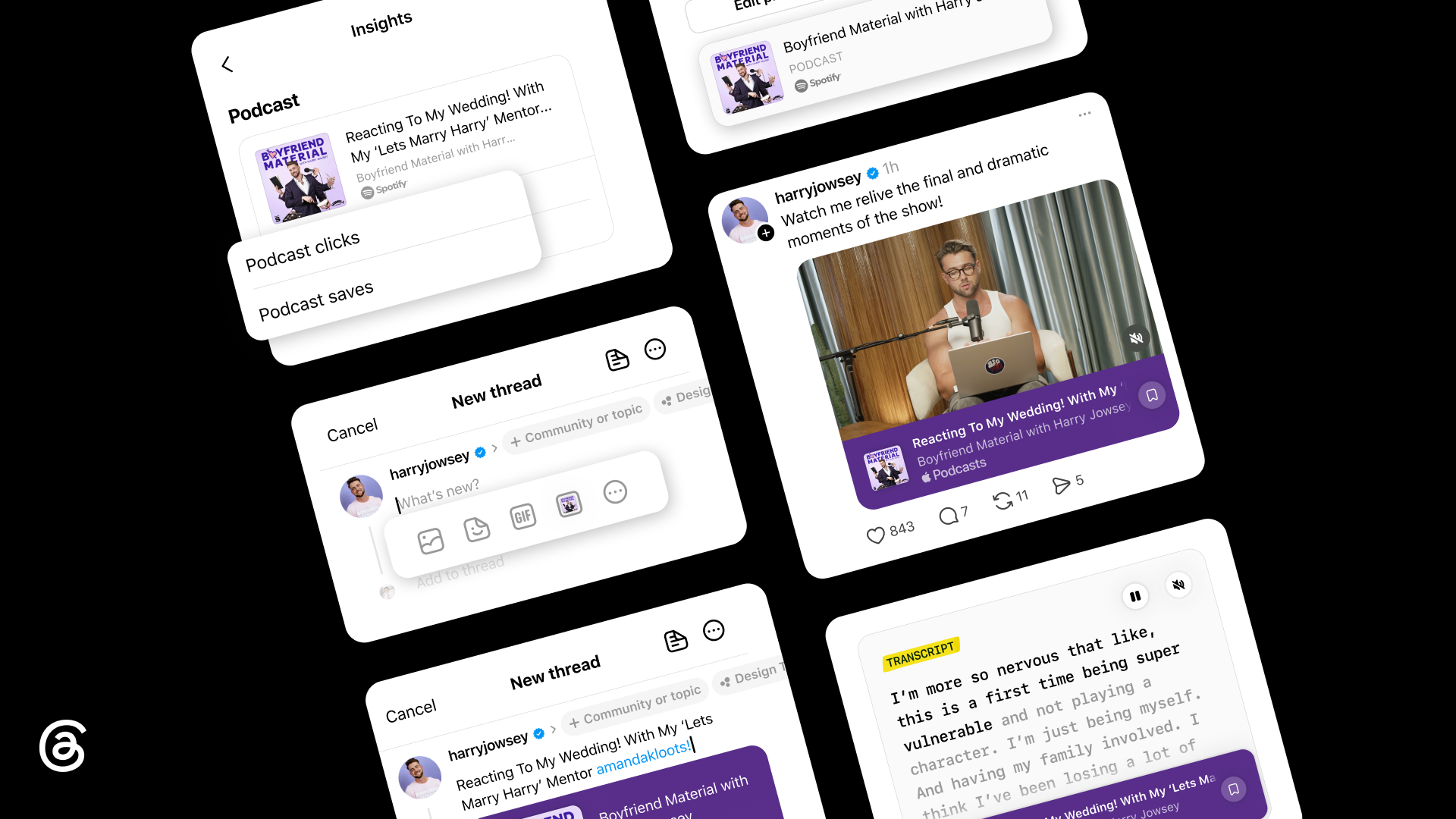
Show banners on your profile and posts. A banner announcing your podcast now travels across your profile and your posts. New visitors understand what you do within seconds — no bio archaeology required.
The episode picker and tappable link cards. Instead of a naked URL, podcast links now render as a rich, tappable card carrying your show's identity, and you can pin a favorite episode front and center. Anyone who has posted bare podcast links and watched them die quietly in the feed knows exactly why this matters.
Highlight posts with transcripts, video, and guest cards. You can now share standout moments as purpose-built posts that include the transcript, a video clip, or a guest card. That single strong minute from your interview becomes its own promotional asset — with the guest featured as an extra surface for discovery.
Automatic share reminders. An opt-in notification from Threads reminds you to share new episodes with your audience. It sounds small. It is not: publishing consistency is the single clearest separator between shows that compound and shows that stall, and this feature removes the friction between an episode going live and it being promoted.
Reach and engagement insights. The new analytics show the reach and engagement Threads drives for a podcast — including clicks and saves. For the first time you can answer, with numbers, the question every podcaster asks about every platform: does this audience actually travel to my show, or does it just nod politely?
The listener side
Listeners can now save episodes they encounter in their feed, building a "listen later" habit familiar from YouTube and Instagram saves. Combined with rich episode cards appearing inside conversations, discovery stops depending on lucky timing — a show you scroll past at midnight is still there tomorrow.
What this means for you as a creator
Most working podcasters share the same bottleneck: production got easy, distribution did not. The Threads toolkit attacks a large slice of that problem, and it lands inside Meta's broader creator push — the same company that recently shipped Meta One with advanced publishing features for creators, including native 30-day story scheduling.
A practical starting routine:
Turn one episode into three assets. Post the main episode card on launch day, a highlighted moment with transcript two days later, and a guest card your guest can reshare to their own audience. Triple the surface area, one recording.
Enable the reminder and lock your cadence. Let the notification anchor a fixed posting rhythm. Consistency builds audience expectation; expectation builds listening habits.
Read the insights monthly, then decide. If clicks-to-saves run high, Threads is delivering real listeners — invest more. If they run low, fix your post titles and card artwork before blaming the platform.
And because the episode itself still has to be worth clicking, anything that shortens preparation is worth grabbing. Scripting and episode prep are exactly where ARWriter's bilingual production tools save creators hours per week.
Quick comparison: Threads toolkit vs. bare-link promotion
| Criterion | Threads (after update) | Traditional bare links |
|---|---|---|
| Link presentation | Rich tappable card with show identity | Plain URL, easy to scroll past |
| Highlighting moments | Built-in transcript, video, and guest cards | Manual clipping, separate uploads |
| Consistency | Automated reminders for new episodes | Entirely manual discipline |
| Measurement | Reach, engagement, clicks, and saves in-app | Partial, via third-party shortlinks |
Where the toolkit sits in your full workflow
To place these tools correctly, picture an episode's journey from idea to impact. It starts with research and scripting, where saved hours compound — AI-assisted audio production already strips days out of what studios used to own. Then comes recording, editing, and publishing the episode to your listening platform. At the top of the funnel sits distribution — and that is precisely where the Threads toolkit operates, turning each finished episode into several display assets spread across days, then measuring which ones return as actual clicks and listens.
The classic mistake is confusing the stages. A creator who spends a week producing an episode and then posts one bare link at launch has spent ninety percent of the effort on something almost nobody sees. The correct sequence runs: faster production, then organized distribution through rich display formats, then measurement that shapes the next episode. Seen that way, the Threads update does not add work on top of your schedule — it formalizes promotion you were already doing randomly, or not at all.
Honest limitations
Four caveats. The rollout is gradual — Meta's own wording — so features may not all appear on your account day one. These are promotion tools, not hosting: your episodes still live on whatever listening platform you chose, and Threads' job is to route audience there. The click-and-save analytics are new, so give them a month or two before drawing baseline conclusions. Finally, banners and cards reward polished visual identity — a badly designed card can hurt more than a plain link ever did, so prepare proper templates for your show before turning everything on.
Frequently asked questions
What is the Threads podcast toolkit?
A set of features Meta announced on September 16, 2026: show banners, an episode picker, rich link cards, highlight posts with transcripts, video, and guest cards, episode saving, automated share reminders, and a reach-and-engagement insights panel.
Is it available to everyone right now?
Meta said the features are "rolling out today" with gradual availability, so accounts gain access progressively rather than all at once.
Does Threads host podcast files?
No. The toolkit handles promotion, presentation, discovery, and measurement. Episode hosting stays on your chosen listening platform.
Why do the new insights matter?
They show reach, engagement, clicks, and saves driven by Threads, letting you quantify — often for the first time — whether the platform sends real listeners to your show.
How should guest cards be used for promotion?
When you host a guest, publish the guest card so they can reshare it to their own audience — your episode gains a free additional distribution channel through your guest's network, wrapped in your show's visual identity.
Do these tools suit small shows or only big ones?
Any show with content worth displaying can use them. Small shows arguably benefit most, since the toolkit substitutes for a dedicated marketing team, while larger programs use it to keep presentation consistent across multiple accounts.
The bottom line
Meta's update concedes what every podcaster already knew: recording is the easy half. By replacing bare links with rich cards, adding measurement, and automating the consistency problem, Threads gives independent shows tools that used to belong to marketing teams. Start by turning your next episode into three assets, and measure what happens within a month. Faster, better preparation — with tools like ARWriter — remains the cheapest advantage you can buy.