On October 22, 2026, French AI lab Mistral AI launched the Voxtral 3 family — its most ambitious speech generation to date, and the first to cover the entire voice loop in one stack: batch and realtime transcription, text-to-speech, voice cloning, and conversational voice agents. Arabic support is explicitly documented in more than one place, and pricing lands at fractions of a cent per minute. The official announcement is live on Mistral's blog, and this is our extended look at what the family means specifically for people who make content for a living.

The timing matters for context: ever since the company shipped Mistral Large 4 with open weights, it has been methodically building a European alternative to the American frontier labs. Voxtral 3 is the strongest evidence yet that this push has reached the audio arena — a market that until now had a short list of serious players: OpenAI, Google, and ElevenLabs among them.
What is the Voxtral 3 family? Five components
Voxtral 3 is not one model but a full system, described on the official page as:
- Voxtral Small Transcribe 3: the flagship speech-to-text model, topping the published benchmark table, with 50+ language support, speaker diarization, and context biasing — at $0.0040/min.
- Voxtral Mini Transcribe 3: a lightweight 4-billion-parameter model built for fast, accurate batch transcription at $0.0035/min.
- Voxtral Mini Transcribe Realtime 3: the streaming variant with sub-500 ms latency across more than 35 languages, at $0.008/min.
- Voxtral Mini TTS 3: the text-to-speech model with state-of-the-art expressiveness and instruction following across 35+ languages and 50+ dialects, at $13 per 1M characters.
- Pro Voice: the professional voice adaptation layer that reproduces a speaker's distinctive character, emotional range, and style across languages — beyond basic cloning.
Transcription at roughly 4% word error rate
The headline number from the announcement: on the FLEURS benchmark measuring word error rate across the 45 languages supported by all seven compared models, Voxtral Small Transcribe 3 scored 4.1% with the language specified and 4.0% with automatic language detection — placing it ahead of Microsoft AI Transcribe 2, Gemini 3.5 Transcribe, Scribe v2, GPT Transcribe, and Whisper large-v3, which scored 16.0% and 14.9% on the same table. In realtime mode across 35 languages, Mini Realtime 3 posted 4.0%–4.2% WER across latency classes — including the 240 ms tier.
Translating that into practical terms: roughly 4 mistaken words per 100 in your recording — versus 15 or more with the widely used free baselines. The gap compounds with volume. A 60-minute podcast episode that used to need an hour of human correction now needs minutes.
Two more features matter for real-world content work. Speaker diarization — the model separates who said what (18.4% on the published diarization benchmark, ahead of dedicated tools like Pyannote at 30.9%). And context biasing: pass a list of brand names and technical terms before transcription, and the model sticks to them instead of hallucinating phonetic approximations — no fine-tuning required.
Arabic is a first-class citizen in this launch
This is the part that matters most to our audience: Arabic is not an afterthought here. The official page demonstrates transcription samples with Arabic listed among the core showcase languages alongside English, Portuguese, Chinese, Hindi, Japanese, and Ukrainian. More importantly, the Voice Presets list covers 18 languages and explicitly includes "Arabic (Emirati, Modern Standard)" — meaning you can generate Arabic voice-over in an Emirati accent or Modern Standard Arabic directly from the interface, with voices that adapt emotion, pace, and emphasis to the sentence's context.
That puts Voxtral 3 on a very short list of commercial models with officially documented Arabic dialect support — joining this month's Jais 3 family of Arabic-native models from the UAE. The trend is unmistakable: Arabic has become a market worth designing for on day one, not an item for the localization backlog.
Text-to-speech: more expressive, cheaper to run
Voxtral Mini TTS 3 does more than read text. Per the announcement, it achieves state-of-the-art expressiveness and instruction following across 35+ languages and 50+ dialects, with voices that react to conversational context — questions sound like questions, exclamations sound excited. New capabilities include voice cloning from 30+ minutes of sampled audio, custom prompt instruction following ("whisper this line"), contextual TTS that respects your preferred pronunciations, and a vocabulary library.
Pricing is the sharpest weapon: $13 per 1M characters — and Mistral states on the page that this undercuts comparable models from OpenAI TTS-1, Deepgram, ElevenLabs Flash, and Gemini Flash. In creator terms: a 10,000-character script (roughly 12–15 minutes of voice-over) costs less than 13 cents.
Clone your own voice — from 30 minutes of audio
Basic cloning needs a 30+ minute sample of your voice. Pro Voice is the professional tier: reproducing a speaker's vocal identity, emotional range, and delivery style across languages. The obvious creator applications: consistent narration across every video you publish without booking studio time — and producing other-language versions in a voice that still sounds like you. The ethical questions that raises are real, and we address them in the limits section below.
Voice agents, ready for production
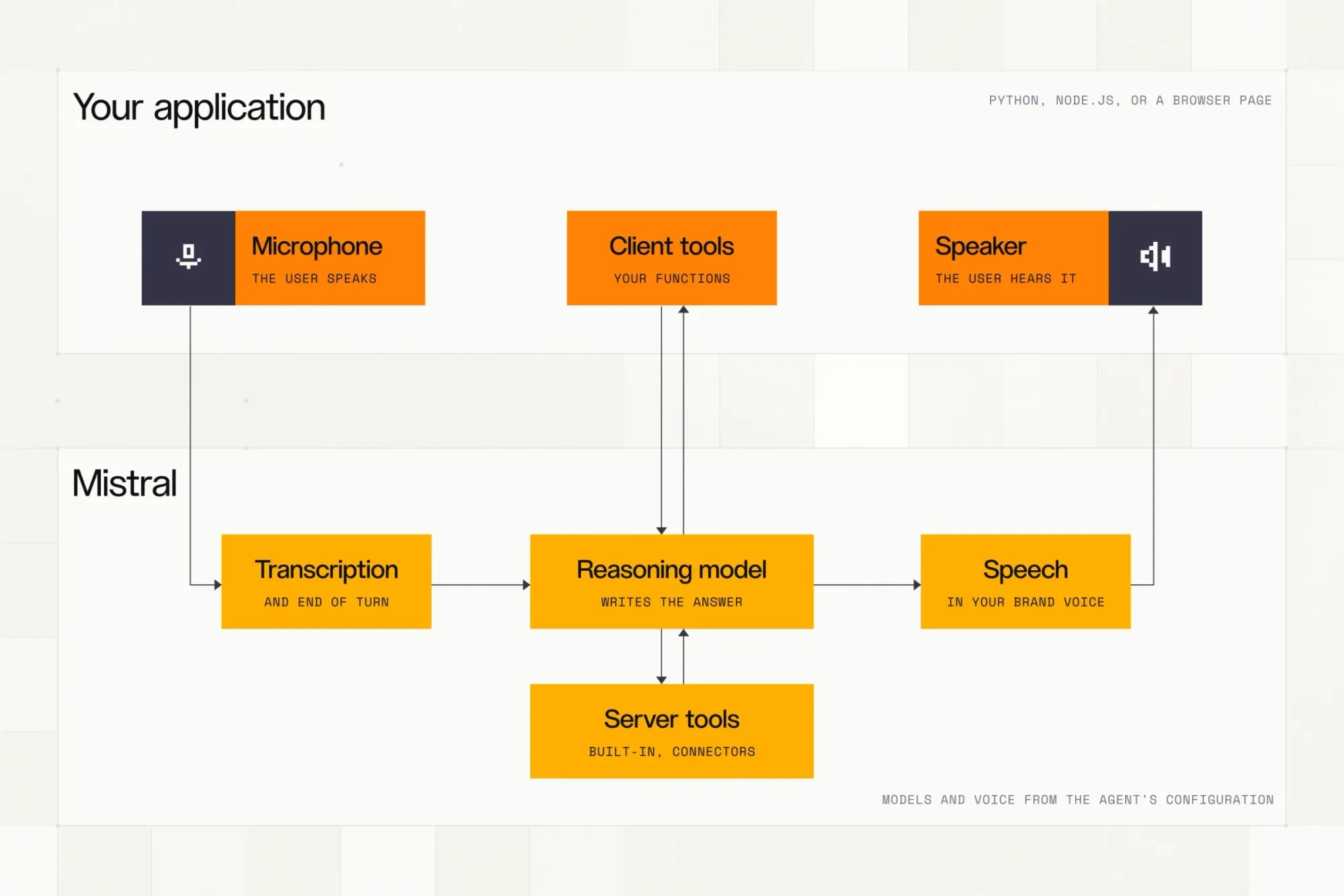
The fifth component skews corporate: a voice agent SDK built on LiveKit, running speech-in, reasoning, and speech-out as one streaming pipeline. The agent listens, detects when the caller has finished speaking (end-of-turn detection), reasons about intent, answers with appropriate emotion, and calls your connected systems to complete tasks mid-conversation. Pricing: $0.04/min with Mistral Small 4 for reasoning, or $0.08/min with a larger model.
Privacy and sovereignty: the European play
Unlike most competitors, Mistral offers two deployment paths: an API hosted in the European Union, or running the full stack on your own infrastructure — with control over where audio is processed and whether it is retained at all. For journalists transcribing sensitive interviews, or organizations subject to local data-residency rules, this can be the difference between "approved" and "forbidden" — the same strategic card Mistral has played across its recent releases.
The complete pricing table
| Component | Official price |
|---|---|
| Voxtral Mini Transcribe 3 (batch) | $0.0035/min |
| Voxtral Mini Transcribe Realtime 3 | $0.008/min |
| Voxtral Small Transcribe 3 | $0.0040/min |
| Voxtral Mini TTS 3 | $13 / 1M characters |
| Voice agent with Mistral Small 4 | $0.04/min |
| Voice agent with larger model | $0.08/min |
What does this mean for you as a content creator?
- Podcasters: accurate transcription with speaker labels for under half a cent per minute — then turn each episode's transcript into a written article as part of the same content package using ARWriter's Auto-Writer: from episode to published post in minutes.
- YouTubers: clean transcripts feed captions, descriptions, and companion posts — and Arabic (or multilingual) voice-over replaces your own voice on off days.
- Course creators: transcribe lectures into searchable text while keeping paid content private through self-deployment.
- Agencies and teams: one voice bill (transcription + TTS + agents) instead of three separate subscriptions, with predictable per-minute pricing you can pass through to client quotes.
Quick comparison: Voxtral 3 vs. the current default
| Criterion | Voxtral 3 (Mistral) | Common current setup |
|---|---|---|
| Claimed transcription WER | 4.0–4.2% on FLEURS | 6% to 16% depending on model |
| Speaker diarization | Built in (18.4% on benchmark) | Usually a separate external tool |
| Ready-made Arabic voices | Yes — Emirati and Modern Standard | Limited or undocumented |
| Transcription price | From $0.0035/min | Varies, typically higher at parity |
| TTS price | $13 / 1M characters | Higher, per Mistral's comparison |
| Hosting | EU-hosted or self-deployed | Provider cloud only, mostly |
The honest limits before you get too excited
Full professional transparency: every number above — WER figures and comparisons alike — was published by Mistral itself on the announcement page and has not yet been through long-term independent review. We have not tested transcription quality on colloquial Arabic dialects specifically (Egyptian, Gulf, Maghrebi); officially documented support for "Emirati and Modern Standard" does not automatically extend to every dialect. Features like cloning and Pro Voice carry ethical weight: use them only on voices you own or have documented permission to use, and expect regulation around synthetic audio to keep tightening — we are already tracking a global wave of disclosure rules around AI-generated content. Finally, AI API pricing shifts fast: treat the table above as launch-day snapshot, not eternal contract.
A suggested workflow: from episode to three platforms
To make this concrete, here is a realistic production loop that ties everything above together. Assume you produce a weekly 45-minute podcast episode and want to maximize its return:
- Transcription (10 minutes of waiting, roughly 16 cents): upload the episode to Voxtral Mini Transcribe 3 in batch mode with diarization enabled, and pass a context-bias list with your guest's name and your field's terminology — you get back a speaker-separated transcript at an expected ~4% error rate.
- Fast correction (10 minutes instead of an hour): scan the transcript specifically for names and numbers — that is where the remaining errors concentrate — instead of proofreading the whole thing.
- Repurposing to text (15 minutes): feed the corrected transcript to ARWriter's Auto-Writer to generate the episode article, pull-quote snippets per platform, the episode description, and a short newsletter blurb.
- Voice-over for clips (5 minutes, under a dollar): generate a short audio intro in Modern Standard Arabic or the Emirati preset — using a stock voice or your own cloned from the 30-minute sample — and a Reels/Shorts teaser is ready without a studio.
- Reverse translation (optional): push the transcript back through for a second-language version in a voice that still sounds like you via Pro Voice — a whole new audience at near-zero marginal production cost.
The net result: one episode becomes a written article, an audio teaser, and posts for three platforms, at a total cost near one dollar and under one extra hour of work — precisely the kind of leverage that makes a release like Voxtral 3 news for creators, not just for audio engineers.
How to get started practically
Sign up directly on Mistral's platform: run your first transcription job on an old recording and compare it against your current output, then audition the Arabic voice presets in the Studio playground before committing to anything. For everything after the transcript — turning the raw text into an article, social posts, and descriptions — that is precisely what ARWriter automates: from raw transcript to publish-ready content.
Frequently asked questions
Does Voxtral 3 support Arabic transcription?
Yes — Arabic is among the 50+ supported transcription languages and appears in the official showcase samples. Quality on colloquial dialects is not separately documented and warrants a field test.
How much does transcribing one hour of audio cost?
At Mini Transcribe 3 batch pricing ($0.0035/min), one hour costs about 21 cents; at the more accurate Small tier ($0.0040/min), about 24 cents. Realtime streaming costs $0.008/min, i.e. 48 cents per hour.
Can I clone my own voice with it?
Yes — basic cloning works from a 30+ minute voice sample, and ready-made Arabic presets include Emirati and Modern Standard Arabic. Only clone voices you own or have documented rights to use.
Where is my audio processed? Can I self-host?
Via Mistral's EU-hosted API, or you can deploy the full Voxtral 3 stack on your own infrastructure, controlling whether any audio is retained at all.
Do I need coding skills to use it?
For the API and the agent SDK, yes — REST or JavaScript basics. But the Studio playgrounds let you test transcription, TTS, and cloning without writing a single line of code.
Bottom line: Voxtral 3 makes voice cheaper, more accurate, and more Arabic-capable than anything previously available at this price point — and the biggest winner is the creator who can now run a complete voice production loop for fractions of a dollar. Try it on your next project, and turn those transcripts into publish-ready written content with ARWriter.