No-Code AI Voice Agent With ElevenLabs Agents: 2026 Guide
Last updated: October 2026
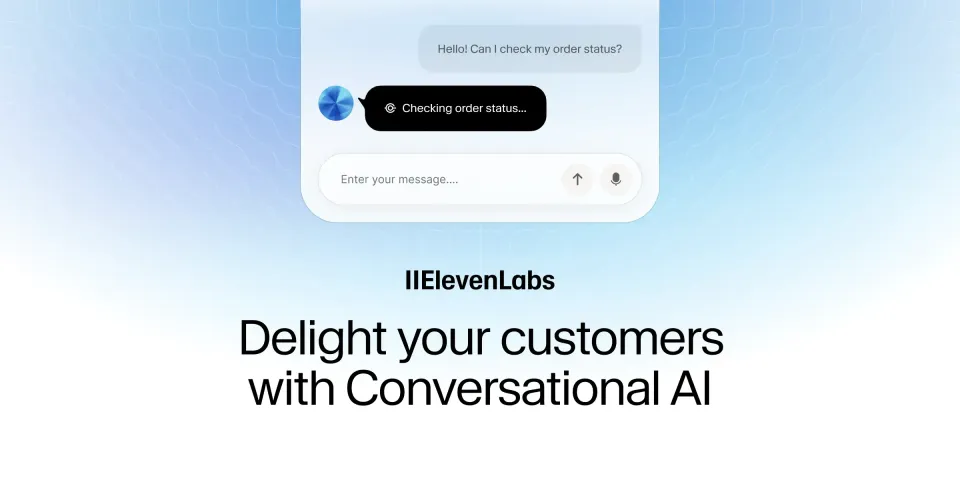
It is 9:40 on a Tuesday night. A customer calls about a late order, hits voicemail, and buys from a competitor before you open. For small teams, missed after-hours calls are lost revenue. ElevenLabs Agents fixes this without a developer: a no-code platform whose AI voice agent answers calls, looks up orders, and resolves support issues in 90+ languages across phone, web, WhatsApp, SMS, and email.
This guide walks the whole path: what a voice agent is, why 2026 is the year to launch one, an 11-step build for one sitting, a production-ready system prompt, honest cost math, and a comparison against Retell, Vapi, and Synthflow — all on the platform's own templates and settings. No code at any step.
The short answer: create a free ElevenLabs account, open ElevenAgents, clone the Order Support template, paste your system prompt, upload your FAQ, pick a voice, run simulated conversations, then connect a phone number, WhatsApp, or web widget. The free tier includes 15 agent minutes with a commercial license — no developer involved.
What Is an AI Voice Agent (and How Is It Different From a Chatbot)?
A voice agent is software that holds a real spoken conversation: it transcribes what the caller says, reasons about it, replies out loud, and takes action — checking an order, booking a slot, starting a refund. A chatbot does similar work in text inside a chat window. The channel changes how you build for it.
The bar is higher on a call. Chat visitors tolerate a short pause; callers read a two-second silence as a dropped line. Speech adds interruptions, accents, and background noise that text never faces. And callers expect whoever answers — human or not — to already know their history.
| Chatbot | AI voice agent | |
|---|---|---|
| Channel | Text in a chat widget or app | Spoken: phone, web, WhatsApp, SMS, email |
| Input | Typed messages, button clicks | Live speech with interruptions and accents |
| Speed expected | A few seconds | Near-instant — pauses sound like errors |
| Typical job | Deflecting FAQ browsing | Order status, rescheduling, triage, urgent issues |
| Failure mode | "I didn't understand that" | Caller hangs up and calls a competitor |
Under the hood, every voice agent chains speech-to-text, a reasoning model, and text-to-speech; ElevenAgents bundles all three and manages turn-taking, so you configure an agent instead of coding one. For the transcription side, see our Grok Voice and Transcribe 2.0 breakdown; for where always-on assistants are heading, read ChatGPT Dots and the always-on agent.
For customer service, voice wins whenever urgency is high — a late order, a missed appointment, a failed payment. If it can wait for an email, a chatbot is fine. If not, you need something that picks up.
Why 2026 Is the Moment for Small Teams
Three things crossed a line in the past twelve months: customer expectations, voice-model quality, and no-code access. An AI phone agent for a small business used to mean an IVR menu and an engineer on retainer. Now it is an afternoon project — and your customers already assume you have one.
The expectation shift is measurable. Zendesk's CX Trends 2026 finds 74% of consumers expect 24/7 customer service because of AI, 88% expect faster responses than a year ago, and 74% hate repeating their story across agents and channels. An AI voice agent for customer service that answers at 2 a.m. with full context is the direct answer to all three.
The market agrees. Grand View Research sizes conversational AI at $14.3 billion in 2025, on track for $78.9 billion by 2033 (a 23.8% CAGR), with customer support the dominant use case and retail/e-commerce 21.1% of 2025 revenue.
And the technology finally matches. Eleven v4, released September 28, 2026 and available across ElevenAgents, was preferred by about 75% of listeners in blind head-to-head tests (win rates of 65–81%). Its v4 Turbo model reports a ~100ms median inference time and ~150ms to first speech, against 262–814ms for competing models. Voice cloning now takes 10 seconds of audio, and the platform reports 10M+ conversations per week. For the live-voice model race, see our GPT Live 1 API and Gemini 3.8 live voice model breakdowns.
Step by Step: Build Your First Agent in One Sitting
One focused sitting covers the entire build: clone a template, paste a prompt, upload your policies, rehearse in simulations, connect one channel. The docs promise a first agent in five minutes; a production-ready support agent takes longer, but the path is the same 11 steps.
- Create a free ElevenLabs account. The free tier includes 15 agent minutes and a commercial license, so you can test before paying.
- Clone a template. In ElevenAgents, use Clone agent on Order Support, FAQ, or Triage. Templates come pre-configured; you edit rather than build.
- Paste your system prompt. Use the skeleton in the next section. This single text box decides most of your agent's behavior.
- Upload the knowledge base. Your FAQ page, shipping policy, and returns policy become the only documents the agent may cite. If yours are thin, fix that before launch — see below.
- Pick voice and language. Choose from more than 16,000 voices, and enable mid-call language switching if your callers mix languages.
- Set guardrails. Define off-topic refusals (no medical, legal, or financial advice), escalation triggers, and topics the agent must never touch.
- Simulate, then validate. Run simulated conversations and automated validation, read every transcript, fix weak answers, and rerun until nothing surprises you.
- Connect one channel. The web widget is one line of HTML; WhatsApp, a phone number, SMS, and email are guided setups. Launch on a single channel first — usually phone or WhatsApp.
- Connect tools. Integrations for Shopify orders, Stripe refunds, Zendesk tickets, Salesforce, Twilio, and calendar bookings let the agent act, not just talk.
- Go live and measure. Track resolution rate, CSAT, and language usage in the built-in analytics, and iterate weekly.
- Add Procedures when ready. Import SOPs so refunds and returns follow an exact script — an alpha capability since June 30, 2026 (how Procedures work).
A Production-Ready System Prompt for a Support Agent
The system prompt is the agent's job description, and vague prompts produce vague agents. Start from this skeleton — written for an e-commerce support agent — and replace the bracketed fields with your details.
Role: You are [Name], the phone and WhatsApp support agent for [Store], an online [niche] store in [country].
Goal: Resolve the customer's issue in this call. Order status, returns/refunds, product questions, order changes.
Tone: Warm, concise, professional. Speak naturally — responses of 1-2 sentences unless explaining steps.
Knowledge: Use only the attached knowledge base (FAQ, shipping policy, returns policy). Never invent policies or prices.
Rules:
- Always confirm the order number or phone number before discussing order details.
- If asked something outside support (e.g., medical, legal, financial advice), politely decline and offer to help with the order.
- For angry customers: acknowledge, apologize once, offer the two allowed remedies (reship / refund per policy).
- If you cannot resolve within 3 exchanges or the customer asks for a human, transfer to a human agent with a short handoff summary.
- Language: reply in the customer's language; switch language mid-call if they switch.
Closing: confirm the issue is resolved, ask if anything else is needed, thank the customer.
What each block does:
- Role and Goal scope the agent to four jobs — anything outside them should trigger a guardrail, not improvisation.
- Tone keeps replies to one or two sentences; long monologues feel unnatural on a call.
- Knowledge is the honesty clause: only attached documents, never an invented policy or price.
- Rules encode your support playbook — identity checks, the two remedies for upset callers, the three-strike limit before human transfer.
- Language switches mid-call when the caller switches; the platform's 90+ language support does the rest.
- Closing forces confirmation that the issue is resolved, keeping your resolution-rate metric honest.
What the Agent Reads: Building the Knowledge Base
Your agent is only as accurate as the documents behind it. Every answer comes from the knowledge base you upload — FAQ, shipping policy, returns policy — and a well-built agent refuses to invent anything beyond those files. Weak source documents produce a confidently wrong agent.
Good agent food looks like good FAQ content: question-shaped headings that match how customers actually ask, concrete numbers for delivery windows and refund timelines, and one topic per page. We walk through that process in How to Write FAQ Pages With AI in 2026 — it doubles as a brief if you outsource the writing.
Maintenance matters as much as the first draft. When a policy changes, update the document, re-upload, and rerun simulations — automated validation flags answers that drifted. For processes that must follow an exact sequence (refunds, returns, cancellations), convert the SOP into a Procedure so the agent executes steps in order instead of paraphrasing.
This is where ArWriter fits. ArWriter drafts the FAQ, shipping, and returns pages your agent is trained on — in English and the other languages your callers use — so your knowledge base is written for voice, not just for search. Plans start at $4.99/month. Start free →
The Cost Math: 900 Minutes vs One Part-Time Hire
Suppose your store gets 300 support calls a month at about three minutes each. That is roughly 900 agent-minutes — around 15 hours of pure talk time — spread across nights, weekends, and time zones. Price it three ways and the trade-off becomes obvious.
The free tier's 15 minutes cover testing, not traffic. For paid usage, ElevenLabs does not publish agent-minute rates — check the Agents pricing tab after signup. As a market reference from a different platform, Retell AI publishes $0.07–$0.31 per minute pay-as-you-go, which puts 900 minutes at roughly $63–$279 per month.
| Option | What 900 minutes costs | Coverage |
|---|---|---|
| ElevenLabs free tier | 15 minutes included | Testing and validation; commercial license included |
| Retell's published rate (market reference) | $63–$279/month at $0.07–$0.31/min | 24/7; per-minute billing |
| ElevenLabs paid plans | Check the Agents pricing tab after signup | Scales per minute; 90+ languages |
| One part-time hire | A fixed monthly wage, plus recruiting and training | Business hours; usually one language |
The human comparison is where it lands. A part-time hire earns the same wage whether the phone rings or not, works a fraction of the week, and covers one language. The agent bills by the minute, answers at 3 a.m., and switches languages mid-call. Even at the top of the market reference range, under $300/month competes with a wage — before counting the calls the hire misses.
ElevenLabs Agents vs Retell vs Vapi vs Synthflow
ElevenLabs Agents is not the only AI voice agent platform worth shortlisting. Retell, Vapi, and Synthflow each pitch a different buyer. Every figure below is the vendor's own published claim, not our test results.
| ElevenLabs Agents | Retell AI | Vapi | Synthflow | |
|---|---|---|---|---|
| Positioning | Support voice agents across phone, web, WhatsApp, SMS, email | "AI call center" | "Voice agents for builders" — API-first | Enterprise "Voice AI OS" |
| No-code depth | Clone templates (Order Support, FAQ, Triage); settings, not code | Visual studio plus developer APIs | Prompt-to-production, but developer-first by design | Visual Flow Designer |
| Languages | 90+, with mid-call switching | Not published on page | Not published on page | Not published on page |
| Pricing transparency | Free tier 15 min; paid rates after signup | $0.07–$0.31/min; $10 free credits | No public numbers | No public numbers |
| Latency (vendor claim) | v4 Turbo: ~100ms median inference | ~600ms | <500ms average | Conflicting figures on its own page |
| Scale proof (vendor claim) | 10M+ conversations/week | Medical Data Systems collects ~$280K/month | 1B calls supported; 2.5M+ agents launched | 500M+ calls |
| Best for | Non-developers running multilingual support | Teams that want a published per-minute rate | Developers embedding voice into products | Enterprises and BPOs; white-label |
How to read it: if a published per-minute price is non-negotiable, Retell discloses one. If you have engineers embedding voice into your product, Vapi is built for that — it even lists ElevenLabs as a voice provider in its bring-your-own-stack model. If you are an enterprise or agency white-labeling call automation, Synthflow aims at you. And if you are a non-technical team that needs one agent across phone, web, and WhatsApp in 90+ languages, that is the lane ElevenLabs Agents occupies as a no-code AI agent builder for support.
Guardrails, Testing, and Compliance Before You Take Real Calls
Building AI voice agents for production is mostly about constraints, not capabilities. Three mechanisms carry the load: guardrails define what the agent must refuse, simulated conversations let you rehearse real scenarios, and automated validation catches regressions every time you change the prompt or knowledge base.
Set guardrails before anything else. The essentials: refuse medical, legal, and financial advice; confirm an order number before discussing order details; escalate to a human after three unproductive exchanges or on request. Each guardrail you skip becomes a support ticket — or worse, a promise your store cannot keep.
Then rehearse: run simulated conversations for your most common call types, read every transcript, and fix weak answers before connecting a real number. Automated validation reruns those checks after every edit.
Handling sensitive data? ElevenLabs Agents is listed with SOC 2 Type II, ISO 27001, HIPAA, and PCI DSS Level 1, with data residency in the US, EU, and India. For a clinic taking patient details, a store taking card payments by phone, or an EU-facing business with residency requirements, those certifications are the entry ticket — configuring your agent and processes correctly remains your responsibility.
After Launch: A Story, Five Mistakes, and the Numbers That Matter
An illustrative composite — not a case study — of a first month, then the mistakes that sink new agents and the numbers that tell you it is working.
An illustrative first month
Marta runs operations for a two-location dental practice in Austin. The front desk misses calls during appointments, and roughly 300 calls a month at about three minutes each roll to voicemail. She clones the FAQ template, uploads the practice's FAQ, insurance, and cancellation policies, picks a calm voice, and enables English-Spanish mid-call switching.
She spends two evenings on simulated calls, fixes the answers that drifted, and connects the main phone line only — no web widget yet. From week one she runs a 30-minute Friday review: read transcripts, fix the two weakest answers, rerun validation, re-upload. The vendor's own sample dashboard shows an 83.4% resolution rate and 4.6 CSAT — vendor demo figures, not Marta's, but a realistic ceiling for a scoped, well-trained agent. On the same product page, Klarna reports a 10X reduction in time to resolution as a customer case.
Five mistakes that sink new agents
- A vague prompt. "You are a helpful assistant" produces an agent that rambles. Write a job description with scope, rules, and remedies.
- A thin knowledge base. An agent with nothing to cite invents policies — the fastest way to promise a refund you do not offer.
- Skipping simulations. The first real customer call should never be the agent's first call of any kind.
- No human escalation. Callers who cannot reach a person hang up angrier than callers who never dialed. Guardrail plus transfer, with a handoff summary.
- Launching everywhere at once. One channel, weekly iteration, then expand. Every channel you add multiplies what can go wrong on day one.
The three numbers to review weekly
Resolution rate — the share of calls closed without a human. Falling numbers point at knowledge-base gaps. CSAT — post-call satisfaction, the truth serum for tone and clarity. Language mix — which languages callers actually use, telling you which voices to refine and which translations to commission next.
Frequently Asked Questions
How do I build an AI voice agent without coding?
Create a free ElevenLabs account, open ElevenAgents, and use Clone agent on the Order Support, FAQ, or Triage template. Paste your system prompt, upload your FAQ and policies, run simulated conversations, then connect a phone number, WhatsApp, or web widget. The free tier's 15 minutes cover a full test build — no code anywhere.
What is ElevenLabs Agents, and who is it for?
ElevenLabs Agents is the platform for building, testing, and deploying AI voice agents across phone, web, WhatsApp, SMS, and email, with 90+ languages and built-in analytics. It targets teams without engineers — store owners, clinics, service businesses — needing calls answered around the clock.
How much does ElevenLabs Agents cost per minute?
ElevenLabs does not publish agent-minute rates on its public pricing page, so do not trust third-party numbers — check the Agents pricing tab after signup. The free tier includes 15 agent minutes with a commercial license. As a market reference from another platform, Retell publishes $0.07–$0.31 per minute.
Can an AI voice agent actually handle customer support calls end to end?
For scoped work — order status, returns, refunds, rescheduling — yes, with guardrails and human escalation for everything else. The vendor's sample dashboard shows an 83.4% resolution rate, and Klarna reports a 10X cut in time to resolution. Scope narrowly; transfer what it cannot close.
What languages does ElevenLabs Agents support (and can it switch mid-call)?
Agents speak 90+ languages and switch mid-conversation when the caller switches — useful for mixed-language markets. You enable it in settings rather than building one agent per language, and analytics show which languages callers actually use.
How do I connect an AI voice agent to my phone number, WhatsApp, or website?
Channels are guided setups in ElevenAgents: the web widget is one line of HTML; WhatsApp, phone, SMS, and email connect from the dashboard. Context carries across channels, so a customer who chats on WhatsApp and calls later never repeats their story.
How do I test an AI voice agent before it goes live?
Run simulated conversations covering your most common call types, read the transcripts, and fix weak answers. Automated validation re-checks after every prompt or knowledge-base change. Connect a real number only once simulations stop surfacing surprises.
What's the difference between ElevenLabs Agents, Retell, and Vapi?
ElevenLabs Agents targets non-developers running multilingual support across channels, with clone-ready templates and 90+ languages. Retell positions as an AI call center and publishes $0.07–$0.31/min pricing. Vapi is API-first for developers embedding voice into their own products — and lists ElevenLabs as a voice provider.
What to do next
The playbook is short. Clone a template, write a real system prompt, feed the agent a knowledge base worth citing, constrain it with guardrails, rehearse, connect one channel, review three numbers every Friday. That is a weekend of work for a support line that never sleeps.
Your knowledge base is the one input you cannot skip — and the one ArWriter writes for you. ArWriter drafts the FAQ, shipping, and returns pages your agent is trained on, in English and the other languages your callers speak, so your agent sounds informed in every market. Plans start at $4.99/month. For the rest of your toolkit, see the best AI apps for small businesses and agencies in 2026.
Sources
- ElevenLabs Agents — official product page
- Eleven v4 announcement — Sep 28, 2026 model release
- Grand View Research — Conversational AI market — market size data
- Zendesk CX Trends 2026 — consumer expectations stats
- Procedures in ElevenAgents — SOP automation feature
Try ArWriter Today
Your AI voice agent is about to cite your support documents on every call. Make sure they are worth citing. ArWriter writes the FAQ pages, shipping policies, and returns guides your agent is trained on — clear, specific, built for voice — in English and the languages your customers speak, starting at $4.99/month.