Updated September 20, 2026 — deep-dive on the September 10, 2026 announcement
On September 10, 2026, OpenAI opened up GPT-Live-1 to everyone building on its API. Until now this full-duplex voice model — the same family that powers natural conversation inside ChatGPT — was a consumer feature you could talk to but never build on. Now any developer, agency, or solo creator with a product idea can ship a voice agent that listens and speaks at the same time, handles interruptions like a human, and bills at a published rate of $0.05 per minute for the voice layer. We went through the official announcement line by line. Here is what actually shipped, what the benchmarks really say, how the pricing math works, and — most importantly — what a working publisher or content business can realistically build with it this quarter.
What exactly shipped on September 10?
Three things, bundled into one release. First, the model itself: GPT-Live-1 is now generally available in the API as a voice layer that listens and speaks simultaneously — no walkie-talkie turns, no dead air while a pipeline catches up. Second, a set of steering controls: developers can shape tone, pace, and conversational style through the system prompt, and delegate heavy reasoning or tool calls to a backend text model of their choosing. Third, an expanded voice library: twelve voices — Quartz, Ripple, Vesper, Willow, Stone, Gleam, Meridian, Bossa, Tempo, Beacon, Delta, and Cinder — spanning accents, dialects, and languages, with OpenAI explicitly promising more voices and more languages "over the coming months."
If you already run a realtime or turn-based voice product, the framing in the announcement is blunt: this is meant to replace stitched-together speech-to-text → LLM → text-to-speech stacks, not sit beside them. Yelp, Speak, Fin, and Cognition are named as early customers — we dig into their numbers below.
The architecture shift: one model instead of three handoffs
Traditional voice agents are a relay race. A transcription system converts speech to text, a language model reasons over that text, and a synthesis system reads the answer back aloud. Every baton pass adds latency and creates a new place for timing, context, or rhythm to break — and the developer is the one left choreographing what happens when a user interrupts, pauses, or changes their mind mid-sentence.
GPT-Live-1 collapses that relay into a single model that reasons over incoming and outgoing audio together. Because it hears itself and the caller at the same time, interruption handling, backchannels ("mm-hm", "right"), and overlapping speech stop being error cases and become normal conversation. The announcement describes the pattern explicitly: GPT-Live-1 handles the conversation while delegating deeper reasoning to the backend — the voice keeps flowing while work happens in the background.
The practical consequence for a small team is significant. You no longer pick one vendor for STT, another for reasoning, a third for TTS, and then write glue code to paper over the seams. You pick a voice layer, then freely choose — per task — how much intelligence sits behind it. The announcement shows an example routing simple, high-volume tasks to a cheaper model and complex customer issues to a heavier one, all inside one continuous session the user never notices.
The benchmarks: what the numbers actually claim
- Full Duplex Bench: GPT-Live-1 improves performance by 30 percentage points over GPT-Realtime-2.1, with the largest gains in turn-taking latency and interactive behavior. In plain terms: it knows when you have finished talking, and when you haven't.
- Tau3: paired with GPT-6 Astra at medium reasoning effort, the stack ranks #1 on a benchmark measuring frontier voice-agent intelligence on end-to-end tasks — spoken customer-service scenarios across airline, retail, and telecom domains, plus banking tasks with knowledge retrieval and account tools.
- Field result from Speak: in early evaluations, the language-learning app found GPT-Live-1 gave learners more time to think before the tutor responded, cutting interruptions by almost 80% versus previous turn-based systems.
A note of honesty: these are OpenAI's own published evaluations and customer quotes, not independent lab results. The pattern matches what early reviewers reported about GPT-Live inside ChatGPT, but if you are betting a product on it, run your own ten-call test before writing the integration docs.
The full capability list from the announcement
- Interruption handling: a single model reasoning over both audio directions, avoiding the latency and brittle handoffs of chained STT–LLM–TTS architectures.
- Reasoning and tool-call delegation: hand off to GPT-6 Astra, a third-party model, or your own systems; the announcement includes a code sample wiring GPT-Live-1 to the Codex SDK.
- Tone, pace, and style steering: conversational personality is defined in the system prompt, not hard-coded.
- Silent context management: handles background noise and dead air without narrating every internal step out loud.
- Long-session reliability: improved context retention across extended interactions — relevant for support calls and tutoring sessions that run long.
- Telephony support: full-duplex agents deployable on phone lines, from restaurant reservations to customer support.
- Native transcripts: ASR transcripts and response text are provided natively, with strong alphanumeric understanding and keyword biasing.
- Turn detection: although it is not a turn-based model, it natively detects turn boundaries for developers who still want explicit turn logic.
Pricing math for a real project
The published number is $0.05 per minute for the front-end voice layer. That is $3 per hour of live conversation — before the backend brain. The announcement is clear that backend reasoning is billed separately, by whichever model you attach: a light model for high-volume simple tasks, GPT-6 Astra at medium effort for complex ones.
Sketch it out. A booking line handling 300 calls a day at an average 3 minutes each runs about 900 voice-minutes daily: $45/day in voice-layer costs, plus backend token costs that depend entirely on how chatty your reasoning model is. Compare that to the loaded cost of a human answering the same line, and the economics explain why voice agents are suddenly on every agency roadmap. The usual cautions apply: successful bots accumulate minutes, so set spend caps, log transcripts, and measure containment rate — the share of calls the agent resolves without a human — from day one.
For fully custom voices (cloning your brand voice rather than picking from the twelve), the announcement routes you to sales rather than self-serve pricing.
What this means for content creators and publishers
GPT-Live-1 is an API product, so nothing changes inside your chat app tomorrow morning. But five workflows just got materially cheaper to build:
- Voice front-ends for your products: an interactive layer where readers or viewers ask questions about your content by voice and get spoken, interruptible answers — a genuinely new format for course creators and newsletter businesses.
- Live-stream and video interactivity: real-time spoken responses to audience input during streams, without an engineering team stitching three vendors together.
- Podcast production assist: a session assistant that respects your pacing (the Speak data point is exactly about giving speakers room to think), controllable in tone and tempo from the system prompt.
- Educational content: tutors that wait for learners instead of steamrolling them — the single most-cited failure of older voice bots.
- Internal team assistants: voice access to your publishing calendar, drafts, and analytics while your hands are busy editing.
Context matters here: this is not happening in a vacuum. Google shipped Gemini 3.8 Live with real-time thinking-and-speaking assistants (see our Gemini 3.8 Live breakdown), Alibaba pushed Qwen3.8-Omni-Flash with native audio-video understanding (explained here), and GPT-6 Astra itself — the model GPT-Live-1 pairs with — launched to work users earlier in September (our coverage: GPT-6 Astra for work). September 2026 is the month realtime voice became table stakes.
Quick comparison: GPT-Live-1 vs the alternatives you can buy today
| Dimension | GPT-Live-1 (OpenAI) | Grok Voice Agent API (xAI) | Gemini 3.8 Live (Google) | DIY STT+LLM+TTS stack |
|---|---|---|---|---|
| Architecture | Single full-duplex voice model + pluggable reasoning | In-house voice stack (VAD, tokenizer, audio models) from xAI | Live model with extended thinking | Three vendors, three contracts |
| Interruptions | Core strength; +30 pts on Full Duplex Bench vs GPT-Realtime-2.1 | Supported via Voice Agent API | Supported with visible thinking | Weak; handoff latency shows |
| Published pricing | $0.05/min voice layer + backend model billed separately | Consumption pricing via console.x.ai | Within Google AI plans | Three separate bills |
| Best fit | Phone agents, rich interactive voice UX | Multilingual agents; Tesla/X ecosystem | Assistants inside Google apps | Highly custom edge cases |
Honest limits and caveats
- API-only. There is no turnkey app; you need a developer or a no-code platform that speaks to the API.
- Arabic and other languages are unverified at launch. The announcement lists new voices across accents and languages but does not certify Arabic quality; the twelve launch voices skew English (Quartz is described as Australian English influenced). Test with native speakers before committing.
- Minutes compound. A successful agent is a hungry agent. Budget by use case, and remember telephony traffic spikes at lunchtime.
- Alphanumerics need field-testing. Improved does not mean perfect; phone numbers, serial codes, and emails read aloud remain the classic failure mode for every transcription-adjacent system.
- One vendor for the voice layer. You can swap the brain behind it, but the voice layer itself locks you to OpenAI's infrastructure.
Who is already running it
The announcement shipped with named, quotable customers. Yelp's CTO Alex Levy reported meaningful improvements in call handling rates for reservations and food orders via Yelp Host, with callers speaking "fuller, more natural sentences." Speak co-founder Andrew Hsu cited the ~80% drop in interruptions during thinking pauses. Fin (Intercom) COO Jordan Neill called it "the clearest signal yet of where voice support is heading." Cognition co-founder Walden Yan described talking through ideas with Devin as starting to feel like collaborating with a teammate. And a healthcare company CTO reported simplifying its code base by 80% and deleting 23,000 lines compared to its previous cascaded build.
Getting started in ten minutes
- Open the announcement page and try the embedded live demo — interrupt it, laugh, change your mind mid-question, take it to a noisy room. This calibrates your expectations faster than any spec sheet.
- Read the official getting-started guide in OpenAI's developer docs (linked in sources below).
- Pick one narrow use case: reservation capture, FAQ triage, or a voice FAQ for one article series.
- Set a small monthly test budget, and measure three numbers: containment rate, response latency, and user satisfaction.
- Only then decide whether this belongs in your production stack — and document your prompt and voice settings so results stay reproducible.
Frequently asked questions
What is GPT-Live-1?
It is OpenAI's full-duplex voice model, made available in the API on September 10, 2026. It listens and speaks simultaneously, handles interruptions natively, and can delegate reasoning and tool calls to a backend text model such as GPT-6 Astra — priced at $0.05 per minute for the voice layer.
How much does GPT-Live-1 cost per minute?
The voice layer is published at $0.05 per minute — $3 per hour of live conversation. Backend reasoning is billed separately at the rate of whichever model you attach to it, so total cost depends on how much thinking your agent does per call.
Does GPT-Live-1 support Arabic?
The announcement does not certify Arabic quality at launch. It promises expanded voice options and language availability "over the coming months," and the twelve launch voices are described across accents and languages with an English skew. Run a native-speaker test on a real sample before shipping Arabic experiences on it.
How is this different from ChatGPT's voice mode?
ChatGPT's voice mode is the finished consumer product; GPT-Live-1 in the API is the same class of technology opened to developers. The API adds what the consumer app withholds: system-prompt control of tone and pace, tool integrations, choice of backend reasoning model per task, telephony deployment, and consumption-based billing instead of a flat subscription.
Do I need a development team to use it?
For any custom integration, yes — or a no-code platform that supports the API and handles session management. If your actual goal is producing written content, visuals, and scheduled posts rather than building software, a creator platform like ArWriter covers that with zero code; browse the full tool list here before spending engineering time.
Sources
- OpenAI's official announcement: Build more natural voice experiences with GPT-Live-1 in the API — primary source for every figure and date in this article (September 10, 2026)
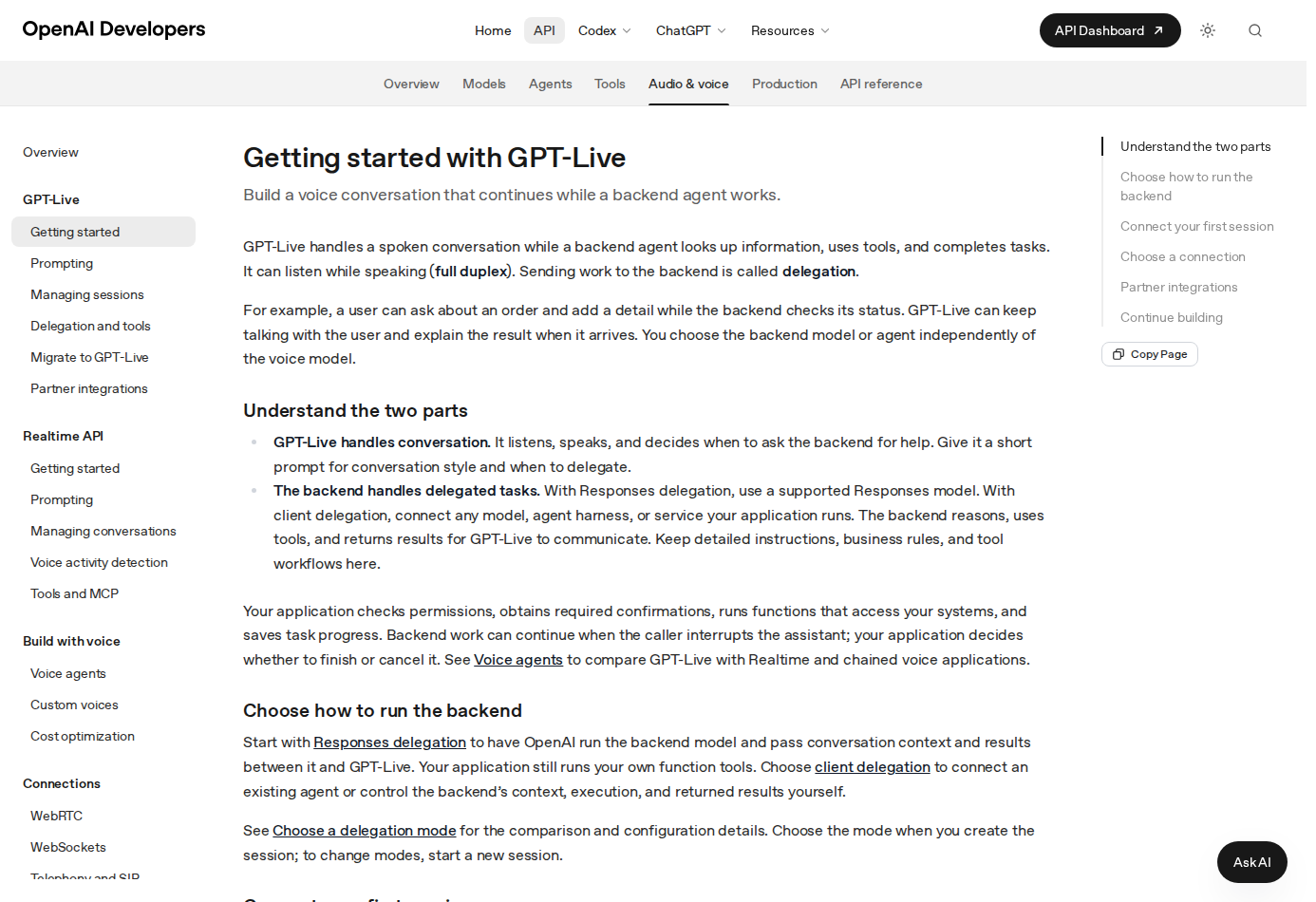
- OpenAI developer docs — Getting started with GPT-Live
- ArWriter context pieces: GPT-6 Astra launch coverage and Gemini 3.8 Live explained
Voice is becoming a layer, not a feature — the same leap text models took two years ago. Build the small experiment now if it fits your strategy, but keep your core edge where it has always been: content your audience cannot get anywhere else. If that content is written, designed, and scheduled in one place, ArWriter is a good place to start.