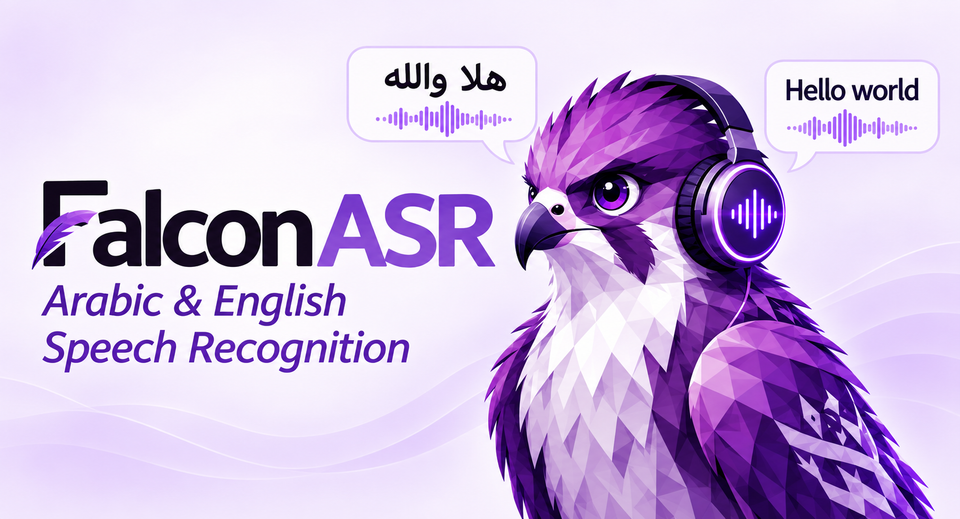
On October 7, 2026, the Technology Innovation Institute (TII) in Abu Dhabi announced Falcon ASR, a 1.6 billion parameter speech recognition model built around Arabic — with a particular focus on the Emirati dialect — that also transcribes English, French, Spanish, and Portuguese using the same weights. Published as an official team post on Hugging Face, the announcement came with evaluation numbers that put the model ahead of the best published result on a widely watched Arabic ASR leaderboard: an average word error rate of 20.92% across six Arabic test sets, versus 23.17% for the previous best in the snapshot the team compared against.
If you are a content creator, journalist, podcaster, or video producer working in Arabic, speech-to-text quality is not an abstract benchmark — it is the hidden tax on your week. Transcripts power SEO-friendly show notes, accurate video captions, searchable archives, interview quotes, and lecture notes. Every point of error rate you shave off is time you get back from correction hell. That is why a research institute in the Gulf publishing state-of-the-art Arabic numbers on a global platform deserves a closer look, and why this article breaks down exactly what was announced, what the numbers mean, and what it changes for real workflows.
Who built it, and why that matters
The Technology Innovation Institute is Abu Dhabi's government-backed research hub, and it has spent the past few years becoming one of the most recognizable names in open model development through the Falcon family. International audiences may remember Falcon as one of the early open-weight challengers in large language models. For Arabic-speaking creators, the institute's relevance is more specific: it treats Arabic dialects as a first-class research target rather than an afterthought. We covered the previous milestone on this blog — Falcon Emirati 7B, TII's Arabic dialect text model — and it is worth being precise about the difference: Falcon Emirati is a language model that reads and writes Emirati Arabic text. Falcon ASR is a speech model that listens to spoken audio and converts it into text. They are complementary pieces of the same regional AI stack.
The announcement itself carries six named authors from the institute — including Abdul Muneer, Shamsa Hamad, and Hakim Hacid, among others — which places it firmly in the category of institutional primary sources rather than press leaks or rumor coverage. Everything in this article traces back to that post and the demo it links to.
The numbers, translated into plain language
Here is every headline figure from the announcement, with context for what it actually means:
- Arabic word error rate of 20.92% on average across six Arabic test sets, using the protocol of the Open Universal Arabic ASR Leaderboard maintained by the ELM Research Center. The best published result in the snapshot the team used — with competitor figures checked on September 30, 2026 — was 23.17%. That is a 2.25 percentage point improvement.
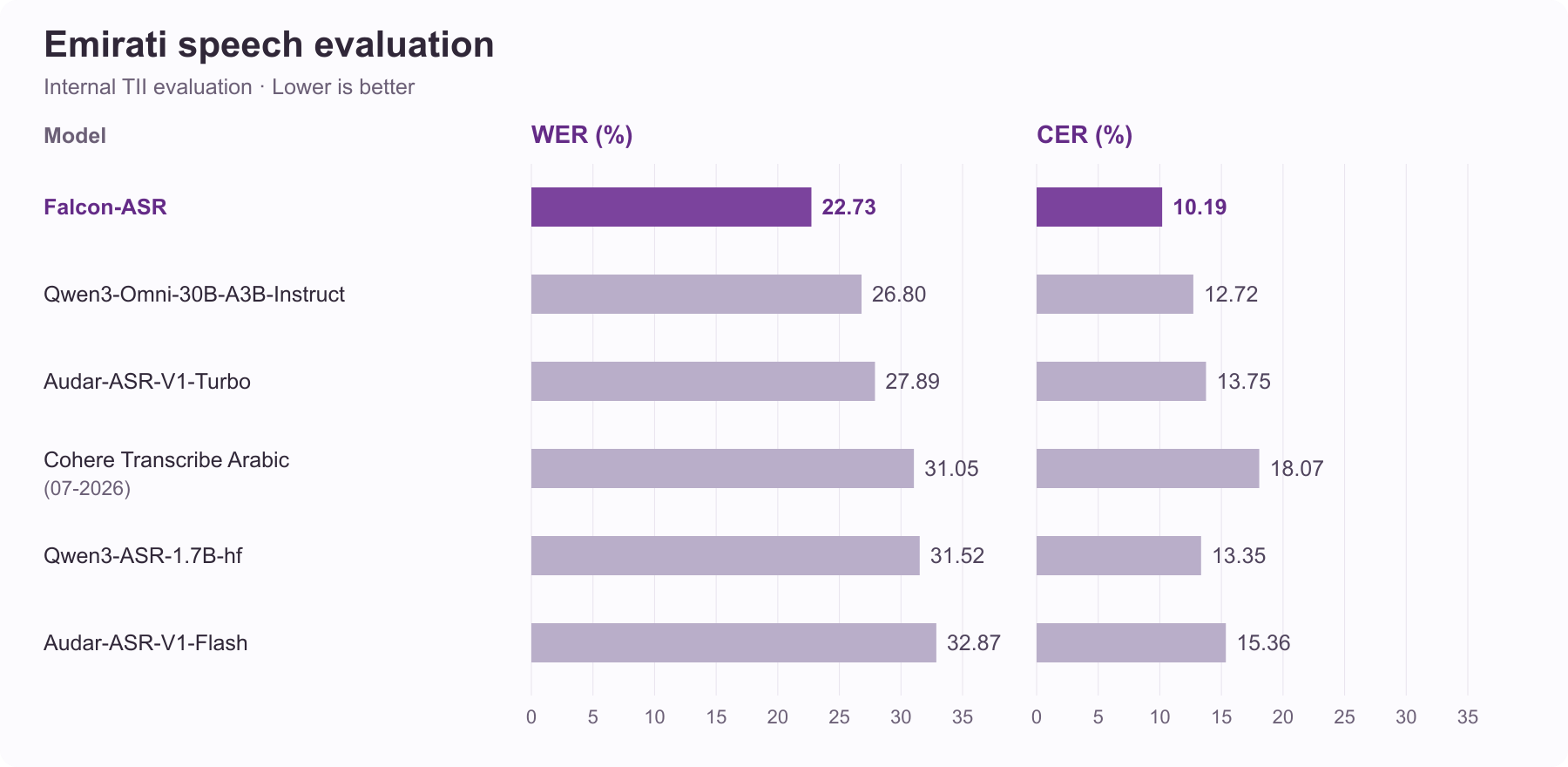
- Emirati-specific evaluation: 22.73% WER and 10.19% CER (character error rate) on TII's internal Emirati and Gulf test set built from held-out recordings with human-validated transcripts. The post states this is the lowest WER and CER among the systems compared, with Qwen3-Omni as the next best — 4.07 percentage points behind.
- English word error rate of 5.74% on the seven public test sets used by the Hugging Face Open ASR Leaderboard.
- Word-level timestamps: every transcribed word is linked to its position in the audio.
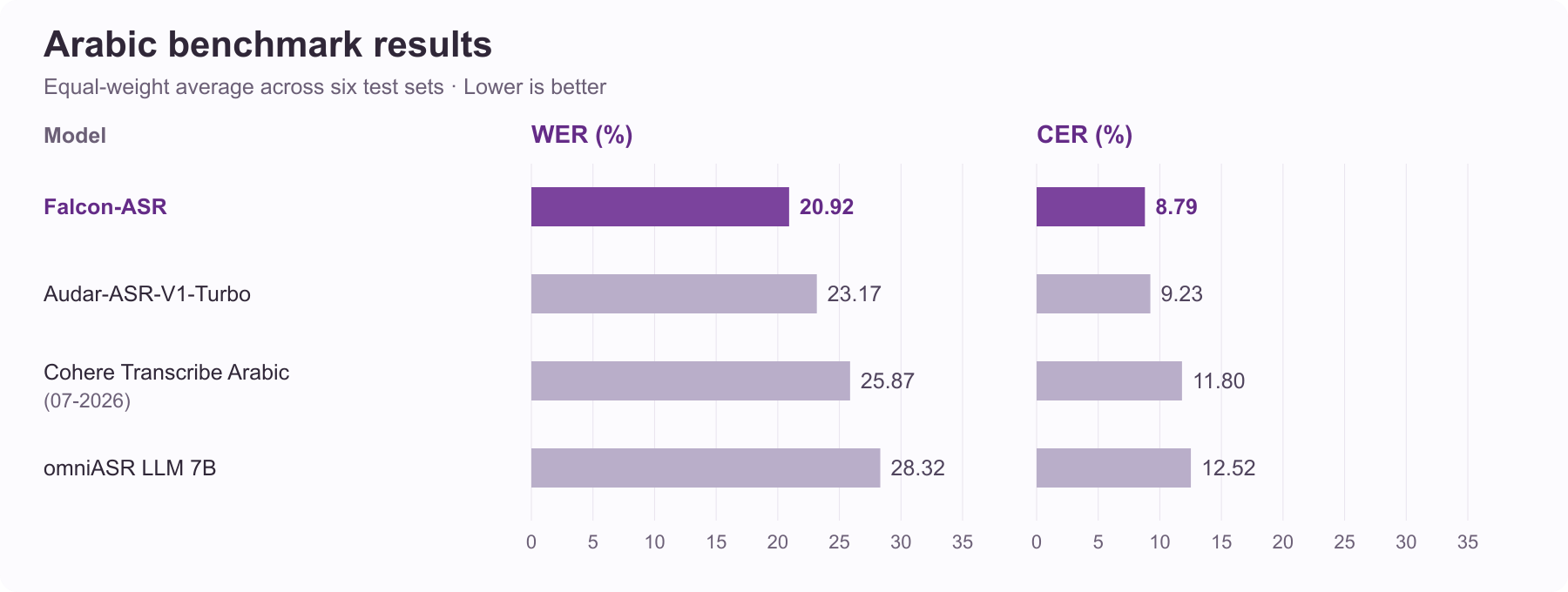
For readers who do not live inside ASR metrics: word error rate counts the words a model gets wrong — deleted, inserted, or substituted. Lower is better. Moving from roughly 23% to roughly 21% is not cosmetic; over a full transcript page, error compounds, and the practical gap between a 20%-WER transcript and a 30%-WER transcript is the difference between a light human pass and rewriting whole sentences. It is also worth noting the evaluation hygiene: the team did not hand-pick favorable comparisons — it adopted the leaderboard's pinned manifests and its equal-weight protocol across the six test sets, which makes the result arguable in the open rather than marketing-only.
Why the Emirati dialect focus is the real story
Most speech recognition systems shine on Modern Standard Arabic — the language of news broadcasts and formal speeches — and degrade sharply on everyday spoken dialects. The uncomfortable truth for content workflows is that almost everything worth transcribing is dialectal: podcasts, interviews, calls, social video. TII says it trained Falcon ASR on Emirati, MSA, other Gulf and Arabic dialects, and English, with the explicit goal of transcribing "the words people use in everyday speech, including dialectal forms and changes between languages."
That last phrase deserves emphasis. Much of the professional content produced in the Gulf mixes Arabic and English inside single sentences — brand names, technical terms, English punchlines mid-sentence. Traditional single-language models break on exactly this pattern. Falcon ASR's five languages run on the same weights with no language flag required, and the output comes back in the language that was actually spoken. For anyone who has watched a transcription tool mangle code-switching, this design choice alone is a workflow-changer.
Trained for real-world audio, not studio audio
Buried in the announcement is a detail that separates serious ASR work from demo-ware: the training data included background noise, overlapping speech, music, room reverberation, telephony effects, and variations in speed and pitch — with the same treatment applied to the Emirati recordings. Why does this matter? Because the audio that actually needs transcribing is rarely clean. It is a phone interview on a noisy line, a panel with crosstalk, a field recording with street sound. Models trained only on studio-clean speech collapse under these conditions; models deliberately exposed to them degrade gracefully.
The word-level timestamps matter just as much for production use. Timestamped transcripts are the foundation of synced video captions, clickable chapter indexes for long recordings, and quick navigation to a specific moment without scrubbing blindly. Many commercial transcription services do not expose per-word timing; an open evaluation of a model that does is a genuine building block for creator tooling.
What this means for you as a content creator
- Podcasters: turn episodes into text for show notes, search visibility, and archive search. Word timestamps let you auto-generate chapter marks.
- YouTubers and video teams: a caption base that survives Arabic-English code-switching — the exact case where generic caption tools embarrass themselves.
- Journalists and researchers: interview transcription in Gulf dialects without re-listening to every minute to fix mangled words.
- Marketing and sales teams: call and meeting transcripts in regional dialect, feeding analytics and CRM notes that actually match what was said.
- Educators: lecture-to-notes conversion for searchable study material.
There is also an economic angle worth stating plainly. Accurate Arabic transcription has been sold by the minute by cloud services, and regional pricing has had little competitive pressure from genuinely strong Arabic models. A Gulf institution publishing leaderboard-topping Arabic results changes that equation over time — especially with an API officially on the roadmap. And for institutions with data-residency concerns, a regional model ecosystem opens the door to keeping sensitive recordings inside regional infrastructure rather than shipping them to foreign clouds.
Quick comparison: your realistic options today
| Criteria | Cloud transcription services | Built-in editor transcription | Falcon ASR (as of October 14, 2026) |
|---|---|---|---|
| Dialectal Arabic accuracy | Varies by vendor | Generally weak | 20.92% Arabic average; 22.73% Emirati in TII's evaluation |
| Arabic-English code-switching | Often needs manual language setting | Weak | Supported on the same weights, no language flag |
| Cost model | Per-minute pricing | Bundled with the editor | Free public demo currently |
| Per-word timestamps | Not always exposed | Rare | Officially supported |
| Access | Instant with subscription | Instant | Live demo; API and native apps announced as planned |
For a broader picture of how speech-to-text has been evolving for creators, see our earlier guide on using Google's models for transcription workflows. The competitive question has shifted from "does Arabic transcription exist" to "whose dialect accuracy wins at what price."
How to try it today
TII published an official Hugging Face demo space — falcon-asr-demo — where you can upload your own recordings and test transcription directly. The post explicitly invites users to try it with their own audio. Our recommendation for a meaningful test: skip the studio-clean clip. Upload three real samples — a clean MSA segment, a dialectal segment, and a difficult real-world one with noise and language mixing — and note where the errors cluster (proper names? English terms? word endings?). Then run the same samples through whatever tool you use today. Thirty minutes of comparison on your own material tells you more than any leaderboard.
The technical foundation, briefly
Falcon ASR builds on the institute's Falcon3-Audio work, and its architecture and training approach are described in the paper "Competitive Audio-Language Models with Data-Efficient Single-Stage Training on Public Data." The phrase "single-stage training on public data" matters to anyone tracking AI economics: it signals a cost-efficient, reproducible recipe rather than a bespoke pipeline that cannot scale. And a small but telling detail — the announcement post itself is published bilingually, in English and Arabic, on the same page. The Arabic-speaking audience is not an afterthought for this model; it is the point.
Honest limits and caveats
- 20.92% is leading, not perfect: roughly one in five words may still need correction on general Arabic, and human review remains essential for publication-grade transcripts of sensitive material.
- Demo-only access for now: at the time of writing, the model's public repository was not yet released for self-hosting; the announcement lists API access and native applications as planned, not shipped.
- Numbers are from the developer's own evaluation: the methodology is transparent and leaderboard-based, but independent third-party replication will firm up the picture.
- The dialect focus is Gulf-first: creators working in Maghrebi or Levantine dialects may see less impressive results until broader evaluations exist.
- Integration requires waiting or DIY: until the API ships, there is no turnkey way to drop Falcon ASR into your production pipeline beyond the demo space.
Frequently asked questions about Falcon ASR
What is Falcon ASR and who developed it?
It is a 1.6 billion parameter speech recognition model for Arabic — focused on the Emirati dialect — developed by the Technology Innovation Institute (TII) in Abu Dhabi and announced on October 7, 2026 in an official Hugging Face blog post.
Is Falcon ASR free to use?
A free public demo space on Hugging Face lets you test transcription with your own recordings. Commercial terms and API pricing have not been announced; the post says API access and native applications are planned.
Does it translate Arabic audio into English?
No — it is a transcription model, not a translation model. It converts speech to text in the spoken language, supporting Arabic, English, French, Spanish, and Portuguese on the same weights.
How is it different from Falcon Emirati 7B?
Falcon Emirati 7B is a text model for understanding and generating Emirati Arabic. Falcon ASR is a speech model that converts spoken audio into text. Same institute, complementary tasks.
Can it generate YouTube captions automatically?
Its transcripts with word-level timestamps can serve as the base for synced captions, but you would pair it with a separate workflow for translation into other languages.
Does it beat Whisper?
The announcement compared against the Open Universal Arabic ASR Leaderboard's best published result (2.25 points better) and named Qwen3-Omni as the next best on Emirati speech (4.07 points behind). It did not publish direct comparisons against every well-known model, so we stick to what was reported.
Does it support live streaming transcription?
The announcement says nothing about live streaming. What exists today is the demo space for uploaded recordings, with API and native apps on the roadmap.
The bottom line
Falcon ASR is a regional research institution delivering globally competitive Arabic speech recognition — dialect-first, code-switching-aware, and trained on messy real-world audio. The practical move today is to benchmark it against your current tool using your own recordings, and to watch for the API release if you build content tooling. And while you sort out your audio pipeline, the text side of your content operation can run end to end on ARWriter's Auto-Writer — from topic to publication-ready article.