Three days ago, on Friday, August 28, 2026, Tencent quietly posted one of the most consequential open-model releases of the quarter: Hy4-preview, the fourth generation of its Hy (Hunyuan) model family, published as open weights on Hugging Face under an Apache 2.0 license. The headline number — 770 billion total parameters — puts it in the same weight class as the largest open models ever shipped, and it arrives only days after Alibaba's Qwen releases lit up the same corner of the industry.
This is not breaking news; it is a coverage-gap explainer. If you run content operations, write for a living, or build tools on top of language models, the question this launch actually raises is practical: does a frontier-scale, openly licensed model from Tencent change anything about how you produce content — especially outside English? That question deserves a more careful answer than the launch-day hot takes provided, so let's work through it properly.
What Hy4-preview actually is
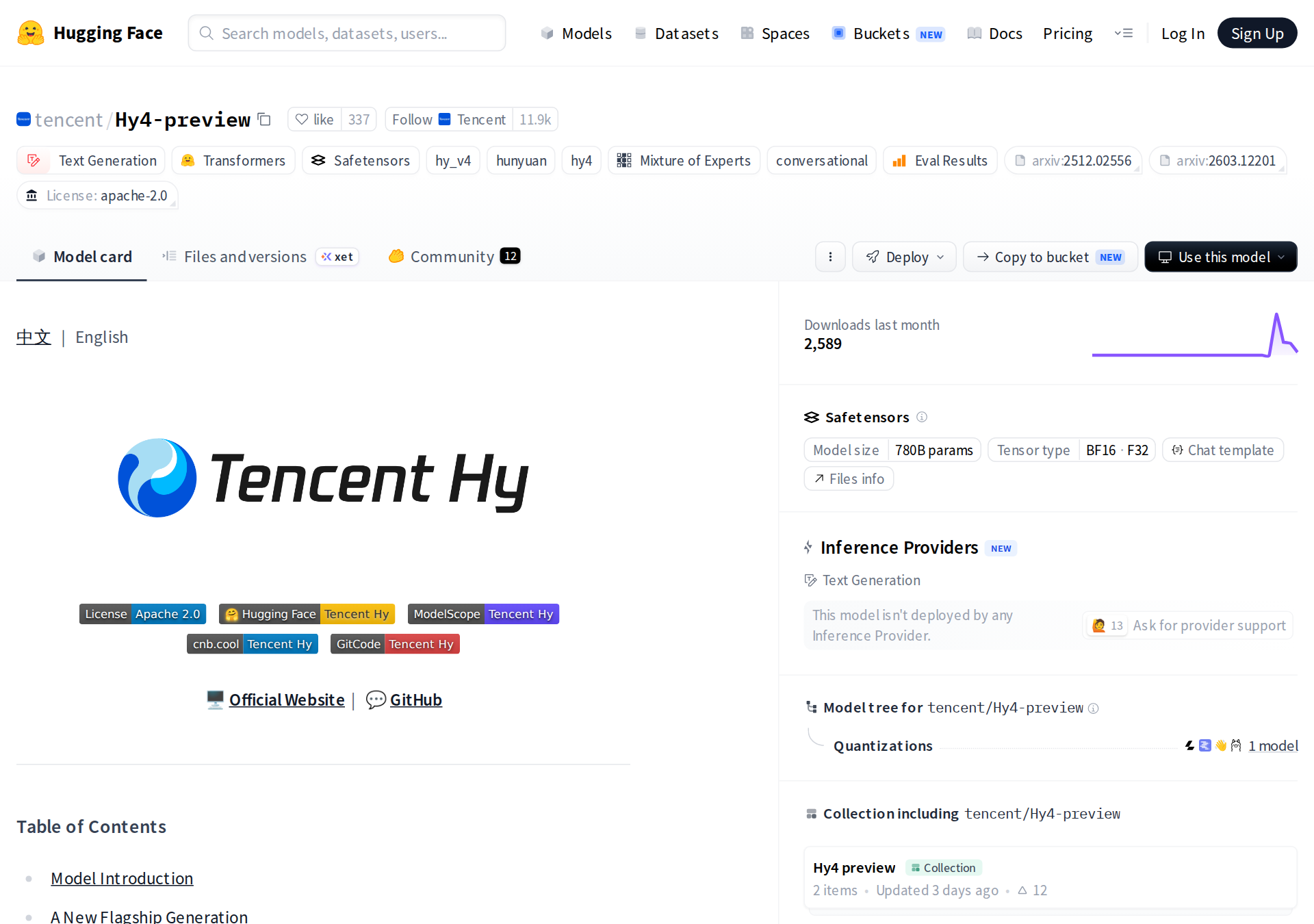
Hy4-preview is Tencent's new flagship-preview large language model, built on a Mixture-of-Experts architecture. The official model card documents the following specifications:
- 770B total parameters, 49B activated per token. The sparse design means only a fraction of the network fires for any given step — frontier capacity at a fraction of the per-token compute.
- A 1-million-token context window — enough to hold an entire book, a full research corpus, or a very long brand-guideline stack in a single conversation.
- 78 transformer layers with 257 experts (256 routed plus one shared), top-8 routing per token.
- Gated DeepSeek Sparse Attention with IndexCache, plus a native Multi-Token Prediction layer for faster speculative decoding.
- A parallel FP8 build (Hy4-preview-FP8) for cheaper inference on modern accelerators.
- Apache 2.0 licensing — commercial use, modification, and redistribution all permitted.
For context on trajectory: the predecessor tencent/Hy3 carried 299B parameters, so this generation more than doubles the family's scale — a detail TechNode reported alongside news that Hy3 usage inside Tencent's ecosystem had jumped dramatically earlier in August.
Why the launch got so much attention
Three elements made this release travel beyond the usual model-release circles. First, the human evaluation: Tencent ran a blind internal assessment in which 163 experts reviewed outputs across 203 real engineering tasks, and Hy4-preview scored 2.99 out of 4 — ahead of GLM 5.3 (2.92) and Kimi K3 (2.94), two of the strongest Chinese-trained rivals. Second, the standard benchmark sheet: 92.3 on GPQA Diamond for graduate-level reasoning, 85.4 on Terminal-Bench 2.1, 82.9 on SWE-bench Multilingual, and 65.7 on the far harder SWE-bench Pro. Third, the sheer fact of openness at this scale — the open-weights race among Chinese labs has now produced multiple frontier-adjacent models in a single month.
TechNode also relayed an internal deployment claim: Tencent says the model lifted end-to-end throughput in its own systems by 31.8% against a baseline. Useful color, but note what it is — a vendor's self-reported internal figure, not an audited result.
Every way to access the model right now
What makes this launch unusually practical is the number of doors Tencent opened simultaneously:
| Access path | Details | Best for |
|---|---|---|
| Open weights on Hugging Face | tencent/Hy4-preview plus the FP8 variant, Apache 2.0 | Developers and self-hosting teams |
| API via OpenRouter and Tencent Cloud | ~$0.834 per million input tokens, ~$2.501 per million output tokens | Product teams building on top |
| Tencent's own products | WorkBuddy and CodeBuddy (Chinese and international versions), Yuanbao, and ima — with free two-week access inside the first two | Everyday users who want zero setup |
The self-hosting door deserves a honesty check, though. The repository's own guidance points to multi-GPU tensor-parallel deployments — on the order of eight high-end accelerators for the standard build. For individuals and small studios, "open weights" here means freedom in principle, not a model you run on your workstation. In practice, most content professionals will touch Hy4 through an API or through Tencent's apps, not by hosting it.
What this means for content creators specifically
Now the part most launch coverage skipped. Read the announcement materials closely and a pattern emerges: nearly every published evaluation is about coding, engineering, and agentic work — SWE-bench, Terminal-Bench, Deep-SWE, SkillsBench. There is no published writing-quality benchmark, no multilingual content benchmark, and no marketing-copy evaluation in the release. Four implications follow.
The writing case is unproven, not disproven. A 770B-parameter model with a million-token context will almost certainly produce coherent long-form English and Chinese text. But "almost certainly" is not a workflow decision. If your business runs on content quality, treat Hy4 as a candidate to test, not a default to switch to.
Non-English quality is an open question. The official materials are published in Chinese and English; no other language is claimed. That matters for anyone producing Arabic, Spanish, Hindi, or other languages, where model quality varies far more than the benchmark tables suggest. Test on your own language and your own domain before trusting any secondhand verdict.
It thinks deeply by default — sometimes too deeply. The model ships with a high reasoning mode enabled out of the box, and the card itself lists "spending longer than necessary reasoning" among the preview's known limitations, with an option to switch reasoning off for direct answers. That is a telling default for a model tuned toward engineering workloads, and a knob worth knowing about if you use it for quick drafts.
"Preview" means preview. This is a pre-GA milestone dated August 28, with no announced date for the stable release. Behavior may shift with updates — a real consideration before you wire it into production pipelines.
So where is the genuine value for a content operation? Optionality and price pressure. An aggressively priced, openly licensed frontier-class model expands your choices: long-document analysis becomes cheap enough to experiment with, and every new heavyweight entrant pushes the whole market's pricing down. The smart play is to benchmark it on one specific, recurring task — say, summarizing 200-page research documents — and let measured results, not launch-day energy, decide whether it earns a slot in your stack.
A four-step test protocol for any new model (including this one)
Rather than relying on impressions, run every new model through the same short gauntlet on real work:
- Linguistic accuracy pass: have it summarize a long article in your working language and audit the output for grammar, register, and dialect consistency.
- Instruction adherence pass: give hard constraints — word count, tone, audience — and measure how literally they are respected.
- Domain terminology pass: feed it text from your field and check how it handles the terms your readers actually use.
- Long-context consistency pass: exploit the million-token window with a large document and multiple dependent outputs; this is where a model like Hy4 should theoretically shine.
And a candid note on where to place your baseline: if your output is Arabic-language content at professional quality, purpose-built platforms — such as ArWriter's Arabic-first creation suite — remain the lower-risk choice, because they are tested against exactly that job. Hy4 is the experiment layer; specialized tooling is the stability layer. Mature content operations typically run both.
How Hy4 compares with its nearest open-model rival
The most instructive comparison is with the open release we covered just days earlier — Alibaba's Qwen3.8-Flash generation:
| Dimension | Tencent Hy4-preview | Qwen3.8-Flash / Flash-Next |
|---|---|---|
| Total parameters | 770B | 125B |
| Activated per token | 49B | 6B |
| Context window | 1M tokens | 262K native, extensible to 1M |
| License | Apache 2.0 | Open (Qwen family) |
| Approx. API pricing | $0.834 / $2.501 per 1M (in/out) | $0.15 / $0.47 per 1M (in/out) |
| Positioning | Heavyweight productivity: coding, long-horizon tasks | Fast, cheap, multimodal day-to-day work |
The practical read: Hy4 competes in the heavyweight division — complex reasoning and very long contexts — while flash-class models remain the economical engine for high-volume routine generation. There is also a third force in the market: closed frontier labs, which push their models directly into creative tooling, as Google has been doing with its Flow video suite — a direction we examined in our coverage of Flow's creative controls upgrade. For creators, the healthiest posture is model-agnostic: match the model to the task, and re-match every quarter.
Trying it in ten minutes
- Open an OpenRouter account, or go straight to Tencent's international WorkBuddy product, which currently includes two weeks of free access.
- Select Hy4-preview and run a short English conversation to calibrate expectations.
- Upload or paste a medium-length text in your working language and assign one concrete task: a summary, a rewrite, or headline options.
- Compare the output against your current tool on the identical task, and keep the winner per task type rather than declaring one overall champion.
- If results justify it, integrate through the OpenAI-compatible API — most existing tooling will connect without meaningful changes.
The honest limitations list
- Self-reported evaluations. The benchmark sheet and the blind human study are Tencent's own; independent third-party verification is still pending.
- A coding-first fingerprint. The stated use cases are software engineering, office productivity, data analysis, game development, and research — content marketing is not on the list.
- Heavy self-hosting requirements. Roughly an eight-GPU class deployment for the standard build keeps true self-hosting in enterprise territory.
- Documented over-reasoning. The model card itself flags excessive deliberation as a preview limitation.
- Uneven regional availability. Tencent's own announcement site was not reachable from every region while this article was being prepared, and product availability varies by country.
What this says about the 2026 model market
Zoom out and the pattern is unmistakable. Within a single month, two of China's largest tech companies shipped openly licensed models at radically different scales but with the same strategic logic: commoditize intelligence, win the ecosystem. Every additional heavyweight open release does two things to the content industry — it lowers the marginal cost of producing good material, and it makes multi-model pipelines (one model for research, one for drafting, one for the working language) progressively easier to justify.
That is the real story for creators in this launch. Not that you should rip out your current stack on a Friday's announcement, but that your stack's cost curve is bending in your favor, month after month, with no sign of stopping.
Our verdict
Hy4-preview is a technically significant, honestly labeled preview of where open models are heading — massive context, sparse efficiency, permissive licensing — wrapped in a benchmark story that has almost nothing to do with creative writing. Developers and technical content teams should absolutely spend an hour testing it through OpenRouter. Working writers and creators outside English should watch it, test it on one recurring task, and re-evaluate at GA. And teams that need dependable multilingual output today — particularly in Arabic — get more value from purpose-built tooling like ArWriter's automated writing workflow, which exists precisely to absorb this market's chaos so your content calendar does not have to.
Frequently Asked Questions
Is Tencent's Hy4 model free to use?
The weights are free to download under Apache 2.0, but hosted API access costs roughly $0.834 per million input tokens and $2.501 per million output tokens. Tencent's WorkBuddy and CodeBuddy products currently include a free two-week access window.
Does Hy4-preview support languages other than Chinese and English?
Tencent's official materials are published in Chinese and English and claim no other languages. Multilingual competence is likely given the model's scale, but unverified — test it on your own language before adopting it.
What does "preview" mean in Hy4-preview?
It is a pre-general-availability release dated August 28, 2026, with no announced stable-release date. Behavior may change with updates, so production-critical workflows should not depend on it alone.
How big is the model and what does it take to self-host?
770B total parameters with 49B activated per token and a one-million-token context. The standard build calls for roughly an eight-GPU tensor-parallel deployment; a lighter FP8 variant also exists.
Is Hy4 good for writing marketing content?
No published evaluation covers writing quality, and the release's benchmarks focus on coding and engineering tasks. Treat it as a promising candidate to test within your stack rather than a proven replacement for specialized writing platforms.
Sources
- Official repository: tencent/Hy4-preview — Hugging Face (specs, license, benchmarks).
- Official collection: Hy4 preview Collection — Tencent on Hugging Face.
- The official announcement is also published on the Tencent Hy site at hy.tencent.ai/research/hy4-preview (the page may be region-restricted).
- TechNode: Tencent open-sources Hy4 preview with 770B parameters and a 1M-token context — August 28, 2026.