When you read about a "new AI model architecture," it is easy to file the news under engineering trivia — until you reach the last number in the line: one cent per million input tokens. That is the practical meaning of what Alibaba's Qwen team quietly began rolling out earlier this week and completed in stages: a writing and visual-understanding engine with extreme economics, open weights for those who want them and a cent-priced API for those who want it ready-made. This in-depth guide explains what actually happened, when, and what every number means for people who write and produce content — without marketing exaggeration.
The timeline, exactly as it happened
Before diving into details, let us anchor the dates to primary sources, because rushed coverage blurred two distinct events into one:
- August 24, 2026: Qwen published the weights of Qwen3.8-Flash-Next on Hugging Face, described as "an experimental preview of the architecture that will underpin Qwen4", alongside an FP8 compressed variant and the benchmark build. That is the official model card creation date, corroborated by the first web archive captures of the repository on August 25.
- Around August 26, 2026: the production version, Qwen3.8-Flash, appeared on the Qwen Cloud platform with a full official page listing pricing and limits; the first archived snapshot of that page is from the evening of August 26.
- Today: we publish this explainer with the full picture in place. This is deliberate backfill coverage of a coverage gap — the events are three to five days old, and we date them honestly rather than dressing them up as breaking news.
So the "event" is not one moment but a sequence: an experimental architecture announcement, then a production cloud product with published prices. The distinction between the two matters, and we return to it in the FAQ.
What is Qwen3.8-Flash-Next, and what makes it different?
Qwen3.8-Flash-Next is a causal language model with a vision encoder — it reads text and understands images together. The headline figures from the official model card:
- 125 billion total parameters, with only 6 billion activated per request, plus 51 billion n-gram embedding parameters and 4 billion for multi-step prediction (MTP).
- A native context of 262,144 tokens, extensible to one million in the production cloud version.
- 512 specialised experts, of which 10 routed experts and 1 shared expert fire on each step — this is where the operating economy comes from.
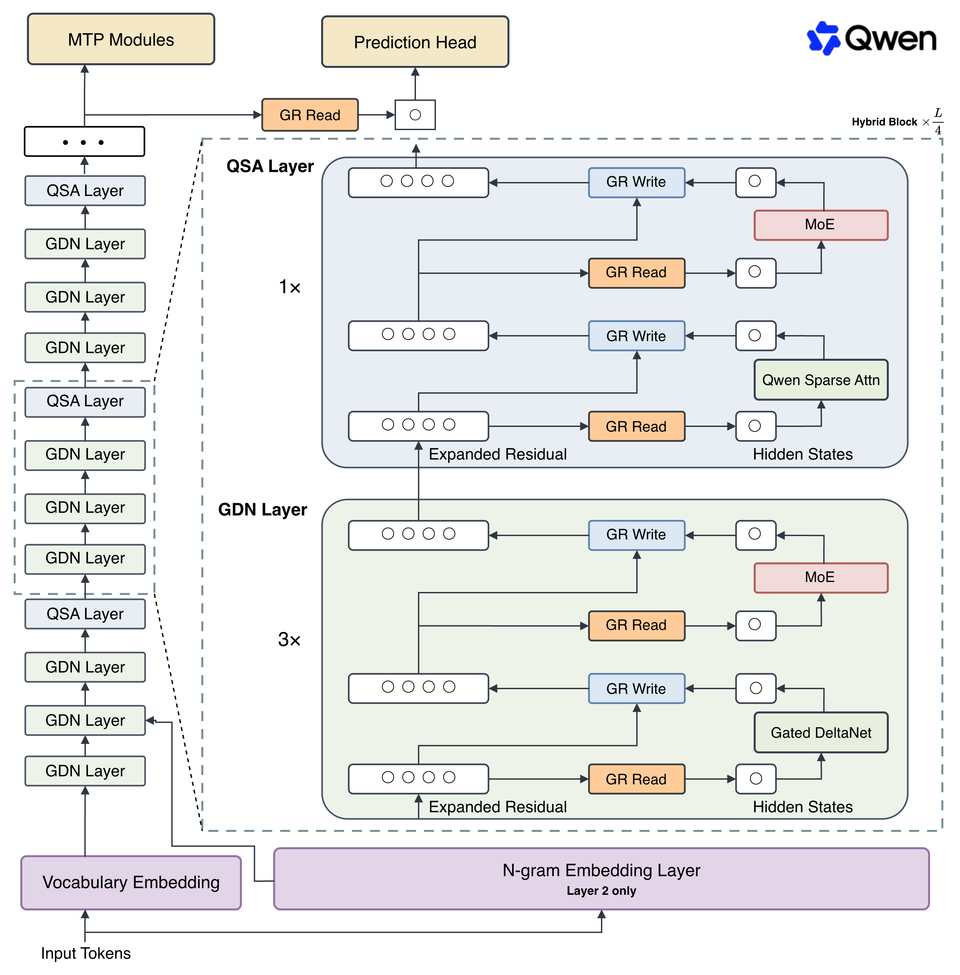
The real innovation is not the size but how these components are orchestrated, as the official diagram above illustrates. Four ideas carry the design:
- Qwen Sparse Attention (QSA): instead of inspecting every token individually when processing long contexts, the mechanism operates at the micro-block level with a defined budget (512 blocks or 2,048 tokens per the official card), visibly cutting long-context latency.
- Gated Residual: a reworked residual stream that modulates information flow between layers through data-dependent read gates and a per-branch scalar write gate across four branches — finer expressiveness while keeping training stable and inference overhead low.
- N-gram Embedding: a clever axis for scaling parameters. The 51 billion embedding parameters are consulted like a vast lexical index only when needed, raising what the model "knows" without raising the cost of each request — an elegant alternative to scaling through mixture-of-experts alone.
- A tailored training recipe: the Muon and AdamW optimizers are assigned to specific weight categories, with traditional batch-size warmups eliminated — training starts directly at the target batch size, cutting total optimizer steps.
The takeaway for non-engineers: a model that "knows a lot" (176 billion parameters across language and lexical stores) but "spends little" (6 billion active per request). That equation is the foundation of every pricing figure we will see below.
The published benchmark results — and the caveats you should apply
Qwen's official card compares the model against Qwen3.8-27B (27B parameters), Qwen3.7-Plus (397B total, 17B activated), DeepSeek-V4-Flash-0731 (284B, 13B activated), and Claude-Opus-4.6. The rows most relevant to content workflows:
| Benchmark | Flash-Next | Qwen3.8-27B | DeepSeek-V4-Flash | Claude-Opus-4.6 |
|---|---|---|---|---|
| Instruction following IFBench | 81.3 | 79.5 | 79.2 | 62.5 |
| Scientific reasoning GPQA Diamond | 91.7 | 89.2 | 90.8 | 91.3 |
| Competitive coding LiveCodeBench v6 | 91.9 | 90.3 | 90.6 | 88.8 |
| Long video understanding LVBench | 76.6 | 72.4 | 63.0 | -- |
| Real-world perception RealWorldQA | 88.5 | 85.9 | 73.9 | -- |
| Chart analysis CharXiv (without tools) | 84.6 | 83.7 | -- | -- |
A content creator's reading of these numbers: instruction following is the quality writers actually feel — how faithfully the model respects tone, length, and structure instructions — and Flash-Next leads that specific test, clearly ahead of Opus-4.6 on it. Long-video understanding, real-world perception, and chart analysis are what matter for anyone who analyses visual material in order to write about it.
Professional honesty requires two caveats, though: these are Qwen's self-published numbers on its declared evaluations, not independently verified results. And no single benchmark means the model is "better than Opus" overall — each test measures one dimension, and your actual work is the only decisive test. Try it on a sample of your own material before committing anything to it.
Qwen3.8-Flash on the cloud: the economics in numbers
The official cloud edition, named Qwen3.8-Flash, is described by the model card as "the official version based on Qwen3.8-Flash-Next", adding production features: a one-million-token context by default and official built-in tools. The official pricing page specifies:
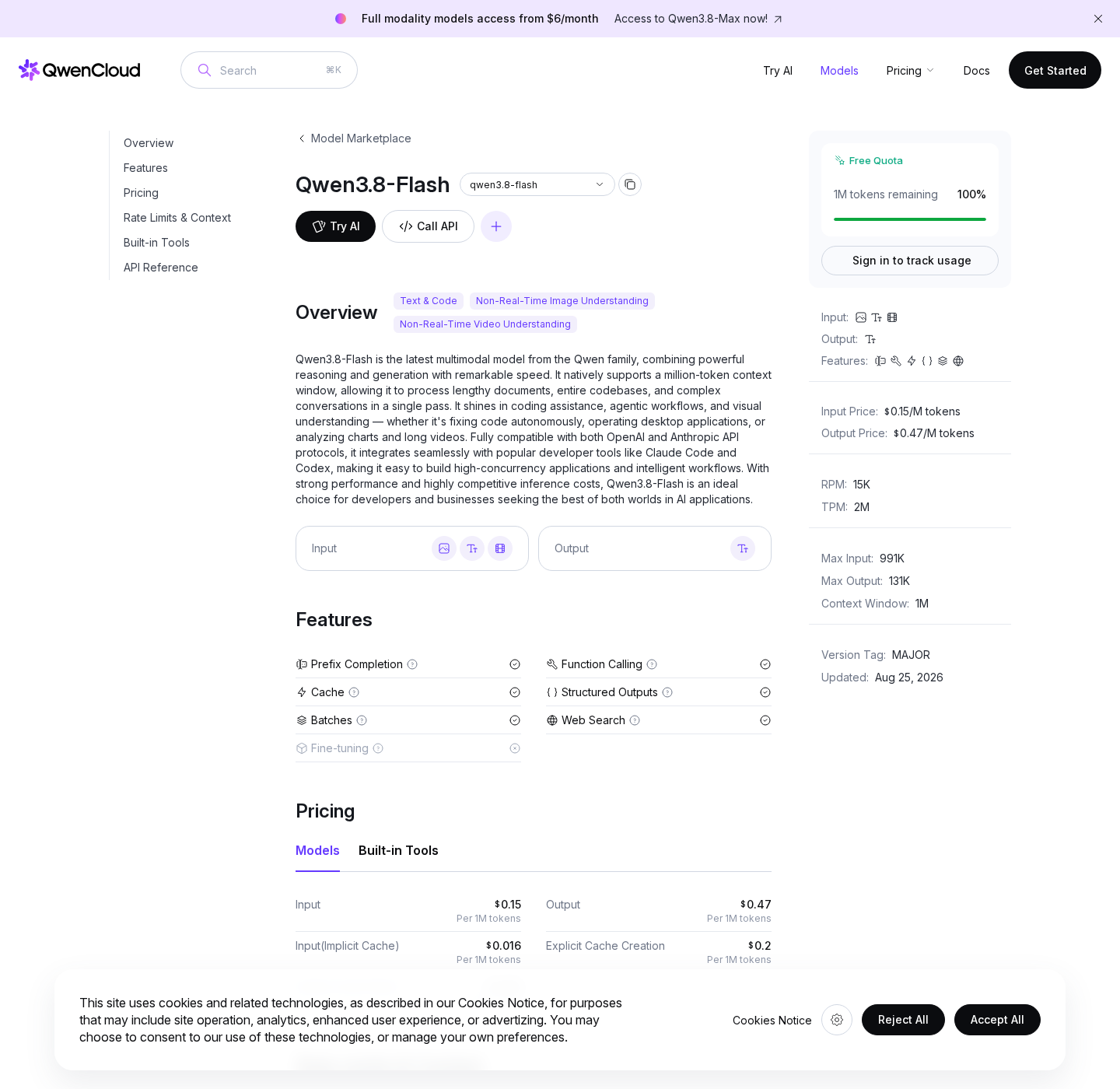
- Input: $0.15 per million tokens; output: $0.47 per million tokens.
- Implicit cache reads: $0.016 per million tokens — reuse of a fixed set of source documents across successive requests becomes nearly free after the first pass.
- Explicit cache creation: $0.20 per million tokens, with reads at $0.016.
- Generous project limits: one million tokens of context, a maximum input of 991K tokens, maximum output of 131K, and a throughput allowance of two million tokens per minute.
- Supported inputs: text, image, and video — per the official model page.
- Full compatibility with both the OpenAI and Anthropic API shapes, so most writing tools already wired to either can be pointed at Flash by changing the endpoint and key.
Let us translate the pricing into content language. A full 1,500-word article is roughly two thousand tokens of output. Assume a research bundle of ten sources averaging eight thousand tokens each: you pay about 1.2 cents for input and under a cent for the first draft. A complete research-and-writing cycle costs less than a cup of tea — which is precisely why this news matters to independent creators and small teams that account for every dollar.
Built-in tools: a research desk inside the model itself
The cloud edition ships with official tools invoked from within the request itself, several of which serve content workflows directly:
- web_search: live web search during generation.
- web_extractor: pulls the content of a specific page for summarising or analysis.
- t2i_search and i2i_search: search for images by text or by a similar image — useful for gathering visual references while preparing a piece or defining a project's visual mood.
- code_interpreter: executes code for data analysis or chart generation when needed.
In practice, the "find sources, then feed them to the model" step can collapse into a single request instead of shuffling between separate tools — a direction the writing-tools market has been moving all year. The winner of that shift will be whoever sustains quality across languages, not just English.
What does this mean for you as a content creator?
- The cost of a word drops to a historic low: drafts, summaries, and large-scale rewriting stop being a painful line in your project budget.
- Visual material as input: a client deck, an infographic, or a long video becomes something the model reads and writes about — opening an "analyse, then write" workflow for visual content.
- A million-token context changes project scale: your entire article archive, a book in editing, or hundreds of pages of research sit in one conversation without painful chunking.
- Trying before committing is trivial: because the API matches OpenAI's and Anthropic's shapes, tools that let you set a custom endpoint can test Flash in minutes with two configuration changes.
- Open weights remain an option for infrastructure owners: the card releases weights under the Qwen Community 1.0 license for those operating their own hardware — stated as a fact for whom it concerns, not a recommendation for every reader to run servers.
Three realistic scenarios from content workflows
To ground the economics in practice, here are three tasks content producers repeatedly face, and how the new math changes them:
- The weekly newsletter: summarising twenty sources and generating three alternative openings used to consume an entire subscription tool's allowance; here the whole operation costs a few cents, making multi-variant drafting a daily habit rather than a luxury.
- Content repurposing: transcribing a podcast episode, then spinning it into an article, social posts, and a short-video script — with multimodal input on the cloud edition and context that swallows the full archive, this becomes a chain of cheap sequential requests instead of a separate project.
- Long-form projects: a writer preparing a book or training guide previously had to slice material into chunks that lost the thread; million-token context keeps the complete draft and all sources in one conversation, so "review chapter three against all the interviews" becomes a legitimate single question.
The common thread across all three is not "smartest" but "cheapest at volume": tasks that were budgeted per project are now budgeted in cents — and that alone redraws the boundary of what a single creator can produce in a week.
Quick comparison: choosing among the options
| Criterion | Qwen3.8-Flash (API) | Consumer subscription model | Premium frontier model |
|---|---|---|---|
| Cost on large volumes | Lowest (cents per full research-and-write cycle) | Flat monthly regardless of use | Far higher |
| Usable context | One million tokens | Usually capped by the plan | Large but multiply priced |
| Image and video understanding | Officially supported input | Varies by service | Supported |
| Fitness for heavy repeated use | Excellent (economy is its design principle) | Good until the plan caps | Reserve for highest-value tasks |
| Best for | Cost-counting teams and independents | Occasional users | Individual decisive tasks |
The working rule: make the economical model your daily workhorse (drafts, summaries, repurposing) and reserve the premium model for the single most important piece of your week. Visual generation lives on a different track altogether, as we covered in our reporting on Wan 3.0, the video model from the same group, and our practical guide to Microsoft's MAI-Image-2.6.
The honest limits: what was not said, and what we will not say
- This is an experimental architecture preview: Qwen itself labels Flash-Next a preview of the Qwen4 architecture; details may change in the final release, and anyone building on it should re-test on every update.
- The benchmarks are self-published: they are Qwen's numbers on Qwen's declared evaluations and do not replace your own testing on your own content and audience.
- Language coverage beyond Chinese and English is not claimed: neither the card nor the product page promises a specific level for other languages, and the family's tuning history centres on Chinese and English. Non-English writers should run their own sample tests before relying on it in front of an audience — that is a practical requirement, not a courtesy.
- Prices can change: the figures quoted are those published at writing time on the international page in US dollars, not a permanent promise.
- The license has terms: commercial use of the open weights falls under the Qwen Community 1.0 license published in the repository — read it before any wide institutional deployment.
- Economy is not absolute superiority: 6 billion activated parameters make it fast and cheap, but the deepest reasoning tasks may remain the territory of far larger, more expensive models.
How to try it today, practically
- Read the primary sources yourself: the official model card on Hugging Face, the blog post and technical report on Qwen's official links below, and the product page on Qwen Cloud.
- Start with a small benchmark of your own: pass three texts from your actual work (with precise instructions on tone and length) and compare outputs against whatever you currently use.
- Test the built-in research line: give it a topic whose sources you already know, and verify the accuracy of what it retrieves yourself before delegating any documentation task.
- Measure cost on a real project for one week: record what you actually spent, to the cent, and only then decide — generic numbers mean little without a measurement from your own workflow.
Official source documents: the official blog post, the model card on Hugging Face, the Qwen3.8-Flash page on Qwen Cloud, and the full technical report. All links are direct and non-affiliated; none carries a commission.
Frequently asked questions
What is the difference between Qwen3.8-Flash-Next and Qwen3.8-Flash?
Flash-Next is the experimental open-weights release published on August 24, 2026 as a preview of the Qwen4 architecture. Flash is the official production build on the cloud based on it, with a one-million-token context by default, built-in official tools, and formal support. Most end users actually want Flash through the API.
Does the model write well in languages other than English and Chinese?
No official claim covers other languages specifically, and the family's tuning history centres on Chinese and English. We recommend a hands-on test on texts from your own niche before relying on it for audience-facing production.
What does it actually cost to use?
At the prices published at writing time: $0.15 per million input tokens and $0.47 per million output tokens, with implicit cache reads at $0.016 per million — putting a complete research-and-write cycle for a long article at a few cents.
Are the weights available for download?
Yes. Qwen released the Flash-Next weights on Hugging Face (including an FP8 variant) under the Qwen Community 1.0 license — an option aimed at those who operate their own infrastructure and accept the license terms.
Where does this announcement sit in the content-tools landscape?
It continues a clear trend: ultra-economical production-grade models competing with subscription tools on cost, from the same group that recently released an open video model, in direct competition with DeepSeek's operating-economy offerings. The ultimate beneficiary is the cost-counting content creator.
Does it work with my existing tools?
The official page declares compatibility with both the OpenAI and Anthropic API shapes, so most tools that accept a custom endpoint can connect with configuration changes and no extra development.
Bottom line
Between August 24 and 26, 2026, an architecture announced in a technical document became a product you pay for in cents: writing and visual understanding with a million-token context and a built-in research desk, at a price that makes trying it an easy decision and adopting it a measured one. The conditions are the usual ones: test on your own content, trust no number you did not measure, and separate your daily workhorse from your premium task. If you want to stay ready for waves of this class, ARWriter's professional prompt library gives you ready templates for measuring and comparing models, and the ARWriter store brings the full production-line tools together.