Last updated: September 2026
What does it really take to learn how to start a podcast in 2026 — a studio, a producer, a four-figure budget? Less than almost anyone assumes. The expensive parts of a launch, from niche research and naming to episode planning and show notes, have moved into AI writing tools that cost a few dollars a month.
The audience keeps growing, too. The Infinite Dial 2026 from Edison Research and SSRS reports that 80 percent of Americans aged 12 and over have listened to or watched a podcast — roughly 230 million people — and 58 percent now listen every month. Demand is not the bottleneck. Execution is.
This guide walks the full path: validate a niche with AI, name and position the show, buy only the gear that matters, record a trailer plus a launch batch, and distribute to Apple Podcasts, Spotify, and directories most English-language guides never mention. You can realistically move from idea to published episode in two to four weekends.
Short answer: Pick a narrow niche and validate 20 episode ideas with AI, lock a one-line promise, spend $100 to $150 on a USB microphone, batch-record three to five episodes, then submit one RSS feed to Apple Podcasts, Spotify, and Anghami. First-time creators using AI for planning typically launch within a month.
What starting a podcast with AI actually means
AI will not host your show or replace the hours you spend behind a microphone. What it does is compress everything around the recording. In 2026, starting a podcast with AI means hiring software for four distinct jobs:
- Planning: niche research, category audits, episode idea lists, guest shortlists
- Writing: scripts, titles, episode descriptions, show notes, launch-week social posts
- Audio: speech enhancement, filler-word removal, and automated mastering after you record
- Repurposing: turning each episode into newsletter sections, blog posts, and clips
The planning and writing layers are where beginners save the most time. Days of staring at a blank page become an afternoon of prompting, editing, and recording.
The market context is worth knowing before you spend anything. Buzzsprout's updated 2026 guide reports that Spotify accounts for 34.4 percent of episode downloads and Apple Podcasts 32.5 percent, and that 62 percent of new listeners say cover art influences what they try. Riverside's creator data shows 80.5 percent of podcasters now record with video.
And per The Infinite Dial 2026, 45 percent of Americans aged 12 and over listen weekly — about 130 million people — while 57 percent have both listened to and watched podcasts. Your early decisions on format, length, and art map directly onto those numbers.
Step by step: from idea to a published first episode
- Name the show and lock a one-line promise. Short, speakable names win because you will say them every episode. Generate 15 candidates with AI, then cut anything over four words, anything hard to pronounce, and anything already taken in your category. Finish with a positioning statement: show name, who it helps, the outcome, the format, and the cadence — one sentence.
- Choose a format and a cadence you can keep. Solo episodes run a median of 18 minutes; multi-host conversations run about 40, according to Riverside. The largest share of episodes, 32 percent, sits in the 20-to-40-minute range, and 40 percent of shows publish every 8 to 14 days, per Buzzsprout's statistics. Pick the format that matches your actual week, not your ambition.
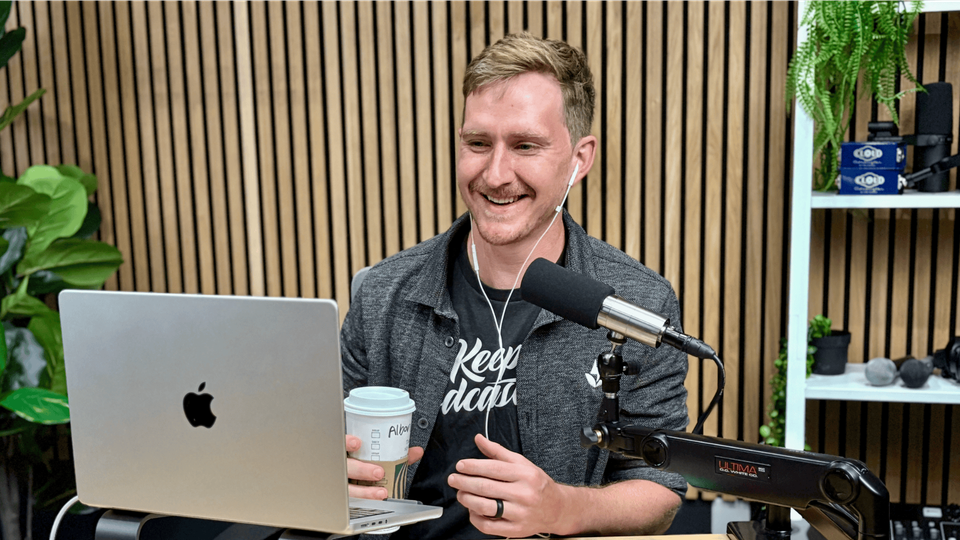
- Buy the minimum credible kit. A USB dynamic microphone around $80, a boom arm, and a pop filter bring you to a realistic $100 to $150 startup — the range School of Podcasting recommends for beginners. Skip the mixer and the $400 microphone until episode ten exists. Record in a soft, quiet room; the room matters more than the mic.
- Script episode one from a template. A cold open, a promise, three segments, and one call to action will outperform improvisation every time. Draft with AI, then edit heavily and read it aloud against a timer — a 30-minute English episode runs roughly 4,500 words. Our podcast script templates cover every format in detail.
- Record a trailer and a launch batch. Cut a 90-second trailer that names the audience and the promise, then batch-record five full episodes before launch day. Batching protects you from the schedule collapses that kill new shows, and it means launch week is about distribution, not production.
- Pick a host and submit your RSS feed. Your hosting platform stores the audio and generates the RSS feed every directory reads. Submit that feed to Apple Podcasts, Spotify, and — often forgotten — Anghami if your audience touches the MENA region. Apple's review can take from a day to about two weeks, so submit first and promote second.
- Publish show notes and repurpose immediately. Every episode should ship with a description, chapters, and a transcript, then feed one newsletter section and a few social posts. AI drafting makes this a 20-minute job; our repurposing workflow covers the full pipeline from one recording.
Validate a niche you can sustain for 50 episodes. Passion fades; specificity compounds. Run a niche-validation prompt (next section) and demand 20 episode ideas you would actually record. If the list strains after twelve, narrow the topic. Then check the top ten shows in your category on Apple Podcasts and read recent reviews for unresolved complaints — those are your openings.
The AI planning workflow: prompts you can copy today
The difference between a useful AI planning session and a wall of generic text is the brief you give the model. State the role, the audience, the constraints, and the output format in every prompt. Then edit like an editor, not a stenographer.
Niche validation comes first:
Act as a podcast strategist. Evaluate the niche "{topic}" for a new show aimed at {audience}.
List 5 gaps no current show fills, 3 risks of this niche, and 10 specific problems this
audience actively discusses. Rank the problems by how often they come up in communities.
Then pressure-test the idea bank — 20 ideas, not 5, because idea 14 is where niches reveal themselves:
Generate 20 episode ideas for a podcast about {topic} for {audience}. For each: a hook title
under 60 characters, a one-sentence listener promise, and the best format (solo, interview,
or co-hosted). Mark the 5 strongest for a launch batch.
Names, positioning, and taglines:
Suggest 15 podcast names for a show about {topic}. Rules: maximum four words, easy to say
out loud, no puns that lose meaning, and each must work as a spoken sign-off. Add a one-line
tagline for each.
{Show name} helps {specific audience} achieve {specific outcome} through {format} every
{cadence}.
The fill-in line above is your positioning statement. If any slot takes more than six words, the positioning is not done.
For launch assets, two more prompts carry most of the weight:
Draft a 90-second trailer script for {show name}. Structure: cold-open hook, who it is for,
the one promise every episode keeps, three episode teases, and a subscribe ask. Conversational
tone, written to be spoken aloud.
Write an episode description for "{episode title}" with a runtime of {X} minutes. The first
two sentences must stand alone in a preview. Include "{keyword}" naturally once, summarize
the payoff, and end with a single call to action. Tight enough to read on one screen.
A guest shortlist prompt rounds out planning — and if you plan a video podcast, the same drafting workflow adapts directly to screen formats, as covered in our guide to AI video scripts.
If you want this workflow without stitching together five subscriptions, ArWriter (https://app.arwriterai.com/) puts GPT-4o and Gemini in one editor with 40+ writing tools, including podcast planning, episode descriptions, and show notes, from $4.99 a month. It writes in English and Arabic, which matters if your show targets customers in MENA markets. For a deeper look at the models doing the drafting, see our Gemini guide for writers.
What it costs to launch: four budget tiers
School of Podcasting puts a realistic beginner startup at $100 to $150. Buzzsprout's gear recommendations step up in tiers around $70, $400, and $960. Combine those with outsourcing math from Riverside — freelance editors charge $30 to $50 per finished audio hour — and the real cost picture looks like this:
| Setup | What you buy | Realistic cost | Best for |
|---|---|---|---|
| Phone-only | Nothing new: phone, wired earbuds, quiet room | $0 | Validating the idea before spending |
| Starter kit | USB dynamic mic (~$80), boom arm, pop filter | $100–$150 | Most new shows |
| Growing show | Better mic plus small interface, closed headphones | ~$400 | Committed weekly solo shows |
| Prosumer | XLR mic, multi-input interface, room treatment, recorder | $960+ | Sponsored shows with multiple hosts |
| Outsourced | Starter kit plus a freelance editor | $30–$50 per audio hour, ongoing | Teams short on time |
Two notes on the table. First, hosting is separate from gear: every show needs a hosting platform for its RSS feed, and free tiers exist for new shows. Second, the $0 row is legitimate — phone recordings cleaned up with AI speech tools now outperform 2015-era home studios, and the full cleanup pipeline is covered in our AI audio production guide.
Publish everywhere: Apple, Spotify, and the directories most guides skip
Distribution is where new podcasters leave audience on the table. Apple Podcasts and Spotify are mandatory; they are a third of downloads each. But submission details differ, and metadata rules quietly decide whether your show surfaces in search.
| Directory | Cover art | Description | What to know |
|---|---|---|---|
| Apple Podcasts | 3000×3000 px | Up to 4,000 characters, about 400–600 words | Review takes from a day to about two weeks; approval feeds many downstream apps |
| Spotify | Same art via your RSS feed | Pulled from the feed | Claim your show at Spotify for Podcasters to see analytics |
| Anghami | Same art via your RSS feed | Pulled from the feed | Dominant podcast app across MENA; submit through their partner portal or a supporting host |
| Podeo | Same art via your RSS feed | Pulled from the feed | MENA-first platform; useful if your guests or customers sit in the region |
| YouTube | 16:9 thumbnail | Video description | 33 percent of weekly US podcast listeners use YouTube most, per The Infinite Dial 2025 |
The Anghami and Podeo rows are the ones no mainstream English guide covers, and they matter more than podcasters think: a show with MENA guests, investors, or customers gets discovered there months before Apple search catches up. Review times vary by portal; expect days, not minutes, and submit at least two weeks before any launch-date announcement.
One more distribution frontier: listeners increasingly ask AI assistants for show recommendations, which makes clean titles, descriptions, and transcripts part of your discoverability work. Our guide to appearing in AI search answers explains that layer.
How a Dallas consultant filled her pipeline with a weekly podcast
Dana Whitfield spent eleven years implementing manufacturing software for mid-size factories in Texas, and in January 2026 she turned that pipeline into a podcast. Shop Floor Signals — 30-minute interviews with plant managers about what actually breaks on a production line — launched with three episodes and a $113 kit: a $78 USB dynamic microphone, a $20 boom arm, and a $15 pop filter, recorded in her Dallas home office with a duvet pinned behind the mic.
The AI part was the planning layer. Dana generated 20 episode ideas with a niche-validation prompt, killed the seven she would never record, and built her positioning statement in an afternoon: Shop Floor Signals helps operations managers reduce unplanned downtime through one 30-minute interview every other Tuesday. Every guest email, episode description, and set of show notes since has been drafted the same way, then edited to sound like her.
The numbers stayed small before they grew. Episodes drew 40 to 60 downloads each in the first month. By month six, episodes averaged about 900 downloads, and the show had produced 14 inbound leads — plant managers and operations directors who heard a specific episode and booked a call. Two of those calls converted into $31,000 of retained consulting work, which paid for the microphone roughly 276 times over.
The lesson Dana repeats to other consultants: the podcast did not work because it got big. It worked because the niche was narrow enough that episode twelve was still obviously for the same person as episode one. AI planning kept that focus cheap.
The quit-before-episode-7 problem and the cadence that beats it
Dave Jackson at School of Podcasting has watched this pattern for nearly two decades: most podcasters quit before episode 7. The cause is rarely audience rejection. It is production debt — a show designed around weekly heroics collapses the first time work, travel, or illness interrupts the schedule.
The counter-plan is boring and effective:
- Batch-record five episodes before launch day. You launch with three to five episodes (the range School of Podcasting recommends) and hold the rest as a buffer.
- Choose cadence from your calendar. Every 8 to 14 days is the most common publishing interval — 40 percent of shows — and it survives real life better than daily ambition.
- Cap episode production at half a day. AI drafts the script and show notes; you record, approve, and upload. If an episode costs more than four hours, shrink the format.
- Pair the show with a newsletter. A weekly email turns every episode into a durable asset instead of a 48-hour spike; our AI newsletter system shows the full setup.
Shows that follow this pattern reach episode 10 with a buffer, and episode 10 is where retention, reviews, and referral loops start compounding.
Common mistakes first-time podcasters make
- Naming the show before validating the niche. A clever name for a vague show helps nobody. Position first, name second.
- Waiting for perfect gear. The $0 phone tier plus AI cleanup beats the studio you keep postponing. Upgrade after ten episodes, not before one.
- Launching with a single episode. New listeners who binge-day-one need something to binge. Launch with three to five episodes plus a trailer.
- Treating AI output as finished work. Generated names, ideas, and descriptions are raw material. Unedited AI copy has a recognizable flatness — verify every number and add your own stories.
- Ignoring metadata. Apple allows 4,000 description characters, and 62 percent of new listeners are swayed by cover art. That is a cheap edge most beginners skip.
- Planning 5 episodes instead of 50. If you cannot list 20 credible episode ideas today, the niche is too narrow or too broad. Fix it now, not at episode 4.
Frequently asked questions
How much does it cost to start a podcast in 2026?
A realistic startup runs $100 to $150: a USB dynamic microphone near $80, a boom arm, and a pop filter, per School of Podcasting. A $0 phone-only launch is possible with AI cleanup. Gear tiers around $400 and $960 suit shows that have already shipped a dozen episodes.
How do I start a podcast for free on Spotify?
Spotify does not charge for distribution. Create an account at Spotify for Podcasters, then either use their free hosting or submit the RSS feed from any host's free tier. Approval is usually quick, and episodes appear once the feed verifies — typically within hours to days.
What equipment do I need to start a podcast at home?
A USB dynamic microphone around $80, closed headphones, and a quiet, soft-furnished room cover 90 percent of home setups. Add a boom arm and pop filter and you are at the standard $100 to $150 starter kit. Skip interfaces and mixers until the show survives ten episodes.
Is it too late to start a podcast in 2026?
No. The Infinite Dial 2026 puts monthly US listening at 58 percent — 167 million people — and 45 percent listen weekly. Discovery keeps shifting toward search and AI answers, which rewards niche shows with clean metadata over incumbents with big back catalogs. Specific beats broad.
Can you start a podcast with just your phone?
Yes. Record in airplane mode with the phone close to your mouth in a soft room, then run the file through AI speech enhancement. Riverside reports 80.5 percent of podcasters now record with video, much of it phone-first. Upgrade the microphone once the habit is proven.
How many episodes should I launch with?
Three to five, plus a trailer of one to two minutes. Launching with a batch gives new listeners depth on day one and protects your schedule, because most new shows fail from production debt before episode 7 — batch recording is the insurance policy.
How long should a podcast episode be?
Match the format. Riverside's medians: about 18 minutes solo, 40 minutes with multiple hosts. The single largest bucket of episodes — 32 percent — runs 20 to 40 minutes. Pick a length you can sustain and hold it steady; listeners reward predictability.
What is the best AI tool to plan a podcast?
The best planning tool combines a prompt library with a real editor, because planning outputs feed straight into scripts and show notes. Look for GPT-4o or Gemini-class drafting, saved prompts, and bilingual output if your audience spans regions. Workflow beats any single-purpose generator.
When sponsors start asking about your show, the first document they request is a media kit — this guide to building a media kit with AI covers every section in one afternoon.
And when a brand asks for campaign details, turn that interest into a signed contract with a sponsorship proposal drafted with AI that works from the first page.
Sources
- The Infinite Dial 2026 — Edison Research at SSRS — US listening, weekly audience, and audio-video consumption figures
- How to Start a Podcast — Buzzsprout — platform download shares, gear tiers, and cover art influence
- How to Start a Podcast — Riverside — video recording adoption and episode-length medians
- How to Start a Podcast — School of Podcasting — startup costs and the quit-before-episode-7 pattern
- Spotify for Podcasters — official submission and verification reference
Your first-episode launch checklist
| # | Task | Done when |
|---|---|---|
| 1 | Positioning statement written | One sentence names audience, outcome, format, cadence |
| 2 | 20 episode ideas generated and pruned | At least 15 you would genuinely record |
| 3 | Name checked and tagline locked | Under four words, clear in your category |
| 4 | Trailer recorded | 90 seconds, names the audience and the promise |
| 5 | Launch batch recorded | 3 to 5 episodes edited and cleaned |
| 6 | Cover art exported | 3000×3000 px, readable at thumbnail size |
| 7 | Show description written | Under 4,000 characters, keyword in first sentence |
| 8 | RSS feed submitted | Apple, Spotify, Anghami — at least two weeks before announcements |
| 9 | Show notes and newsletter queued | Every launch episode has a description, chapters, transcript |
| 10 | Episode 6 recorded before launch day | The buffer that beats quitting |
Learning how to start a podcast with AI is mostly a sequencing problem: validate, position, batch, distribute, repurpose — in that order, with software doing the drafting and you doing the judgment. ArWriter covers the drafting side end to end — prompt library, GPT-4o and Gemini editor, 40+ tools for scripts, descriptions, and show notes — from $4.99 a month at https://app.arwriterai.com/. Your first episode is closer than it was when you opened this guide.