Last updated: September 2026
ChatGPT ads just took their biggest leap yet. On September 16, 2026, OpenAI published an announcement titled "Reimagining advertising with AI" that adds three layers to its ad platform in one move: Sponsored Agents — brand-backed conversational agents users can talk to after clicking an ad — AI tools that build the ad itself from a natural-language prompt, and official HubSpot and Shopify integrations that pull campaigns into the tools businesses already run on. If you buy, plan, or write ads for a living, this announcement touches all three parts of your job. The event is two days old at the time of writing, but most coverage stopped at the headlines. This guide goes deeper: what each piece actually does, what it costs you in workflow changes, and how to prepare before the international rollout widens on September 23.
In plain terms: OpenAI is turning its ad slot into a conversation and its ad builder into a prompt box. The user asks, a clearly labeled brand agent answers, and the advertiser writes the campaign in plain English instead of filling out forms. Nothing about it replaces your Google or Meta spend today — but it changes what "ad copy" means faster than either of those platforms ever did.
What exactly was announced? Four things
- Sponsored Agents (experiment, US only) — selected advertisers in the United States can attach a brand-sponsored conversational agent to their ads.
- Natural-language campaign management — an Ads Manager experience inside ChatGPT where campaigns are created, updated, and analyzed by prompting.
- A creative assistant — suggests ad copy and images based on your landing page and campaign objective, with the advertiser reviewing and approving every output.
- HubSpot (first CRM partner) and Shopify (first commerce partner) — available immediately in the US, and expanding internationally "in markets where ChatGPT Ads are available" starting September 23, 2026.
How Sponsored Agents work — and the three guardrails
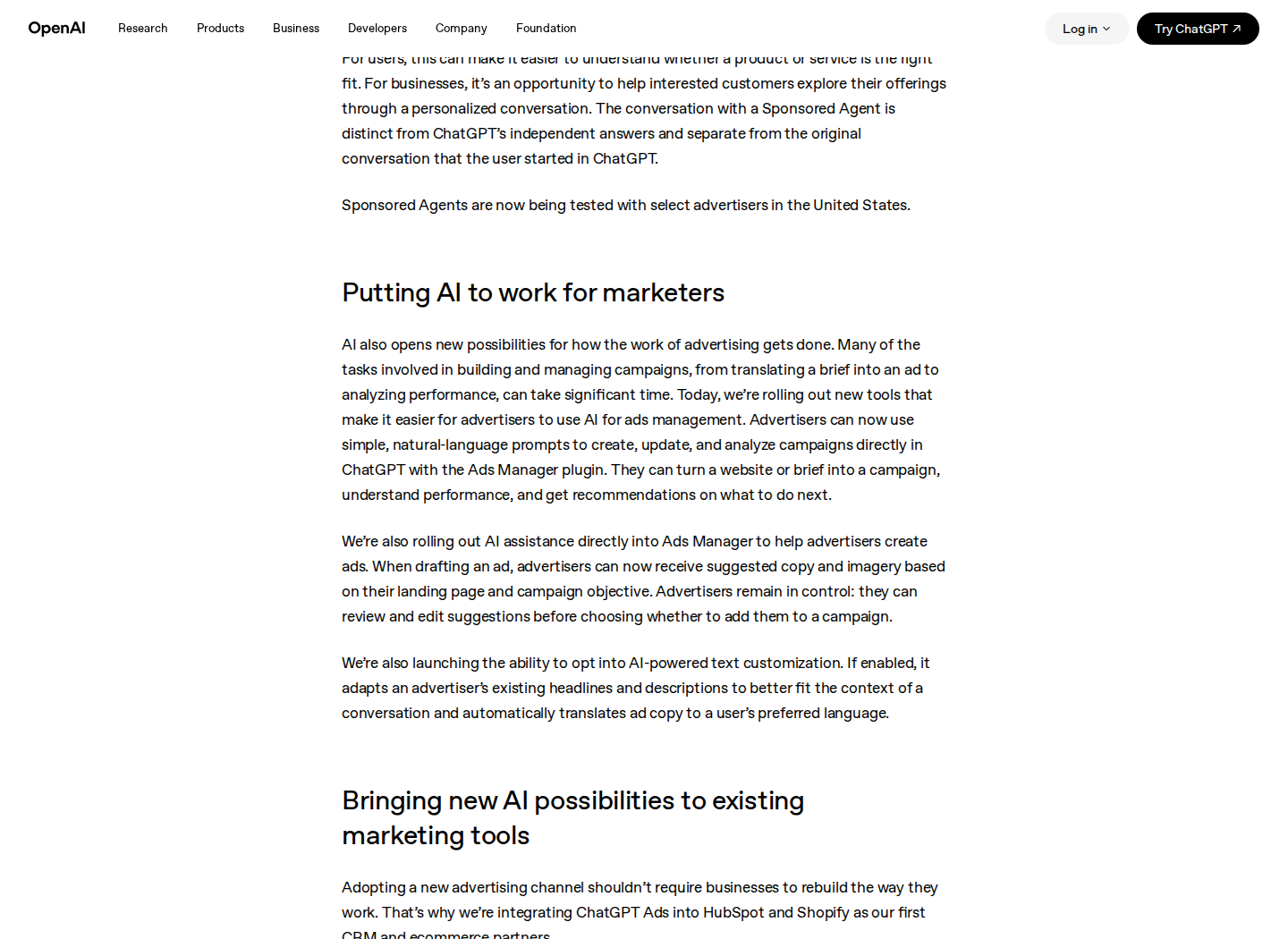
The core idea addresses an old gap. A traditional ad answers "what is this product?" but the actual buyer keeps asking follow-ups: does this dining table fit my room, how many people does it seat, how do I care for the finish? OpenAI's own announcement uses exactly that dining-table shopper as its example. With Sponsored Agents, after clicking an ad, the user can start a clearly labeled conversation with an agent sponsored by the brand — explain what they need, ask anything, and move to the brand's site when ready for the next step.
Three rules from the announcement matter more than the feature itself, because they will decide whether users trust it:
- Labeling is mandatory. The agent conversation is explicitly marked as sponsored by the brand. No blending.
- Separation from ChatGPT's answers. The sponsored conversation is "distinct from ChatGPT's independent answers" — the model's unpaid response stays its own thing.
- Separation from the original chat. The agent conversation is also separate from the chat the user was having before they clicked, which protects the user's context from commercial contamination.
Read those three together and you see OpenAI's bet: the ad industry's newest format is a conversation that only works if it feels honest. For advertisers, that means the format rewards brands with genuinely helpful answers — not brands with the biggest budgets for interruption.
The ad-creation tools: from prompt to campaign
The second half of the announcement changes how ads get made, and it is the part closest to home for anyone who writes marketing content:
- Ads Manager inside ChatGPT. Advertisers write in natural language to create, update, or analyze campaigns. The system converts "a website or marketing brief" into a full campaign, reads performance, and recommends next steps.
- Creative suggestions. When drafting an ad, the AI proposes copy and images built from your landing page and campaign objective — and the advertiser reviews and edits before anything goes live. The final call stays human.
- Optional text personalization. When enabled, the model adapts your existing ad headlines and descriptions to the conversation's context — and automatically translates your ad text into the user's preferred language. That single line quietly makes every ChatGPT ad campaign a multilingual campaign. An English ad you write in Austin can render in Arabic, Japanese, or Portuguese depending on who's asking, with no separate creative production per market.
The practical consequence: "ad writer" and "ad designer" are becoming buttons inside the platform. What separates advertisers now is the quality of the inputs — a landing page that actually explains the product, a brief that states the audience and objective clearly, brand terms a machine can build on. Garbage prompt, garbage campaign; sharp inputs, campaigns that used to take a creative team a week. If your strength is writing precise briefs and clean product copy, this update works in your favor.
HubSpot and Shopify: the ads come to your dashboard
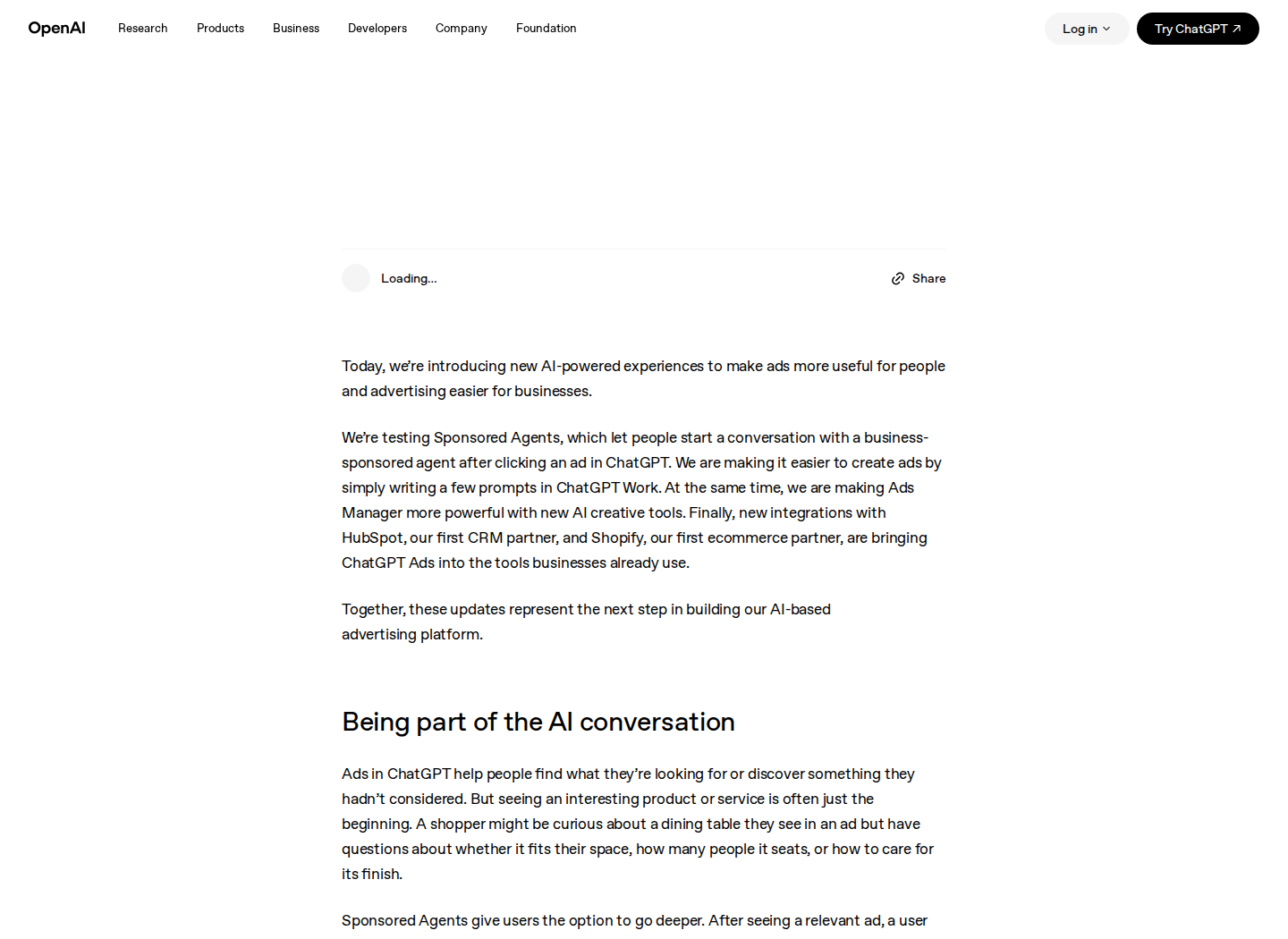
Rather than forcing business owners into yet another standalone platform, OpenAI announced two official integrations on the same day:
- HubSpot — first CRM partner. Connect a ChatGPT Ads account to customer conversations, create ads and track their performance, and follow leads from inside HubSpot itself, with the ads drawing on HubSpot's data context.
- Shopify — first commerce partner. A ChatGPT Ads app in the Shopify App Store lets merchants create and manage campaigns directly, with products already flowing through Shopify Catalog so campaigns launch and track immediately. Live for US merchants now, and going international in markets where ChatGPT Ads operate from September 23, 2026.
Open registration for eligible businesses is open through the ads portal at ads.openai.com, written exactly that way in the official announcement.
A walkthrough: what a sponsored conversation might look like
To make the format concrete, here is an illustrative scenario consistent with how OpenAI describes the experiment. Imagine a mid-size retailer of ergonomic office chairs entering the program once it expands internationally:
- The trigger. A user asks ChatGPT how to fix back pain from long workdays and what chair features actually matter. Among the results appears a shopping agent sponsored by the retailer, labeled as an ad.
- The conversation. The user opts in and asks about seat height, lumbar support, and whether a model fits a small apartment desk. The agent answers from the sponsor's catalog — budget, use case, preferences — while the user always knows this is a sponsored exchange.
- The handoff. The conversation ends with a shortlist and a link to the retailer's site. The main chat, and ChatGPT's independent answer about back pain, were never touched.
The difference from a banner is structural: the user chose the conversation, the format answers pre-purchase questions instead of shouting a slogan, and the advertiser pays to be helpful rather than loud. (This scenario is illustrative of the format OpenAI described; the company has not published the language or market list for the experiment beyond its initial US advertisers.)
Why this lands now: OpenAI's ad year in context
The pace tells the story. In January 2026, OpenAI published its approach to advertising as a limited US test inside free and Go plans. By early September, the platform had crossed a billion dollars in advertiser spend and opened self-service across the Middle East, North Africa, India, and Europe. This week's announcement adds the agent layer, the creation tools, and the integrations in a single stroke. One year, zero to a full-stack ad business.
The timing also reads as a competitive answer. Google and Meta have spent two years shipping AI ad-creation features of their own. OpenAI's counter bundles the channel (hundreds of millions of people asking the model purchase-intent questions), the creation tool (prompt to campaign), and the distribution (HubSpot and Shopify) into one place. For small advertisers, the entry barrier drops again — and, less comfortably, your results now depend even more directly on the quality of your inputs: landing pages, product descriptions, FAQs. Writing itself just became an advertising advantage.
What this means for marketers and agencies
- Your landing page is now an ad input. The creative assistant reads it to draft ads, and the translation layer makes it multilingual. An outdated page doesn't just convert poorly anymore — it generates weak ads.
- Prompt-writing is a billable skill again. Campaign creation by natural language means the person who writes precise, information-dense briefs gets better campaigns than the one who doesn't. This is the same skill that already separates good AI content work, as we covered in our guide to AI lead-gen and sales automation with GPT-6 Astra.
- FAQ content becomes agent fuel. A sponsored agent answering pre-purchase questions performs only as well as the answers behind it. Brands that invested in thorough FAQ and product pages hold an edge on day one.
- Agencies should reposition, not panic. Media-buying mechanics compress into a prompt box, but strategy, briefs, creative review, and measurement stay human work. The agency that productizes "ChatGPT Ads readiness audits" — landing pages, catalogs, Q&A coverage — has a new service line this quarter.
- Watch the measurement gap. A new channel means new attribution questions. Set expectations with clients now: early-channel data is directional, not gospel.
Quick comparison: where ChatGPT ads stand after September 16
| Criteria | ChatGPT Ads (post-announcement) | Google Search Ads | Meta Ads |
|---|---|---|---|
| User intent | Direct questions to the model + opt-in brand conversations | Explicit search intent | Interest-based, often low intent |
| Ad creation | Prompt-based, copy and image suggestions built in | Mature tooling plus separate AI helpers | Advantage suite, increasingly automated |
| Commerce integration | Shopify and HubSpot official (international from Sep 23) | Deep and long-established | Deep and long-established |
| Automatic ad translation | Built in and officially announced | Limited | Limited |
| Channel maturity | Young; agents are a US experiment | Decades | Over a decade |
A practical first-30-days plan
- Week 1 — observe only. Ask ChatGPT the purchase questions your customers ask. Note when commercial results appear and what they look like. Spend nothing.
- Week 2 — fix your inputs. Rewrite your landing page and top product descriptions so a machine reading them would describe your offer accurately. Draft the ten pre-purchase questions customers actually ask; they feed both the creative tools and future agents.
- Week 3 — test small. If self-serve is live in your market, run one minimal campaign on one product. Compare cost and lead quality against your current best channel — our rundown of AI apps for small business and agencies can help you slot this into the rest of your stack.
- Week 4 — decide with data. If session quality and conversion beat existing channels, scale gradually. If not, keep observing; the format is iterating monthly.
The rule that has held across every new ad channel still applies: early movers get cheap reach, but the ones who arrive with prepared copy, clean catalogs, and real answers win the channel.
Limits and open questions
- Sponsored Agents are a US experiment with selected advertisers — no announced international timeline yet.
- No pricing was published in the announcement. Cost per conversation or per sponsored-agent interaction is undisclosed; expect to learn it inside the ads portal after registering.
- Measurement is immature. Don't assume your Meta ROAS math transfers.
- User trust is the whole ballgame. If labeling and separation feel like theater, users will punish the format — and OpenAI with it.
- Single-vendor risk is real. A channel owned by one provider inside a closed environment argues for diversification, not migration.
By the way, if you're staring down a growing pile of ad copy, landing pages, and product descriptions that now feed AI campaign builders, ArWriter gives you a bilingual editor and template library for exactly that kind of writing — starting at $4.99/month.
Frequently Asked Questions
What are Sponsored Agents in ChatGPT?
An experimental US feature announced September 16, 2026: after clicking an ad, users can start a clearly labeled conversation with an agent sponsored by the brand to ask product questions and move to the brand's site when ready — separate from both ChatGPT's independent answers and the user's original chat.
When do ChatGPT Ads integrations go international?
OpenAI says the Shopify ChatGPT Ads app and the HubSpot integration are live for US businesses now and expand to markets where ChatGPT Ads are available starting September 23, 2026.
Can AI write my ad inside ChatGPT?
Within stated limits, yes: it suggests copy and images from your landing page and campaign objective, you review and approve everything, and an optional personalization mode adapts headlines to conversation context and auto-translates ad text into the user's language.
How is this different from a normal ChatGPT ad?
A standard ad is a message shown alongside answers. A Sponsored Agent is an interactive, clearly labeled conversation the user opts into after clicking — built to answer pre-purchase questions rather than display a static pitch.
Do I need an agency to run ChatGPT Ads?
Not necessarily: natural-language campaign management is designed to remove the media-buying specialist layer. But strong briefs, creative review, and results analysis still reward professional skill — in-house or agency.
Will Sponsored Agents replace search and social ads?
Far too early to claim. The channel is young while Google and Meta hold decades of data and integrations. The realistic outcome is an additional layer with high purchase intent — and possibly lower early costs — alongside existing channels.
What does it cost to advertise on ChatGPT?
OpenAI published no pricing in the announcement. Registration through the official ads portal shows cost models by market and campaign type; start with a small test budget and measure before scaling.
Sources
- OpenAI's official announcement: Reimagining advertising with AI — primary source, September 16, 2026
- OpenAI: Our approach to advertising and expanding access — the January 2026 policy context
- GPT-6 Astra for Work: pricing, availability, and what teams actually get — related OpenAI platform coverage
For content professionals, the September 16 announcement reduces one more barrier between a blank page and a live campaign — which makes the writing that feeds these systems the scarcer, more valuable skill. If that's the skill you want on your team this quarter, start with the tools in ArWriter and be ready before the rollout widens.