When OpenAI launched GPT-6 Astra on September 3, 2026 — the launch we covered here — it introduced a model. When the company published its follow-up announcement on September 9, it introduced something teams care about far more: availability, pricing, and evidence. Astra is now live in ChatGPT Work, Codex, and the API, at a published rate of $10 per million input tokens and $50 per million output tokens, backed by named customer results from Figma, Box, Thomson Reuters, Databricks, and Hebbia.
For anyone who builds content operations — agencies, in-house marketing teams, solo creators shipping at volume — this second announcement is the one that turns a benchmark headline into a budget line. This piece breaks down what OpenAI actually shipped, what the partner numbers say, what it costs, and where the honest caveats sit. Every figure below comes from the official announcement page or OpenAI's published developer documentation.
What actually shipped on September 9
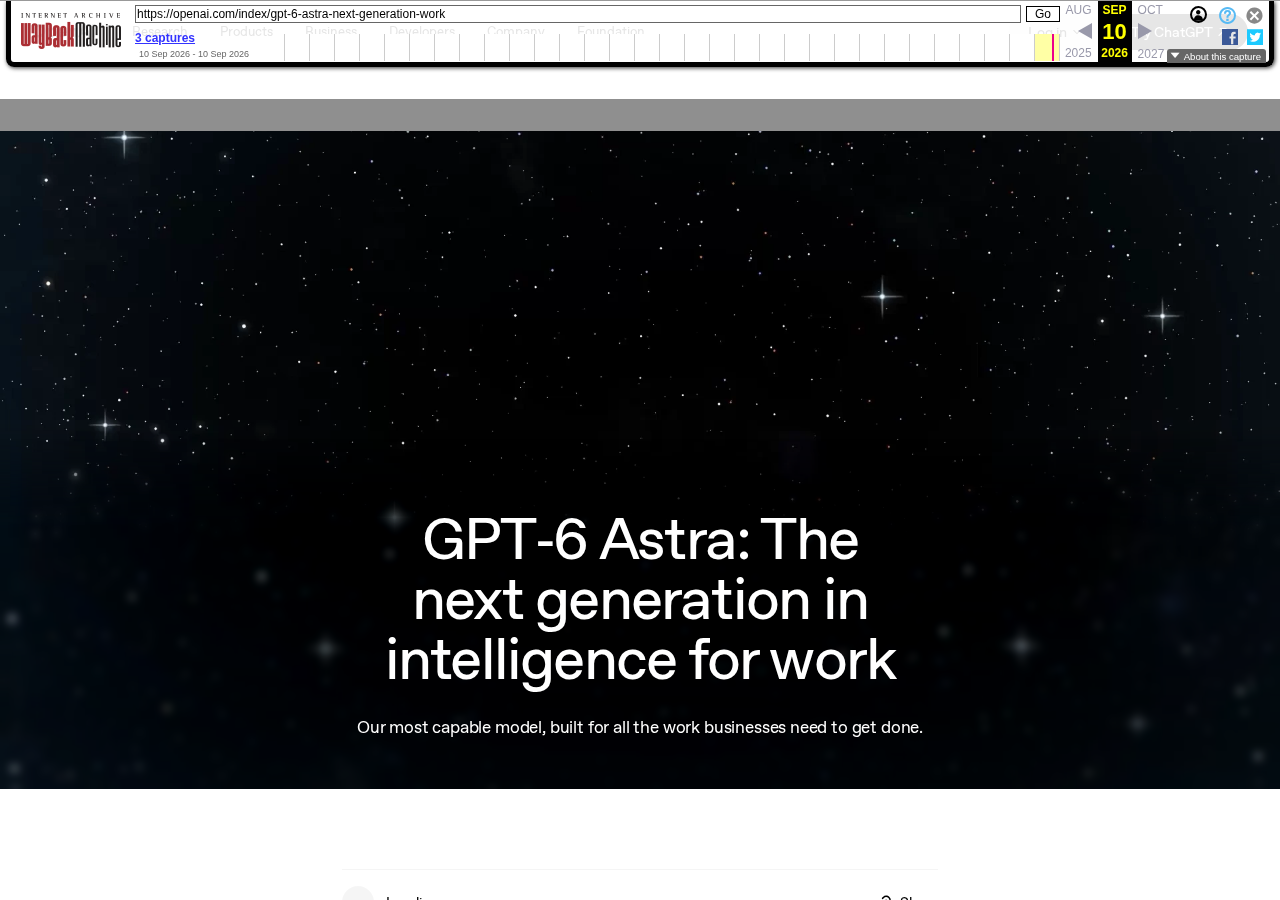
The announcement, titled "GPT-6 Astra: The next generation in intelligence for work," leads with a single availability line: the model is now in ChatGPT Work, Codex, and the API. OpenAI describes Astra as state-of-the-art across computer use, browsing, professional work, software engineering, cybersecurity, and science — but the operational detail buried in the next paragraphs matters more than the superlatives.
Most AI deployments historically demanded preparation: clean data pipelines, redesigned workflows, custom integrations built before any value appeared. Astra's bet is the opposite. Inside ChatGPT Work and Codex, the model "can write code and work through the same applications people use every day — even when those applications don't have an API." The model operates the interface the way a person does: clicking, reading, navigating. In OpenAI's words, businesses can put it to work "within their existing workflows from day one, without extensive preparation or engineering work."
If you have spent years watching automation projects stall because the scheduling tool never talked to the design tool, or because the client platform gated its data behind approval queues, that is the friction this approach sidesteps. Not by magically fixing integration debt, but by removing it as a prerequisite for starting.
Why a "work model" matters to content teams
The most telling example in the announcement comes from OpenAI's own marketing department, and it sits squarely inside the content production world. OpenAI's developer and marketing teams used Astra and Codex to turn "three hours of multicamera footage" into the finished GPT-6 Astra Developer First Impressions video — an asset that has "already garnered over 550k views in just 4 days." The model was not asked for a caption or a hashtag; it was handed raw material and asked to ship a finished product.
The second detail, stated almost in passing, is the one brand teams will feel: Astra is "better at following a company's voice, templates, and design standards, so the first result is closer to something a team can put to use." Anyone who has managed a brand style guide across writers knows the drill — AI drafts arrive generic, and a human spends a pass bending them back into the house voice. OpenAI claims, and customer testimonials corroborate, that this gap has narrowed measurably.
The announcement also lists what teams did with Astra in the first days of rollout: optimizing GPUs, spotting discrepancies in financial statements, and "producing more on-brand decks." The published demos include a consistently styled presentation, a formatted spreadsheet, and a styled document — deliverables that previously needed a designer's touch to look client-ready.
What the partners actually measured
Vendor announcements age badly without third-party numbers, so the named testimonials deserve a close read. These are companies building products on the model, which makes their quotes closer to engineering notes than applause.
Hebbia, the enterprise document-analysis platform, supplied the two most concrete numbers on the page. Founder and CEO George Sivulka: Astra "produced the best decks we've tested and followed the brief 17% more faithfully than the next-best model, while sourcing its claims to the right document 19% more often." For teams producing client-facing analysis, brief fidelity and claim traceability are exactly the failure modes that make AI drafts unusable without heavy review.
Box, through VP of AI Products Yashodha Bhavnani, highlighted judgment rather than fluency: Astra "was better at declining to assert conclusions the documents didn't support, and across the evaluation it was >10% less likely to make confidently incorrect assertions." That is the difference between a model that sounds right and one that stays right.
Figma chief design officer Loredana Crisan offered the quote most relevant to visual creators: "Astra gets your vision and knows how to use Figma to achieve it, working through complex designs while you stay in control of the creative direction." The design tool itself vouching for the model's fluency inside its own canvas is notable — this is the workflow half of ARWriter's audience lives in daily.
Thomson Reuters (VP Applied Research, Omar Bari) pointed at "a clear jump in intelligence and writing quality, with stronger multi-agent coordination and a better grasp of the quiet intent behind a request" — essential in legal work, where precision and nuance carry consequences. Databricks reported a new state of the art on its OfficeQA Pro and Pro V2 benchmarks with "significantly better cost per task than GPT-5.6 Sol," and Cognition integrated Astra into Devin's harness on launch day, citing clearer videos and more concise reports.
The pricing picture
API pricing starts at $10 per million input tokens and $50 per million output tokens. On a pure per-token basis that reads premium. The defense OpenAI offers is efficiency, stated plainly in the announcement: Astra "has been trained to complete tasks in fewer tokens with fewer retries, which means less rework and lower cost per task," and OpenAI claims the majority of the cost-efficiency frontier on professional work and coding evaluations, including Terminal-Bench 4.0 and the Artificial Analysis Intelligence Index.
The practical budgeting rule for teams: price the task, not the token. A deliverable that took three regeneration cycles on a cheaper model and still needed a human rewrite may cost less overall when the first draft lands usable. Developers should also note from the official model guidance that Astra delivers stronger results "while using substantially fewer output tokens — delivering a lower estimated API cost per task than earlier models despite its higher per-token pricing."
Two fine-print items worth flagging early: Zero Data Retention is available for eligible API customers on supported endpoints, subject to approval — significant for anyone handling regulated client data. And the model has hard limits documented in the guide: no none reasoning-effort level, and Fast mode is unavailable with EU data residency.
Quick comparison: Astra versus GPT-5.6 Sol at work
Restricting the table to claims OpenAI published itself keeps it honest:
| Dimension | GPT-6 Astra | GPT-5.6 Sol |
|---|---|---|
| Availability | ChatGPT Work + Codex + API (from Sep 9) | Existing product surfaces |
| API price per 1M tokens | from $10 input / $50 output | Lower per token (per Databricks' comparison) |
| Cost per completed task | Lower — fewer tokens, fewer retries (OpenAI and Databricks) | Higher in partner evaluations |
| Unintended outcomes on safety benchmark | Reference point | 89% more than Astra (OpenAI internal test) |
| Brief and template adherence | Announced improvement, backed by Hebbia (+17%) | Baseline |
The one explicit external comparison in the announcement targets Anthropic's Claude Fable 5.1: Astra produced unintended outcomes 74.7% less often on OpenAI's internal computer-use safety benchmark. Treat both numbers as single-source — a lab measuring on its own yardstick — but at least they are published numbers that can be argued with, rather than vibes.
What this means for your workflow
If you are a solo creator or small team: the practical entry point is a ChatGPT Work subscription (the consumer Pro tier went through a demand-driven pause during the same week, as we covered separately). Run one deliberate experiment this week: hand the model a long raw asset you already own — a meeting recording, footage, a research document — and ask for a finished, on-template deliverable. Measure elapsed time against your current process before forming an opinion.
If you run an agency or content team: the announced gains concentrate in "company voice, templates, and design standards." Set up a small measurable trial: execute the same five briefs on your current model and on Astra, then count revision rounds before sign-off. Hebbia's 17% and 19% figures give you a realistic order of magnitude for what an improvement looks like — meaningful, not miraculous.
If you build products: the model identifier is gpt-6-astra on the Responses API. The developer guide also documents capabilities that matter for agent-style products: async tool calling, mid-turn steering over WebSocket, and mid-conversation reasoning changes that preserve the prompt cache.
On positioning against specialized tools: a stronger general model shifts where deep execution happens, but it does not replace the layer that holds your templates, your Arabic/English content conventions, and your publishing targets. Writers and marketers who produce daily tend to pair a frontier model for depth with a specialized writing and scheduling tool for throughput — the complement, not the substitution, is the rational setup.
Safety and administrative control
Giving a model permission to act inside business applications requires trust, and OpenAI spent much of this announcement earning it. On its internal computer-use safety benchmark — which tests "the hardest business scenarios such as exposing confidential information, sharing a dashboard too broadly, or deleting data" — Astra produced unintended outcomes 89% less often than GPT-5.6 Sol and 74.7% less often than Claude Fable 5.1. The company adds that additional confirmation and automated review further improved performance.
Administrators get new enterprise controls: restricting access to approved websites and desktop applications, managing uploads and downloads, and controlling browsing history. ChatGPT Work and Codex include confirmation policies that can require human approval before consequential actions, plus automated review of potentially unsafe or unauthorized tool calls. The suggested deployment posture is staged — start locked down, expand gradually. Alongside Astra, OpenAI shipped enterprise plugins in ChatGPT Desktop for Oracle Analytics, Power BI, Navan, and Avalara, built on the new browser-use capabilities.
One governance note stands out: Astra is "the first model to reach the Critical cybersecurity capability threshold" under OpenAI's Preparedness Framework, which triggered strengthened protections against misuse and unauthorized actions. And in a deliberate restraint, "enterprise access is off by default at launch" — an administrator must enable it under the applicable rate card and agreement.
Honest limitations
- Premium per-token pricing. Unstructured, sprawling prompts can burn budget quickly. Scope tasks tightly and specify deliverables.
- Enterprise access ships disabled. Someone on your side must make an explicit enablement decision; this is not a silent rollout.
- A model that asks questions. OpenAI's own guidance notes Astra asks clarifying questions more often than GPT-5.6 Sol — safer for consequential work, slower for lightweight tasks unless you prompt for initiative explicitly.
- Single-source numbers. The 89% safety figure and benchmark claims are OpenAI's own measurements or partner testimonials. Independent evaluations will follow; wait for them before betting the roadmap.
- Admin overhead is real. The new controls only protect you if someone configures allowlists for sites and applications in your organization.
Getting started today
Teams can try Astra in ChatGPT Work or Codex, or build against it in the API. A sensible first session: pick one recurring deliverable, produce it end-to-end with Astra against your template, and document where it saved time and where it needed correction. Pair the model with the rest of your production stack — for daily multilingual content work, tools like ARWriter's auto-writer handle the repeatable drafting and publishing layer while the frontier model covers deep, messy, multi-step jobs. The full toolset lives at app.arwriterai.com/tools.
Frequently asked questions
How much does GPT-6 Astra cost in the API?
Pricing starts at $10 per million input tokens and $50 per million output tokens, per the official announcement. OpenAI's stated efficiency argument is fewer tokens and fewer retries per completed task, so the meaningful comparison for teams is cost per deliverable, not cost per token.
What is the difference between the September 3 and September 9 announcements?
September 3 introduced the model and its arrival in ChatGPT. September 9 made it enterprise-ready: availability in ChatGPT Work, Codex, and the API, published pricing, enterprise admin controls, and named customer results.
Is GPT-6 Astra available to regular ChatGPT subscribers?
The September 9 announcement covers the work channels — ChatGPT Work, Codex, and the API. The model itself reached the ChatGPT app with the original launch, though new Pro signups went through a temporary pause under demand pressure that OpenAI addressed separately.
Does Astra work in languages other than English?
OpenAI did not publish language-specific claims in this announcement. The improved instruction, voice, and template adherence applies to writing generally; teams producing non-English content should benchmark the model on their own briefs before standardizing on it.
Do I need to do anything to enable Astra for my organization?
Yes. Enterprise access is off by default at launch. An administrator must enable it under the applicable rate card and agreement, and OpenAI recommends starting from a restricted configuration and expanding access over time.
Sources
- GPT-6 Astra: The next generation in intelligence for work — OpenAI (September 9, 2026)
- Using GPT-6 Astra — official developer guide, developers.openai.com
- OpenAI puts Pro subscriptions on hold due to Astra demand — TechCrunch (September 10, 2026)
- The Verge coverage of the GPT-6 Astra release
Every figure and quotation in this article was checked against the official announcement text on openai.com. Coverage last updated September 12, 2026.