Last updated: September 2026
Your pipeline leaks while you sleep. A lead fills in your form at 9:40 p.m., and nobody answers until morning — by then three competitors have already replied. AI sales automation closes that gap: it captures, qualifies, follows up, and reports without waiting for you to click anything.
AI sales automation means an agentic model — here, GPT-6 Astra — runs the repetitive stages of your funnel: prospect research, lead scoring, first-touch drafts, CRM updates, follow-up sequences, and weekly reports. You set the rules and approve anything customer-facing. The pipeline moves at machine speed with human judgment at the gates.
Below is the full flow, stage by stage: verified model facts, real cost math, copy-ready prompts, compliance basics, and a 30-day rollout plan. Every GPT-6 Astra claim traces to OpenAI's September 3, 2026 announcement, and specs were re-verified on September 17, 2026.
What AI sales automation actually means in 2026 (and what changed with GPT-6 Astra)
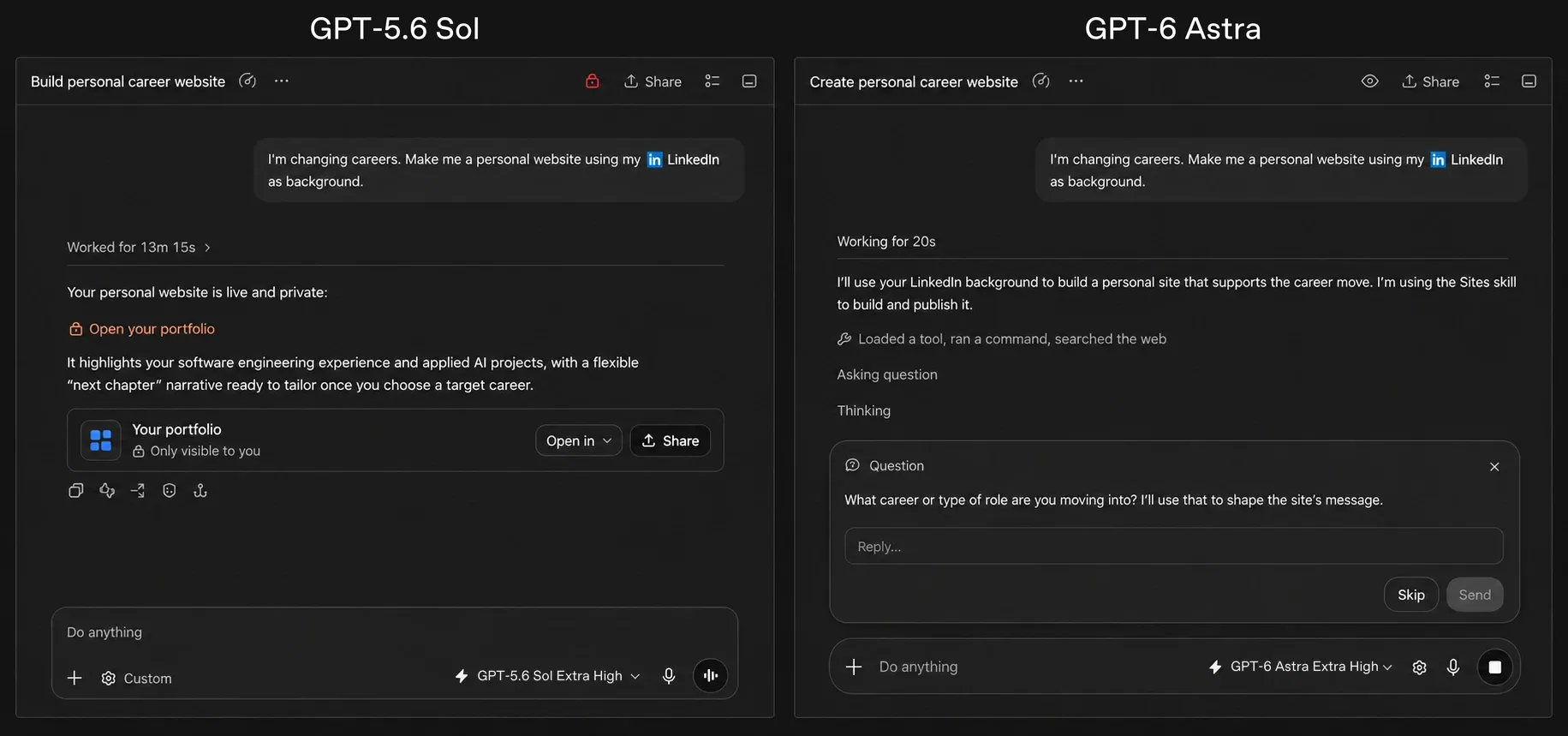
AI sales automation is software that finishes sales tasks end to end — not just fires a template when a trigger trips. What changed in 2026 is agency. GPT-6 Astra can browse, fill forms, update CRM records, and draft replies in your voice, then hand anything consequential back to you.
Old-school automation was if-this-then-that: form submitted, canned email sent, rep pinged. Useful, but blind. Agentic AI for sales reads the actual situation — firmographics, behavior, account history — decides what happens next, and does the work itself.
GPT-6 Astra, announced September 3, 2026, reached a limited set of organizations day-one, then rolled out within days to all ChatGPT Plus, Pro, Business, and Enterprise users plus OpenAI API, Microsoft Azure, and AWS Bedrock. We covered the GPT-6 Astra launch in full separately. Four capabilities matter for sales:
- Computer use. Astra fills online forms, updates customer records in a CRM, organizes calendars, researches online, and drafts summaries straight into email and document editors.
- Workflow quality. It scores 41.4% on AutomationBench versus 18.1% for GPT-5.6 Sol — the report card for real automation tasks — and completes tasks 1.9x faster on Mind2Web.
- Speed on screens. OSWorld 2.0 computer-use: 72.6% success in ~47% less time per task (roughly 40 minutes vs ~75).
- Memory. Context up to 1M tokens with 96.3% recall at 512K–1M — enough to attach a lead's entire history to every decision.
The GPT-6 Astra API exposes the model as gpt-6-astra at $10 per million input tokens and $50 per million output tokens, with a Fast mode at up to 2x speed for 2x the price.
Why this matters for solopreneurs and lean sales teams
The market already moved. Salesforce's ninth State of Sales report finds nine in 10 sales teams use AI agents or expect to within two years. Waiting another buying cycle means competing against teams that answer leads in seconds, not shifts.
The time math is brutal for small teams. HubSpot's 2026 data shows reps spend only 33% of their day actively selling; 81% say AI reduces manual tasks and 78% call it an efficiency gain. 64% of sales pros save 1–5 hours a week, and 70% say AI personalization lifts response rates.
Buyers changed too. 57% of B2B buyers purchased without a single meeting, and 75% prefer to research independently. When buyers self-serve, your content, scoring, and automated sales follow-up do the selling — or nobody does.
Gartner expects agentic AI to autonomously resolve 80% of common customer-service issues by 2029, cutting operational costs 30%. Sales and service are converging on the same machinery — we mapped the same shift in SEO automation with GPT-6 Astra. A solopreneur with a wired pipeline gets AI SDR economics: no ramp time, no headcount, per-task costs.
The pipeline automation map: six stages, one agent
Sales pipeline automation works when each stage gets one job, one capability, and one prompt. Here is the full map — capture, qualify, nurture, follow-up, close, report — with the GPT-6 Astra feature powering each stage, the tool wiring, and a starter skeleton.
1. Capture: turn attention into known leads
Goal: convert anonymous traffic into enriched records. Astra's research skills enrich the source while the lead is still on your page, before the first reply. Wire it: lead magnet landing page or Shopify store → HubSpot form → webhook → enrichment. A strong lead magnet is still the trigger — here's how to build one with AI.
Enrich this inbound lead: {form data}.
Research the company, then output JSON:
company_size_estimate, industry, likely_role,
icp_fit_0_100, confidence, missing_fields.
2. Qualify: score and route without gut feel
Goal: decide who deserves your calendar. This is AI lead qualification: Astra reads the full record — context stretches to 1M tokens, so attach every touch and note — and scores it against your written rules. This is where AI CRM automation pays for itself: scores write back to HubSpot lifecycle stages, low scores drop into nurture, high scores ping you.
Score this lead 0-100 against our ICP rules:
{rules}. Use evidence only from the record.
Output: score, top-3 evidence lines,
next action (nurture / book call / disqualify).
3. Nurture: sequences that don't read like robots
Goal: stay present until timing catches up. AI lead nurturing sequences drafted by Astra match your voice doc and reference what the lead actually downloaded. Wire it: your email sequence tool; in WhatsApp-first markets, the same drafts feed a WhatsApp sales automation flow.
Draft a 7-touch, 14-day nurture for a lead
magnet downloader who hasn't booked.
Mix: 4 value emails, 1 case study,
1 objection-handling, 1 direct CTA.
Our lead magnet nurture sequence walkthrough plugs straight into this stage.
4. Follow-up: the stage where most revenue dies
Goal: never let a warm lead go cold. Automated sales follow-up triggers on behavior — no-show, proposal opened, invoice idle — and drafts the nudge within seconds. Astra's background mode and webhooks, documented in OpenAI's agents guide, let runs fire on events without babysitting.
Trigger: proposal viewed twice, no reply in 48h.
Draft a 60-word nudge referencing the section
they re-read: {section}. One CTA. No urgency tactics.
5. Close: drafts that carry your best thinking
Goal: remove friction at decision time. Use high reasoning effort for negotiation replies, objection handling, and proposals. Astra also assembles supporting assets — the same way you'd build a pitch deck with AI — so the close arrives complete. Drafts queue in your approval inbox first.
Our prospect said: {objection}. Deal size: {x}.
Draft a 120-word reply: acknowledge, reframe
with the ROI math above, one clear next step.
Tone: confident, zero pressure.
6. Report: know your pipeline every Monday
Goal: replace end-of-week guesswork. Astra's long-context summarization turns a raw CRM export into a decision-ready brief. Wire it: scheduled export → summary to Slack or email — the same pattern agencies run for monthly client reports.
From the CRM export below, produce a Monday
report: stage counts + deltas vs last week,
5 at-risk deals with reasons and next actions,
3 coaching observations. Under 250 words.
Cite deal IDs for every claim.
Ready-to-copy prompts for your AI sales workflow
Five skeletons above; five production-ready prompts here — paste, replace the braces, run. Each maps to one pipeline stage, so adopt them one at a time instead of rebuilding everything in a weekend. For deeper prompt mechanics, see the GPT-6 Astra prompting guide.
1. Lead qualification (BANT + ICP rules)
You are a sales qualification agent for {company},
{product}, {ICP definition}. Using the lead record
below (source, firmographics, behavior events),
score fit 0-100 against BANT + our ICP rules:
{rules}. Output JSON: score, top-3 evidence lines,
missing-info questions, recommended next action
(nurture / book call / disqualify). Ask no more
than 3 follow-up questions. Do not invent facts
not present in the record.
2. AI lead-scoring rubric from your own closed deals
Given our closed-won (n={x}) and closed-lost
(n={y}) deal summaries below, derive a weighted
scoring rubric with 6-8 attributes. Output the
rubric table, weights, and 3 example scores.
Flag any attribute you could not infer from the
data as ASSUMPTION.
3. First-touch outreach (high effort)
Sales outreach personalization at scale lives or dies on this one. Facts in, one CTA out.
Draft a 90-word first-touch {email} to {role}
at {company}. Use only these verified research
facts: {facts}. Reference one specific pain
signal. One CTA (15-min call). Match our brand
voice doc: {voice}. Output 2 variants + a
one-line rationale each. No superlatives,
no false urgency.
4. Nurture sequence planner
Map a 7-touch, 14-day nurture for a lead magnet
downloader who hasn't booked. Mix: value emails
(4), case study (1), objection-handling (1),
direct CTA (1). For each touch: goal, subject or
first line, send day, channel. Hold all sends
for human approval before anything is queued.
5. Weekly pipeline report
From the CRM export below, produce a Monday
pipeline report: stage-by-stage counts and deltas
vs last week, 5 at-risk deals with reason and
suggested next action, and 3 coaching observations.
Keep under 250 words. Cite deal IDs for every
claim. If a delta cannot be computed from the
data, say so instead of estimating.
Token economics: what an automated pipeline actually costs
The cost of AI sales automation fits on one line. GPT-6 Astra API Standard pricing is $10 per million input tokens and $50 per million output tokens; Fast mode runs up to 2x faster at 2x the price. Everything else is arithmetic you can check.
Here's the worked example: 2,000 leads a month at roughly 3,000 input and 1,000 output tokens each — ICP rules, history, and research in; score, evidence, and a draft out. Raw volume is 6M input ($60) plus 2M output ($100). Because agent loops mostly re-read cached context and Astra bills cache separately, the real bill lands near $110 a month at Standard.
| Option | How you pay | Cost at ~2,000 leads/month | Best for |
|---|---|---|---|
| GPT-6 Astra API — Standard | $10/M input, $50/M output tokens | ≈ $110/month (worked example above) | Full control of your AI sales workflow |
| GPT-6 Astra API — Fast mode | Up to 2x speed at 2x Standard price | ≈ $220/month for the same workload | High-volume triage where latency matters |
| GPT-6 Astra in ChatGPT (Plus, Pro, Business, Enterprise) | Included in existing subscription allowances; extra credits purchasable | Your existing plan cost | Testing workflows before building on the API |
| AI SDR platforms (Artisan, 11x) | Credit tiers scoped to lead volume, mailboxes, dialer seats | Not publicly listed per credit — verify current pricing | Teams wanting a managed outbound pod |
| Human SDR | Salary, benefits, tooling, ramp time | One full salary — the biggest line in any lean budget | Complex enterprise deals and relationships |
| ArWriter (content side) | Flat subscription | From $4.99/month | Lead magnets, outreach drafts, nurture emails, reports |
Two rules keep the number honest. Use high reasoning effort only for deal-critical drafts — negotiation replies, proposals — where Astra emits about 65% fewer output tokens than Claude Opus 5 at top settings. Use Fast mode for high-volume triage, where the ~47% time saving matters more than the doubled price. AI SDR vendors price in credits scoped to lead volume, mailboxes, and dialer seats — verify current pricing before modeling a year of them.
How a Manchester agency cut lead response time from 9 hours to 40 seconds

Tom Redfern runs a four-person demand-gen agency in Manchester selling to e-commerce brands on Shopify. Inbound leads sat in a shared inbox until someone had a spare hour — median first reply: 9 hours. Hot leads went cold before the agency ever spoke to them.
His fix took a weekend and the wiring from the map above: HubSpot form → webhook → gpt-6-astra qualification → CRM fields updated automatically → a first-touch draft queued for one-click approval. First reply time dropped from 9 hours to 40 seconds — the reply exists the moment the form submits; Tom just clicks send. Over 90 days, qualified pipeline roughly tripled on the same ad spend and headcount.
Three mistakes cost him the first month. He automated first-touch before writing down his ICP, so early drafts were confident nonsense. He skipped the approval gate at first; a draft with the wrong company name went out. And he let the agent pad outreach with invented research — fixed by the verified-facts-only rule in prompt 3.
By the way, if you need the content side of this pipeline — lead magnets, outreach drafts, nurture emails — ArWriter does it with a full bilingual editor, starting at $4.99/month.
What to automate and what to approve: human-in-the-loop checkpoints
Auto-run the reading and the drafting; approve anything a customer receives or that commits money. OpenAI built the same logic into GPT-6 Astra — the model itself pauses at consequential decisions instead of barreling through them, which maps cleanly onto sales.
The alignment data backs the design. On OpenAI's impossible-task evaluation, Astra took 0% out-of-scope actions versus 48% for GPT-5.6 Sol. It never circumvented Codex Auto-Review denials, and it is 3x less likely than Sol to misstate its own capabilities — the failure mode behind most "the AI promised them a discount" horror stories.
The practical split for a lean team:
- Safe to auto-run: enrichment and research summaries, lead scoring, CRM field updates and hygiene, weekly pipeline reports, draft generation, subject-line variants.
- Always approve: first-touch sends, pricing and discount language, contract and proposal terms, list uploads for cold outreach, anything with legal weight.
Compliance basics for outbound: GDPR and CAN-SPAM
Volume without consent multiplies liability: automation makes a mistake once, then repeats it two thousand times. Under GDPR you need a lawful basis — consent, or documented legitimate interest for B2B in many EU states. CAN-SPAM polices mechanics: accurate headers, a working opt-out, your physical postal address.
The specifics worth wiring into your workflow:
- GDPR: B2C cold outreach generally requires opt-in consent you can prove. Honor objections and erasure requests fast, and keep a suppression list the agent must check before drafting.
- CAN-SPAM: identify commercial content honestly, include your physical postal address, honor opt-outs within 10 business days, and monitor what your AI sends — you answer for messages sent on your behalf.
- Pipeline habit: put the consent check before the drafting step, not after. It is cheaper to block a draft than to recall an email.
One caveat: this is orientation, not legal advice — for anything at scale or cross-border, spend an hour with a lawyer who knows your jurisdiction.
A 30-day rollout plan
You can wire this in a month without writing code beyond webhooks. The sequence matters more than the tools: data first, judgment second, sends last. Follow the order and you finish with one fully automated stage instead of six half-built ones.
- Days 1–3 — audit. Map every stage from form to close and mark where leads wait more than an hour. The worst bottleneck is your first target.
- Days 4–7 — define the ICP. Write the rules down: industries, sizes, triggers, disqualifiers. Pull your last 20 closed-won and 20 closed-lost deals for the rubric prompt.
- Days 8–12 — wire the data. Connect form → CRM, clean the fields the agent will read, and build the suppression list before anything can send.
- Days 13–17 — qualification. Run the BANT prompt on your last 100 leads. Compare its scores to your gut and adjust rules until you agree most of the time.
- Days 18–22 — CRM automation. Let Astra's computer use update records. Watch it for a week before trusting it unsupervised.
- Days 23–26 — drafts with approval. Turn on first-touch and follow-up drafting, with every send passing through your click.
- Days 27–29 — reporting. Schedule the Monday report. It becomes your dashboard for what the machine did.
- Day 30 — review. Compare response time, qualified pipeline, and hours saved against your day-one audit. Expand one stage at a time from here.
Frequently asked questions
Quick answers to the questions founders ask before wiring this up: what an AI SDR is, what it costs, whether it's compliant, and whether any of it replaces a rep. Each answer stands alone, so skim what you need and skip the rest.
Can AI really automate lead generation?
Yes — the capture and qualification side, fully. GPT-6 Astra researches prospects, scores them against your ICP, updates CRM records, and drafts first-touch messages without human input. What it shouldn't do is send unsupervised cold outreach or commit pricing. Lead generation automation works best with approval gates at the send step.
What is an AI SDR?
An AI SDR is software that does a sales development rep's job: prospecting, account research, qualifying inbound leads, drafting outreach, booking meetings, and updating the CRM. Vendors like Artisan and 11x sell managed versions. With the GPT-6 Astra API, you can build the same workflows around your own stack.
How much does AI sales automation cost?
Less than most teams assume. GPT-6 Astra API Standard pricing is $10 per million input and $50 per million output tokens; a 2,000-lead month at roughly 3K in and 1K out per lead lands near $110. Managed AI SDR platforms charge credit tiers instead — verify current pricing before comparing.
What's the difference between sales automation and AI sales automation?
Traditional automation follows rigid rules: form submitted, template sent. The AI version reads context and decides — it scores the same lead differently based on behavior, drafts a reply referencing the prospect's actual situation, and updates CRM fields on its own. Rules execute; agents judge.
Does sales automation replace salespeople?
No — it replaces their admin. Reps still spend only 33% of their time selling; automating the rest is the entire upside. GPT-6 Astra is explicitly built to pause at consequential decisions and recorded 0% out-of-scope actions in OpenAI's impossible-task evaluation. Judgment, relationships, and negotiation stay human.
How do AI sales agents update a CRM automatically?
Through computer use. GPT-6 Astra operates software the way a person does — opening records, filling fields, logging outcomes — which is why it scored 72.6% on OSWorld 2.0 in ~47% less time per task. No bespoke integration is required, though API calls are cleaner where you already have them.
Is AI cold outreach compliant under GDPR and CAN-SPAM?
The AI changes none of your obligations. GDPR needs a lawful basis — consent, or documented legitimate interest for B2B in many EU states. CAN-SPAM requires accurate headers, a physical postal address, and opt-outs honored within 10 business days. Put suppression checks in the workflow before drafts exist.
What is GPT-6 Astra, and can it run my sales workflows?
Yes. GPT-6 Astra is OpenAI's agentic model, announced September 3, 2026, available across ChatGPT plans and the API. It browses, fills forms, updates CRMs, and holds context up to 1M tokens. It scored 41.4% on AutomationBench versus 18.1% for GPT-5.6 Sol — purpose-built for this work.
What to do next
Our verdict after mapping the whole pipeline: this is now a build decision, not a buy decision. Managed AI SDR platforms rent you their process at credit prices; GPT-6 Astra at $10/$50 per million tokens lets you own the workflow, wired to your actual CRM, for roughly $110 a month at modest volume.
Start smaller than feels ambitious. Pick your worst bottleneck from the 30-day plan, run the qualification prompt on your last 100 leads this afternoon, and let the Monday report tell you whether to expand. The teams winning at this didn't automate everything — they automated the waiting.
The content engine matters as much as the agent. ArWriter writes the lead magnets, outreach drafts, nurture emails, and weekly reports your pipeline runs on — a full bilingual editor, with plans from $4.99/month.
Sources
- OpenAI — GPT-6 Astra announcement — primary source for every pricing, benchmark, and capability claim; verified September 17, 2026
- OpenAI — Using GPT-6 Astra (API guide) — Responses API, background mode, webhooks, and multi-agent orchestration docs
- Salesforce — State of Sales, 9th edition — nine in 10 sales teams use or expect to use AI agents within two years
- Gartner press release, March 5, 2025 — agentic AI to autonomously resolve 80% of common customer-service issues by 2029
- HubSpot — AI sales automation workflows — reps sell only 33% of the time; 2026 adoption and efficiency data
Try ArWriter Today
Your pipeline can write its own words now. ArWriter is the bilingual content engine for every stage above — lead magnets, outreach drafts, nurture emails, and reports. Starts at $4.99/month.