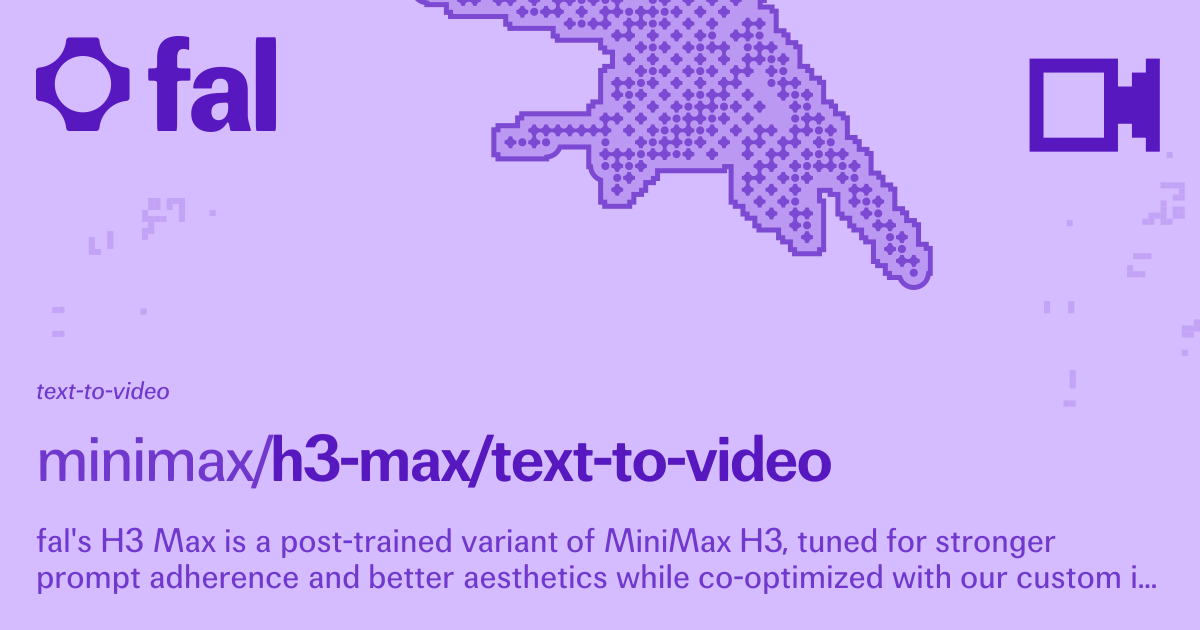
On September 1, 2026, the generative media platform fal released H3 Max, a post-trained version of MiniMax's open-weights H3 video model, developed by fal Research in close collaboration with the MiniMax team. Independent leaderboards now rank it ahead of heavyweight rivals including Veo 3.1 and Kling 3.0, and it generates video faster than real time — a five-second clip in roughly three seconds. But the detail that should anchor your planning today: the current 50% promotional pricing ends in late September, after which rates double. This guide breaks down what the model is, what it has proven, what it actually costs, and whether it belongs in your production stack.
Primary sources: fal’s official H3 Max launch press release and the official fal.ai model page with current pricing.
A note on timing, stated plainly: this is not a same-day story. The launch happened at the start of the month, and we are covering it now as a deliberate deep-dive — because two things changed since launch day: confirmed independent benchmark leadership, and the approaching end of the promotional pricing window. Anyone who decides before the end of September locks in half the cost.
What is H3 Max, and who built it?
The backstory is unusual and worth understanding. MiniMax, the Chinese AI lab, released its H3 video model with open weights — meaning anyone can download, run, and adapt it. fal, the US-based platform that specializes in hosting and serving generative models at production scale, took the original H3 weights and put them through substantial post-training: additional intensive training focused on the two things content creators care most about — prompt adherence (doing literally what you asked) and visual quality.
But fal went further than retraining. Its inference team co-designed a serving engine around the model as it evolved, treating model research and inference optimization as one problem rather than two. That is why fal describes itself as "the original creator of H3 Max" — this is not simply H3 hosted on someone else's GPUs; it is a new variant of the model, engineered together with the infrastructure that runs it.
The MiniMax team itself endorsed the result. In the official press release, the MiniMax H3 team said: "MiniMax H3 Max combines state-of-the-art video quality with a step-change in generation speed, making high-quality video generation practical for many more real-world applications at a much broader scale… We've worked closely with fal since day one, and their expertise in generative AI infrastructure and ability to bring frontier models into production quickly and reliably make them a natural partner."
If you followed our earlier MiniMax coverage — such as our guide to the base H3 model at launch or our review of the MiniMax Design desktop app — think of H3 Max as "H3 after an intensive training camp, bolted onto a racing engine."
What "faster than real time" means in practice
The official numbers from fal's announcement:
- A five-second video generates in approximately three seconds of wall time.
- Throughput is roughly 35x that of the official MiniMax H3 endpoint.
- In fal's testing, an average of 15x faster than models of comparable quality.
- And from Design Arena's independent statement: performance "up to 50× faster" within the same quality band.
Why does this matter to a working creator? Because generation wait time has been the single biggest operational bottleneck in AI video tools. When you wait two minutes to learn whether a prompt worked, you try a handful of clips per day and give up. When you wait seconds, generation becomes interactive refinement: generate, watch, adjust the prompt, regenerate — dozens of iterations in one session. That is precisely the workflow short-form creators need, cycling quickly through variants of a clip before choosing the keeper.
The independent benchmark results, precisely
Here we do not rely on fal's word alone — two independent evaluators provide the rankings:
First, Design Arena (human preference evaluation): H3 Max holds the #1 spot on the Image-to-Video leaderboard with an Elo rating of 1,341, ahead of official MiniMax H3 itself (1,333) and other leaders including Seedance 2.5, FLUX.3, and Gemini Omni Flash. Design Arena stated on the record: "With performance in the same band as MiniMax H3 and generation speeds up to 50× faster, MiniMax H3 Max by fal establishes a new speed–preference Pareto frontier, as verified by Design Arena's independent benchmarking."
Second, Artificial Analysis (automated, large-sample evaluation): fal's H3 ranks #1 on the Image-to-Video Leaderboard with Audio, with an Elo of 1,201 computed across 2,177 samples — ahead of ByteDance Seedance 2.0, MiniMax H3, Gemini Omni Flash, Grok Imagine Video 1.5, Veo 3.1, and Kling 3.0.
For context: these Elo ratings come from pairwise comparisons judged by humans (Design Arena) or large-scale automated evaluation (Artificial Analysis). The 8-point gap between H3 Max and base H3 on Design Arena is real but not a chasm — the decisive advantage is combining this quality tier with this speed, a combination no other model had achieved on either board.
fal adds its own internal human-preference testing: in head-to-head matchups against 12 leading video models, H3 Max ranked first in overall quality, prompt understanding, and aesthetics, winning the majority of matchups against every model tested.
Pricing in full: before and after the promotion
This section is the heart of your decision. The figures below are quoted from the official model page on fal as it stands today (September 2026):
- Current promotional rates (50% off, limited time): $0.025 per second at 480p, $0.04 per second at 768p, $0.08 per second at 1080p.
- After the promotion ends: $0.05 per second at 480p, $0.08 per second at 768p, $0.16 per second at 1080p.
The official page note says the discount runs until the end of September (the on-page note literally reads "September 31" — a typo on fal's page, since the month has 30 days; practically, end of month). From the date of this article, that leaves roughly two weeks to generate your clip backlog at half cost.
Now let's translate those numbers into real content budgets, as fal's own announcement did:
- A 5-second clip at 768p during the promotion: about $0.20 ($0.40 after it ends).
- A 10-second TikTok or Instagram asset: $0.40 now, $0.80 later.
- A 30-second piece: $1.20 now, $2.40 later.
- A designer producing ten 10-second concept animations: $4.00 during the promotion — $8.00 afterward.
How you actually use H3 Max
The model is served through three official fal surfaces:
- The API: for developers and product teams — dedicated endpoints for text-to-video and image-to-video generation.
- The Playground: a direct in-browser interface where you write a prompt, pick a resolution, and generate — the natural entry point for non-programmers.
- fal Agent: the platform's agent that manages an end-to-end generation workflow step by step.
One practical note: because the model's headline improvements are in prompt adherence, your output quality rises sharply with well-constructed prompts — scene, camera, lighting, motion. If you want to build that skill, studying structured prompt patterns helps; a free starting point is ARWriter's image prompt library, whose principles (subject, style, composition, lighting) transfer directly to video prompting.
What this means for your content workflow
Scenario 1 — short-form Reels and TikTok creator: you need 20 short clips a month for backgrounds and animated intros. At 768p after the promotion, that is roughly $16/month — less than a single editing-tool subscription, with no camera and no shoot.
Scenario 2 — e-commerce store: animate static product photos via the image-to-video path. A 5-second clip per product means a 50-product catalog refresh costs about $40 during the promotional window — a budget that was unthinkable two years ago.
Scenario 3 — content agency: the real test is not one clip but a production line: idea, prompt, fast iterative generation (where fal's speed dominates), then editing and publishing. The model solves the middle bottleneck; ideation, copy, and distribution remain your tooling — multilingual drafting and scheduling handled by platforms like ARWriter that produce content and publish it across channels from one place.
Quick comparison: H3 Max versus what creators use today
- Versus Veo, Sora, and Kling: on Artificial Analysis' video-with-audio board, H3 Max explicitly outranks Veo 3.1, Kling 3.0, and Seedance 2.0 — but leaderboards shift monthly, and each model has stylistic strengths (cinematic look, facial realism, complex motion). The honest method: run one reference prompt, identical, on two models, and compare on your own style.
- Versus official MiniMax H3: H3 Max is faster (~35x throughput) and slightly higher on Design Arena — the added value is the speed plus improved prompt adherence, on top of the base model's quality.
- Versus other open video models (Wan, LTX): open-weights models we have covered, such as Alibaba's Wan 3.0, offer self-hosting freedom if you own the hardware; H3 Max offers ready production speed with zero server management. The right choice depends on your volume and technical depth.
A practical production line: from idea to ready post in one hour
To translate the numbers into a tangible way of working, here is a structured pipeline that takes about an hour per Reel:
Step 1 — idea and scenario (10 minutes): define the clip: what appears in the first two seconds? What is the core motion? What visual impression do you want? Write a two-line scenario per shot, and decide whether you start from text (text-to-video) or from an existing image (image-to-video — the natural path for product content).
Step 2 — a disciplined prompt (10 minutes): structure your prompt in four layers: the subject and its description; camera motion (slow push-in, lateral tracking, locked shot); lighting and style (soft studio light, glossy commercial look); and the final format (768p is usually enough for social). With a model known for prompt adherence, every word you write will be executed — delete what you do not want, and skip decorative filler.
Step 3 — fast iteration rounds (20 minutes): this is where the speed advantage pays. Generate three variants of the first shot, compare, keep the best direction, then change one variable per round (lighting or motion only — never everything at once). With generation measured in seconds, twenty minutes buys you ten iterations; the previous generation of tools burned a full day on the same loop.
Step 4 — edit, write, publish (20 minutes): assemble the best takes in your editor, add captions and hashtags, then publish or schedule. For the writing side, dedicated tools fit better than a chat window — pair the clip with polished multilingual copy generated through ARWriter's auto-writer to produce a full description plus a companion post for your other channels, so one clip feeds three platforms at once.
The bottom line: for a budget under one dollar (even after the promotion ends), you get professional-grade video raw material that two years ago required a videographer, an editor, and a full day of work.
Honest limitations to read before you pay
- Prices double after September: every calculation above changes at month-end; budget on post-promotion rates in your monthly planning so the shift does not surprise you.
- Developer-first platform: fal is not a simple phone app. The Playground is approachable, but the professional workflow (API, billing, queues) assumes some technical comfort.
- The lead is narrow on some boards: 8 Elo points on Design Arena is not a landslide, and boards update continuously — rankings may look different in a month.
- USD billing, international card: there is no regional payment option yet; you need a card that works internationally.
- Short durations: all official cost examples are 5–30 second clips; longer content means multi-clip generation and downstream editing.
- Disclosure obligations: like all generative output, platforms expect AI-generated video to be labeled — follow Instagram's and TikTok's AI-labeling rules to protect your reach.
Frequently asked questions about H3 Max
What is the MiniMax H3 Max model?
It is an AI video generation model released by the fal platform on September 1, 2026 — a post-trained version of MiniMax's open-weights H3 model, improved for prompt adherence and visual quality and engineered to generate faster than real time.
How fast is H3 Max at generating video?
According to fal, a five-second video generates in about three seconds of wall time, with throughput around 35x the official MiniMax H3 endpoint and an average 15x speed advantage over comparable-quality models.
How much does H3 Max cost per video?
During the promotional period ending late September 2026: $0.025/second at 480p, $0.04/second at 768p, and $0.08/second at 1080p. After the promotion, rates double to $0.05, $0.08, and $0.16 per second respectively.
Does H3 Max beat Veo and Sora?
On Artificial Analysis' independent video-with-audio leaderboard, H3 Max outranks Veo 3.1, Kling 3.0, Seedance 2.0, and Grok Imagine Video 1.5 with an Elo of 1,201, and it holds #1 on Design Arena's image-to-video board — though rankings evolve and stylistic strengths differ between models.
How can I try MiniMax H3 Max?
Through fal.ai: the in-browser Playground for quick experiments, the API for developers, or fal Agent for end-to-end workflows — all supporting text-to-video and image-to-video at 480p, 768p, and 1080p.
Do I need a powerful computer to run H3 Max?
No. Generation runs on fal's cloud infrastructure — a browser and an account are enough in the Playground, unlike self-hosted open-weights models that require serious hardware.
Bottom line
H3 Max is a rare case of competition directly benefiting the end user: an open-weights model picked up by an engineering-driven platform and turned into a faster, more obedient variant that tops independent rankings while pricing itself in fractions of a dollar per second. The practical decision has a clear shape: if video content is in your plan for next quarter, the pre-September window halves your cost. Start with two test clips built on a disciplined prompt, judge the style against your own audience, then build the production line: generate on fal, and handle multilingual copy, scheduling, and publishing with a dedicated tool like ARWriter's toolset — from idea to channel.