Last updated: September 2026 — Explainer on Midjourney V8.2 (default since 24 July 2026). Not fake breaking news.
Midjourney V8.2 became the default model on 24 July 2026 with an official focus on aesthetics, image quality, and Personalization — plus a new Edit Model for changing finished frames without regenerating them from scratch. If you ship ads, thumbnails, social sets, or brand visual systems, this guide (revised September 2026 after two months of production use) covers what changed, when to stay on V8.1, how the Edit Model fits a real pipeline, how to re-tune style references, and how it compares with tools creative teams already use — without PR gloss.
AI Overview: Midjourney V8.2 is the image model Midjourney made the default on 24 July 2026. Its announced improvements target aesthetics, image quality, and Personalization, alongside a new Edit Model for localized edits. Because default changes shift everyone's outputs, creators should re-test approved brand assets before bulk production, pin versions on live campaigns, and keep typography and logos in a design tool.
Source: official @midjourney post on X — 24 July 2026.
What Midjourney actually said on 24 July 2026
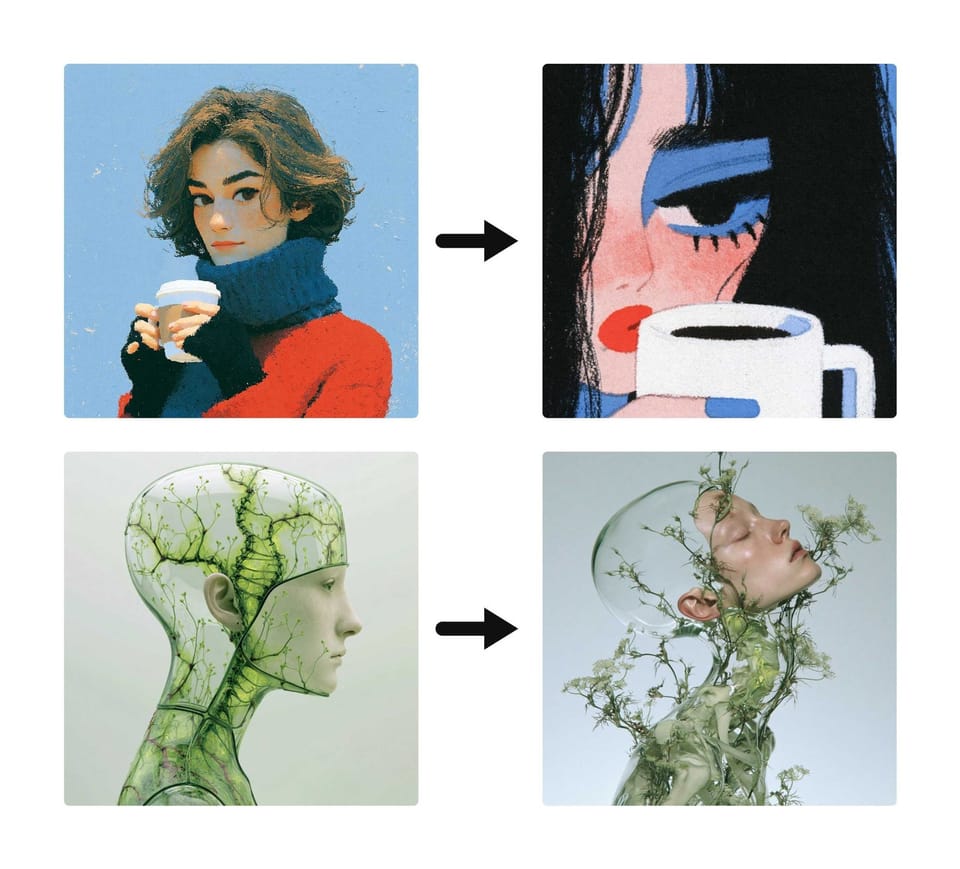
Midjourney announced it was releasing V8.2 and making it the default. The update focuses on aesthetics, personalization, and image quality. The official post describes the new style as more creative, bold, edgy, and fresh, with personalization working better than ever. The Version 8.2 update page matches that framing. Version history notes place V8.2 as default on that date after V8.1 held the default slot from 10 June through 23 July 2026.
Defaults matter because everyone's outputs shift even if nobody touches settings. Prompt libraries calibrated on V8.1 drift in color, contrast, and mood. Two months of live production since the switch confirms the drift is real but not uniform: product-adjacent frames moved less than portrait and mood work, where the bolder grade is most visible.
The 2026 version timeline in one minute
If you skipped a few releases this year, here is the compressed history: V8 carried the first half of 2026 as the workhorse default. V8.1 took the default slot on 10 June 2026 — a refinement release, calmer grade, better coherence. V8.2 replaced it on 24 July 2026, six weeks later, with the aesthetic leap and Personalization improvements discussed above. The pattern worth internalizing: Midjourney has moved the default roughly every one to three months through 2026, which means any prompt sheet older than a quarter is historical documentation, not a production tool. Teams that pinned --v on critical work sailed through both bumps untouched; teams that relied on the default re-learned their own style library twice in one summer.
V8.2 vs V8.1: when the new default wins, and when to stay put
The question every operator asks first is not "is V8.2 better?" but "which of my jobs does it change?" Here is the working split we use after re-baselining a dozen brand kits:
| Dimension | V8.1 | V8.2 |
|---|---|---|
| Default taste | Calmer, more neutral grade | Bolder, higher contrast, "edgier" per official notes |
| Aesthetics focus | Consistent workhorse window (10 Jun – 23 Jul) | Aesthetic quality is the headline improvement |
| Personalization | Works, needs more ranking history | Better signal from fewer ratings, per announcement |
| Product / packshots | Safe default for conservative brands | Wins after sref re-tuning; can overshoot out of the box |
| Portraits / mood work | Good | Visibly stronger for most testers |
| Legacy campaigns | Version already approved | Do not touch mid-flight |
Practical rules:
- Stay on V8.1 for live paid campaigns that were approved on it. Pin the version until the flight ends; a mid-flight default bump is how carousels stop matching.
- Move new bold-aesthetic briefs to V8.2 — energy, lifestyle, editorial thumbnails. That is where the new grade pays immediately.
- Conservative brand systems need a detune pass first: lower stylize values, quieter srefs, then compare against V8.1 side by side before committing.
- Do not mass-regenerate the archive. Re-test the twelve assets that actually run (see playbook below); the rest of the library is inventory, not a to-do list.
The new Edit Model: local changes without a reroll
The quiet operational win in the V8.2 window is the Edit Model. Instead of re-prompting and praying that the rest of the frame survives, you select a region and describe the change — swap a background, remove a prop, recolor a jacket — and the untouched areas stay put.
Where it earns its fast hours:
- Client corrections. "Make the label bigger, keep everything else" used to mean a reroll lottery. Now it is one targeted edit and a version note.
- Channel variants. One approved hero frame, edited per crop or per market background, keeps visual consistency across a placement set.
- Typography plates. Generate clean plates, then edit in reserved space — but still set final type in Figma or Canva where kerning and language rendering are controllable. In-image text remains variable across languages; do not bet a multilingual campaign on it.
Limits to respect: heavy edits that move composition (new subject, changed camera angle) still favor a fresh generation; and every edit is another generation event on your plan's terms — track fast hours separately from exploratory spend so "one small fix" requests from clients do not quietly eat the budget. Log edits in the same asset sheet as generations, with the edit prompt recorded, or the frame becomes unreproducible.
A worked example: a client approves a hero frame for a fitness campaign, then legal asks to remove a background billboard. Pre-Edit-Model workflow: re-prompt, reroll twenty times hoping the model keeps the athlete's pose and lighting, deliver "close enough." Current workflow: select the billboard region, describe the clean wall, one pass, same pose, same grade, done in three minutes. The frame stays the approved frame — that is the entire value proposition, and it is why edit history belongs in your asset log.
V8.2 parameters quick table
The knobs that matter after the bump, updated for current production use:
| Parameter | What it does | V8.2 working note |
|---|---|---|
--v 8.2 |
Pins the model version | Use on every critical job; never rely on the default staying put |
--stylize 0-1000 |
Strengthens Midjourney's aesthetic opinion | Lower it (100-250) when the bolder default fights a calm brand |
--sref + --sw |
Style reference image(s) and weight | Re-tune weights after the bump; old weights overshoot on V8.2 |
--omni (Omni Reference) |
Points character/object identity across frames | Best tool for consistent thumbnails and mascots |
--p (Personalization) |
Applies your ranked-preference profile | Re-validate profiles on V8.2 before bulk runs |
--ar |
Aspect ratio | Set per placement (1:1, 4:5, 9:16) at generation time |
--seed |
Reproducibility anchor | Log it with the prompt or the winning frame is gone |
--no |
Negative exclusions | Still supported; retest exclusions that behaved differently on V8.1 |
If your prompt sheet predates 24 July, treat every row as untested until re-scored — that is the honest default posture after any model bump.
Why Personalization is the real workflow story
Personalization is not a beauty filter; it is a preference layer trained by your rankings and feedback. Midjourney says it works better in V8.2, and production use agrees: profiles converge faster with fewer ratings. For studios running multiple brands:
- Keep separate preference profiles per brand when possible so a sports client does not inherit a perfume client's look.
- After a default bump, re-test 10 canonical prompts per brand before mass production.
- Log version, stylize, sref/moodboards, and seeds — or you cannot reproduce a winning frame three weeks later.
What it means for content creators
- Re-baseline brand kits. Run A/B on approved templates: same prompt on V8.1 (if still selectable) vs V8.2. Score color match, product fidelity, and mood. "Prettier" is not the same as "on-brand."
- Draft wide, lock, then ship. Use faster exploratory modes for ideation, lock a style pack, render finals, finish type in a design tool, then schedule. V8.2's pitch is aesthetic quality; your process still needs a lock step.
- Text-in-image still needs a plan. Do not assume perfect typography for every language. Sensitive campaigns should composite headlines in Figma/Canva atop clean plates — and use the Edit Model only for reserving space, not final type.
- Labeling and client policy. With broader AI transparency rules rolling through 2026 in the EU and platform-level AI labels elsewhere, confirm client policy on disclosing synthetic creatives before you scale.
By the way, if you need bilingual prompt libraries plus scheduling around your visual pipeline, ArWriter helps with the writing/scheduling half — it is not a Midjourney replacement, and it should not be sold as one.
The operator playbook: default bump to shipped campaign
First 90 minutes.
- Pull 12 client-approved images from the last 60 days.
- Recover prompts and style refs.
- Regenerate on V8.2 with identical settings.
- Score color / faces / product / mood (1-5).
- Rebuild moodboards for anything under 4.
- Update the team's standard prompt sheet with the 2026-07-24 timestamp.
- Pause bulk generation if drift is severe — cheaper than pulling live ads.
Common failure modes after a default bump. Mass-regenerating hundreds of assets without a scorecard floods shared drives with unapproved variants. One shared Personalization profile across unrelated brands slowly makes every client look the same. Shipping broken typography because nobody checked language rendering. Forgetting to pin the model version on live campaigns, then wondering why the new cover does not match last week's set.
Countermeasures are boring and effective: no bulk production before twelve scored samples; no client delivery without prompt metadata; no sensitive multilingual type left solely to the generator. For teams larger than three, appoint a style keeper who can reject assets missing version logs.
Budget discipline. V8.2's nicer defaults increase casual generations — exploratory beauty is a budget line. Cap weekly experimental renders separately from billable campaign production, and count Edit Model passes in the same ledger. That one split prevents both invoice shock and creative thrash.
The freeze list. Any live paid campaign should pin the version that produced the winning creative until the flight ends. Keep the freeze list visible in the asset sheet, not in someone's memory.
Measure the upgrade with business metrics: thumbnail CTR, first-round approval rate, and hours from brief to approved master. If CTR rises and revisions fall, the default bump paid for itself. If not, retune Personalization before blaming the team. A realistic two-designer social pod shipping ~40 approved stills a week can dip for a week after a default change, then climb above baseline once moodboards are rebuilt. Plan for the dip-then-discipline curve.
Build the asset library and the publish calendar
The difference between hobby volume and professional systems after a model bump is library design. Use a four-folder spine: 01-raw (generator output), 02-selected (designer shortlist), 03-finished (type and logo applied), 04-published (what actually shipped, with campaign URL). Filename tokens should include client code, date, and model version, e.g. acme_2026-08-14_v82_hero-01 — and an e suffix for Edit Model passes (..._v82e_fix-label) so edited frames stay traceable to their parent generation.
Pair folders with a living sheet: short prompt, image link, score, approved flag, brand-drift notes, approver name, edit history. After a month you will know which prompt families got worse on V8.2 and which improved. That dataset beats another hype tutorial.
If you sell into conservative verticals, tag "soft brand / bold brand" before production. A default that feels edgier can create last-minute rejections from clients who liked last quarter's calmer grade — catch that in briefing, not in final QA. Contractors need an onboarding pack: five accepted frames, five rejected frames, and banned style words. Without it, you will burn V8.2's speed gains on revision ping-pong.
From prompt to publish calendar. Most explainers stop at "the image looks better." Operators need the path to publish. After a still is approved, write three caption lengths, one CTA, and two test time slots; drop the asset into your scheduler with campaign tags the same day so it does not rot in a folder. A great still with no ship date is inventory, not marketing.
Match visual energy to first-line copy: a bolder default can fight a calm verbal brand unless you lower stylize or feed quieter references. For paid, export platform crops before Ads Manager — 1:1, 4:5, 9:16 as finished masters, not emergency in-platform crops that clip faces. Long-form articles need varied illustrative moods within one palette; readers tire of the same lighting recipe under every H2.
Spend the first two hours each month pruning rejected frames and refreshing contractor onboarding examples. Monthly hygiene is cheaper than quarterly archaeology. When the next default arrives, rebuild from the selected layer upward — do not reinvent folder taxonomy. And if stakeholders demand "AI originality," keep a short appendix of rejected alternatives; showing what you did not ship builds trust that V8.2 is a tool under direction.
Quick comparison
| Tool | Look quality | In-image text | Social finish | 2026 note |
|---|---|---|---|---|
| Midjourney V8.2 | High, bolder default taste | Variable | Export to editor | Default since 24 Jul, Edit Model added |
| ChatGPT Images | Strong with chat context | Improved over prior gens | Fast in-chat | Iteration friendly |
| Gemini image stack | Strong product shots | Test per language | Google ecosystem | Bundled value |
| Canva AI | Template-native | Excellent manual type | Best for rapid publish | Design layer |
| Adobe Firefly | CC-integrated | Model-dependent | Good for CC teams | Licensing clarity for some orgs |
Field scenarios
DTC apparel drop: 30 on-model variants on a shared plate. V8.2 looks richer; pin camera logic with real product refs, use the Edit Model for colorway swaps, add price typography in a layout tool.
Multi-location hospitality group: do not share one Personalization profile across all properties or every café will inherit the same cinematic grade.
Education YouTube: CTR-friendly bold covers help, but character consistency across 10 thumbnails beats one-off beauty — that is an Omni Reference job.
B2B SaaS marketing pod: three product marketers shipping launch assets quarterly. Use V8.2 for abstract hero visuals, the Edit Model to localize the same hero per region (background objects, color accents), and keep UI screenshots native — never generate fake product screenshots for docs or ads; composite real captures instead.
What to watch next
- How long V8.2 stays default
- Edit Model capability updates and cost behavior
- Typography reliability updates
- Official video roadmap posts on official channels only
- Pricing page changes — ignore unverified screenshots
Frequently Asked Questions
What is Midjourney V8.2?
The image model Midjourney made default on 24 July 2026, positioned around aesthetics, quality, and Personalization per the official announcement, with an Edit Model for localized changes shipping in the same window.
Is V8.2 always better than V8.1?
Not for every brand system. V8.2 leans bolder by default; conservative brands often need lower stylize and re-tuned srefs before it beats V8.1 on their scorecard. Run your own tests before bulk production.
Should I regenerate my entire archive?
No. Re-test live campaigns and approved templates first. Keep frozen versions for assets that already converted. The archive is a library, not a backlog.
What is the Edit Model in V8.2?
An editor that changes a selected region of a generated image — background swaps, object removal, recolors — while keeping untouched areas stable. It replaces reroll-lottery fixes for client corrections; heavy compositional changes still favor a fresh generation.
Can I still use V8.1 after the default change?
Selecting the prior version is generally available on paid terms while Midjourney supports it, but treat availability as temporary. Anything long-lived should carry a documented prompt + version + seed so it can be reproduced or intentionally migrated.
Did Midjourney announce Arabic-specific features in V8.2?
No separate Arabic launch in that announcement. Test language needs yourself, and keep final typography in a design tool for Arabic scripts.
How do I keep results reproducible?
Log prompt, version, style parameters, references, seed, and date in an asset sheet — plus every Edit Model pass with its own prompt.
Do I still need Canva or Figma?
Usually yes, for type, logo safety, and channel-specific crops. The generator produces raw potential; the design tool produces shippable masters.
Does using the Edit Model consume fast hours?
Treat every edit as a generation event on your plan's terms and budget accordingly — the exact metering follows your current plan, so check the official pricing page rather than forum claims. The operational rule stands regardless: log edit passes in the asset sheet and cap client-driven "small fixes" per project, or corrections will silently consume the exploratory budget.
When should I expect the next default model?
Midjourney moved defaults roughly every one to three months through 2026, so plan for another bump rather than being surprised by one. Keep the scorecard playbook reusable — the next transition should cost you ninety minutes, not a restructure.
Practical verdict
Treat 24 July 2026 as a style recalibration date. Test, document, then scale: re-score twelve approved assets, split Personalization by brand, composite sensitive typography outside the generator, attach every approved still to a scheduler row the same day, and measure CTR and revision rounds rather than aesthetic vibes alone. Share primary sources with stakeholders who only watch recap videos — official language reduces argument time, and the scorecard ends the arguments that sources alone cannot. For writing and scheduling around the visual stack, use ArWriter where it fits — and keep human taste as the final art director.
Sources
- Midjourney — Version 8.2
- @midjourney on X — V8.2 announcement
- Midjourney Docs — Version