Last updated: August 2026 — Explainer on the July 2026 Gemini Drop (posted 31 July) plus the 29 July macOS voice update and 30 July Spark/Chrome expansion. Honestly dated — not fake breaking news.
Google’s July 2026 Gemini Drop is a creator-relevant bundle: speak-to-Gemini on macOS for dictation, rewrites, and voice-driven image edits; broader Gemini Spark access; new app connectors; and image features (insert yourself via avatar; deeper personalization in the US). If your day mixes writing, light research, and creative production, this is a workflow translation of the official posts.
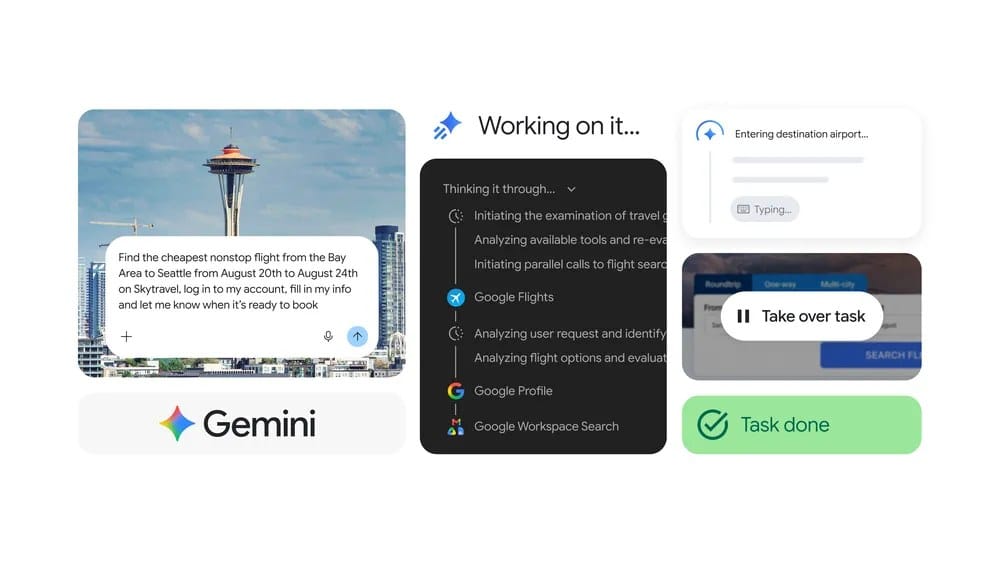
Official visual from Google’s Gemini Drops materials.
What shipped in the July Drop?
The 31 July Drop page lists:
- Speak to Gemini on macOS — intelligent dictation, transform highlighted text, summarize, generate/edit visuals by voice (detailed 29 July).
- Gemini Spark expanding globally (footnote: not available in EEA, UK, Switzerland, and Nigeria).
- Gemini 3.6 Flash and 3.5 Flash-Lite availability (model economics covered in our separate explainer — not fully rehashed here).
- Add yourself to images via a saved avatar.
- Connectors: Dropbox, Zillow Rentals, Viator.
- More personalized images for all US users.
On 30 July Google also detailed Spark’s Chrome integration for auto browse (US first) and Pro access expanding to 160+ additional countries.
macOS voice: write where the cursor already is
Long-press Fn for intelligent dictation into the active window — cleaned speech, mid-sentence corrections, formatted text at the cursor. Enable reasoning in settings and Gemini can use on-screen context: summarize local files, rewrite highlighted copy, generate or tweak images with voice. Launch language: English for all Gemini macOS users, more languages later.
What it means for content creators
1) Fewer tab switches while drafting
Dictate into Docs, Notion, or your caption field without bouncing through a browser chat for every polish pass.
2) In-place rewrites
Highlight a paragraph and voice a tone change. Useful for email newsletters and deck copy.
3) Voice-sketched visuals
Great for ideation; finish brand-critical type and logo safety in a design tool.
4) Spark as errand layer, not editor-in-chief
Use Spark for multi-step web errands with permission; keep humans on payments and client-facing publish. Google calls out prompt-injection defenses and handoff on sensitive actions — still supervise.
5) Availability is not universal
Read the footnotes. EEA/UK/Switzerland/Nigeria exclusions for Spark matter for remote teams. Chrome auto browse starts in the US.
By the way, for bilingual production, prompt libraries, and scheduling with a human final pass, ArWriter complements Gemini rather than replacing every Google surface — Plus starts at $4.99/month.
Quick comparison
| Need | Gemini Drop stack | Common alternative | Note |
|---|---|---|---|
| In-app dictation | Strong on macOS (EN first) | OS dictation + other voice models | Language coverage is the constraint |
| Agentic web tasks | Spark + Chrome (US first) | Browser agents / desktop agents | Permissions discipline required |
| Daily cheap model | 3.6 Flash (separate article) | Other economy tiers | Don’t confuse Drop UX with model RPM |
| Campaign visuals | Avatar + personalization (geo-limited) | Midjourney V8.2 + layout tools | Test brand fit |
| Scheduling | Not the Drop’s core | ArWriter / Buffer / Later | Connect after generation |
Honest limits
- macOS natural-language features launch in English.
- Spark geo exclusions are real operational constraints.
- US-first Chrome automation should not become a global SOP overnight.
- Connectors help specific journeys (files, rentals, travel) more than generic publishing.
- Image personalization availability is region-scoped — check before promising clients.
One-week adoption plan
- Pilot Gemini macOS on two editors only.
- Define five English voice macros (summarize, shorten, B2B tone, CTA options, outline).
- Ban unsupervised Spark actions that spend money.
- Tag drafts with source: voice Gemini / human / other model.
- Route final captions through your normal QA.
- Schedule with your usual tool; keep analytics feedback weekly.
- Read our Gemini 3.6 Flash creator explainer for model-tier choices.
Helpful product surfaces: tools, prompt library, image prompts, auto-writer.
How this coexists with your stack
The Drop does not retire Claude, GPT, or Midjourney. It pulls Google’s assistant closer to the macOS desktop and background tasks. A sane multi-tool setup: Gemini for English voice and Google-ecosystem errands; a writing desk for long-form QA; a specialist image model when aesthetics dominate; a scheduler for shipping.
Frequently Asked Questions
What is the July 2026 Gemini Drop?
A bundled set of Gemini app updates Google published on 31 July 2026 covering macOS voice, Spark expansion, image features, and connectors.
Does macOS voice support every language today?
The launch post specifies English first, with more languages later.
What is Gemini Spark?
Google’s agentic task layer in the Gemini app for getting work done with broader automation — with geographic availability limits.
Should I connect Chrome and passwords to Spark?
Only with clear policy. Prefer least privilege; keep humans on checkout and legal actions.
Is this a Midjourney killer?
No. Different jobs. Many teams will keep both.
Where are the primary sources?
Google’s Keyword blog: July Drop hub, macOS natural language post, Spark+Chrome post.
Why is there no X embed?
This run relies on official blog.google posts; we do not invent tweet status IDs.
What to do next
If you are on macOS, run one English dictation pilot and time it. If your primary language is not English yet, keep your current drafting path for that language. Verify Spark availability before rewriting team SOPs. Pair generation with human review and scheduling — ArWriter if you need bilingual ops in one place.
Permissions, privacy, and team hygiene for Spark
Before enabling agentic browsing, write an allowlist: approved research domains, brand accounts only, and a hard ban on personal checkout profiles. Consider a separate browser profile for automated errands so personal history never mixes with a night-running agent. Any workflow that touches customer contracts, invoices, or private lists should stay human until your security bar is explicit.
For macOS voice: dictation hears the room. Do not draft embargoed strategy aloud in open offices. Use a directional mic headset and disable dictation during client calls. These small habits prevent leaks better than default toggles.
For bilingual teams, document which steps happen in English via Gemini voice and which happen in other languages in your primary writing desk. Without that map, you will fork conflicting drafts of the same article. Put a “source language” stamp at the top of every draft.
Do not let the Drop become an excuse to drop editorial review. Faster dictation increases draft volume; quality remains an editor decision. Tie KPIs to approved assets shipped, not minutes saved alone, or you will reward noise.
Also schedule a monthly connector review: which app links are still needed, which tokens to revoke, and whether Chrome auto browse expanded to your region. Availability changes; sticky permissions should not outlive their use case.
Measure the Drop’s effect on editorial throughput
Do not rely on vibes. For two weeks, log per piece: time to first draft, time to final approval, revision rounds, and whether voice dictation or Spark was used. Compare against last month’s baseline. If draft time falls without more client complaints or factual errors, adoption is working. If weak drafts multiply, you are rewarding speed over quality.
Maintain a Spark deny-list: no payroll systems, no client email sends, no direct social publishing. Good agents research and prepare; humans or approval-gated schedulers publish.
For avatar and personalization image features, require written consent for employee or customer likenesses. Convenience is not a rights waiver. Store consent beside the asset.
If part of the team is on Windows, do not silently standardize on macOS-only tricks. Document a browser-based fallback path so review capacity stays even. Uneven tooling creates bottlenecks.
Run a weekly live teardown: an editor shows a dictated draft, what they cut, and the final. Internal transparency trains faster than keynote demos. After a month, promote only the habits that survived contact with real deadlines into the SOP.
Re-check geographic availability before quarterly client promises. Selling Spark automation into a region where it is excluded damages trust more than a modest proposal would.
Finally, separate experiments from production calendars. Label pilot weeks clearly so analytics drops or spikes are not misread as channel algorithm changes when the only change was a new dictation habit.
A restrained weekly usage pattern
Monday: dictate the weekly content outline in English on macOS, then finalize language variants in your primary editor. Tuesday: use Spark only to gather source links for one campaign—no financial logins. Wednesday: one conceptual image pilot with human approval. Thursday: voice-rewrite English newsletter paragraphs. Friday: revoke unused connectors.
The cadence prevents “turn on everything” chaos. Each day has one measurable job. After four weeks, keep what produced value and delete theatrical steps from the SOP.
Freelancers serving EU clients must respect Spark’s stated regional exclusions. Do not sell London stakeholders an automation path that is not available. Document manual fallbacks.
Agencies should pilot in a sandbox Google AI account, not inside a browser profile stuffed with client passwords. Isolation is cheaper than an access incident.
In proposals, split “draft production” from “browser agent management” as line items. Clear pricing prevents clients from assuming infinite automation with zero human hours.
If a client asks whether to cancel other tools after the Drop, the professional answer is no until eight weeks of metrics move: draft time, error rate, and editor satisfaction. Premature consolidation costs more than a temporary dual stack.
Keep a rollback note: which features you enabled, on which date, for which team. When quality dips, you can disable a single change instead of blaming “AI” as a monolith.
Operator summary
The July 2026 Drop helps most if you draft in English on macOS or run Google-ecosystem errands. It helps less immediately if your entire production line is another language with no English path. Spark is a permissioned task layer with geographic limits, not a replacement editor. Measure for two weeks, sandbox experiments, and never sell a feature your client’s region excludes. Route outputs through human review and scheduling—tools like ArWriter can cover bilingual ops without pretending to replace Gemini.
Pin the three official blog URLs in the team wiki. When someone asks “did this land for us yet?”, read the page instead of arguing from memory. Documentation is part of quality, same as the prompt.
Adoption rule: one editor, one voice macro, one non-sensitive Spark task. Scale only after numbers move. Scaling without measurement is how smart tools become collective noise.
Revisit this explainer when Google expands macOS languages or Spark regions—those two constraints drive most of the creator-relevant upside still pending.
Before you close this tab: verify Spark availability on your account’s country list, try one English voice macro on macOS if you have it, and update a written permissions policy. The July 2026 Gemini Drop is not a mandate to rebuild everything; it is a menu of capabilities you select with intent. Keep two-week measurement as habit, human review as non-negotiable, and client promises limited to features that are actually enabled—not headline features from a keynote card.
If writers and macOS-based producers collaborate across languages, assign one owner to translate English voice drafts into the final language so tone does not fork mid-article. That cheap coordination step prevents half-and-half posts. After every settings change, snapshot reasoning mode and connected apps in a shared doc so rollbacks are possible when quality dips without drama.
Next week run exactly one experiment and log a number: minutes saved, errors avoided, or extra approved assets. Small repeated numbers beat long debates without data. If the experiment fails, write the reason down so nobody repeats it next month. Documented failure is cheaper than random success. That mindset turns the Gemini Drop from a news wave into a production system you can improve each quarter while keeping a human accountable for what reaches the audience. Re-read Google’s three primary posts whenever a teammate brings a rumor; primary text is still the cheapest quality control in a noisy tool market.
When in doubt, re-check blog.google the same day you enable a feature, and log the change so the team has a rollback point. Daily discipline is what separates teams that use Gemini deliberately from teams that chase every announcement until they burn out.