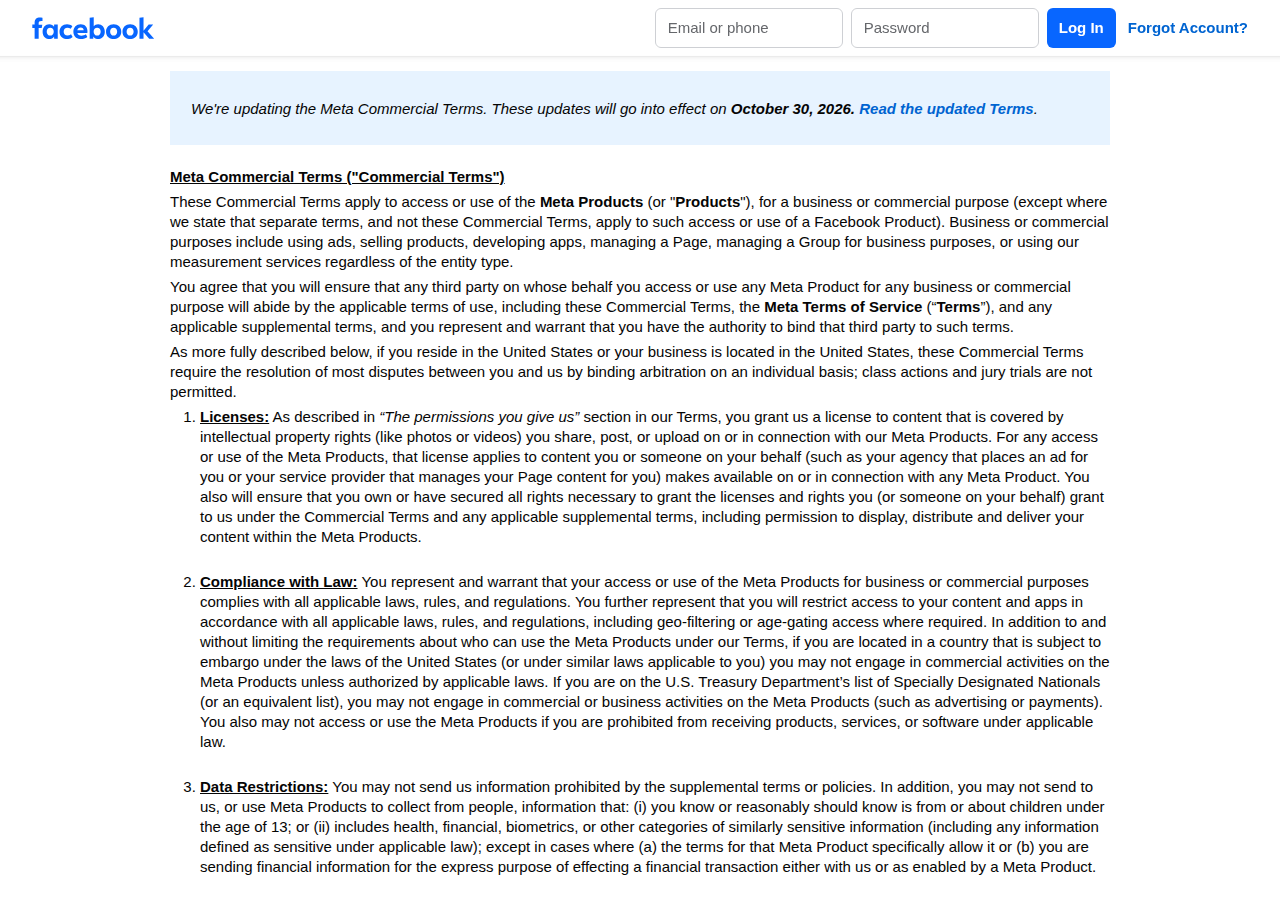
Three days after a wave of criticism, Meta removed a sentence from its updated Commercial Terms on October 17, 2026 — language that legal experts read as permission to use publisher content for AI training, for free. The story is not over: the amended terms still take effect on October 30, and the reporting that surfaced the clause flagged that business accounts have no opt-out. Here is what site owners and business-account users need to know.
What exactly happened?
The timeline, as documented across press coverage:
- Mid-October: Meta published an updated version of its Commercial Terms, effective October 30, 2026, covering business use across Facebook, Instagram, WhatsApp, and Messenger.
- October 15: Nieman Lab published a report flagging new language that read as a license to scrape site content, with legal warnings — most prominently from James Grimmelmann, professor of digital and information law at Cornell.
- October 17: After public pushback, Meta removed the contested sentence entirely and issued a new statement. Nieman Lab's original reporting had already noted there is no opt-out for business accounts ahead of October 30, and that legal experts read the new language as an opening for Meta to argue its commercial terms supersede robots.txt.
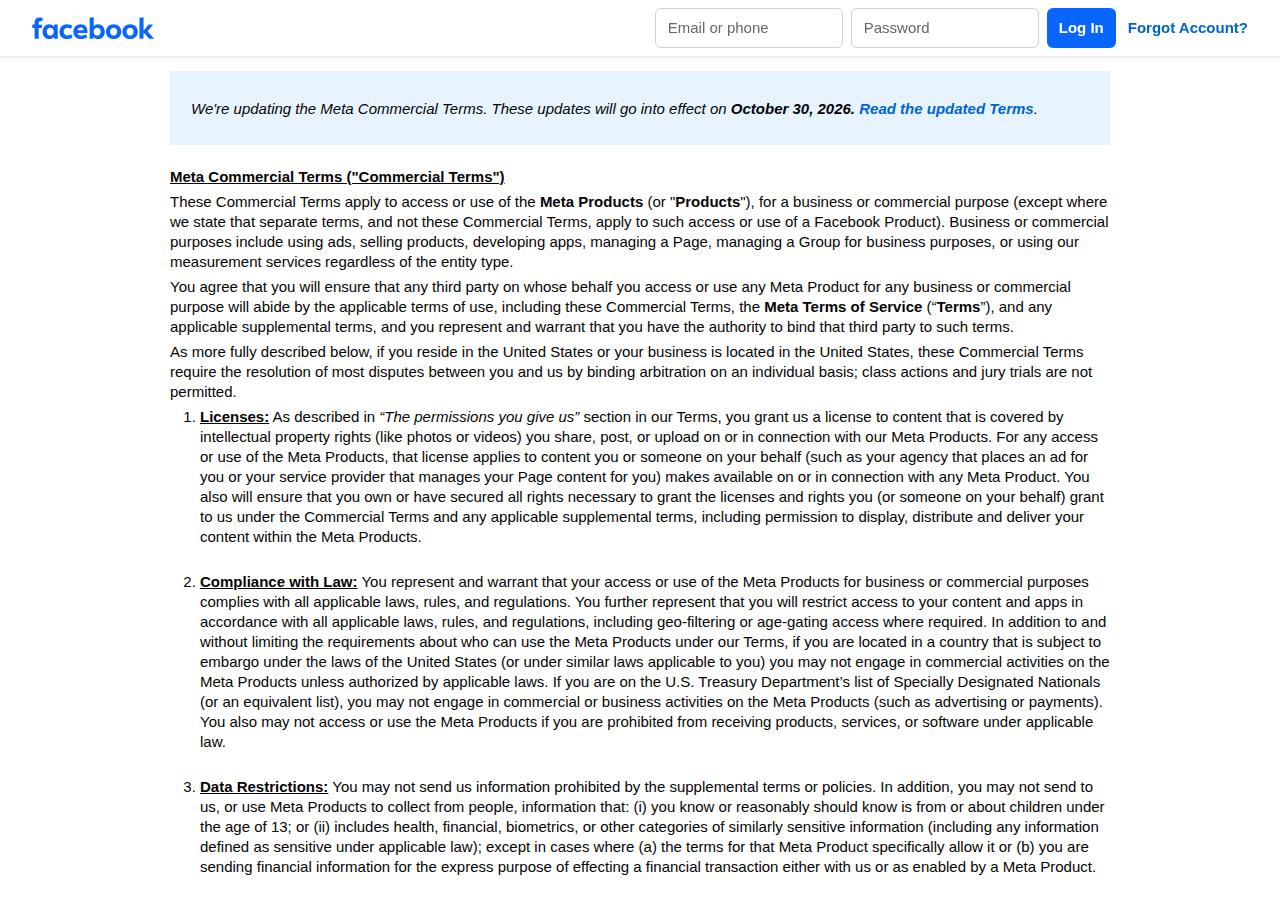
When preparing this article on October 18, we checked the live Commercial Terms page directly: the contested sentence no longer appears in the displayed text, while the update notice and its October 30, 2026 effective date remain.
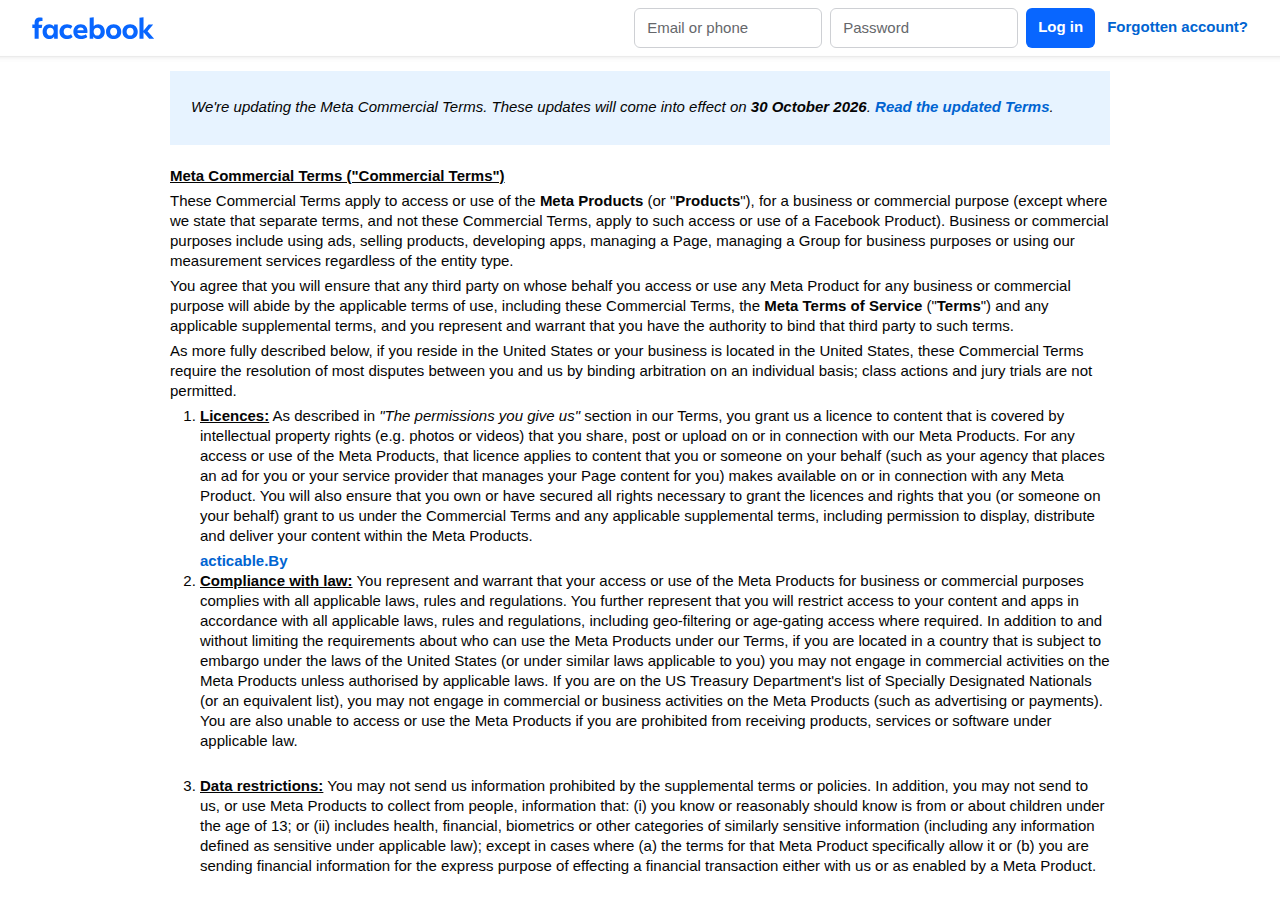
The exact language that started the storm
This paragraph — quoted verbatim by The Verge from the updated terms before deletion — is the heart of the story:
"You authorize us (or any entity acting on our behalf) to use automated software (such as web scrapers, bots, robots, spiders, crawlers, and user agents) and create test credentials to access, index, cache, analyze, collect, retrieve, or crawl the domains, web pages, or URLs... associated with your products or services... Meta may use any content from such domains, web pages, or URLs to provide, develop, improve, research, train, and maintain the integrity of, the Meta Company Products, services, and features..."
The fatal words: "Meta may use any content from such domains... " combined with "train." That is the phrasing legal experts read as a sweeping, unpaid license — and because these terms bind every business account on Meta's platforms, publishers faced a stark choice: accept the wording, or do what the terms literally prescribe — "stop all access or use of our Products for business or commercial purposes."
What Meta said
Meta spokesperson Daniel Roberts first pushed back on October 16 with a denial: "There is no change to how Meta uses web crawlers; any suggestion to the contrary is false," adding that content owners can still use robots.txt to signal preferences. After the deletion, he went further in a statement to The Verge on October 17:
"We've heard you and want to clarify: the crawling terms we consolidated only applied to our ads and business products, and we've clarified that in the terms themselves. It does not change how Meta uses web crawlers. As always, content owners can use robots.txt to signal their preferences. This is not about scraping news sites, and these updates don't give us new rights that supersede those preferences."
Andy Stone, Meta's VP of communications, said in a post quoted across coverage that the update is designed "to make sure we're able to pull accurate information about products for sale on third-party websites when making on-platform ad and content recommendations, not about scraping news sites."
Why this matters to you as a creator or publisher
- You are probably covered by these terms. Any business page, ad account, shop on Facebook or Instagram, or WhatsApp Business use falls under the Commercial Terms. Any domain you tie to Meta products (a pixel, data feeds, links) could have fallen under "associated domains" in the old wording.
- Legal experts do not consider the story closed. In its October 15 report, Nieman Lab quoted Grimmelmann's blunt framing: publishers "either have to trust that Meta doesn't mean the full extent of what these terms say, or they have to stop" using business accounts — and no opt-out exists ahead of October 30. The deletion removed the clearest sentence, not the whole logic.
- The wider context: your content is a strategic asset. Meta has already struck paid AI licensing deals with major news organizations (coverage names CNN, Fox News, USA Today, and People Inc. among them). Critics read the deleted clause as an attempt to obtain the same value from everyone else, unpaid. It fits a pattern we have tracked in our ongoing coverage — from Facebook's new plain-language algorithm controls to YouTube's expanded AI labels and conversational search inside platforms — of platforms rewriting who benefits from whose content, and how. For independent producers, the golden rule has not changed: build your written and visual archive on ground you own (your site, your mailing list) and treat the platforms as a distribution layer, using an integrated production workspace like ARWriter that outputs publish-ready, schedulable content from one place.
How to protect your content today: practical steps
- Update your robots.txt with explicit rules for Meta's crawlers (such as Meta-ExternalAgent). Even after the deletion, this is the measure Meta itself endorses and the one you can verify technically. Do not rely on intent — rely on what is enforceable.
- Separate marketing content from your paid archive. If you publish promotional excerpts on Meta's platforms, the excerpt is usable under platform terms — the full version belongs on your own site.
- Audit Meta pixel and SDK connections to sensitive pages. The old wording talked about domains "associated with your products or services" — the less direct technical linkage, the narrower any broad reading.
- Document your ownership. Timestamps, publication records, and a clear license on your site (Creative Commons or custom) are your evidence if you ever need to prove ownership or negotiate.
Quick comparison: before and after the deletion
| Aspect | Wording before October 17 | Status after October 17 |
|---|---|---|
| Right to use "any content" from associated domains | Explicitly stated, including "train" | Sentence removed from the live page |
| Meta's position | "No change to how Meta uses web crawlers" | "We've heard you" + clarification that the terms cover ads and business products only |
| Expert reading | Potentially broad license superseding robots.txt | Continued caution: no opt-out, no final consolidated text published yet |
| Effective date | October 30, 2026 | October 30, 2026 (unchanged as announced) |
The limits of what we know — honestly stated
This is a moving legal story. A full final text of the amended terms has not been published for line-by-line analysis in this article; expert readings cited above (with names and sources) remain legal interpretations, not court rulings. What is documented with certainty: the clause existed (verbatim, as quoted), it was removed (verified on the live page), Meta's successive statements are quoted in full, and the expert concerns continue. Any legal decision about your own site deserves a review of the final terms — ideally with counsel — before they take effect on October 30.
Frequently asked questions about Meta's updated terms
What did Meta change in its terms?
Meta published updated Commercial Terms effective October 30, 2026, which included language authorizing automated software to access domains associated with business accounts and allowing Meta to use "any content" from them, including for training. After criticism, Meta deleted that language on October 17.
Can Meta train AI on my website content?
Meta denies the terms grant any new right and says robots.txt preferences remain respected. The contested sentence was removed, but no final consolidated text has been published for line-by-line review, and the reporting noted business accounts cannot opt out ahead of October 30 — which is why technical controls (robots.txt) remain the trustworthy line of defense.
Who do these terms cover?
Anyone using Meta products for a commercial purpose: business pages, advertising, shops, commercially managed groups, and WhatsApp Business accounts — across Facebook, Instagram, WhatsApp, and Messenger.
What if I refuse the new terms?
The terms state the option plainly: stop all commercial access to Meta's products — a costly choice for most businesses, which is exactly why the public reaction to the wording was so sharp.
Sources for this article: Meta's Commercial Terms page (checked live on October 18), an archived capture via the Wayback Machine, and coverage by The Verge (deletion covered here), TechCrunch, and Nieman Lab.