Last updated: October 15, 2026. The event dated here is Meta's official announcement of October 13, 2026, "Your Algorithm, Your Words: New Ways to Shape What You See on Facebook." This is a deep-dive explainer, not breaking coverage — every claim below is anchored to the official announcement.
On October 13, 2026, Meta announced a structural shift in how Facebook's ranking works: instead of only inferring your interests from likes and watch time, you can now tell the algorithm what you want, in your own words. The feature set — called "Your Algorithm, Your Words" — lives inside the Facebook app through the three-dot menu on any post, and it covers both the main Feed and Reels.
For casual users, this is a pleasant UX upgrade. For page owners, social media managers, and creators who have built their organic reach on Facebook for years, it redraws the playing field: any audience member can now "add" your topic to their feed — or subtract it — with a single typed sentence, and recommendations update in real time accordingly. This guide explains exactly what changed, how the technology works, and what to do about it practically.
What Meta actually announced
The official Meta newsroom post documented three new mechanics:
- The "Your algorithm" hub: a dedicated space, accessible from the three-dot menu on posts, where users add and manage the topics they want to see more of in Feed and Reels. Meta describes it as "a dedicated space to tell us exactly what you're into."
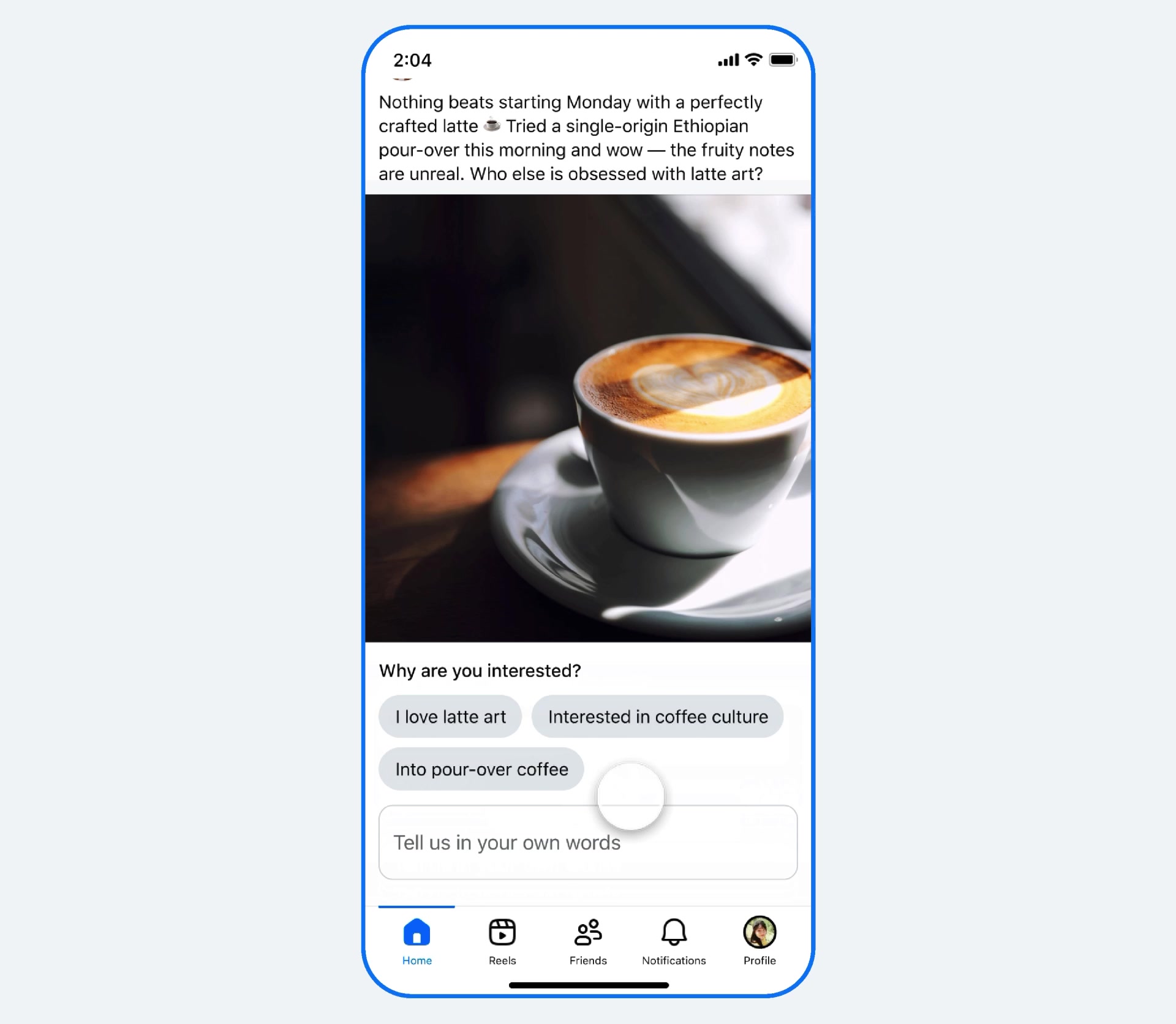
- Conversational follow-ups after feedback: after tapping "Interested" or "Not interested," Facebook may ask a follow-up question; the user answers in plain language about what they liked or disliked, and "your recommendations will update in real time."
- A redesigned three-dot menu: the per-post menu was rebuilt to surface these controls instead of burying them.
The technology behind it
The most consequential technical detail in the announcement — and the one most coverage missed: Meta states explicitly that large language models take the user's freeform text and blend it with Meta's existing behavioral signals — likes, comments, watch behavior, "among thousands of other signals." Meta's own framing: this is "an algorithm you can actually talk to," with results "adapting within the same session to reflect what matters to you right now."
Why does this matter to you as a publisher? Because ranking is no longer a silent function of behavior alone; it is now a conversation between each user and the platform. A user typing "show me more budget keto recipes" produces a far stronger, cleaner signal than dozens of passive likes — and every explicit signal like that simultaneously displaces content that was not named. Possibly yours.
Why now? The context behind the shift
- In February 2026, Meta launched "Dear Algo" on Threads — its sibling app — letting users address the ranking algorithm directly to tune their feed. That experiment paved the way for bringing the approach to Facebook itself, at a vastly larger scale.
- Competing platforms are converging on the same model: major search surfaces have shifted toward conversational interfaces that answer and recommend, and today's users increasingly expect to "talk" to every product they use. We covered this shift in depth in our guide to getting content cited by Gemini and AI Mode — the rule is identical everywhere: written clarity wins.
- Meta itself is pouring AI investment across its apps — from the Muse Wonder models we covered at launch to these personalization tools — two faces of one strategy: deeper understanding of each user.
- Regulatory pressure around algorithmic transparency — especially in the European Union — has made user-facing control tools a compliance card platforms are happy to play voluntarily.
Bottom line: explicit, written personalization is not an experiment anymore; it is the platform direction of 2026. Anyone building a strategy on a guess-only algorithm is building on sand.
What this means for you as a content creator on Facebook
- Sharp topical identity beats generalism: when users type their interests explicitly, recommendations gravitate toward pages with a razor-sharp topic identity ("budget keto recipes") rather than general-interest pages. Can your page be described in one sentence a user would actually type?
- "Not interested" got easier — and more dangerous: frictionlessly saying "I don't want this" in natural language means misleading or bait content gets excluded faster. Honest, precise titles now protect your distribution directly.
- Written engagement weighs more: a comment explaining why someone loved a post is now direct recommendation fuel. Design posts that provoke descriptive replies ("I tried this and it worked because…"), not just emoji.
- Reels is inside the equation: the controls cover Feed and Reels together, so short videos face the same written personalization — topic identity in a Reel now matters more than a trending sound alone.
- Session timing compounds: with recommendations adapting "within the same session," publishing when your audience's stated interests are active may matter more than before.
- Richer data for the platform: every typed sentence trains the models on finer preferences — the gap between publishers who understand their audience textually and those who post blindly will widen.
- An opening for specialized non-English content: users type interests in their own language, and competition for written topical niches in Arabic and other languages is thinner than in English — a genuine window for serious specialized pages.
Quick comparison: feed controls before and after October 13, 2026
| Aspect | Before October 13, 2026 | After the update |
|---|---|---|
| Expressing interest | Like, follow, hide | Freeform typed text |
| Access to controls | Buried across multiple settings | "Your algorithm" hub in the three-dot menu |
| Speed of effect | Gradual, over days | Real-time, within the same session |
| Recommendation source | Implicit behavior only | Explicit text plus implicit behavior |
| Coverage | Feed primarily | Feed and Reels together |
| Underlying tech | Traditional classifiers | Large language models blending text with signals |
A step-by-step readiness guide
- Try the feature yourself (when it reaches your account): the rollout is underway with no detailed schedule. Open the three-dot menu on any post, look for the "Your algorithm" hub, and type your page's topic the way your audience would.
- Rewrite your page identity as one sentence: if you cannot summarize your page in a phrase people search for ("English learning for Arab professionals"), the new system will struggle to match you. Fix the identity before anything else.
- Make headlines match content literally: a user who decides to "hide everything about X" after one misleading post removes your entire topic from their feed. Clickbait now kills distribution twice.
- Create content that gets described in words: ask questions in your captions that invite descriptive answers; reward written experiences — every descriptive comment is a fresh recommendation signal.
- Cover topics, not incidents: make the majority of your calendar revolve around the pillars your audience would actually name when typing — rather than one-off viral events.
- Diversify beyond a single platform: sharper personalization means narrower bubbles; presence across platforms spreads the risk. Multilingual publishers can adapt one piece into platform-specific versions with ARWriter's toolset instead of rewriting everything from scratch.
If you run a full monthly calendar, planning and drafting Facebook and Threads content together inside one Arabic-first workspace keeps a specialized page consistently supplied — which is exactly what this update rewards.
What this means for small business and niche pages specifically
Facebook still hosts millions of small-business pages that treat it as their primary storefront — and for them, this update cuts differently than for personal brands:
- Local service pages win first: a user can now type "plumbing tips and honest quotes" and keep seeing the local plumber who explains clearly. Topic-sharp service pages (a dentist who explains procedures, an accountant who demystifies taxes) match typed intents far better than generic "follow us for everything" pages.
- E-commerce catalogs face a harder test: pure product-dump posts are exactly what users prune when they start curating in words. Product pages survive by becoming content pages — usage guides, comparisons, honest how-tos around what they sell.
- B2B pages get a rare consumer-style lever: a procurement manager typing "supplier reliability content" is a niche nobody competed for textually until now — specialized B2B content has an open lane.
- Community-first pages compound: pages whose audiences already write descriptive comments inherit an advantage from day one; pages that farmed emoji reactions do not.
- Watch your insights monthly: when the feature reaches your audience, its fingerprint appears in reach sources and content-type breakdowns. Early measurement tells you which of your content pillars match what your audience actually types.
Honest limitations of the update
- No detailed timeline: the announcement names no countries or dates, so do not assume your audience has the feature yet — watch your power users first.
- Hyper-personalization cuts both ways: as users narrow feeds to typed topics, organic space for new, unnamed content shrinks — follower acquisition may get harder, not easier.
- The announcement never mentions creators: there are no numbers about page reach impact, nor about whether pages can appear inside the "Your algorithm" hub. Every creator implication in this article is reasoned from the announced mechanics and could prove wrong with time.
- Privacy questions are open: more typed text means richer platform data, and the public debate over how Meta uses these inputs is not settled.
Frequently asked questions
When will "Your Algorithm, Your Words" reach users outside the initial rollout?
Meta published no detailed schedule, describing the feature only as "rolling out." Major Facebook features typically reach global audiences within weeks of announcement; the reliable signal is the "Your algorithm" option appearing in your own three-dot menu.
Can a user permanently remove my page from their feed with these tools?
Effectively, yes — someone who writes that they no longer want a given topic will see recommendations for that topic decline immediately. That is precisely why content must match its promise: one misleading post can cost you an entire topic, not just one hide.
How is this different from Dear Algo on Threads?
Same core idea — addressing the algorithm in natural language — but Dear Algo launched on Threads in February 2026 as the first experiment, while this update brings the approach to Facebook itself and adds a central topic-management hub plus Reels coverage.
Should I change the type of content my page publishes because of this?
Not the type — the focus. Broad multi-topic pages are the biggest losers; pages describable in one sentence are the winners. Audit your page identity before making any drastic content change.
Does this update affect paid ads or only organic reach?
The announcement covers feed and Reels personalization for users — organic distribution. Ad targeting may benefit indirectly over time from deeper topical understanding, but the announcement mentions no direct change to the ads system.
I run several pages on different topics — should I merge them or keep them separate?
Keep them separate and sharpen each further. In a written-recommendation system, two topic-sharp pages capture two different typed lists, while one merged general page is hard to match to any list at all. Merging only makes sense when two topics are so close that your audience would type the same phrase for both.
How do I confirm the feature has reached my account?
Open any post in your feed, tap the three-dot menu, and look for an option referencing "your algorithm" or managing the topics you want to see. If it is absent, the rollout has not reached you yet — its appearance in that menu is the only official signal available today.
The bottom line
"Your Algorithm, Your Words" turns Facebook from a platform that guesses your interests into one that asks about them — and audiences worldwide will adapt to this new conversation quickly. Page owners with a sharp topical identity, honest headlines, and written descriptive engagement will find the update works for them. Those publishing "everything for everyone" will discover that everyone is now typing exclusion lists that do not include them. Start today with one sentence: what would your audience type to see your content?
And if you want a writing partner to keep that specialized content flowing in Arabic at a steady cadence, that is precisely what ARWriter was built for — writing, planning, and publishing from one place.