On October 15, 2026, Meta released Muse Spark Open: an 816-billion-parameter open-weight model it calls the most capable US open-weight model to date, unveiled alongside Apple with a promise that it runs locally on a desktop — specifically, two Mac Studios with M5 Ultra chips using the MLX framework. This guide covers what it is, what running it actually costs, who it is really for, and whether content creators should care yet.
For years, the practical question hanging over every large language model has been the same: when do we get a frontier-class model that runs on our own hardware, with no monthly subscription and no data leaving the building? The joint Meta-Apple announcement of October 15, 2026 is the strongest American answer yet: Muse Spark Open, an 816-billion-parameter model with downloadable weights, optimized for Macs through Apple's MLX framework. But there is a real distance between the headline and the everyday reality — this article walks that distance carefully.
What exactly is Muse Spark Open?
Based on Meta's announcement as reported by The Verge and TechCrunch, Muse Spark Open is:
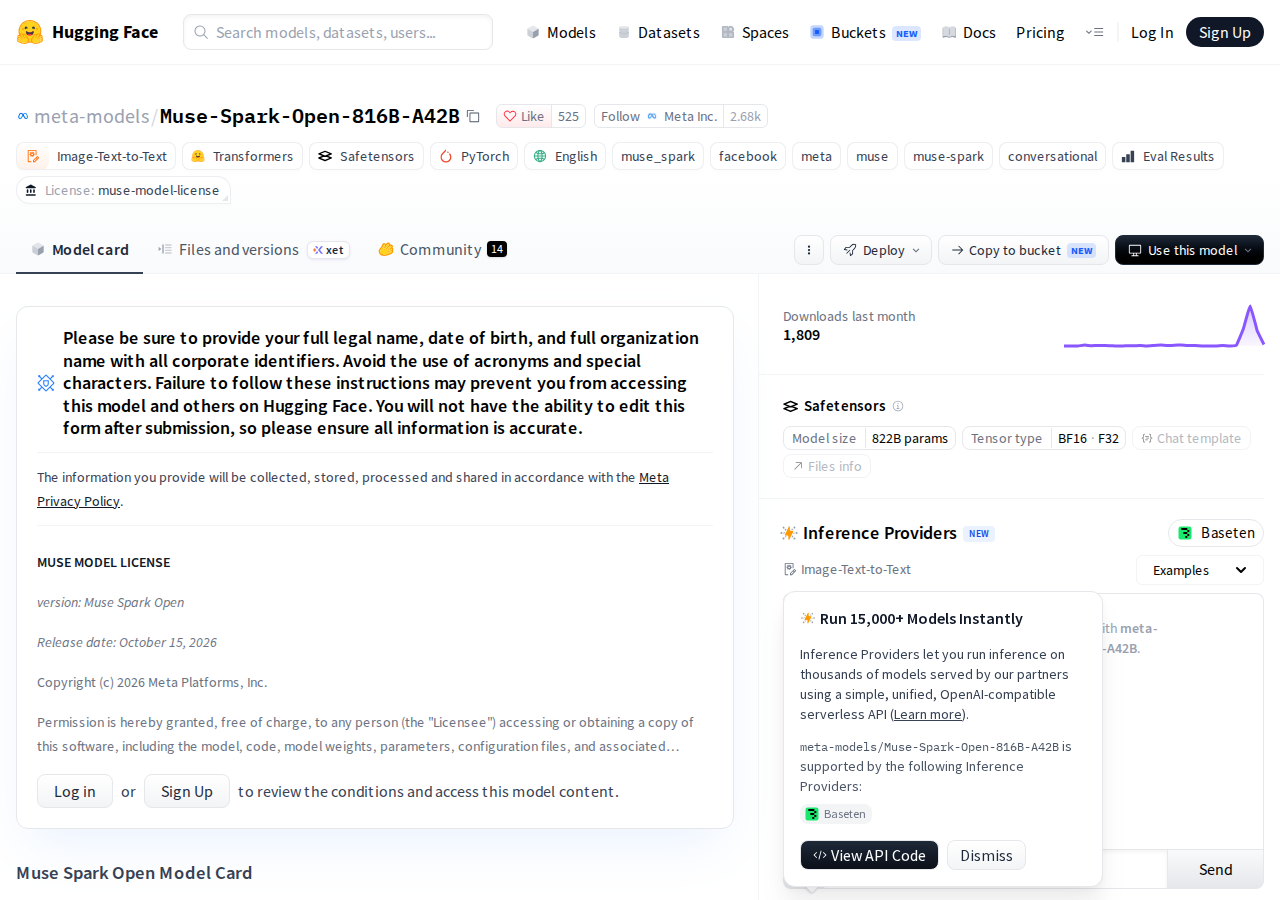
- A mixture-of-experts model with 816 billion total parameters and roughly 42 billion active ones — both numbers visible in the official Hugging Face repository name:
Muse-Spark-Open-816B-A42B. - Natively multimodal — classified on Hugging Face as an Image-Text-to-Text model, meaning it takes images and text together.
- Open-weight under a custom license called muse-model-license. Note the distinction: open weights are not the same as an MIT or Apache license; downloads require accepting the license and requesting access on the repository page.
- The most capable US open-weight model to date, by Meta's own description — a company claim, quoted by The Verge, not an independent verdict.
For context on where it sits in Meta's lineup: 2026 brought the Muse family of personal and assistant models (including Muse Wonder, which we covered at launch, plus Muse Image and Muse Video for generation). Muse Spark is the line aimed at agentic and software work — and "Open" is its weight-available edition.
The Apple story: 816 billion parameters on a desk
The most striking part of the launch is not the model itself but the partnership. Meta and Apple — traditionally rivals — collaborated for several months, according to Meta chief AI officer Alexandr Wang in comments to Axios, to make the model run well on Macs via MLX, Apple's machine learning framework built for Apple Silicon.
Meta's official framing: Muse Spark Open is "the first model in its class" that can "run on your desktop using two Apple M5 Ultra Mac Studios with the latest MLX framework." Mark Zuckerberg posted on X that the weights were "releasing today" and run "great on new Mac Studios thanks to work with @johnternus and Apple." Apple's CEO John Ternus replied: "Amazing to run a model of Muse Spark Open's caliber and scale this efficiently, right from your desk."
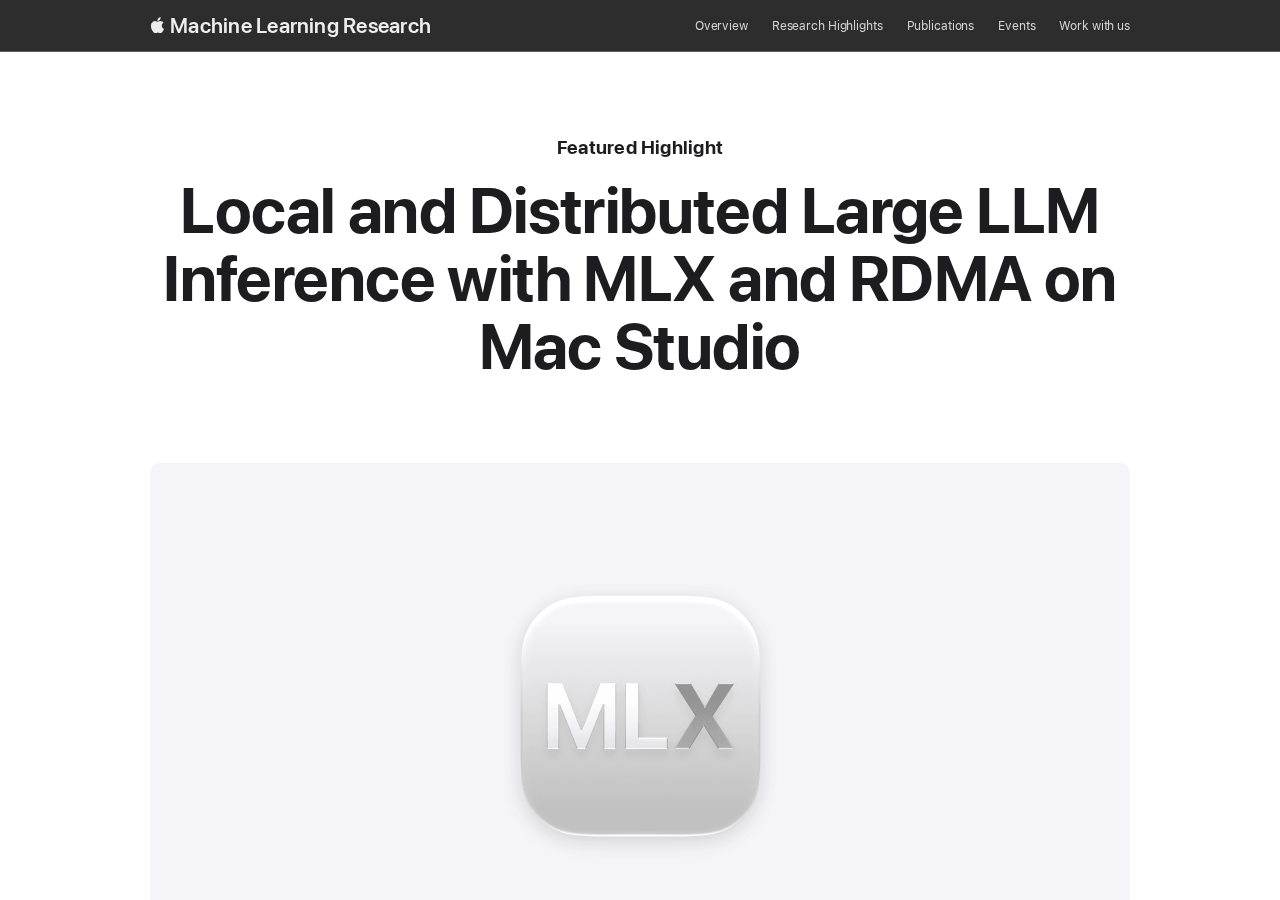
Apple backed it with a technical post the same day — "Local and Distributed Large LLM Inference with MLX and RDMA on Mac Studio" — and a community 4-bit build appeared on Hugging Face's mlx-community organization dated October 15.
What running it actually costs: the honest math
This is where the enthusiasm needs a pause. "Runs on your desk" specifically means two Mac Studios at the top M5 Ultra configuration — a hardware bill that runs into the tens of thousands of dollars before accessories. The launch message is aimed at labs, companies, and professional developers, not at individual creators.
But the story does not end there, and that is why it matters strategically:
- Community builds are far cheaper. Within hours of launch, compressed variants appeared through the Hugging Face community — GGUF builds from unsloth and ggml-org suitable for popular local runtimes, 4-bit builds for Mac users via mlx-community, and an INT4 build from intel-ai. Compression trades away performance, and independent measurements of those specific builds are still thin on the ground.
- The direction matters more than the desk. A year ago, running a model this size locally was practically impossible. Today it is a budget line. Tomorrow it will be a single machine. Every step in that direction lowers costs for everyone — cloud users included.
- Privacy as an absolute value. For teams producing sensitive content (newsrooms, clinics, legal firms), keeping inference inside the building is worth more than the hardware invoice alone suggests.
Who the model is really for: reading past the noise
Meta's official description of where it excels — as relayed by The Verge — names "long-horizon tasks, complex software engineering, and multi-step reasoning." Translated: this model is aimed primarily at developers, agentic workflows, and coding, not at marketing copywriting.
So what does that mean for a working content creator? Three clear takeaways:
- You will not replace your cloud writing tools with it this month. A hosted model with a polished Arabic-ready interface (or a workspace like ARWriter that manages models, language, and publishing in one place) remains easier, cheaper, and more reliable than operating an 816-billion-parameter model yourself.
- But it is leverage for the tools you do use. Models like this become the substrate under scheduling, editing, and analysis platforms — including the production and publishing tools creators rely on. Cheaper inference eventually arrives at your screen as cheaper, faster features, whether or not you ever learn the model's name.
- If you are technical and curious: the mlx-community repository makes experimentation possible on high-unified-memory Macs, and GGUF builds run in the usual local runtimes. That is a legitimate exploration path — not a production dependency yet.
Quick comparison: where it stands among known options
| Option | Strength | Practical limit for creators |
|---|---|---|
| Muse Spark Open (Meta/Apple) | 816B parameters, open weights, local execution via MLX, free download after license acceptance | Very expensive hardware, coding/agentic focus, no Arabic-facing interface |
| DeepSeek V4.1 Flash | Million-token context at very low API prices, MIT-licensed weights (as we covered) | Cloud-first; self-hosting demands expertise and hardware too |
| Major cloud models (GPT/Gemini/Grok) | Best Arabic readiness and complete production tooling around them | Monthly subscriptions; data passes through the provider |
The equation is simple: if your priorities are reliability, Arabic quality, and a ready workflow, the cloud remains the rational choice today. If your priorities are absolute privacy and full control, and you own the hardware and skills, open weights have finally become a real option — not just a slogan.
What about the Arabic language?
Neither the official announcement nor the model card makes a specific claim about Arabic performance — no published benchmarks, no Arabic examples. Meta has historically been among the stronger companies for widely-spoken languages given its multilingual training data, but a good expectation is not a documented number. Practical advice: if you want to evaluate it, run simple Arabic comprehension and summarization tasks on the available compressed builds and measure the results against your current tool before making any decision.
Honest limitations, stated plainly
- The license is not free-software free: muse-model-license is a custom Meta license, not MIT or Apache. Read it before any commercial use.
- Access is request-gated: the official repository requires accepting the license and being granted access — standard practice, but worth knowing upfront.
- Performance claims come from Meta: "most capable in class" is the company's own framing; full independent evaluations are still landing.
- Real hardware cost as detailed above: the official "desk" experience is two M5 Ultra Mac Studios.
- The tooling ecosystem is early: most ready-to-use integrations today are developer-facing (SGLang announced day-0 support, and Amazon SageMaker made it available in JumpStart) — a polished non-technical end-user experience barely exists yet.
The wider backdrop: the open-weights race is heating up
This launch lands in an unmistakable context: a strong return of the "big model, open weights" idea. We recently covered Meta's Muse Wonder launch on October 13, the Gemini free-tier model limits that took effect October 9, and FLUX 3 Klein's open image weights earlier in October. The common thread: major companies no longer fear giving away weights — they now compete on them, because the value has moved from "access to the model" to "the tools and services built around it."
For a working creator, the practical conclusion is this: do not memorize model names. Watch the three lines that actually touch your work — Arabic quality, price, and who ships ready-made tools on top. That is precisely what our ongoing coverage tracks for you.
In plain terms: what "open weights, runs locally" actually means
For readers new to this space, the picture in three points, jargon-free:
- Weights are the file that holds a model's "knowledge." The model you chat with in any app is, at its core, a huge file of numbers produced by training. When those numbers are downloadable, you can — in theory — run the model on your own machine instead of a company's service.
- "Locally" means the computation happens on your processor. No message leaves your device to a server, no subscription is billed monthly, no outage stops your work. In exchange, you pay for hardware and manage the technical complexity yourself.
- Why big models are hard to run locally: file size translates into memory. An 816-billion-parameter model at full precision needs hundreds of gigabytes of fast memory — which is why running it (compressed) on just two desktop machines was the surprise of this launch, where such sizes used to require entire datacenter racks.
Why did Apple participate at all? The strategic reading
Behind the "rivals make peace" headline sits clear commercial logic for both sides. Apple wants to prove its silicon — with the large unified memory of Mac Studio — is a first-class destination for professional AI, not just a creative machine for video and design. Meta wants its open model to spread as widely as possible, including onto the rival's hardware with its enormous install base. The relative loser: cloud resellers of open-weight models, who were used to being the only practical route to running them.
For creators, the partnership is a model of a trend worth tracking: consumer and prosumer hardware is gradually becoming capable of running what used to be cloud-only. That points toward cheaper production tools that work offline — we are not there yet, but the direction is now visible in numbers rather than promises.
A practical one-week evaluation plan (for the technically curious)
If you would rather judge the model yourself than trust headlines:
- Days 1-2: request access to the official Hugging Face repository (accept the license) and read the model card and attached evaluations.
- Days 3-4: try a compressed build suited to your hardware — mlx-community 4-bit on a high-unified-memory Mac, or GGUF in your usual local runtime.
- Day 5: run ten realistic tasks from your actual work (summarize, draft, interpret an image) in Arabic and English, and log results side by side with your current tool.
- Days 6-7: score: response time, Arabic quality, electricity and hardware cost versus your current subscription, and data security. The decision is then arithmetic, not emotion.
The honest expected outcome for most creators: local running is educational fun and not yet production-viable — but that same evaluation table will change quickly with each new generation, which is why it is worth re-running periodically.
A practical summary before you go
If everything above had to fit in three sentences: first, Muse Spark Open is a genuine technical milestone — the first US model of this scale to become seriously desk-runnable, under a partnership between two historic rivals. Second, its audience today is engineers, researchers, and privacy-absolute organizations, not a creator looking for a writing tool — and that difference is a real usage gap, not a nuance. Third, its effect on you is indirect but real: competitive pressure that will push down the prices of the cloud tools you already use, and a wave of innovation that will reach you within months as new features inside familiar production platforms. Watch this space — we will track when this wave turns from lab news into tools on your screen.
Frequently asked questions about Muse Spark Open
What is Muse Spark Open?
A Meta model with 816 billion total parameters (about 42 billion active, mixture-of-experts), natively multimodal, released as open weights under the muse-model-license. It was announced on October 15, 2026, in partnership with Apple, and runs locally on Mac Studio machines via the MLX framework.
Is Muse Spark Open free?
The weights are free to download after accepting the license and requesting access on Hugging Face. But running full capability needs expensive hardware (Meta and Apple's official setup is two M5 Ultra Mac Studios), and hosted usage through cloud providers is priced by those providers.
When was Muse Spark Open released?
Announced October 15, 2026, with weights and the mlx-community compressed build appearing the same day.
Is it good for writing content in Arabic?
Meta has published no Arabic-specific benchmarks, and the model targets coding, agentic, and long-reasoning work. For production Arabic writing, tools built around cloud models remain the safer choice today.
Can it run on a regular computer?
At full capability, no — the official setup is two M5 Ultra Mac Studios. Community compressed builds (4-bit, GGUF) lower the requirements substantially at a performance cost, and suit experimentation rather than production.
Sources for this article: Meta's official Hugging Face repository, Apple's technical post on machinelearning.apple.com, and coverage by The Verge and TechCrunch, October 15-16, 2026. No official X post is embedded because the original status links could not be directly verified at publication time — statements are quoted as they appeared in press coverage.