Kimi K3.1 Pro: Moonshot's 2.8T Open-Weight Model, Explained
Last updated: October 2026
How much of your AI workflow actually requires a closed, expensive frontier model — and how much of it just needs a model that is good enough, cheap, and yours to run? On October 23, 2026, Chinese lab Moonshot AI pushed that question one step further with Kimi K3.1 Pro, its most capable open-weight model to date. Within hours, independent trackers had it ranked fourth on their intelligence index, within touching distance of models that cost an order of magnitude more to run.
Kimi K3.1 Pro is a multimodal conversation model with 2.8 trillion total parameters (104 billion active, mixture-of-experts) and a 1-million-token context window. It is live on kimi.ai and its apps today, with full model weights promised by November 4, 2026, plus a faster sibling, K3.1 Pro Highspeed.
Source: Kimi.ai official account on X
What actually launched on October 23
Two artifacts define this release, and both matter if you are deciding whether to pay attention.
The first is the announcement post on X from Moonshot's Kimi account: K3.1 Pro is live on Kimi.ai, with open weights landing November 4. Short, dated, and checkable.
The second is the technical blog post on kimi.ai, and this is where the substance lives. K3.1 Pro is not a bigger K3 — it is K3 put through substantially more post-training compute, using joint reinforcement learning across what the company describes as "hundreds of downstream domains". In plain terms: instead of optimizing for a leaderboard, Moonshot trained the model to finish long, messy, multi-step jobs.
Three structural facts from the launch are worth committing to memory:
- 2.8T total parameters, 104B active per query. The mixture-of-experts design keeps a huge reservoir of specialized paths and activates only a slice at a time, which is how you get 3T-class capability without 3T-class inference bills.
- A 1,048,576-token context window. That is enough room for an entire content archive, a full market report, or a complete product documentation set in a single conversation.
- A Highspeed companion.
kimi-k3.1-pro-highspeeddelivers the same family of capabilities at 2-3x the speed — built for apps where latency matters more than the last point of benchmark performance.
The model accepts vision input alongside text, and per the platform docs you can dial reasoning depth across three levels (low, high, max) to trade cost for thinking time.
The numbers Moonshot published
Moonshot's launch post leads with three arenas: coding, 3D work, and finance. Here is the full slate, quoted directly from the company's own benchmarks:
| Benchmark | K3.1 Pro result | Stated comparison |
|---|---|---|
| Terminal-Bench 4.0 (coding) | 65.7% | GPT-6 Astra: 58.2% — Claude Opus 5.5: 66.4% |
| Kimi Code Bench 3.0, long-horizon | 61.2% | Previous K3: 55.95% |
| BenchCAD (with tools) | 92.7% | Opus 5.5: 96.2% — GPT-6 Astra: 95.9% |
| BenchCAD (no tools) | 72.8% | — |
| OfficeQA Pro v2 (office tasks) | 64.4 | State-of-the-art per Moonshot's announcement |
| Frontier Finance | 58.6 | — |
| Hallu Bench Hard (hallucination rate) | 8.3% | K3 scored 23.4% |
| xdev-bench-hard, pass@3 (security) | 81.0% | 90.5% before cyber-data removal |
Two rows deserve a closer look.
The hallucination row is the one content professionals should underline. On Moonshot's internal Hallu Bench Hard, the model's fabrication rate dropped from 23.4% on K3 to 8.3%. No benchmark settles the hallucination question for your niche, your language, or your sources — but a two-thirds reduction in the previous generation's error rate is a meaningful directional signal for anyone whose drafts need to survive fact-checking.
The security row is a deliberate step down: Moonshot removed cyber-attack training data before committing to open weights, and pass@3 on xdev-bench-hard fell from 90.5% to 81.0%. That is the price of shipping a 3T-class model to the public. Security teams should know the trade existed; everyone else can read it as evidence the company is taking the release seriously.
To demonstrate long-horizon capability, Moonshot had the model build a walking simulator on top of the open-source human-atlas project — 296 skeletal components and 402 muscles. K3.1 Pro fixed 36 moment-arm errors and got the body to walk for 11.2 seconds. It is a showcase, but the shape of the showcase matters: whole projects, not clever one-liners. Independent of the company's own numbers, the Artificial Analysis intelligence index placed K3.1 Pro fourth at launch, near Claude Opus 5.5 on coding and agent benchmarks.
Why content creators should care
You do not need to care about model rivalries. You do need to care when the economics of research, drafting, and analysis shift under your feet. Four things shift here:
- Near-frontier capability in a browser tab. The model is usable on kimi.ai and its mobile apps right now. For solopreneurs and small agencies, that makes it a serious bench-test candidate against the subscriptions you are already paying.
- The 1M-token context changes research workflows. Feed it your last two years of newsletter issues plus three competitor teardowns plus a 120-page industry report, then ask structural questions: what have we never covered, what angles are saturated, where does our positioning drift. That class of question used to require data-tooling budgets.
- Lower fabrication rates cut review cycles. An 8.3% hallucination score does not retire your editor. It shortens the distance between first draft and publishable draft — which is where agencies actually lose money.
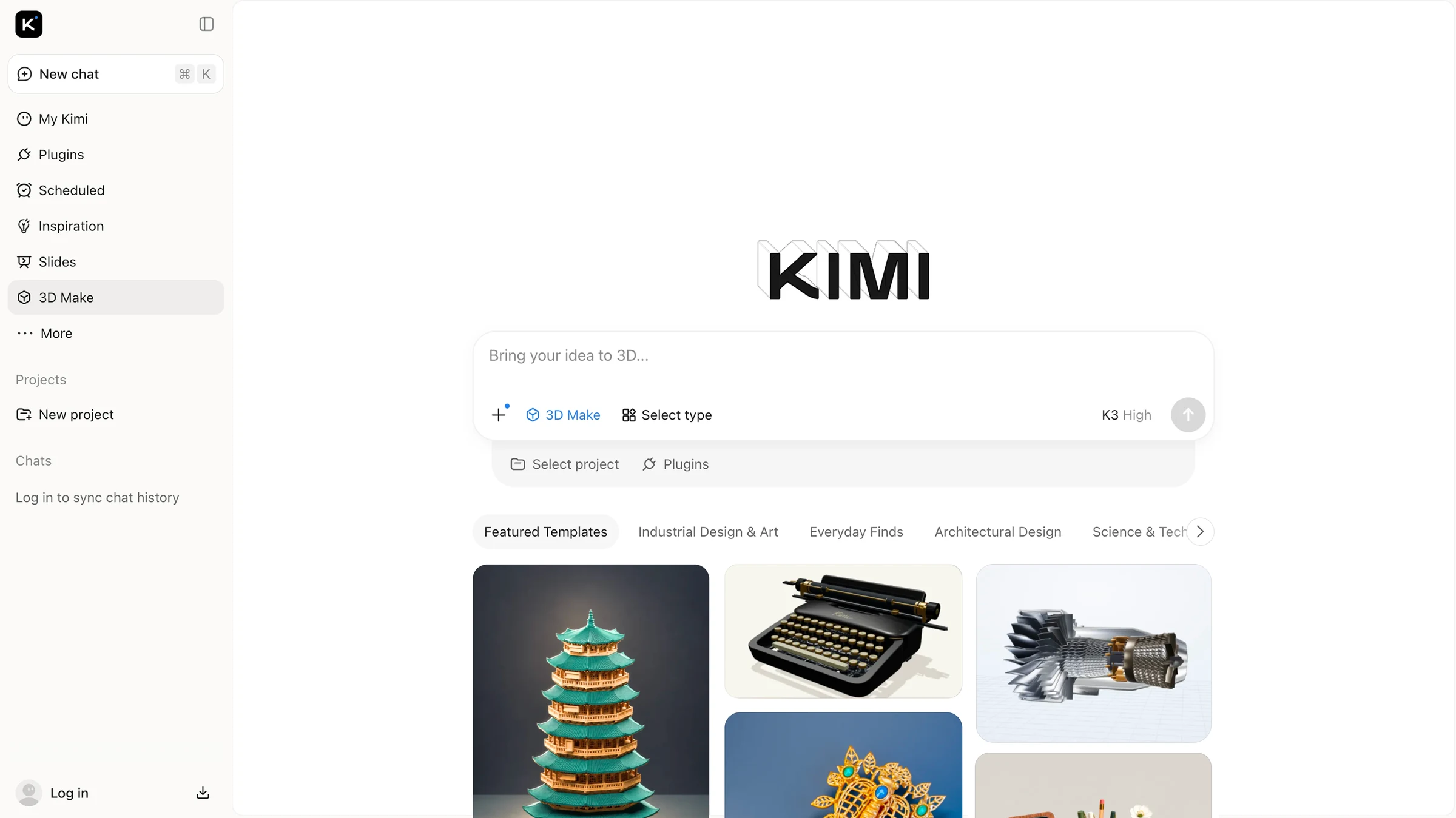
- 3D Make opens a lane for visual creators. The feature is live inside the kimi.ai app and generates 3D assets; the model also works with Unity, Unreal, and Godot. If your content is video, education, or product-adjacent, this is production tooling, not a demo reel.
The open-versus-closed pricing story is now moving on two fronts: we walked through OpenAI's own aggressive price positioning in our GPT-6.1 Sol launch coverage, and this week the open side answered.
By the way, if you are assembling an Arabic-market content stack — writing, scheduling, publishing from one place — the ArWriter store bundles those tools with regional pricing.
How to access Kimi K3.1 Pro right now
- On the web: open kimi.ai, start a conversation, and select the K3.1 Pro model. This is the fastest way to judge output quality on your actual work.
- On mobile: native apps ship for iOS, Android, and HarmonyOS.
- For document work: Kimi Work (version 3.1.0 and newer) points the model at files and long reports.
- In your editor: Kimi Code exposes it via the
/modelcommand for developers. - Via API: platform.kimi.ai serves
kimi-k3-1-proandkimi-k3.1-pro-highspeedon flat pay-as-you-go billing with a minimum $1 top-up, tier-based rate limits that scale with cumulative balance, automatic 5-minute context caching, and a Zero Data Retention option for sensitive workloads. Enterprise access is off by default until requested.
One housekeeping note from Moonshot's own docs: the K2 series stops accepting new users on October 31, 2026 and fully retires by end of December. If any of your automations still call K2 models, migration week has arrived.
How it compares to GPT-6.1 Sol, Claude Opus 5.5 and Jais 3
| Model | Developer | Weights | Stated context | Standout fact |
|---|---|---|---|---|
| Kimi K3.1 Pro | Moonshot AI | Open, due Nov 4, 2026 | 1M tokens | 2.8T params MoE; hallucination rate cut to 8.3% |
| Kimi K3.1 Pro Highspeed | Moonshot AI | Same upcoming release | 1M tokens | 2-3x faster than the base model |
| GPT-6.1 Sol | OpenAI | Closed | Not stated here | $2/$10 per million input/output tokens |
| Claude Opus 5.5 | Anthropic | Closed | Not stated here | 66.4% on Terminal-Bench 4.0 in Moonshot's comparison |
| Gemini 4 Argon | Closed | Not stated here | Ships inside the Gemini app ecosystem | |
| Jais 3 family | MBZUAI + Inception42 | Open | Up to 512K tokens | Arabic-native models up to 375B parameters — see our launch explainer |
Read the table as a decision aid, not a verdict. If your filter is cost and openness, K3.1 Pro owns this week. If your filter is maximum reliability on high-stakes English output, the closed frontiers still hold the edge in independent testing breadth. And if your work is Arabic-first, the Jais 3 family was purpose-built for that job.
November 4: open weights and what actually changes
"Open weights" is the most overloaded phrase in AI marketing, so let us be precise about what Moonshot has promised — full model weights published by November 4, 2026 — and what that unlocks when it happens:
- Independent scrutiny. Researchers and enterprises can audit behavior instead of trusting a blog post. In a market running on vibes, auditability is a differentiator.
- Private deployment. Banks, government-adjacent teams, and agencies bound by client data rules can host the model inside their own perimeter — the same argument we examined when Meta shipped Muse Spark Open for local Mac hardware.
- Community derivatives. Expect compressed variants, Arabic-tuned fine-tunes, and domain builds within weeks of release, as happens with every major open drop.
Two caveats keep the promise in proportion. License terms are not yet announced — open weights do not automatically mean free commercial use, and the license will decide what product builders may do. And until the files are actually downloadable on November 4, "open" remains a promise, not a property.
The honest limitations
Every launch has a fine-print section. This one has five entries:
- The weights are not out yet. Everything about "open" is scheduled for November 4. Judge the model then, not now.
- Writing was not the headline benchmark. Moonshot tested coding, 3D, and finance. There is no editorial-writing benchmark and no long-form quality data in the announcement — test it on your own briefs.
- It does not lead everywhere. On BenchCAD it trails Opus 5.5 (96.2%) and GPT-6 Astra (95.9%) with 92.7%. Massive progress for open weights; not the overall crown.
- Official API prices are not published as static numbers. The platform's pricing pages render dynamically; the widely-cited figures — $2 input / $10 output per million tokens, $0.20 cached (roughly a third cheaper than K3) — come from Artificial Analysis's independent tracking. Treat them as well-sourced estimates, not a rate card.
- The security ceiling is intentional. The cyber-data scrub cost ~9.5 points on xdev-bench-hard. For defensive security work that matters; for content work it is noise.
A practical first week with a 1M-token model
Here is a test plan a two-person content studio can run in a week, framed as an experiment rather than a testimonial:
- Day 1 — Baseline. Pick three real briefs you already produced this month. Regenerate them with K3.1 Pro using your normal prompts. Score factual accuracy, structure, and edit time against the originals.
- Day 2-3 — Context stress test. Load a full content archive (or client's) into one conversation. Ask gap-analysis questions: uncovered topics, repeated angles, positioning drift. Verify five claims manually — always.
- Day 4 — Cost modeling. If the API estimates hold, price a realistic monthly token volume against your current subscription stack. Build the comparison on your own numbers, not vendor math.
- Day 5 — One production asset. Ship one real deliverable that passed human review end to end. If the week produced zero shippable work, you have your answer regardless of benchmarks.
The pattern to notice: the model sits at the research, analysis, and first-draft stage of the pipeline. Human review, sourcing, and language editing stay where they are. A bigger model does not remove the editor; it raises the editor's throughput.
Frequently Asked Questions
What is Kimi K3.1 Pro?
A multimodal AI model from Moonshot AI launched October 23, 2026, with 2.8 trillion total parameters (104 billion active, mixture-of-experts) and a 1-million-token context window. A faster variant, K3.1 Pro Highspeed, launched alongside it.
Is Kimi K3.1 Pro free to use?
You can use it directly on kimi.ai and its mobile apps. The API is pay-as-you-go with a minimum $1 top-up; independent tracking by Artificial Analysis puts it at about $2 per million input tokens and $10 per million output tokens.
When will Moonshot release the open weights?
The company's stated date is November 4, 2026, per both the launch blog post and platform documentation. License terms for commercial use have not been announced yet.
How good is Kimi K3.1 Pro at coding?
It scored 65.7% on Terminal-Bench 4.0 — above GPT-6 Astra (58.2%) and just under Claude Opus 5.5 (66.4%) in Moonshot's published comparison — and it works with Unity, Unreal, and Godot for full-project tasks.
Can it handle an entire content archive in one conversation?
Yes, in principle: the 1,048,576-token window accepts hundreds of pages of input. Real-world retention across that span varies by task type, so verify citations and claims from any long-context session before publishing.
Should Arabic-focused teams use K3.1 Pro or Jais 3?
Different tools. K3.1 Pro brings near-frontier general capability and huge context; the Jais 3 family was purpose-built for Arabic with native dialect support. Many Arabic teams will reasonably use both for different jobs.
Sources
- Kimi K3.1 Pro launch blog post — official Kimi blog — full announcement with benchmarks and specs
- Launch announcement on X from the official Kimi.ai account — 2.8T/104B architecture and weights date
- Kimi K3.1 Pro API quickstart guide — model IDs, reasoning settings, billing structure
- Artificial Analysis: Kimi K3.1 Pro launch benchmarks — independent index ranking and pricing estimates
- Simon Willison's K3.1 Pro review — independent day-one assessment
What to do next
The open-weights race crossed a line this week: 3T-class capability, a million tokens of context, and a public weights date on the calendar. The studios that benefit will not be the ones arguing about leaderboards — they will be the ones that run one real project through the model this week and keep whichever tool survives contact with their actual editorial standards.
If your workflow is Arabic-first, ArWriter's subscription store bundles writing, scheduling, and publishing tools built for the region — a practical baseline to test the new model against.