At its DevDay conference in San Francisco on Tuesday, September 29, 2026, OpenAI quietly reshuffled its model lineup. One week after shipping GPT-6 Sol, the company introduced GPT-6.1 Sol — a model it positions with a simple pitch: near-Astra intelligence at one-fifth of the price. If you produce content at any serious volume, that gap between capability and cost is the whole story. Here is what launched, what it costs, where it is (and is not) available, and what it means for your workflow.
What actually improved in GPT-6.1 Sol
According to the official model documentation, GPT-6.1 Sol delivers "near-Astra performance at a lower cost" for complex coding, computer use, and professional work. The upgrades OpenAI highlighted over the previous GPT-6 Sol include:
- Factual accuracy: OpenAI says the share of responses containing a factual error at low reasoning effort drops from 11.4% (GPT-6 Sol) to 7.7%, and that across all reasoning settings the new model stays within 1.9% of GPT-6 Astra's error rate.
- Instruction integrity: the model is more reliable at honoring explicit restrictions, less likely to take unauthorized actions mid-task, and more upfront about its own limitations — all of which matter when your content pipeline depends on templates and guardrails.
- Document understanding and multistep work: notable gains in digesting long documents and chaining tasks together without losing the thread.
We covered the original GPT-6 Sol and Luna price cut when it landed, so think of today's release as the first point-release upgrade of the Sol line inside the GPT-6 generation.
The pricing, in plain numbers
These figures come directly from the official pricing tables, side by side with GPT-6 Astra:
| Per 1M tokens | GPT-6.1 Sol | GPT-6 Astra |
|---|---|---|
| Input | $2 | $10 |
| Output | $10 | $50 |
| Cached input | $0.10 | $1 |
| Cache writes | $2.50 | $12.50 |
Exactly one-fifth on both input and output. A few operational notes for high-volume users: Batch and Flex modes are 50% cheaper than Standard, Fast mode doubles the price, and requests above 272K input tokens are billed at 2× input and 1.5× output rates.
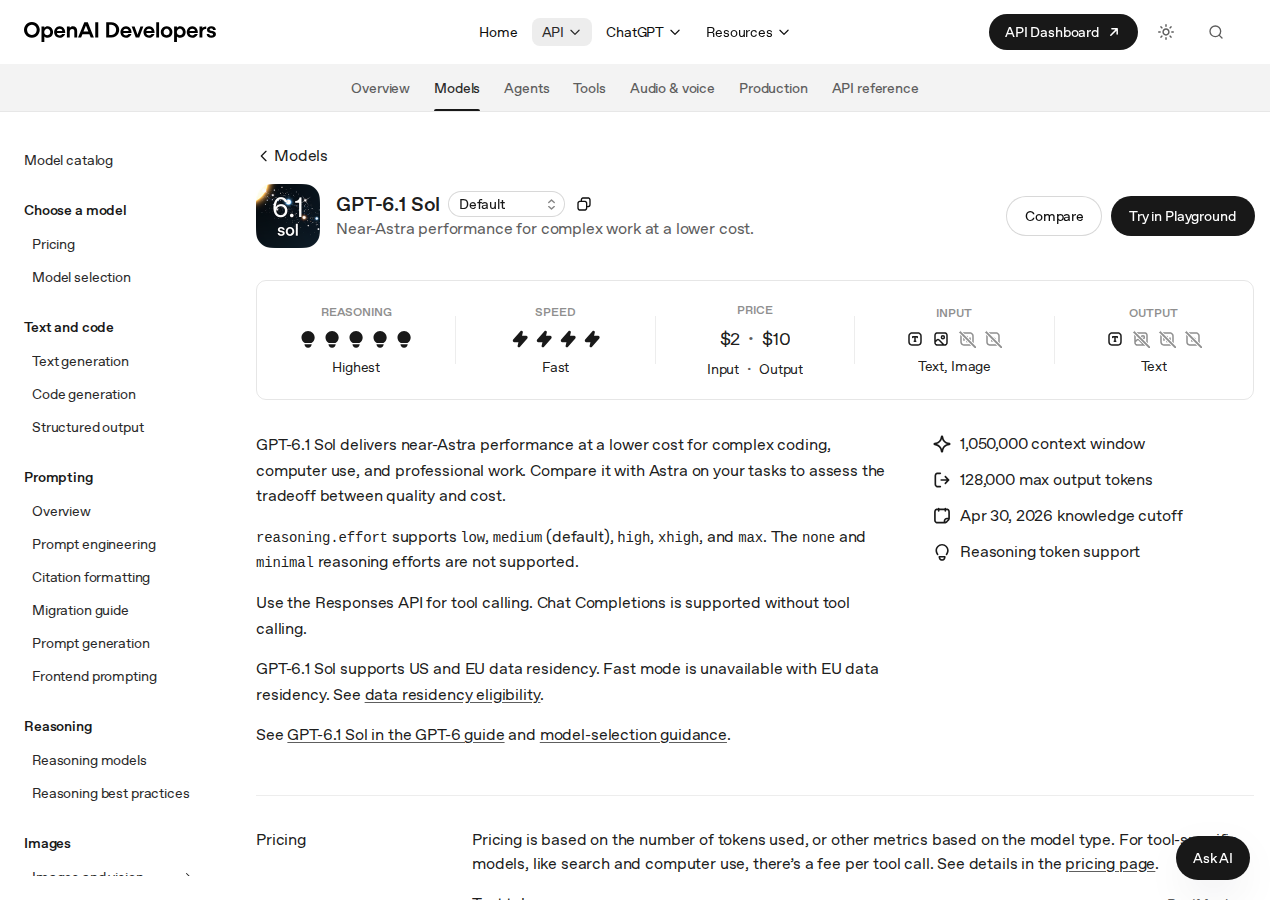
Official technical specifications
- Context window: 1,050,000 tokens (max input 922,000).
- Max output: 128,000 tokens — enough for very long reports in a single response.
- Knowledge cutoff: April 30, 2026.
- Modalities: text and image input, text-only output.
- Reasoning effort: low, medium (default), high, xhigh, and max via the API.
- Data residency: US and EU supported; Fast mode is unavailable with EU residency.
- Multi-agent: supports the Multi-agent beta in the Responses API.
Where it is available — and where it is not
This trips people up, so here is the official line: GPT-6.1 Sol is rolling out to Plus, Pro, Business, Enterprise, and Edu accounts inside Codex (desktop app and CLI) and ChatGPT Work on web and mobile. It is not available in the regular Chat window, and Free and Go plans are excluded at launch. Enterprise and Edu workspaces get it off by default until an admin enables it.
What this means for content creators
- Bulk production gets cheaper per unit of quality. Same mid-tier price as before, but closer to flagship accuracy — better first drafts per dollar, less manual correction.
- Factual accuracy is a publishing feature, not a benchmark. Cutting factual errors from 11.4% to 7.7% at low effort means faster review cycles and fewer corrections after you hit publish — critical in finance, health, and news-adjacent content.
- It slots into the new Work stack. Announced at the same conference, ChatGPT Space and Pages give teams collaborative documents with the model beside them — GPT-6.1 Sol is the engine that fits that environment.
If you run serialized content operations — articles, product descriptions, scheduled social posts — you can automate the full research-to-draft chain in tools like ARWriter's auto-writer and reserve API models like Sol for review and fact-checking passes.
One operational tip straight from the rate card: if your reference material is stable (brand voice guide, style rules, banned-word lists), put it at the front of every request so prompt caching applies — the gap between $2 and $0.10 per million input tokens compounds fast as your monthly volume grows. Conversely, if your tasks exceed 272K input tokens (entire books, article archives), remember the whole request is billed at doubled input rates; splitting into smaller batches is often genuinely cheaper despite the extra requests.
Quick comparison against the direct competition
| Model | Input/Output per 1M | Best for |
|---|---|---|
| GPT-6.1 Sol | $2 / $10 | Complex workflows at moderate cost |
| GPT-6 Astra | $10 / $50 | The hardest end-to-end work |
| Claude Sonnet 5.5 | $2 / $10 | Documents, decks, and design polish at speed |
Notably, Claude Sonnet 5.5 — announced by Anthropic one day earlier — sits on exactly the same price line. The mid-tier "workhorse" bracket is suddenly crowded, and that competition lands directly in your budget's favor.
Honest limitations to weigh before switching
- The model is explicitly built for complex coding, computer use, and professional work — OpenAI's announcement and documentation say nothing about creative writing gains or improvements for specific languages, so test on your own material.
- No regular Chat access, no Free or Go access at launch; you need at least Plus and the Work or Codex surfaces.
- No audio or video output, and no image generation — it is a text model with vision input.
- Huge prompts above 272K tokens cost more, and Fast mode doubles your bill.
- GPT-5.6-era models remain available during the transition, so there is no forced migration yet.
How to start using it today
- Plus and above: open ChatGPT Work on web or mobile, or Codex in the desktop app, and select GPT-6.1 Sol from the model picker.
- API users: call it as
gpt-6.1-solon the Responses API, starting at medium reasoning effort. - Turn on prompt caching for repeated templates and fixed instructions — cached input is a tenth of the standard rate and visibly lowers the monthly bill.
The bottom line
GPT-6.1 Sol is not "smarter at everything." It is a deliberate deal: most of Astra's capability at a mid-tier price. For volume content producers weighing quality against spend — especially now that Anthropic's Sonnet 5.5 matches it dollar for dollar — this week is a good moment to re-audit your AI invoice.
Frequently asked questions
What is GPT-6.1 Sol and when was it released?
It is OpenAI's new text model announced at DevDay on September 29, 2026, offering near-GPT-6 Astra performance at one-fifth of the cost, with improvements in factual accuracy and instruction-following.
Is GPT-6.1 Sol available in regular ChatGPT?
No. It is available in Codex and ChatGPT Work for Plus, Pro, Business, Enterprise, and Edu users, and it is not offered in the standard Chat window or on Free and Go plans at launch.
How much does GPT-6.1 Sol cost?
Via the API it is $2 per million input tokens and $10 per million output tokens, with cached input at $0.10 and a 50% discount on Batch and Flex modes.
Does GPT-6.1 Sol support languages other than English?
It accepts multilingual input and output like other GPT models, but OpenAI's announcement and documentation do not claim language-specific improvements in this release, so validate quality on your own workload.
Sol or Astra — which should I use?
Astra remains stronger on the hardest problems, but Sol lands within 1.9% of Astra's factual error rate (per OpenAI) at a fifth of the price, making it the practical default for most day-to-day work.
Sources
Official GPT-6.1 Sol model documentation (developers.openai.com) · Official DevDay 2026 announcement page (learn.chatgpt.com) · Official models and pricing documentation · TechCrunch launch coverage, September 29, 2026.