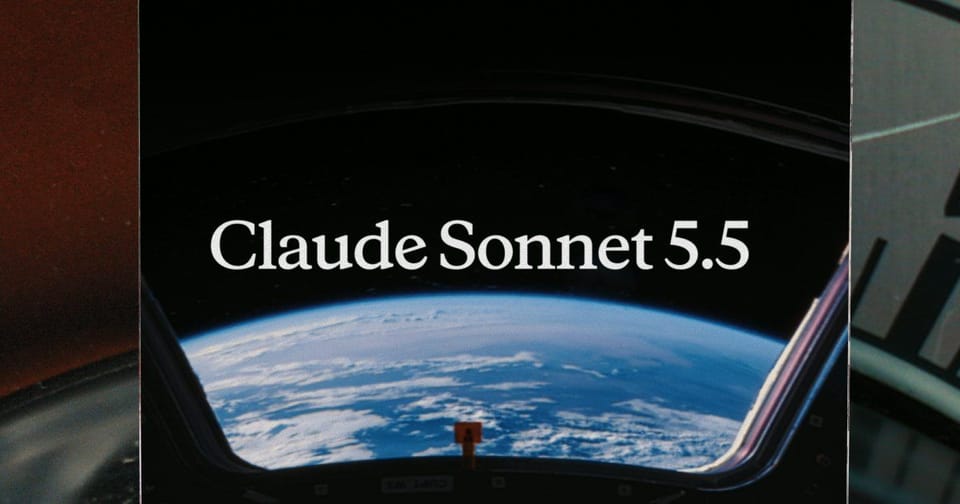
On September 28, 2026, Anthropic announced Claude Sonnet 5.5, the second model in the Claude 5.5 family after Opus 5.5. Two days on, the picture is settling: this is not a cosmetic refresh of the Sonnet line but a repositioning — a model that keeps the previous generation's list price while running 30%+ faster and costing up to 30% less per task, with unusually large gains in documents, decks, and design polish. This guide walks through everything Anthropic has officially announced, with the numbers; sets the model against Opus 5.5 and against OpenAI's GPT-6.1 Sol (launched one day later at the exact same price point); and answers the practical question — where does Sonnet 5.5 fit in a working content creator's stack?
The short version: what exactly was announced
In Anthropic's official wording, Sonnet 5.5 is "a clear upgrade over Claude Sonnet 5, runs 30%+ faster, and costs up to 30% less for most work." It is positioned as a faster, lower-cost complement to Opus 5.5: where Opus is built for complex work requiring careful judgment, Sonnet 5.5 is strongest at "well-scoped everyday tasks, fixing bugs, and creating polished documents, slides, and spreadsheets" — and the announcement adds that it has "a sharp eye for design." Claude Haiku 5.5, aimed at high-volume, cost-sensitive applications, joins the family "in the coming weeks."
The crucial financial detail: the list price is unchanged from Sonnet 5 — $2 per million input tokens, $10 per million output tokens, and $0.20 per million for cache reads — but the model needs far fewer tokens to finish the same job. That is where the real saving lives: up to 30% less per task, per Anthropic's own testing.
The official numbers: leaps or marketing polish?
The announcement's comparison table pits Sonnet 5.5 against Sonnet 5, Opus 5.5, and GPT-6 Sol. The highlights:
| Eval | Sonnet 5.5 | Sonnet 5 | Opus 5.5 | GPT-6 Sol |
|---|---|---|---|---|
| Terminal-Bench 4.0 (agentic coding) | 70.6% | 10.3% | 66.4%¹ | — |
| FrontierCode 1.1 (merge-ready code) | 46.2% | 42.4% | 54.4% | 52.1% |
| CursorBench 4.0 (ambiguous tasks) | 55.5% | 34.1% | 57.8% | — |
| GDPval-AA v2.1 (real-world work) | 1844 | 1449 | 1846 | 1487 |
| AA-Briefcase v1.1 (long-horizon knowledge) | 1811 | 1359 | 1822 | 1483 |
| Chartography (visual chart recognition) | 61.6% | 15.6% | 64.4% | 53.6% |
Read the columns and the story jumps out: Sonnet 5.5 towers over its own predecessor (70.6% versus 10.3% on Terminal-Bench alone), lands within two points of Opus 5.5 on real-world work — and clearly ahead of GPT-6 Sol there: 1844 versus 1487 on GDPval-AA, 1811 versus 1483 on AA-Briefcase. Opus 5.5 still leads on open-ended, complex work, a fact Anthropic states with disarming candor: "Opus 5.5 remains clearly stronger at complex, open-ended work requiring sustained judgment."
One charming footnote illustrates the vision upgrade: Sonnet 5.5 is the first Sonnet model to beat Pokémon Red working only from screenshots — a long-horizon test of visual understanding and memory.
The real cost story: not price per token, but cost per task
This is the part that matters to whoever pays the invoice. Official pricing:
| Per 1M tokens | Sonnet 5.5 | Opus 5.5 |
|---|---|---|
| Input | $2 | $4 |
| Output | $10 | $20 |
| Cache reads | $0.20 | $0.20 |
| Cache writes | $2.50 | $5 |
But the bigger difference is in cost per task, not the rate card. Per the official announcement:
- On Terminal-Bench at Medium effort (the default in the Claude apps), Sonnet 5.5 beats Sonnet 5's best score for less than a tenth of the cost per task.
- On FrontierCode at High effort (the Claude Platform default), it matches GPT-6 Sol's best score at roughly a fifth of the cost per task.
- On AA-Briefcase at Medium, it beats Sonnet 5's best at about a ninth of the cost.
- And on FrontierCode at High it scores ten full points above Sonnet 5 at the same setting for roughly a fifteenth of the per-task cost.
The technical secret is token efficiency, and the early customer quotes tell the same story: Box measured an average of 121K tokens per answer where Sonnet 5 needed 497K — with higher accuracy, 2.4× the speed, and 12% fewer total tokens; Slack logged roughly 14% fewer output tokens across its internal evals; Atlassian expects its Rovo agents to run up to 30% faster.
The content-creator angle: cleaner writing and an eye for design
Anthropic is not marketing Sonnet 5.5 to programmers alone. The announcement says outright that the model "writes more clearly than our previous generation of models," and that early testers called it "a better partner for collaboration than Sonnet 5." For content work specifically:
- Design instinct: testers highlighted its "knack for design" — it adds polish to user interfaces and follows slide templates to produce decks needing minimal manual editing.
- The ten-slide experiment: in an internal test, Anthropic gave the model a public company's quarterly earnings materials and call transcripts plus a slide template and asked for a 10-slide operating review. Two experts judged the first draft "ready to send as is." That scenario maps directly onto anyone building reports and decks for clients or management.
- Documents and spreadsheets by name: the model's official strengths include "creating polished documents, slides, and spreadsheets" — its positioning literally passes through your office suite, not just a terminal.
- Speed as a production feature: "our fastest Sonnet model to date" plus clearer writing means shorter review cycles for anyone on a daily publishing clock.
If you run serialized content operations, this model is a strong candidate for the drafting-and-polish stage: research and planning in a purpose-built pipeline like ARWriter's auto-writer, then final drafting with Opus for heavy lifts and Sonnet 5.5 for the daily grind. To see where global models complement a specialized platform instead of replacing it, browse the tools lineup.
Quick comparison: Sonnet 5.5 vs Opus 5.5 vs GPT-6.1 Sol
One day after Anthropic's announcement, OpenAI shipped GPT-6.1 Sol on the exact same price line ($2/$10). The week we are living through is a rare pricing moment in the capable-mid-tier market:
| Criterion | Sonnet 5.5 | Opus 5.5 | GPT-6.1 Sol |
|---|---|---|---|
| Input/Output per 1M | $2 / $10 | $4 / $20 | $2 / $10 |
| Official positioning | Everyday tasks, documents, design | Complex judgment, open-ended work | Complex coding and professional work |
| Context window | Not stated in announcement | Not stated in announcement | 1.05M tokens |
| Headline value claim | Up to 30% cheaper per task than Sonnet 5 | 40% cheaper than Opus 5 | One-fifth of Astra's price |
From our own archive: we covered Opus 5.5 and its 40% price drop and the original GPT-6 Sol and Luna cuts — Anthropic's lineup now reads: Opus for depth, Sonnet for speed, Haiku (soon) for volume.
Safety: the first Sonnet with cyber safeguards
Because Sonnet 5.5's cybersecurity capabilities are "comparable to Opus 5's," it is the first Sonnet model to launch with cyber safeguards and fallbacks "like those we've developed for our most capable models." Its biology safeguards carry over unchanged from Sonnet 5. Anthropic stresses both guardrails target a narrow set of high-risk requests and that "routine software development and most life sciences work are unaffected." On the automated behavioral audit — roughly 1,850 scenarios — the model improves on or matches Sonnet 5 on most alignment measures, and a full System Card is published for the details.
Honest limitations before you commit
- It is not an Opus replacement for depth. Anthropic itself says Opus 5.5 "remains clearly stronger" at complex open-ended work — do not migrate every sensitive pipeline at once.
- Most headline numbers are agentic. The dramatic jumps are in coding and terminal work; content writing gets "clearer writing" but no dedicated benchmark claim.
- No Arabic-specific claims. The announcement says nothing about improvements to Arabic in particular — test on your own material.
- External-score caveats: some GPT-6 Sol numbers in the table were measured after OpenAI fixed an image-understanding bug, and Anthropic notes third-party scores may not be updated yet — good transparency, but it means fine-grained cross-model comparisons are fragile.
- A migration detail for developers: if you run Sonnet with thinking off, you must switch to the new between_tools setting before moving to Sonnet 5.5, per the official migration guide.
- Context window not in the launch page: check the platform's technical docs rather than the announcement.
What early testers report
Alongside the benchmarks, Anthropic published pre-launch testimonials — most intersecting directly with a creator's concerns: quality, speed, and the cost of repetition:
- Epic Games: "In Epic's early testing, Claude Sonnet 5.5 cleared the same quality bar you'd expect from a higher-tier model… kept responses snappy, handled multi-hour tasks, and delivered with less prescriptive prompting."
- Base44: across 118 real app builds, it produced Opus 5-level apps in 3.6 iterations per build on average versus 7.7 — faster results with fewer attempts, the fewest failed tool calls of any model compared, and rarely stalled mid-build waiting for a human answer.
- Unity: "90% of Sonnet 5.5's work passed" a runtime check where a task only counts if the change actually works when reopened — a harsh standard that measures outcomes, not claims.
- Atlassian: expects its Rovo agents to run "up to 30% faster" than with Sonnet 5 — the same figure the company cites for output speed.
Read these as a buyer, not a follower: most quotes come from engineering companies, but the repeating pattern — higher quality in fewer steps with less human intervention — is precisely what lowers the cost of the task, not the token, in any content pipeline.
The economics for a content team, in one example
Let's ground the numbers with simple arithmetic using only official list prices. Suppose a team burns 10 million input tokens and 5 million output tokens monthly on everyday content work:
- On Sonnet 5.5: (10M × $2) + (5M × $10) = $20 + $50 = $70/month.
- On Opus 5.5 at the same volumes: (10M × $4) + (5M × $20) = $40 + $100 = $140/month.
- On GPT-6.1 Sol: identical math to Sonnet 5.5 = $70.
The $70-versus-$140 gap looks modest until your volume grows tenfold — and then it speaks loudly. Beyond the rate card, effective per-task cost drops further through token efficiency (up to 30% per Anthropic) and $0.20 cache reads for standing instructions, so treat these figures as a ceiling, not a quote. The accounting takeaway: splitting work between two models (Opus for heavy planning, Sonnet for daily loads) has never been easier to justify.
How to start using it today
- Claude apps: the model is available now across platforms; effort defaults to Medium in the apps and High on the platform — start with the default and raise effort for heavy tasks.
- Developers: the identifier is
claude-sonnet-5-5on the Claude Platform, also available via Amazon Web Services, Google Cloud, and Microsoft Azure, with zero data retention supported. - Content teams: draw a clear split — Opus 5.5 for planning and complex judgment, Sonnet 5.5 for daily drafts, reports, and decks — and lean on $0.20 cache reads for repeated standing instructions.
The bottom line
Two days in, Claude Sonnet 5.5 looks like the family's practical bargain: an unchanged list price, 30%+ more speed, and a design instinct that pushes documents and decks closer to done. With GPT-6.1 Sol contesting the same price line a day later, content operators are enjoying a rare buyer's market. Run both on your real tasks and measure cost per task — not price per token. That is the metric you win with.
Frequently asked questions
When was Claude Sonnet 5.5 released and what does it cost?
Announced September 28, 2026, at $2 per million input tokens, $10 per million output tokens, and $0.20 for cache reads — the same list price as Sonnet 5, with up to 30% lower cost per task thanks to token efficiency.
What is the difference between Sonnet 5.5 and Opus 5.5?
Opus 5.5 handles complex judgment and open-ended work at double the price ($4/$20); Sonnet 5.5 is the faster (30%+) and cheaper-per-task option, strongest at well-scoped everyday tasks and polished documents, slides, and spreadsheets.
Is Sonnet 5.5 good for writing and content work?
Yes, by its official positioning: it writes more clearly than the previous generation, produces polished documents and decks, and follows slide templates with a noticeable design touch — though most published performance numbers concern coding and agentic work.
Where is Sonnet 5.5 available?
Per the official announcement it is now available on all platforms, including Amazon Web Services, Google Cloud, and Microsoft Azure, and on the Claude Platform as claude-sonnet-5-5, with zero data retention supported.
Is it worth upgrading from Sonnet 5?
For most workloads, yes: same list price, 30%+ speed, up to 30% lower cost per task, and clearly higher results on knowledge work and image understanding — just handle the between_tools setting if you run with thinking off.
Does Sonnet 5.5 improve Arabic-language output?
The announcement makes no Arabic-specific claims, so judge it on your own content: run a sample of your real Arabic workload and compare quality and cost against your current model before a full switch.
Sources
Official Claude Sonnet 5.5 announcement page, September 28, 2026 (anthropic.com/claude-sonnet-5-5) · Official performance and pricing tables · Sonnet 5.5 System Card · ARWriter's prior coverage of Opus 5.5, Sonnet 5, and the GPT-6.1 Sol launch.