OpenAI quietly reshuffled its model lineup on October 26, 2026, with the release of GPT-6.1 Terra — a mid-tier model that halves standard API prices while improving writing quality, visual reasoning, and speed. If you run content operations, build AI writing tools, or simply watch your per-article token bill, this launch changes the math more than any OpenAI release since the Sol and Luna price cuts in September.
What OpenAI announced
The official launch post describes GPT-6.1 Terra as "a fast, efficient model that combines detailed visual reasoning and precise computer use alongside clearer, more natural writing," positioning it as "a significant step up from GPT-5.6 Terra" for the communication and computer-based tasks "that fill the workday — from drafting proposals and interpreting technical drawings to filling out forms and editing videos."
That framing matters. Terra is not chasing the frontier. It is the workhorse slot in a now three-tier stack: GPT-6 Luna for cheap high-volume work, Terra for daily mid-range work, and GPT-6.1 Sol and GPT-6 Astra for the hardest problems. Independent analyst Simon Willison, who tested the model within hours of release, compared its position to Anthropic's Sonnet slot: neither the cheapest nor the most capable option, but the rational default for most production workloads.
Pricing: the headline numbers
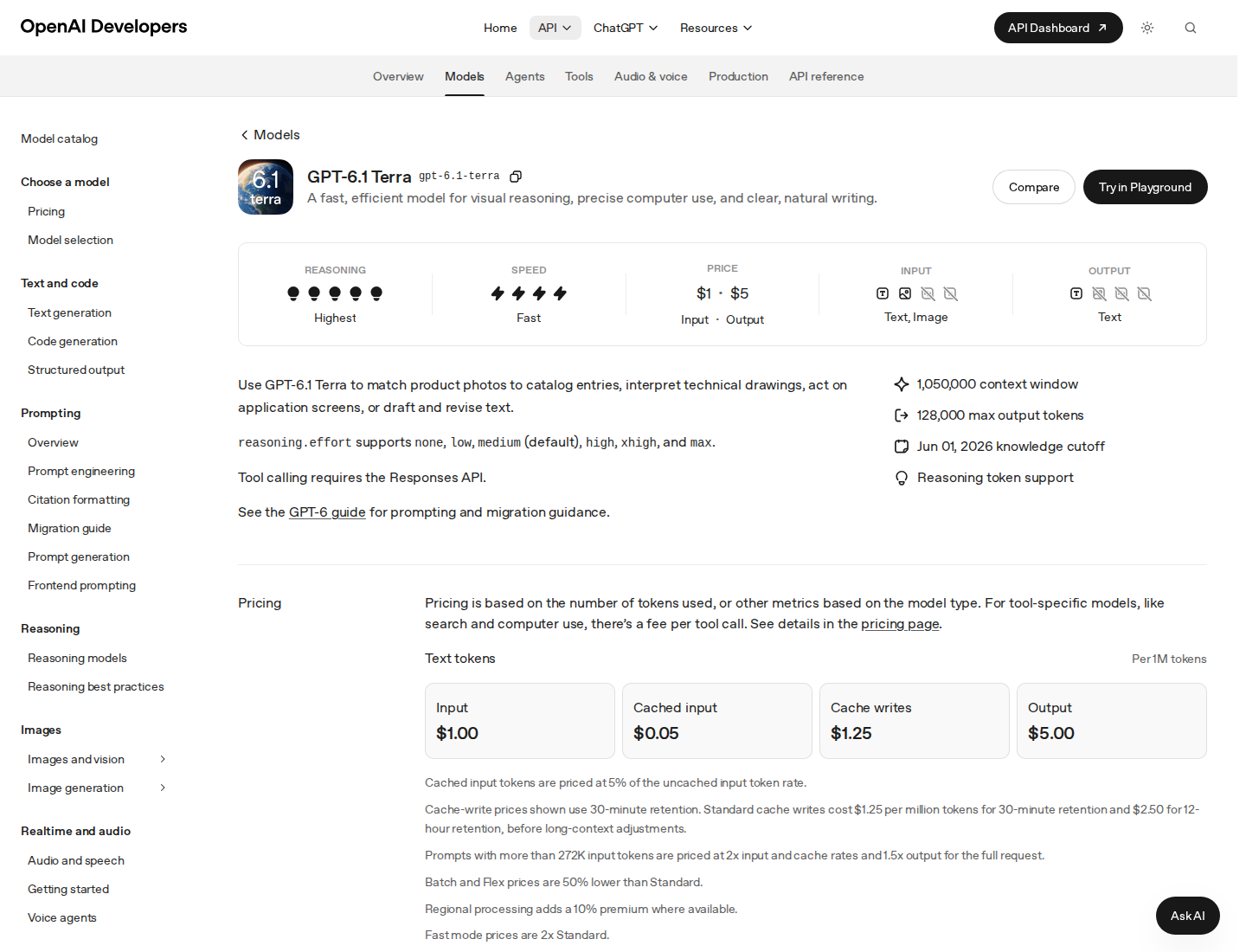
| Metric | Price per 1M tokens |
|---|---|
| Input | $1.00 |
| Cached input | $0.05 |
| Cache writes (30-min retention) | $1.25 |
| Output | $5.00 |
Per OpenAI's own announcement, those standard rates are 50% lower than both GPT-5.6 Terra and GPT-6.1 Sol. Willison's analysis adds the useful reference point that Terra still runs roughly 10x the price of GPT-6 Luna. Fine print worth knowing before you commit:
- Prompts above 272,000 input tokens are billed at 2x input and cache rates, and 1.5x output, for the entire request.
- Batch and Flex processing take another 50% off — the cheapest path for scheduled, non-urgent content pipelines.
- Regional data processing, where available, adds a 10% premium; the Fast mode doubles prices.
Specs that content teams should care about
The developer documentation fills in what the announcement leaves out, and two numbers stand out:
- A 1,050,000-token context window (922,000 max input, 128,000 max output). That is room for an entire brand book, a season of transcripts, or a full product catalog in a single request — enough to keep tone consistent without re-feeding style guides.
- Text and image in, text out. Terra reads screenshots, technical drawings, and photos, but generates no audio or video. Knowledge cutoff: June 1, 2026. Reasoning effort scales from none through low, medium (default), high, xhigh, and max. Tool calling requires the Responses API; classic Chat Completions remains supported.
What actually improved
Three published results from OpenAI translate directly into content-workflow value:
- Fewer factual errors. On OpenAI's internal benchmark of error-inducing prompts, the error rate at low reasoning effort fell from 53.6% (GPT-5.6 Terra) to 16.7% — a drop of nearly 37 percentage points. At maximum effort, Terra reaches 4.3%, nearly matching GPT-6 Astra and GPT-6.1 Sol. For anyone publishing factual content at volume, this is the single most important number in the launch.
- Three times faster task completion than both GPT-6 Astra and GPT-6.1 Sol, per the announcement — visible latency savings when generating batches.
- Stronger visual reasoning. On MMMU-Pro, Terra beats GPT-5.6 Terra at every reasoning setting and comes close to Astra and Sol at a fraction of the cost.
Coding improved too — 50.3% on Terminal-Bench 4.0 at max effort, more than double the previous Terra's 21.5% — but OpenAI explicitly steers complex engineering work back to Sol and Astra.
What this means for your content workflow
- API-based writing tools just got cheaper to run. At $5 per million output tokens, long-form generation with improved factuality becomes viable for product descriptions, localized landing pages, and client deliverables at scale. Batch mode halves that again for overnight jobs.
- Massive context kills the style-guide problem. Load your guidelines, past articles, and terminology once; every generation in the request stays anchored to them.
- It reads images but does not make them. Use Terra to describe, analyze, or restructure visual material — image and video generation still belongs to dedicated models and tools.
- Availability: from day one, Terra is live for Plus, Pro, Enterprise, and Edu plans inside ChatGPT Work and Codex (the same usage allowance now covers more tasks), via the API as
gpt-6.1-terra, and on Amazon Bedrock. - Honest caveat for ChatGPT subscribers: OpenAI's Ted Sanders summarized it on Hacker News — for subscribers this is "not a major release"; its real value is for API users. If your current model works for you, there is no urgency.
Quick comparison against the obvious alternatives
| Model | Input / Output per 1M | Best fit |
|---|---|---|
| GPT-6.1 Terra (new) | $1 / $5 | Daily writing at volume, visual analysis, repetitive office work |
| GPT-6.1 Sol | ~2x Terra | Hardest reasoning and coding tasks |
| GPT-6 Luna | ~1/10 of Terra | Classification, extraction, ultra-high-volume short text |
| Claude Haiku 5.5 | Anthropic's cheapest tier, with API cuts up to 90% | High-volume short-form workloads |
For deeper background, see our coverage of the GPT-6.1 Sol launch, the original Sol and Luna 50% price cut, and our analysis of Claude Haiku 5.5's aggressive API pricing.
Back-of-envelope math: what an article costs on Terra
To make the pricing tangible: a 1,500-word article consumes roughly 2,500 output tokens plus 3,000 to 5,000 input tokens for instructions and source material. At the new rates, that is under two cents of output cost and fractions of a cent on input — generating 100 publishable drafts a month now costs less than a couple of dollars in raw generation. Layer on the 50% Batch discount for scheduled overnight jobs and the economics suddenly support content types that never penciled out before: product copy in multiple languages, per-customer personalized messaging, automated weekly summaries. That is the real story of this mid-tier refresh — not smarter AI alone, but production economics that let you experiment with formats instead of rationing them.
The computer-use angle, for completeness
Although writing is our focus here, fairness requires noting what OpenAI is promoting loudest: Terra's desktop automation. The company measures it on OSWorld 2.1, where agents complete multistep tasks in real applications — building a 3D model from a technical drawing, for instance — and reports that the new Terra surpasses the previous generation's best score at a fraction of the cost per task. For teams assembling end-to-end content pipelines, that means Terra can plausibly own intermediate steps — reading a screenshot, filling a form, preparing a file — rather than just drafting the copy. The writer becomes one station in an automated line.
Limitations to weigh honestly
- No audio or video output — text only.
- OpenAI itself recommends Sol or Astra for the most complex coding tasks.
- Long prompts above 272K tokens double your input costs; plan document chunking accordingly.
- Its declared strength is "technical communication"; for premium creative long-form, the higher tiers remain the safer bet.
- Safety posture is documented: Terra meets the Critical cybersecurity threshold under OpenAI's Preparedness Framework, with a published system card.
The bottom line
GPT-6.1 Terra is a rationalization release, not a frontier leap — and that is precisely why it matters for professional content operations. Near-frontier writing quality and factuality, three-times-faster turnaround, and half the price of the previous mid-tier make it the new sensible default for volume work. If you would rather not assemble this pipeline yourself, ARWriter's article and research writer bundles Arabic-first drafting, sourcing, and publishing in one workflow, and the full tool set covers the image and prompt side that Terra leaves untouched.
FAQ
Is GPT-6.1 Terra available on ChatGPT Plus?
Yes. Since October 26, 2026 it is available to Plus, Pro, Enterprise, and Edu subscribers inside ChatGPT Work and Codex, with the same allowance covering more tasks than GPT-5.6 Terra did.
How much does GPT-6.1 Terra cost via the API?
$1 per million input tokens and $5 per million output tokens, with cached input at $0.05 and a further 50% discount on Batch and Flex processing.
Is Terra better than Sol for writing?
OpenAI says Terra is "probably better than Astra and Sol at technical communication" and much faster, while Sol remains stronger for complex tasks overall. For routine volume writing, Terra is the better price-to-quality choice.
What is GPT-6.1 Terra's context window?
1,050,000 tokens total, with up to 922,000 input tokens and 128,000 output tokens. Requests above 272,000 input tokens are billed at 2x input rates.
Does GPT-6.1 Terra generate images or video?
No. It accepts text and image inputs and produces text output only. Media generation requires separate tools.