On October 7, 2026, Anthropic released Claude Haiku 5.5, its cheapest, fastest and most capable small model to date — with per-token prices cut by as much as 90% versus Haiku 4.5. The announcement completes the 5.5 generation that began with Opus 5.5 on September 22 and Sonnet 5.5 on September 28, arriving weeks before a reported run at going public, according to Reuters, and in the middle of what analysts increasingly describe as an open pricing war between the major AI labs.
If you run content operations — an agency desk, an e-commerce catalog, a newsroom pipeline or a stack of client newsletters — the headline is simple: bulk summarization, classification and first-draft generation now cost roughly a tenth of what they did last week. Below is the full pricing picture, the official benchmark numbers, what it means for production workflows, and the honest limits you should weigh before migrating.
What Anthropic actually announced
Haiku 5.5 is built for high-volume, cost-sensitive work: summarization, conversation compaction, repetitive queries, classification, sub-agent tasks inside larger pipelines, and latency-critical use like live support. Anthropic calls it «the cheapest, fastest, and most capable small model we've ever released.» It is available immediately on the Claude Platform under the model ID claude-haiku-5-5, and on all three major clouds — Amazon Web Services, Google Cloud and Microsoft Azure — from day one, with an official migration guide for teams moving off Haiku 4.5.
One structural change matters more than it looks: Haiku 5.5 is the first small-class Claude with an adjustable effort setting. You can dial each request between cost-saving and maximum reasoning — a capability previously reserved for the larger models — which turns the small model into a genuinely flexible production tool rather than a fixed compromise.
The new pricing, in full
Here are the official rates per million tokens, for requests up to 100K tokens:
| Per 1M tokens — requests up to 100K | Haiku 5.5 | Haiku 4.5 | Sonnet 5.5 |
|---|---|---|---|
| Input | $0.10 | $1.00 | $2.00 |
| Output | $0.50 | $5.00 | $10.00 |
| Cache reads | $0.01 | $0.10 | $0.10 |
| Cache writes | $0.125 | $1.25 | $2.50 |
Official Anthropic pricing from the October 7, 2026 announcement. Requests above 100K tokens fall into a second tier (input $0.50, output $2.50).
Input drops from $1.00 to $0.10 per million tokens and output from $5.00 to $0.50 — a 90% cut on the base tier. Anthropic says the average running cost across real usage patterns falls «around 75%», since long requests are billed at the higher tier. Cache reads at one cent per million are effectively free context for repeated work, which is precisely the pattern content pipelines use.
Performance: official numbers, not slogans
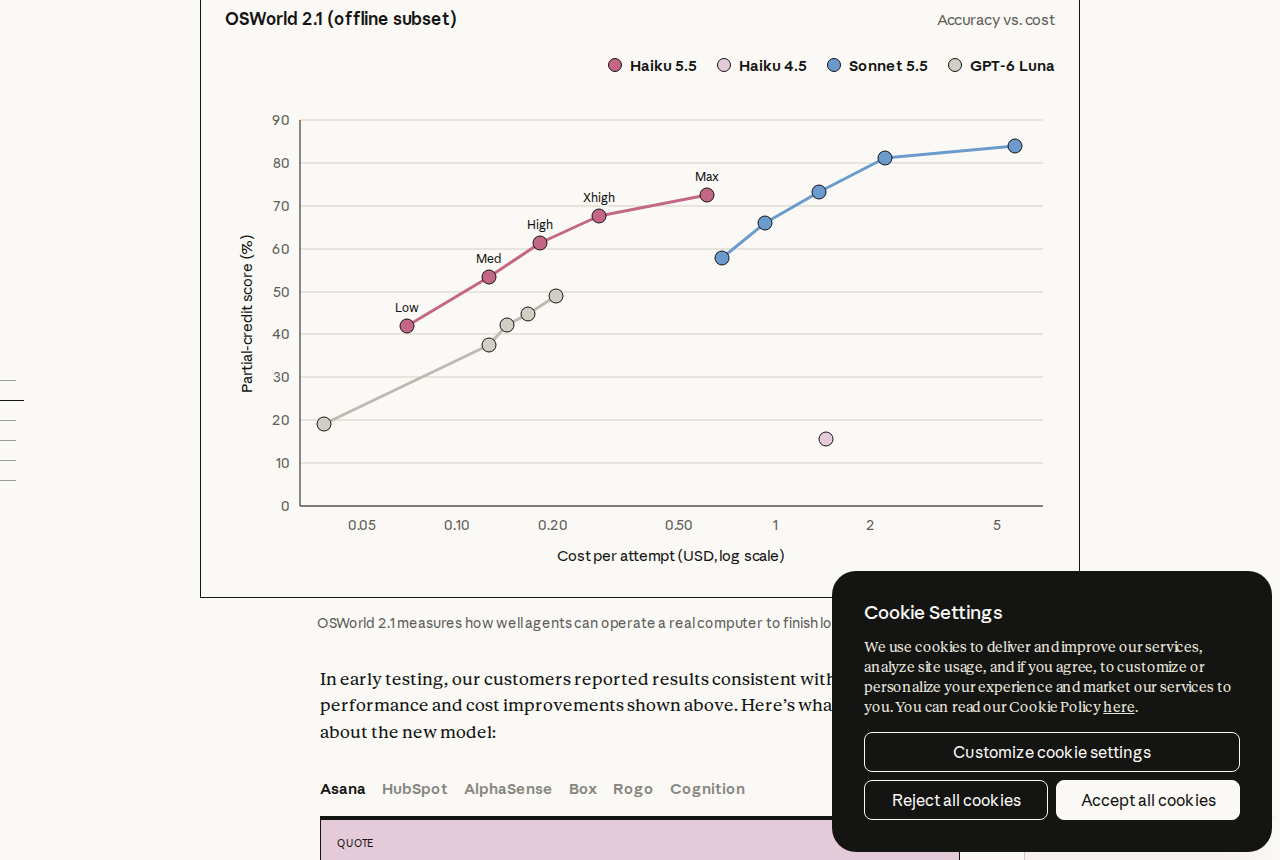
On GDPval-AA v2.1 — a benchmark of real professional work across 44 occupations — Haiku 5.5 scores 1620, well ahead of Haiku 4.5 (735) and ahead of OpenAI's GPT-6 Luna (1437), while Sonnet 5.5 remains in front at 1840. On Chartography, the visual-reasoning test, it jumps from 6.4% to 46.4%; on OSWorld 2.1, the computer-use benchmark, from 15.7% to 72.4%.
Early customers quoted in the announcement documented real production gains: Asana measured over 30% lower task latency and up to 2.5x faster inference per agent turn; HubSpot recorded its best-ever internal score (92.8%) on CRM evaluation suites; Box saw an 11-point quality gain at roughly half the latency; AlphaSense measured a statistically significant quality improvement across 400 test queries on a feature doing 8 million calls a week.
What this means for content operations
The expensive part of content production has never been the flagship model — it is the volume layer underneath: summarizing source material, tagging and routing drafts, generating product descriptions by the hundreds, pre-formatting newsletters, triaging reader comments. That is the layer Haiku 5.5 targets, and at the new price the unit economics of automation change fundamentally.
Three patterns are worth adopting immediately:
- Two-stage drafting: generate outlines and rough first passes on Haiku 5.5, then route only the winners to Sonnet 5.5 or Opus 5.5 for final polish — a pipeline that cuts the bill by roughly an order of magnitude.
- Summarize-and-classify at scale: daily briefings, competitor monitoring and archive processing become cents-per-day tasks.
- Latency-sensitive replies: as Anthropic's fastest model to date, it fits live support and interactive drafting where wait time matters.
A quick sense of scale: summarizing 1,000 articles a month at ~3,000 tokens each means 3 million input tokens — $3.00 at Haiku 4.5's old rate, $0.30 at the new one, before counting that the new model is faster. For teams that prefer finished multilingual output without managing models and rates at all, ARWriter's Auto-Writer handles research, drafting and publishing in one workspace — a practical alternative when the goal is content, not infrastructure.
Quick comparison: which model for which job?
| Job | Best pick | Why |
|---|---|---|
| Bulk summaries and tagging | Haiku 5.5 | Cheapest and fastest; ample quality for repetitive tasks |
| Publication-ready writing | Sonnet 5.5 | Higher craft; its cache reads are now half price |
| Complex analysis, long projects | Opus 5.5 | Top-tier capability at 40% below Opus 5 |
A practical split of the three-model lineup after the Haiku 5.5 launch
Two quieter changes in the same announcement
First, Sonnet 5.5 cache reads dropped from $0.20 to $0.10 per million tokens, which Anthropic says makes most agentic workloads about 20% cheaper — significant for anyone running multi-step generation chains. Second, the company is rolling out a new monthly API credit for Max and Team subscribers starting this week: $100/month for Max 5x, $200/month for Max 20x, and up to $500 pooled for Team plans, usable on any model — effectively free experimentation budget for teams building on the platform.
Honest limitations
- Not a replacement for the big models on complex chains: Terminal-Bench 4.0 shows 39.2% for Haiku 5.5 versus 70.6% for Sonnet 5.5 — the gap on long multi-step work is real.
- The 90% headline applies to the short-prompt tier; requests above 100K tokens are billed higher (input $0.50, output $2.50), which is why the blended average saving is «around 75%».
- All comparisons above come from Anthropic's own announcement; independent evaluations will take time to confirm the picture.
- No language-specific claims: the announcement makes no dedicated Arabic-language improvements for this release — regional teams should test on their own samples before committing production volume.
How to start today
The model is live now on the Claude Platform via claude-haiku-5-5 and on AWS, Google Cloud and Azure, with an official migration guide for Haiku 4.5 users. Anthropic also updated its Python and TypeScript SDKs with beta support for computer use and browser use — relevant if your pipeline drives tools, not just text.
And if you would rather stay focused on content than on rate tiers: ARWriter's toolset starts at $4.99/month (Plus), with Pro at $9.99 and Premium at $24.99, covering writing, images and scheduling in Arabic and English from a single dashboard — on a day when model prices are falling, the real question is which tool saves your actual hours.
Frequently asked questions
How much does Claude Haiku 5.5 cost?
$0.10 per million input tokens and $0.50 per million output tokens for requests up to 100K tokens, versus $1.00 and $5.00 on Haiku 4.5 — a 90% cut on the base tier, with Anthropic citing «around 75%» average running-cost reduction across real workloads.
How is Haiku 5.5 different from Haiku 4.5?
Besides the price cut, it scores far higher across the official benchmark suite (1620 vs 735 on GDPval-AA v2.1), is Anthropic's fastest model to date, and is the first small Claude with an adjustable effort setting for balancing cost against reasoning depth.
Does Haiku 5.5 replace Sonnet 5.5?
No. Anthropic explicitly positions Sonnet 5.5 and Opus 5.5 as the better choices for complex agentic and coding work — Haiku 5.5 shines on narrow, high-volume tasks that were previously cost-prohibitive, such as compaction, summarization and sub-agent work.
Is Arabic supported in Claude Haiku 5.5?
The model operates within Claude's general language coverage, but the launch announcement does not claim Arabic-specific improvements. Test it against your own Arabic content before moving production workloads.
When did Claude Haiku 5.5 become available?
October 7, 2026, simultaneously on the Claude Platform, Amazon Web Services, Google Cloud and Microsoft Azure.
Primary source: Anthropic's official Claude Haiku 5.5 announcement, October 7, 2026. On the same day, OpenAI rolled out GPT-6 with its new Intelligent UI to all ChatGPT users — covered separately here.