On November 5, 2026, Thinking Machines Lab — the research company founded by former OpenAI chief technology officer Mira Murati — quietly released the second generation of its models: Inkling 2 Small. One week later, on November 12, the company made a more consequential move: the model's full weights went up on HuggingFace under an Apache 2.0 license, free for anyone to download, study, fine-tune, and ship commercially. The result is a 594-billion-parameter mixture-of-experts model (with 17 billion active parameters per call), with image input support, sitting within striking distance of the closed frontier on agentic benchmarks — and now owned by no one.
If your mental model of "open weights" still means smaller, weaker models a tier behind the majors, Inkling 2 Small is the release that should update it. This explainer covers what the model is, what its own published benchmarks actually show, what it can genuinely do for writers, researchers, and designers, how to access it, and the honest limits nobody's thread will tell you.
Who is Thinking Machines Lab, and why the name matters
Thinking Machines Lab launched in early 2025 led by Mira Murati and quickly assembled one of the densest concentrations of senior AI research talent outside the big labs. Its distinguishing stance is philosophical as much as technical: open weights for large models are a capability that should be managed responsibly, not blocked. The lab articulated this in a July 2026 position post titled "A Safe Path to Open Weights," and Inkling 2 Small follows that playbook precisely — a closed-weights debut on the company's Tinker platform on November 5, then full weights released on November 12 after external safety testing and red-teaming. (Tech press including SiliconANGLE and VentureBeat reported during launch week that the company is closing in on a roughly $5 billion fundraise; that figure is press reporting, not a company confirmation, and is treated here as such.)
The official specifications, verbatim from the announcement
- Architecture: Mixture-of-Experts, 594B total parameters, 17B active — frontier-class capacity with throttled inference cost.
- Inputs: text and images; the model reads and reasons over visual input.
- Variable effort: dial reasoning depth per task, from cheap fast answers to long deliberation.
- General intelligence score: 31 on the Artificial Analysis Intelligence Index, "far surpassing" the company's previous generation, with gains in agentic coding, vision, knowledge work, and reasoning — in the announcement's own words.
- Training: a more efficient pretraining run plus the company's largest unified reinforcement-learning run to date.
The numbers worth pausing on: PMPP-Hard
What separates this launch from typical model marketing is transparency. Thinking Machines published its full results on PMPP-Hard, a grueling agentic-coding evaluation of 69 real tasks, with four independent attempts per model, a 10-hour budget, and two independent LLM audits of every submitted solution. The mean results:
| Model | Mean tasks solved / 69 | Pass@4 / 69 |
|---|---|---|
| GPT-6 Astra | 63 | 63 |
| Kimi K3.1 Pro | 60.5 | 63 |
| Claude Opus 5.5 | 60 | 64 |
| Kimi K3 | 55.75 | 66 |
| DeepSeek V4.1 Flash | 55.25 | 62 |
| Inkling 2 Small | 54.25 | 64 |
| GLM 5.3 | 52.5 | 61 |
| Mistral Large 4 | 50.25 | 61 |
Read the table honestly. Inkling 2 Small does not top it — GPT-6 Astra, Kimi K3.1 Pro, and Claude Opus 5.5 lead on the mean. But an open-weights model landing mid-pack among the frontier names, with a best-of-four of 64 (tied with Claude Opus 5.5, near the table's best Pass@4 of 66), is the actual headline. Specialized press — The Decoder — has called it the top-scoring western open-weights model, with a download size it estimates at roughly 394 GB; that size figure is press-reported, not stated in the company's announcement.
What it can actually do: demos from the announcement
The launch showcases are unusually verifiable because the model built them itself, end to end:
- A living city simulator in Three.js: every building, texture, and car generated procedurally from a single road — no pre-made assets — with power, budgets, and emergencies to manage.
- A Linux PC in the browser: a from-scratch PC emulator written in Python that boots a real Linux kernel with a web interface.
- Map-to-video and hand-drawn animation: an apartment walkthrough generated from a floor plan, and hand-drawn origami cranes that land and animate in a Blender scene the model supervised and revised.
The demo that matters most for knowledge workers
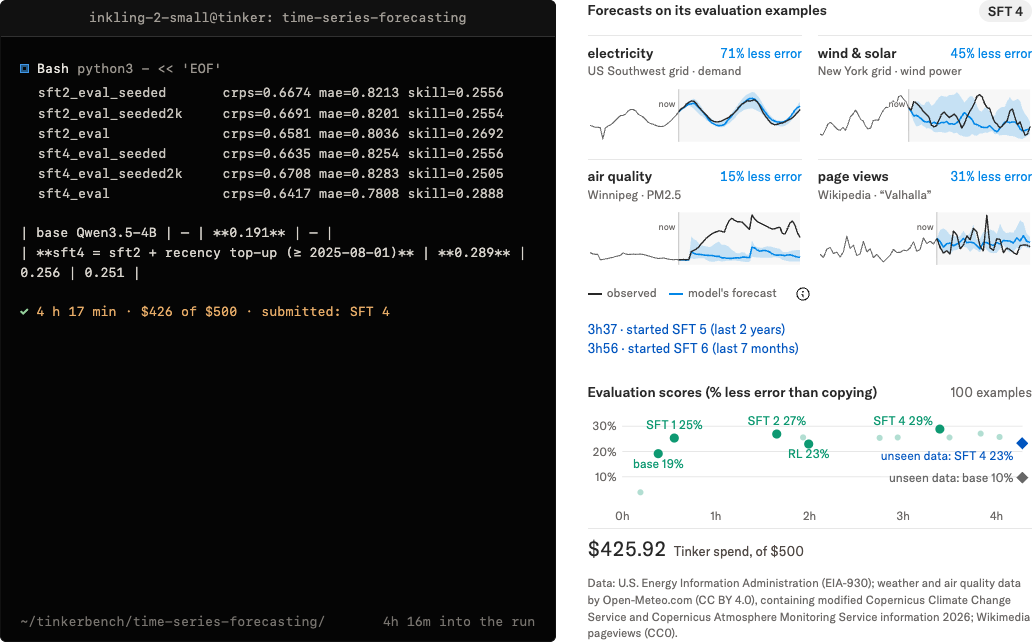
Beyond the showpieces, the category the announcement calls agentic knowledge work is the one writers and researchers should watch: long-horizon tasks where the model gathers, experiments, and self-corrects. The flagship example ran on the company's Tinker platform: Inkling 2 Small was asked to train a better version of Qwen3.5-4B for time-series forecasting. It wrote its own evaluator, iterated on training datasets and recipes across SFT and RL approaches, debugged as it went, and more than doubled the forecasting score after 4.5 hours of work — for $426 in Tinker spend against a $500/12-hour budget. The invoice is itself a lesson: agentic capability is powerful, and metered, even when the weights are free to own.
How to actually access it, channel by channel
Since the November 12 weights release, access runs through five documented channels:
- Direct download from HuggingFace under Apache 2.0 — for anyone with the hardware, or an interest in studying and customizing the model.
- Thinking Machines' Tinker platform: an instant playground, plus fine-tuning and sampling, with downloadable checkpoints.
- Seven hosted API providers: NVIDIA, Fireworks, Together, Baseten, Nebius, Modal, and Cloudflare — seven companies now competing on price for the same model instead of one gatekeeper.
- Local runtime support on day one: Unsloth, SGLang, vLLM, and TokenSpeed.
- Post-training tooling: Miles, SkyRL, and Snowflake Cortex Training — a telling list, since it reveals the real target audience: teams building their own AI systems, not just chat users.
What this means for you as a creator or knowledge professional
- Writers and researchers: the nearest-term value is long-horizon knowledge work — synthesizing many sources, drafting research-grade material, checking chains of reasoning. Caveat: the lab has published nothing official about Arabic (or any specific language's) writing quality; test it on real texts from your domain before trusting it professionally. For dependable day-to-day Arabic output, a specialized Arabic-first toolchain — such as ARWriter's article and research writer — remains the safer production lane, with Inkling as a supporting research layer.
- Developers and product builders: this release is aimed squarely at you. A near-frontier model you can own, fine-tune, and serve through seven competing providers means AI product features without single-vendor lock-in — and the $426 fine-tuning run shows customization costs have entered small-team territory.
- Designers and visual creators: its vision input and generative demos (Blender-supervised animation, interactive 3D) open a door to interactive experiences without deep engineering — provided you bring direction skills: knowing what to ask for and how to critique the result. For visual scene ideas and prompts, a structured library like ARWriter's image prompt library pairs naturally with any generative model.
Why open weights matter in practice, not as a slogan
"Open" gets thrown around loosely in AI coverage, so here is what Apache 2.0 ownership concretely buys you:
- Privacy under self-hosting: anyone serving the model on their own infrastructure processes client drafts, unpublished research, patient or student data without it ever leaving their building — a decisive factor for academic researchers and privacy-conservative institutions across emerging markets.
- Deep customization without permission: Apache 2.0 explicitly permits fine-tuning and commercial deployment of the result. You can train it on your publication's house style or your industry's terminology and sell services built on it — something many closed-model terms expressly forbid.
- Stability and longevity: a model you own does not change overnight because a vendor deprecated a version, adjusted its behavior, or raised its price. For anyone building a commercial product, that alone justifies exiting single-vendor dependence.
- Auditable transparency: safety and research teams can inspect the model itself rather than trust assurances — the core of Thinking Machines' declared "safe path" philosophy.
Two dates, two events: November 5 versus November 12
Precision matters because some secondary coverage blurred them. On November 5, the model was announced and served exclusively through Tinker, weights closed. On November 12, after a week of external safety testing and red-teaming, the full weights landed on HuggingFace alongside the runtime and post-training integrations. If you see a headline dated November 12 declaring a "launch," it refers to the weights release, not the original announcement — a full week of verification apart, and a meaningful distinction for anyone tracking whether the company actually follows its own stated process.
Operating cost versus the alternatives
Thinking Machines published no unified pricing — correctly, since pricing is now distributed across seven competing providers. But the Tinker showcase offers a real-world anchor: a self-directed training task that ran 4.5 hours cost $426. With 17B active parameters, per-token costs sit above sparse 8-9B models but far below what a dense 594B model would imply. The practical buyer's rule: compare per-million-token rates across at least three of the seven providers before committing — spreads between them for the identical model can approach a factor of two.
Quick comparison: Inkling 2 Small versus your current options
| Dimension | Inkling 2 Small | Closed frontier models | Previous open models |
|---|---|---|---|
| Weights | Open, Apache 2.0, downloadable | Closed, proprietary | Usually open |
| Scale | 594B total / 17B active | Undisclosed | Typically far smaller |
| Agentic performance | 54.25 mean on PMPP-Hard | 55.25 to 63 | Generally out of contention |
| Provider choice | 7 API hosts + local | Single vendor | Varies |
| License | Apache 2.0, commercial use | Restrictive ToS | Mixed |
Honest limits before you plan around it
First, "17B active" cuts per-call cost but not the hardware reality of serving 594B parameters locally — for most people and companies, practical access means the seven hosted providers or Tinker, paid by usage. Second, the published evaluation leans heavily agentic-coding; there is no official word on Arabic quality or on long-form creative writing tasks. Third, near-frontier is not frontier: GPT-6 Astra, Kimi K3.1 Pro, and Claude Opus 5.5 all beat it on the mean benchmark. Fourth, the reported multibillion-dollar fundraise is unconfirmed press reporting and changes nothing about what you can download today.
Frequently asked questions
What is Inkling 2 Small and who released it?
It is the second-generation AI model from Thinking Machines Lab, the company founded by Mira Murati, announced November 5, 2026. It is a 594-billion-parameter mixture-of-experts model with 17 billion active parameters, image input support, and adjustable reasoning effort.
Is Inkling 2 Small free and open source?
Its full weights have been downloadable from HuggingFace since November 12, 2026 under Apache 2.0, which permits commercial use. Practical use is either a costly local deployment or paid access through Tinker and seven listed hosting providers — "open" here means ownership freedom, not free inference.
Does Inkling 2 Small support Arabic?
The lab has published no official results for Arabic or any specific language on writing tasks. The model is broadly trained and likely multilingual, but the sound approach is to test it on domain-relevant Arabic texts before any professional reliance.
How large is the download and what hardware does it need?
The company did not state an official weights size; specialized press estimates around 394 GB. Full local serving is beyond typical personal machines — the practical route for individuals and businesses is the seven hosted providers or Tinker on a usage basis.
How can I try Inkling 2 Small today?
Three routes: the Tinker playground on Thinking Machines' site for instant testing and fine-tuning; an account with one of the seven hosted providers (NVIDIA, Fireworks, Together, Baseten, Nebius, Modal, Cloudflare); or downloading the weights from HuggingFace if you operate the required infrastructure.
The bottom line: what actually changed
Two weeks ago, every content and product team faced a forced choice between open models and strong ones. Inkling 2 Small collapses most of that trade-off: roughly 80 to 90 percent of frontier agentic performance, full ownership, customization rights, and a seven-provider market competing on your price. For anyone building AI-powered products — including in Arabic markets — this is the strongest entry point into heavy open models to date. The rational setup is a two-layer workflow: a dependable Arabic-first production lane like ARWriter for daily output, and an open-model research and customization layer like Inkling for everything beyond it. We will track the first independent Arabic-language evaluations as they appear.
Sources: Thinking Machines' official Inkling 2 Small announcement (November 5) and open-weights update (November 12, 2026). Press-reported estimates: The Decoder, SiliconANGLE, and VentureBeat, November 2026. For a practical comparison with another open image model, see our MiniMax H3-Image explainer.