Last updated: August 2026
If you run a content team, a Shopify brand blog, or a freelance editorial practice, GLM 5.2 from Z.ai shows up in two ways: as a raw API model with aggressive long-context claims, and as the engine behind chat and product experiences. This guide ignores developer cosplay and answers the operator question: what does GLM 5.2 change for drafting, cost control, and weekly publishing cadence?
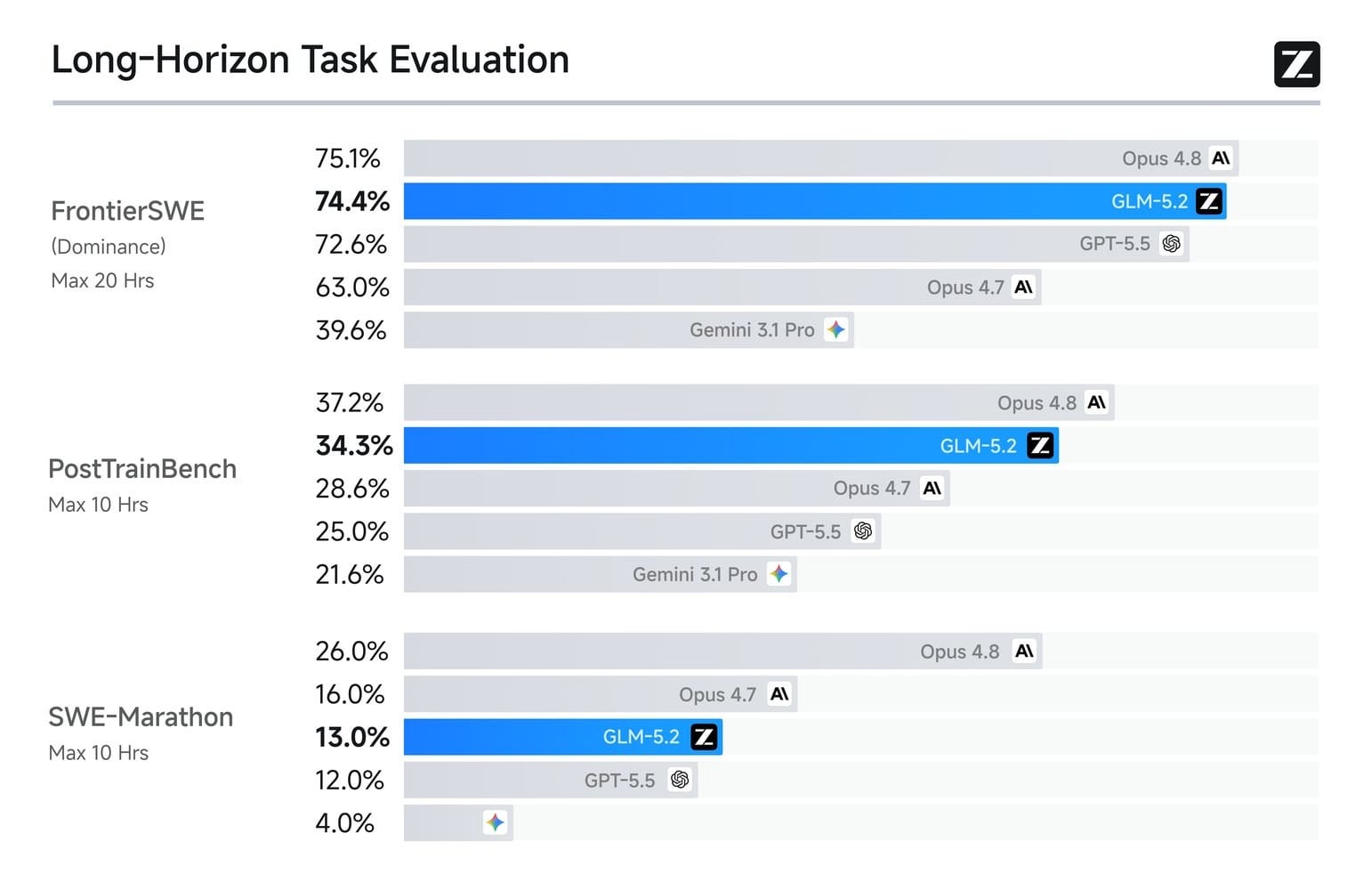
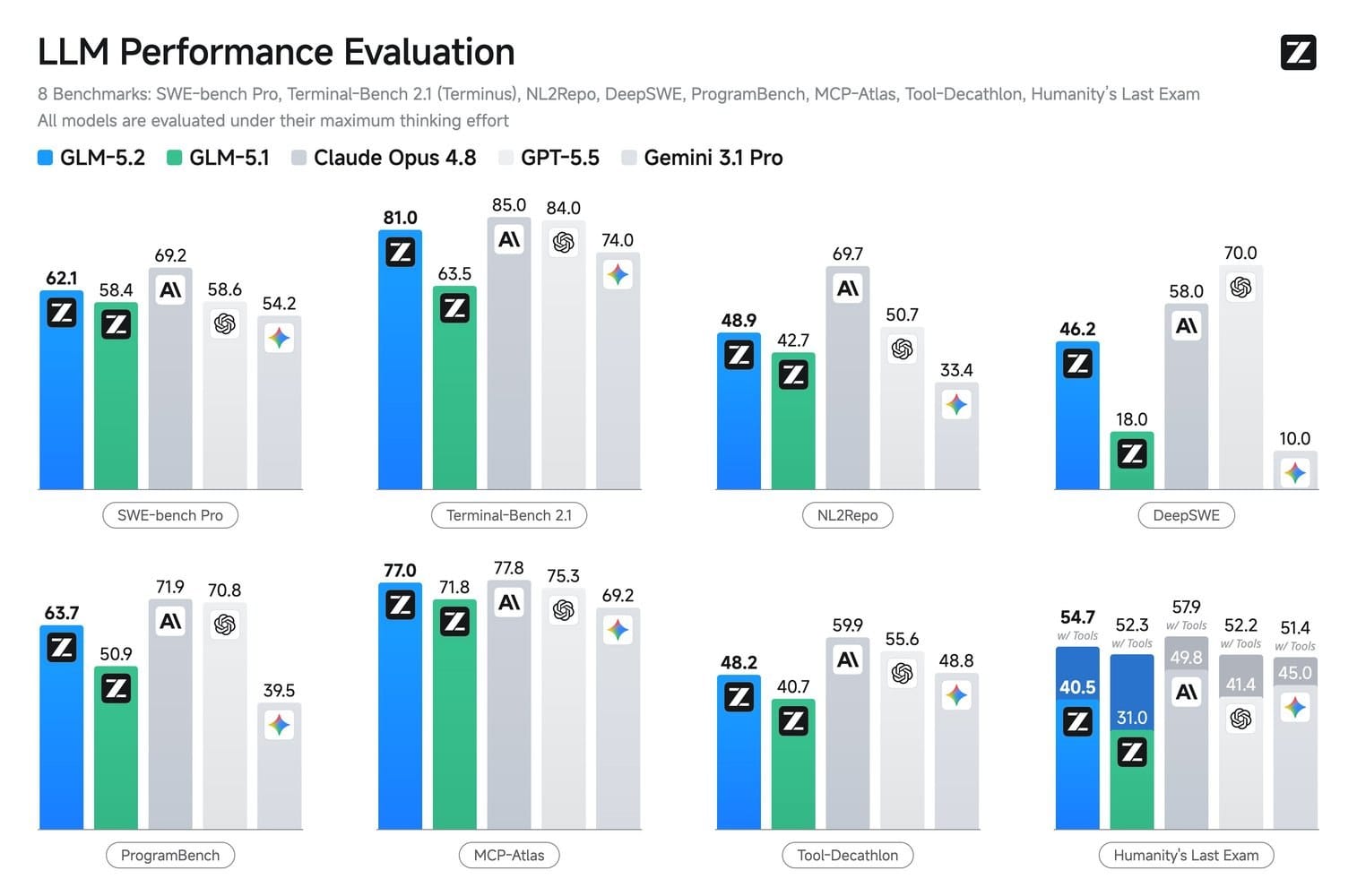
Short answer: Official docs price GLM-5.2 at $1.4 input / $0.26 cached input / $4.4 output per 1M tokens, with a 1M-token context and up to 128K max output. That combination is attractive for long briefs, multi-asset packs, and repeated system prompts. It is not a license to skip human review—and coding benchmark screenshots are a weak proxy for brand voice in your market.
What GLM 5.2 is in product language
According to Z.ai’s model page, GLM-5.2 is a flagship foundation model aimed at long-horizon work: text in, text out, with thinking modes, streaming, function calling, context caching, structured output, and MCP integration. Marketing emphasizes open-source flagship status for long tasks. For content teams, the transferable properties are stable long context, tooling hooks for product builders, and a price band you can actually model in a spreadsheet.
Non-builders can try chat.z.ai (positioned around GLM-5.2). Builders call glm-5.2 via https://api.z.ai/api/paas/v4/. Many teams never touch the API—they feel the model only through a writing product. That is fine. Optimize for shipped posts, not for collecting model IDs.
Why pricing pages matter more than demo videos
From the official pricing table:
| Meter | GLM-5.2 (USD / 1M tokens) |
|---|---|
| Input | $1.4 |
| Cached input | $0.26 |
| Cached input storage | Limited-time free (as listed) |
| Output | $4.4 |
Illustrative planning math (not a bill guarantee): a draft that spends ~8K input tokens and ~3K output tokens is still cents-level on this card—until you paste a novel-length brand book into every call without caching. If your team reuses the same voice guide daily, cached input at $0.26 is the difference between “affordable flagship” and “why is the invoice spicy?”
Compare with seat-based tools when you want a monthly ceiling plus workflow UI. ArWriter publishes Plus $4.99, Pro $9.99, Premium $24.99—a different cost shape than pure tokens. Run both numbers with your real volumes.

What actually changes in a content week
- Longer single-session briefs: keep research notes, voice rules, and examples together instead of chopping threads.
- Cheaper iteration loops versus some pricier frontier SKUs—if quality on your tasks holds.
- More first drafts per planner meeting, which only helps if editors still kill weak ideas.
- Higher risk of sameness if prompts stay generic; speed amplifies template smell.
Model choice is half the stack. The other half is process: intake brief → draft → fact check → channel split → schedule. Products like ArWriter, Auto-Writer, and a shared prompt library exist so the model does not live as twelve chaotic chat tabs.
A 60-minute quality battery for writing teams
- PDP description (120 words) with banned medical claims.
- Tone transfer: cold FAQ → friendly support email, same facts.
- 1,200-word article from a bullet outline; watch structure and invented stats.
- Channel split: article → 5 social posts, no new numbers.
- Editing pass: feed messy human text; demand corrections + change list.
Score each task by minutes of human edit time to publishable. The winning model is the one that reduces edit minutes at acceptable cost—not the one with the flashiest coding chart. For adjacent creator-focused model notes, see Claude Opus 5 for content creators and Gemini 3.6 Flash. For file automation (different job), see OpenCode for content creators.
Operator comparison table
| Dimension | GLM 5.2 | Top-tier Claude class | Flash-class Gemini | ArWriter product layer |
|---|---|---|---|---|
| Job focus | Long drafts + API workflows | Hard reasoning + polish | High-volume cheap drafts | End-to-end content production UX |
| Listed API band | $1.4 / $4.4 (+ $0.26 cache in) | Usually higher on flagship SKUs | Lower on flash SKUs | Monthly seats |
| Context | Up to 1M (official) | Long on modern tiers | Long on modern families | Depends on routed engine |
| Best when | You need volume + long briefs | You need max editorial judgment | You need speed cheaply | You need shipping tools, not raw meters |
| Watch-outs | Vendor coding benches ≠ brand voice | Cost | More rewrite sometimes | Not a software IDE agent |
By the way: if you want writing and scheduling without babysitting token meters all day, ArWriter packages editor workflows and prompt tooling from $4.99/month. Use raw GLM when you are optimizing unit economics; use a product when you are optimizing team throughput.
Two realistic team patterns
Pattern A — cost reset: A US DTC content pod moves first drafts to GLM 5.2, keeps final legal-sensitive lines on a stricter review lane, and cuts model spend while raising draft count. Edit Thursdays remain sacred. Output quality tracks editor discipline, not model mythology.
Pattern B — failure: A marketplace seller asks for “clinical proof in three days” and publishes invented studies. The model complied with a bad incentive. They added hard negatives in the system prompt and a human claims checklist. Tools inherit your ethics.
When to pick GLM 5.2—and when not to
| Choose it when… | Avoid heavy reliance when… |
|---|---|
| Long, repeated drafts need a controlled $ / piece | Tasks are medical/legal without experts |
| You reuse large style guides (cache helps) | You expect one-click publish with zero review |
| You build multi-channel packs from pillars | You will not maintain prompt standards |
| Flagship Western SKUs blow the budget on routine work | The job is pure image/video generation |
Prompt patterns that reduce edit time
You are a senior ecommerce editor.
Write a 120-word PDP in clear professional English.
Banned: medical promises, absolute guarantees, fake awards.
Inputs: [features, materials, size, price].
Output: title + body + 3 benefit bullets.
Turn the article below into 5 LinkedIn posts.
Each: 1-line hook, 80–120 word body, one CTA.
Do not add statistics that are not in the source.Act as a strict editor.
Return: (1) corrected draft (2) bullet list of changes
Focus on repetition, vague claims, and limp openings.Store winners in a shared library. A model without institutional memory becomes a slot machine.
Cost mistakes teams repeat
- Comparing $/1M without measuring real prompt size.
- Ignoring cache while repasting a 20-page voice doc.
- Confusing promotional chat access with production API pricing.
- Forgetting human-minute cost; a “cheap” model that doubles edits loses.
- Signing annual commits on a one-week vibe check.
Chat vs API vs product UI
- chat.z.ai — individual exploration.
- API — automation and custom tools (with engineering time).
- Content product — when the KPI is publishing, not integration. Start here if your team is editorial.
Most marketing orgs over-index on option 2 because it feels “serious.” Serious is a calendar that ships.
A simple weekly cadence
Sunday: pick two angles max. Monday: long drafts with style guide in context. Tuesday: human edit + sources. Wednesday: channel splits. Thursday: schedule + link checks. Friday: score which pieces needed heavy rewrites. This prevents GLM 5.2 from becoming a noise hose.
If you serve multiple English locales (US/UK/SEA), keep separate examples. “Global English” prompts often produce bland mid-Atlantic mush.
Limits you should state in any internal recommendation
- Official coding/agent benchmarks are vendor narratives aimed at builders.
- Hallucinations continue—especially on prices, dates, and citations.
- Cloud processing means reading data policies before client confidentially.
- Prices move; re-check docs before quarterly planning.
- Text models do not replace design or video pipelines.
How GLM 5.2 fits with the rest of a 2026 stack
- Language model layer: GLM 5.2 or peers by task.
- Production UX layer: ArWriter / your CMS / scheduler.
- File automation layer: only if needed—see OpenCode article (different problem).
- Agency process layer: AI content workflow for agencies.
- Voice system: brand voice guide for content teams.
Adoption checklist for a 2–5 person pod
- Single owner for model decisions
- Frozen 5-task evaluation set
- Monthly token spend cap
- Home for winning prompts
- Client data policy
- Re-evaluation date (30–45 days)
If outputs feel “fine but soulless”
Do not model-hop daily. Add two real samples of your best writing, ban dead phrases in your niche, request two tones then merge manually, and separate research (human sources) from prose (model). If edit time still exceeds 60% of each piece after two weeks, fix the brief before the model name.
Strong models on weak briefs stay weak. Include audience, offer, objection, proof, and CTA every time.
Editorial standards that keep long-context models useful
Long context is a liability if you stuff it with contradictions. Teams get better results when they maintain a single canonical voice doc, a short list of hard negatives, and a rotating set of “gold” samples rather than pasting every Slack argument into the prompt. GLM 5.2 can carry a large brief; it cannot reconcile a brand that has not decided who it is.
Create three living files:
- Voice: 1–2 pages of do/don’t with examples.
- Claims policy: what proof is required before a sentence ships.
- Channel specs: length and CTA rules per network.
Attach those files (or their distilled form) on Monday drafting sessions. Mid-week ad-hoc chats without the files are how drift returns. This is process, not model magic—but process is what turns a $1.4/$4.4 meter into business value.
Measuring ROI without vanity dashboards
Track four numbers for four weeks after a model switch:
- Drafts started per week
- Median human edit minutes to publish
- Token or seat spend
- Rework rate after publish (typos, claim corrections)
If drafts rise while edit minutes and rework also rise, you bought a content landfill. If spend falls and edit minutes fall with stable rework, the switch worked. Publish this scoreboard to the team so model debates use evidence instead of Twitter screenshots of vendor benches.
Also separate SEO outcomes from model choice. Rankings lag. Do not crown GLM 5.2 (or any model) as an SEO strategy after seven days of traffic noise. Crown it as a production tool when the four operational numbers improve.
Procurement note for finance partners
Finance will ask for predictability. Pure API spend floats with experimentation. Mitigations: monthly hard caps, separate keys for “prod” vs “sandbox,” and a rule that new prompt experiments run on smaller contexts first. If predictability matters more than unit economics, a seat product may win even when raw tokens look cheaper on paper—because it bounds behavior.
Document which legal entity holds the Z.ai account, who can raise limits, and how client confidential data is excluded. These are boring paragraphs that prevent exciting incidents.
Sample planning numbers for an English content pod
Suppose a pod ships eight long articles and forty short assets monthly. If GLM 5.2 reduces average long-form edit time from 45 minutes to 30, that is roughly two editor hours saved on articles alone—before short-form. Multiply by fully loaded hourly cost. Sometimes the savings dwarf model price differences; sometimes you learn the bottleneck is research and SME access, not prose. No model fixes an empty insight pipeline.
Watch for bland global-English cadence, filler transitions, and confident citations that were never in the brief. Those are prompt and process issues as often as model issues. Tighten negatives, rerun the battery, then decide. Log model version and date in your editorial notes so next quarter’s re-test is comparable.
Frequently Asked Questions
How much does GLM 5.2 cost?
Officially $1.4 per 1M input tokens, $0.26 cached input, $4.4 output. Confirm on Z.ai’s pricing page before buying—promotions change.
Is GLM 5.2 good for long-form content?
Its 1M context and flagship positioning target long work. Validate on your outlines and edit-minute metric.
GLM 5.2 vs Claude for writing teams?
Compare on your battery and total cost (tokens + edits). Neither wins universally across all brand voices.
What is the context window?
Docs list 1M context and 128K max output for GLM-5.2.
Do we need the API if we use ArWriter?
Not necessarily. You need consistent publishable quality. Raw API is optional infrastructure.
Can we skip human editors?
No—especially for claims, prices, and regulated niches.
How does caching change cost?
Repeated large system prompts get much cheaper on the cached input meter when the feature applies—design prompts accordingly.
How do we pilot in one week?
Five real tasks, two models max, edit-minute scoreboard, spend cap, keep-or-kill decision on Friday.
What to do next
Read the official model and pricing pages, run the battery on your content—not Twitter screenshots—and wire the winner into a boring, reliable publishing system. If you want that system with Arabic-capable workflows and scheduling under one roof, start at app.arwriterai.com.
Sources
Write, prompt, and schedule without juggling raw infrastructure all day: Start on ArWriter →