
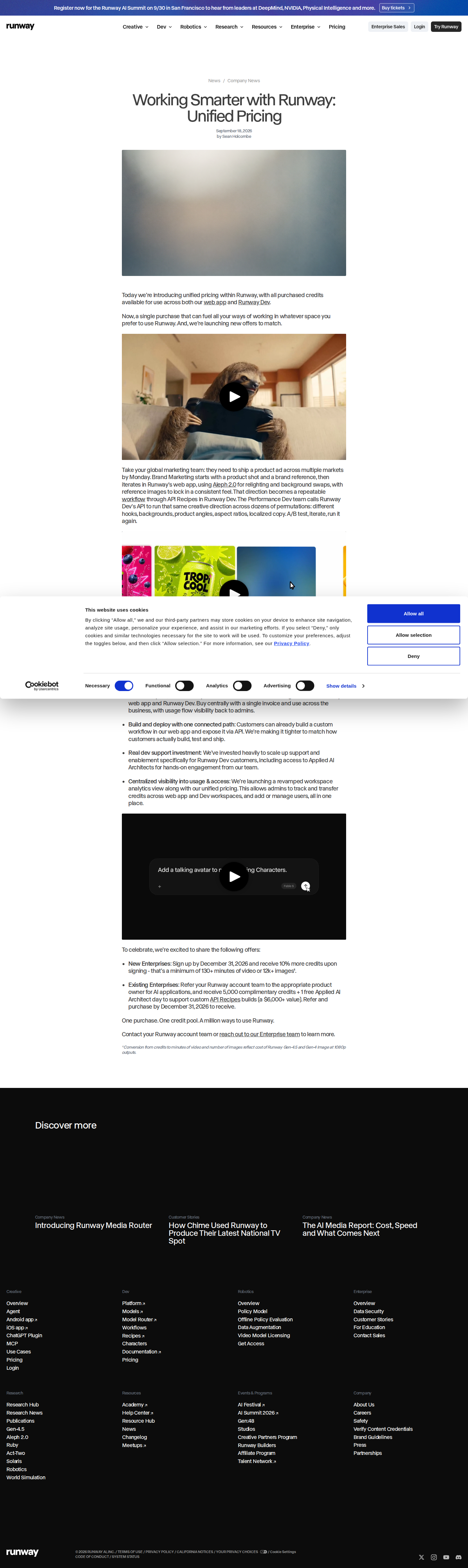
Runway has quietly redrawn how it sells AI video. In an announcement published on September 18, 2026, the New York-based company declared that purchased credits are now "fungible across Runway's web app and Runway Dev" — one credit pool, one invoice, one contract covering both the visual editor your designers use and the API your engineers build on. For studios and content teams that were juggling separate commitments for each side, that split just disappeared.
The post, titled "Working Smarter with Runway: Unified Pricing" and authored by Sean Holcombe, closes with the line that summarizes the whole strategy: "One purchase. One credit pool. A million ways to use Runway."
What exactly changed
Until now, a typical commercial Runway customer managed two parallel relationships. Credits for the web app — where marketing teams generate and iterate on video — lived under one budget. Anything consumed through Runway Dev, the programmatic side, was negotiated separately, billed separately, and tracked nowhere in particular. The new model merges them into four concrete capabilities:
- A single credit pool purchased centrally, with a single invoice and admin-level visibility into who is spending what across every project.
- A connected build-and-deploy path: workflows assembled visually in the web app can be exposed as an API service, with tighter integration promised down the line.
- Revamped workspace analytics, letting administrators transfer credits between web and Dev workspaces and manage users from one place.
- Human support invested in developers — access to "Applied AI Architects" for hands-on help building custom API recipes.
The numbers in the offer
Alongside the structural change, Runway attached two time-boxed packages that expire on December 31, 2026:
| Offer | Who qualifies | Details |
|---|---|---|
| Signing bonus | New enterprise customers | +10% extra credits on signing — which the company equates to a minimum of 130+ minutes of video or 12,000+ images |
| Referral program | Existing enterprise customers | 5,000 complimentary credits plus one free Applied AI Architect day, a package Runway values at "$6,000+" |
One footnote matters more than it looks: the minutes-to-credits math is based on Gen-4.5 video and Gen-4 image consumption at 1080p. Treat the published figures as a floor, not a promise — heavier models and higher resolutions burn through the same pool faster.
Read the change in context: Runway's crowded September
Unified pricing did not appear in a vacuum. Look at the company's own news feed for this month alone:
- September 4 — a Team Plan for groups of 2 to 9 seats, starting at $55 per seat, with shared projects, pooled credits, and Brand Kits.
- September 8 — Runway for Premiere Pro and After Effects, putting generation inside the editing suites professionals already live in.
- September 17 — Enhance Frame Rate, a post-generation tool for lifting frame rates on generated clips.
- September 18 — the unified pricing announcement this piece covers.
Together they sketch a company assembling a full professional layer — teams, consolidated contracts, editor integrations, engineering support — aimed squarely at agencies and production studios with renewals to sign.
What it means for you as a content creator
Let's be precise about who this touches. If you are an individual on a free or standard plan, the announcement contains no new prices for you — it simply does not address consumer plans. The practical impact lands in three places:
- You run a small team or agency producing commercial video: the era of two budgets and two usage ceilings is over. When your renewal conversation comes up, ask for the new structure to be applied before December 31 so the 10% bonus lands in your pool.
- You build products on top of video models: prototyping visually in the web app and shipping through the API no longer requires parallel purchases, which effectively lowers the cost of experimentation before commit.
- You are evaluating the market now: fungible credits make cost-per-minute comparisons between vendors meaningfully more transparent — exactly what you want before committing to an annual contract.
And if AI video is only the visual stage of a wider content pipeline — scripts, product copy, scheduled posts — tools like ARWriter's auto-writer cover the language side of that pipeline before a single frame gets generated.
A quick comparison with how creators actually buy today
- Flat monthly subscriptions (the default for individual plans across the industry): comfortable for solo creators, increasingly awkward for teams.
- Unified consumable credits (Runway's new model): best suited to agencies, because cost follows actual usage across every production channel.
- Time-limited promotional pricing: some platforms — like the MiniMax promotion we examined in an earlier piece — double their rates once the promo window closes, so always model the post-discount cost.
Honest limits and caveats
- The announcement ships no updated public price list for individual tiers; details are routed through the sales team, which tells you the intended audience.
- The "130 minutes / 12,000 images" equivalencies are estimates pinned to 1080p output on specific models and will vary with your real workload.
- Both December 31 offers can be withdrawn or restructured before the deadline.
- Within the first day, no detailed independent press coverage had landed — the primary source here is the company's own announcement, which is the only authoritative record available so far.
Frequently asked questions
Does unified pricing change individual plan prices at Runway?
No. The September 18 post announces nothing about consumer plan pricing. It restructures how enterprises buy and pool credits, and any individual-plan change would need its own announcement.
Can monthly subscription credits now be spent through the API?
The announcement covers centrally purchased credit commitments for teams, not individual subscription credits. If API access is essential to your workflow, review your account with the sales team before signing anything.
When does the +10% bonus offer end?
Signing — or, for referrals, referring and purchasing — must happen by December 31, 2026 according to the official post.
Is Runway available in Arabic?
The interface and documentation are English-first. Arabic prompts can work, but historically the strongest results come from carefully engineered English prompts — one reason dedicated Arabic prompt tooling exists alongside these platforms.
Do small Team Plan customers get the centralized analytics too?
The revamped workspace analytics ship with the new enterprise package, while the smaller Team Plan carries simplified equivalents like pooled credits and shared projects. Exact boundaries show up inside your own account comparison.
What was actually different between app credits and API credits before?
Runway sold separate commitments: generation consumed inside the web app was billed under one contract, while programmatic usage through Runway Dev sat under another, with its own invoice and its own tracking. The core of the September 18 announcement is dissolving that split — one pool works across both paths, so you can prototype an idea visually and turn it into an API integration without double-buying.
Official source: Runway — "Working Smarter with Runway: Unified Pricing" (runway.com, September 18, 2026).
The bottom line
Runway's unified pricing is a small change on paper and a telling one in direction: the AI video market is graduating from "try this shiny tool" to "run it as a production line with a budget you can negotiate." For professional creators, the practical read is that video generation has become part of the billable, negotiable stack — and in a market this competitive, negotiating before December 31 might be worth a free 10%.
If the writing half of your production line is still the weak link — scripts, descriptions, multilingual scheduled posts — ARWriter's toolset handles the language side in one place, leaving video pricing to be the interesting question rather than the bottleneck.