Pinterest just turned visual search into an ad auction — here's the full picture
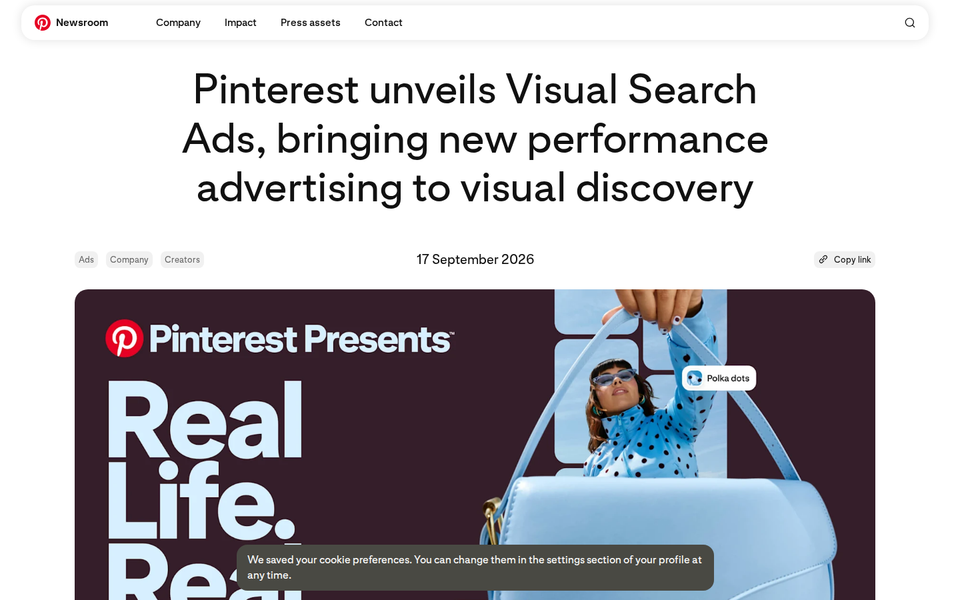
On September 17, 2026, at its annual Pinterest Presents advertiser summit, Pinterest announced the biggest shift in its ads business in years: Visual Search Ads, a new performance format that places paid results directly inside visual search outcomes and Pin closeups, letting advertisers bid to be the top response a user sees — and click through to their site. Alongside it came a wave of Performance+ upgrades and an AI room-redesign feature called Restyle that quietly trains an entire user base to shop from photos.
If you run marketing for an e-commerce brand, manage social for clients, or create visual content professionally, this is not another incremental placement update. It's Pinterest converting its most defensible asset — 80+ billion searches per month, the vast majority visual and more than half carrying commercial intent, per the company's own announcement — into an addressable ad surface. This deep dive covers what actually launched, how the mechanics work, what the surrounding Performance+ updates mean, where the honest limits are, and how to prepare before the beta reaches your ad account.
Why visual search monetization is a bigger deal than it sounds
Text search monetized intent brilliantly for two decades: you type what you want, an auction decides who answers. Visual search has always had the intent without the clean monetization layer — users photograph a marble countertop, a dress, a chair, and expect the platform to understand the object, the style, and the taste behind it. Pinterest's answer, built on what CEO Bill Ready described in the announcement as Pinterest Intelligence — "our AI-enabled visual understanding of images, products, taste and intent" — is now mature enough to sell against.
Ready's framing in the official newsroom post is worth quoting for what it signals: traditional search advertising has long relied on keywords, but in an AI-driven world people express themselves in much richer ways. The subtext for advertisers: the unit of meaning is shifting from the keyword to the image. That has direct budget implications — it rewards catalog quality and photographic consistency, and it punishes stores that treat imagery as an afterthought.
How Visual Search Ads actually work
According to the announcement, the new format combines two matching layers that previously lived in separate products:
- Keyword relevance: like classic search ads, your bid attaches to what the user is looking for — the query, the lens text, the context.
- Visual match: Pinterest Intelligence compares the visual content of the search (or the Pin being zoomed) against your creative and catalog, so the ad surfaces when your product answers what the user is literally looking at.
The placement inventory is the part that's genuinely new money: ads appear prominently in Pinterest Search Results and in Pin closeups — the zoomed view where purchase consideration happens. Advertisers bid for their response to be the top answer connecting to their site. Pinterest positions the format squarely as lower-funnel: built for conversions and sales rather than awareness, and fully compatible with Performance+, the AI-driven campaign suite that automates targeting and buying.
For context on why that pairing matters: Performance+ is Pinterest's answer to Advantage+ and Performance Max — machine-optimized campaigns fed by your catalog. Visual Search Ads slotting into that suite means a merchant can plug in a product feed, let the system match visual intent, and pay mostly for the moment of highest commercial intent the platform ever sees: an active search.
The Performance+ upgrades announced the same day
Three additions shipped alongside the headline feature, each aimed at a different merchant pain point:
- Priority Products: manual control to push specific products to the front of automated promotion — the fix for seasonal launches and promos where the algorithm would otherwise spread spend across the whole catalog. For Q4 planning, this is the one to test first.
- Self-serve A/B testing: advertisers can now run their own experiments across creative, targeting, and Performance+ settings without managed-account support. Faster iteration cycles, cheaper learning.
- App Promotion objective: a global beta for app installs. Pinterest cited one advertiser achieving up to an 85% improvement in cost per install versus previous workarounds — a single-case number, but directionally significant for DTC apps.
Restyle: the consumer feature doing quiet strategic work
The same event introduced Restyle, launching in beta in the US and Canada: users photograph a room, and the feature reimagines the space in different design styles, letting them test ideas and compare options inside their actual home. Pinterest framed it as bringing Pinterest Intelligence directly into the consumer experience for the first time at this depth.
Strategically, Restyle is a demand-generation engine for everything else Pinterest announced. Every reimagined room is implicitly a shopping cart waiting for matching products — and the same visual understanding that powers the redesign powers the ads that will eventually fill it. If you sell home, furniture, décor, or renovation-adjacent products, watch this feature's rollout geography closely: when it reaches your market, the volume of visual "this is what I want my space to look like" signals will jump, and Visual Search Ads are the toll booth on that traffic.
Pinterest also announced season two of its premium CTV series Bring My Pinterest to Life, where users' boards get transformed into real spaces with experts and brands — a brand-side signal that the company is investing in making boards feel commercially actionable.
Who should care, and who shouldn't
Act now if: you sell visually evaluable products — furniture, décor, fashion, gifting, beauty, crafts, wedding-adjacent anything — and your catalog photography is clean and consistent. The beta is rolling out to eligible advertisers in all Pinterest ad markets in the weeks following September 17, so readiness is the differentiator. Your first-mover advantage is cheap reach in auctions that haven't filled up with competitors yet, in an environment where — unlike Meta and TikTok — most advertisers in many niches still haven't built serious Pinterest muscle.
Wait and watch if: your product is invisible-by-photo (SaaS, services, B2B), your imagery is inconsistent or lifestyle-less, or your margins can't support experimental channel testing. Visual search can't match what it can't see; fix the catalog first.
Content creators and freelancers: a new service line is being born — visual catalog optimization for search. Product photography direction, Pin design that survives zoom, feed hygiene. We compared the leading AI image tools for this kind of production work in our image generator face-off; the same tools now have a channel-specific payoff.
Social commerce watchers: the pattern repeats across platforms — TikTok's AI shopping assistant (which we covered in our TikTok shopping breakdown) and Pinterest's visual search ads are the same thesis with different inputs: AI-mediated discovery collapsing the distance between "I saw it" and "I bought it." Diversifying beyond a single platform's mediation is becoming a core skill.
A concrete preparation plan (before the beta hits your account)
- Verify your business account and claim your website — foundational, non-negotiable, and still missing on a shocking number of merchant accounts.
- Upload a clean product feed. Priority Products presupposes a functioning catalog; the visual matching layer presupposes product images that are high-resolution, centered, and background-consistent.
- Audit imagery against the 2:3 vertical standard. Pin format favors tall verticals; your product shots should survive being zoomed to full screen.
- Seed organic demand signals. Spend a month publishing 30–50 quality Pins across seasonal boards and watch what earns saves and clicks organically — that's a free prediction of what the ad algorithm will reward.
- Instrument measurement before spend. Pinterest tag, conversion API where applicable, and clear KPIs (cost per click, cost per session, ROAS) so the first campaign dollars buy data, not just traffic.
- Budget for a learning phase. New formats price cheaply early and mature quickly; the advertisers who fund the learning phase own the efficiency data later.
Quick comparison: Pinterest visual search vs your current channels
| Channel | Dominant intent | Content lifespan | Best for |
|---|---|---|---|
| Pinterest (post-update) | Planning + active visual search, majority commercial | Months to years | Home décor, fashion, gifting, seasonal catalog plays |
| Google Search ads | Explicit text intent | Instant, no compounding | Known-product demand capture |
| Meta/Instagram ads | Social inspiration + retargeting | Days | Scale, lookalikes, aggressive creative testing |
| TikTok ads | Entertainment-driven discovery | Weeks, performance-bound | Impulse offers, trend-riding products |
The distinctive combination Pinterest now offers: search-grade intent with social-grade creative formats, plus content longevity neither Google ads (ephemeral auctions) nor Instagram posts (feed decay) provide. It's the only channel in the table where your media spend and your organic archive compound together.
Honest limitations and caveats
- "Coming weeks" is a gradual rollout: the beta reaches eligible advertisers across ad markets progressively — confirm availability inside your own ads manager before committing plans to it.
- Restyle is US/Canada beta only: don't build market promises on it elsewhere yet.
- The 85% CPI figure is one advertiser's result in the App Promotion beta — directional, not a benchmark.
- Regional audience density matters: in several markets Pinterest's user base is far smaller than Meta's or TikTok's; the play is high-intent niches, not blanket reach. If your buyers don't plan visually, they may not be there at all.
- English-first campaign tooling: the ads interface remains English-centric; manageable, but a real friction point for some teams.
- Garbage catalog, garbage performance: visual matching amplifies whatever you feed it. The upgrade doesn't rescue weak photography — it exposes it faster.
Frequently asked questions
What are Pinterest Visual Search Ads?
A new performance ad format announced September 17, 2026, that places ads inside visual search results and Pin closeups. Ads match both keyword relevance and visual similarity to what the user is searching for, and advertisers bid for their response to be the top answer linking to their site. The format targets lower-funnel objectives and integrates with Performance+ campaigns.
When will Visual Search Ads be available in my ad account?
Pinterest said the beta rolls out to eligible advertisers across all its ad markets "in the coming weeks" following the September 17 announcement. Availability is account-specific — check your ads manager rather than assuming immediate access.
How much search activity does Pinterest actually get?
Over 80 billion searches per month, per Pinterest's announcement — the vast majority visual, with more than half carrying commercial intent. That intent concentration is the core of the monetization thesis.
What is Pinterest Restyle and where is it available?
Restyle is an AI feature, launched in beta in the US and Canada, that lets users photograph a room and see it reimagined in different design styles, comparing options within their own home. No rollout timeline for other markets has been announced.
Do I need a product catalog to benefit?
Practically, yes. The visual matching layer works from your creative and catalog; Priority Products explicitly requires a feed. A verified business account, claimed website, and clean product imagery are the minimum viable setup.
Is Pinterest worth it for small brands, or only big budgets?
Small brands arguably benefit more, not less. Pinterest's costs per click in visual categories remain below Meta's in many markets, organic Pins keep driving traffic for months with zero spend, and the new self-serve A/B testing removes the managed-account barrier that used to favor big advertisers. The real investment is production discipline — consistent, zoomable product imagery — rather than media budget.
Bottom line: the image is becoming the keyword
Pinterest's September 2026 updates compress a simple strategic message: users increasingly search with cameras, and the first ad platform to auction that behavior at scale in a discovery context just opened for business. Merchants and creators with disciplined visual catalogs inherit the early advantage — cheaper auctions, compounding content, and intent data their competitors won't see until prices rise.
Getting catalog-ready is mostly a content production problem: product descriptions, Pin copy, board structure, and imagery that survives zoom. Tools like ARWriter handle the multilingual content pipeline — copy, descriptions, scheduling, and publishing — so the visual catalog you build this quarter is ready to monetize the moment these formats reach full availability.