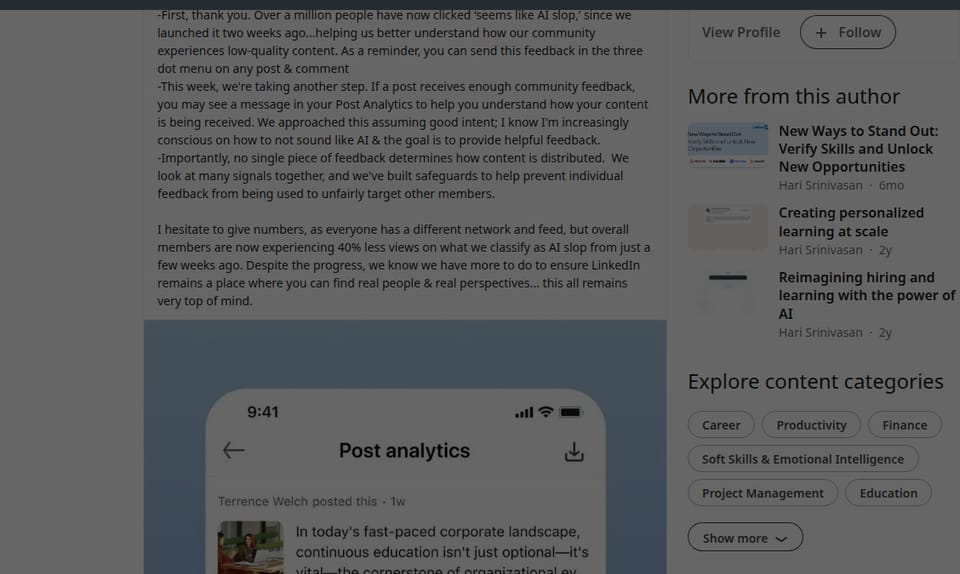
LinkedIn has shared the first hard numbers on its war against low-quality AI-generated posts, and they move fast: more than one million members clicked the platform's "Seems like AI slop" button in roughly two weeks, and the company says the average member now sees 40% fewer views of content it classifies as AI slop compared with a few weeks earlier.
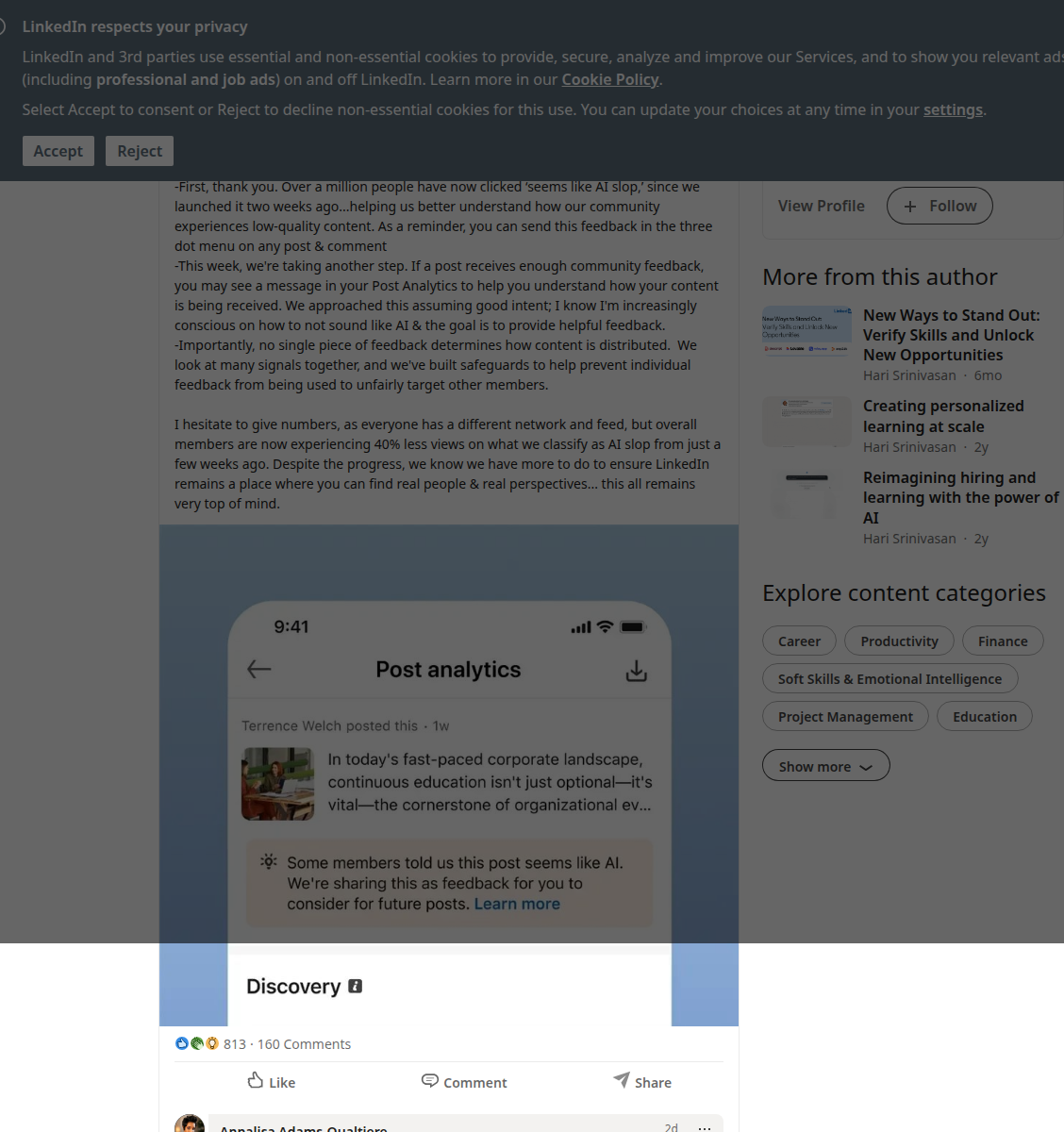
The update landed in an official post from Hari Srinivasan, LinkedIn's Chief Product Officer, on Thursday, August 21, 2026. It follows the platform's July 30 announcement of a package of tools aimed at what it calls "AI slop" — generic, unedited, machine-written text that floods feeds and erodes trust in the network.
What LinkedIn actually shipped
On July 30, 2026, LinkedIn introduced a reporting option inside the three-dot menu on any post or comment, letting any member flag content that "seems like AI slop." This week Srinivasan revealed the adoption numbers — more than a million people have used it since launch — along with the platform's first outcome metric: members are, on average, experiencing 40% less views on content LinkedIn classifies as AI slop than they did a few weeks earlier.
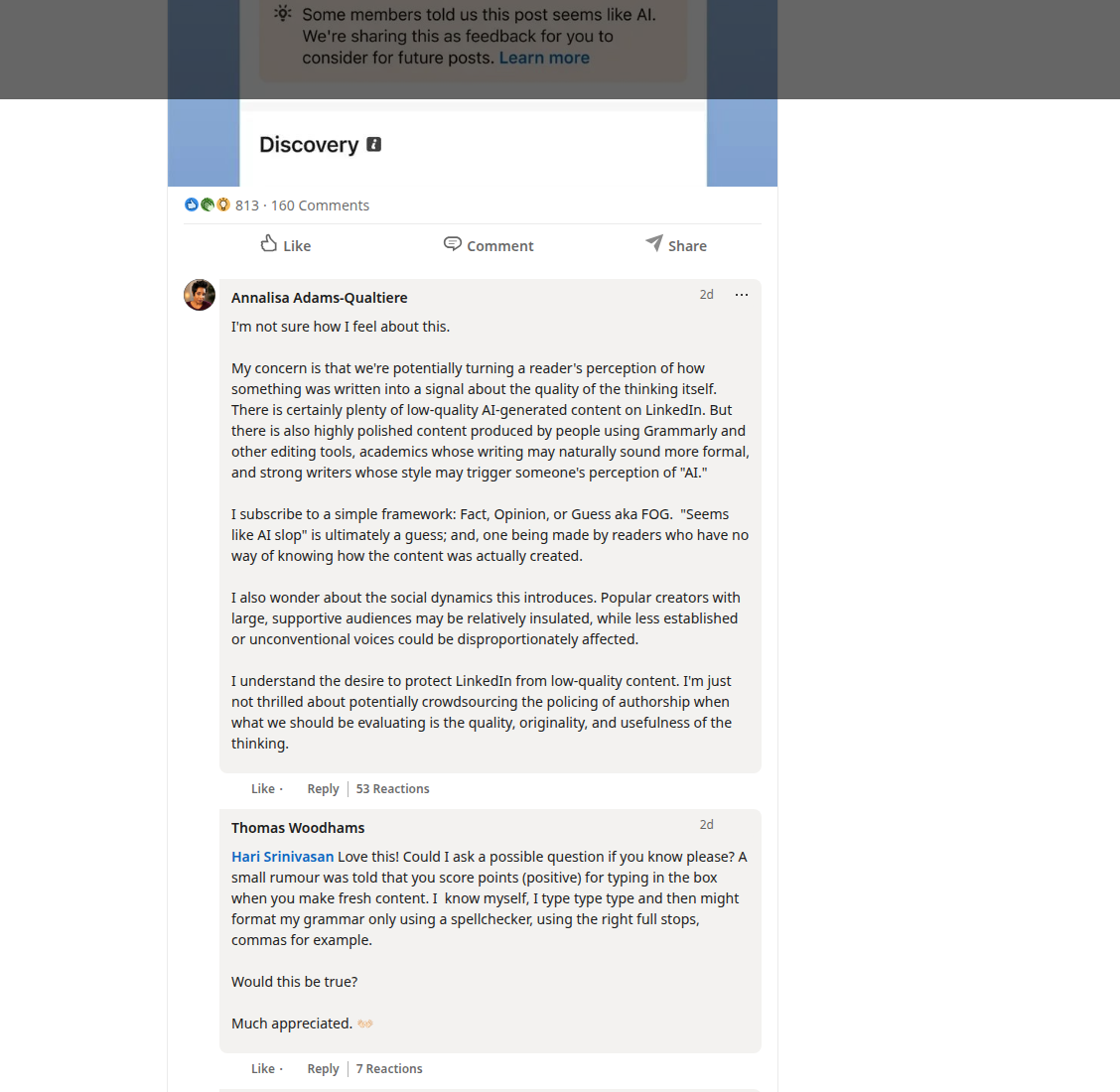
The button was not shipped alone. In the same July package, LinkedIn deployed what it described as "new and improved" classifiers that identify machine-written posts, and it quietly removed a feature that used AI to "enhance your post" — an implicit admission that some of the problem originated in its own tooling. The platform also began showing a notice to authors whose posts keep getting flagged: "Some members told us this post seems like AI."
The backdrop explains the urgency. AI-detection firm Pangram — in reporting carried by 404 Media — found that about 41% of LinkedIn long-form posts carry markers of being fully AI-generated. For a platform whose core promise is authentic professional expertise, that number is an existential nuisance.
Nor is this a one-off campaign. Earlier in 2026, LinkedIn said it would crack down on comments created at scale "with little or no human involvement," which signals that the slop program is a long arc of expanding enforcement rather than a seasonal cleanup. Tellingly, Srinivasan closed his own post with a personal note — that he has become "increasingly conscious on how to not sound like AI" — an admission from the platform's top product executive that the bar for professional writing has genuinely moved.
For anyone managing a company page or a ghostwritten executive brand, the dual message is blunt: publishing automation is not the target, but unreviewed machine output is. The fine line between those two is what will separate accounts that keep compounding reach from accounts that fade quietly out of their followers' feeds.
Why this matters if you publish on LinkedIn
Whether you run personal branding for yourself, handle a company page, or ghostwrite for executives, three things just changed:
- Reach is now tied to perceived authenticity. A 40% drop in views for flagged content means an unedited, machine-drafted post doesn't just underperform — it can be quietly throttled out of your audience's feed entirely.
- Your audience is the enforcement layer. The reporting button lives in the reader's hands. One weak first impression can compound into a durable distribution penalty, decided by the very clients and peers you are trying to reach.
- Disclosure beats detection. Nothing in LinkedIn's messaging bans AI assistance — Srinivasan wrote that the company approached the problem "assuming good intent" and that the goal is "to provide helpful feedback." The dividing line is between AI as a drafting aid you review and AI as a copy-paste publishing engine.
There is also a competitive angle for non-native English writers. Much of the slop crackdown targets the flat, listicle-heavy register that generic models produce. Writers who bring genuine local market insight — and who use AI to sharpen structure rather than replace thinking — are comparatively safer. Tools built for that workflow, like ARWriter's article and research writer, lean the same way: draft with AI, keep the human voice and review before publishing.
Quick comparison: how platforms handle AI content now
| Platform | Mechanism | Known effect |
|---|---|---|
| Member reporting button + AI classifiers | 40% drop in views of classified slop (official) | |
| Google Search | Spam and scaled-content-abuse policies | Ranking demotions — see our August 2026 spam update coverage |
| X | Open-sourced recommendation logic + feedback signals | Quality-based feed tuning (details here) |
The direction is consistent across platforms: distribution is being repriced in favor of content that reads like a person made it, because engagement data punishes everything else.
Honest limitations to keep in mind
- Classification is imperfect. Automated classifiers err in both directions — stiff human writing can be caught, polished AI writing can slip through. LinkedIn has not published accuracy figures.
- The 40% figure is an average. Srinivasan himself wrote that he hesitates to give numbers "as everyone has a different network and feed." Your individual mileage will vary.
- Less slop ≠ more reach for you. The metric describes a drop in one content category, not a promised boost for everything else.
- Transparent AI use can still get flagged. Creators who openly disclose AI assistance in parts of their process may occasionally be reported anyway; clear disclosure is your best defense, not a guarantee.
A practical checklist to protect your reach
- Review every AI-assisted draft before posting; add your own opinion, a number from your market, or a first-person example.
- Start from your own idea and let the model handle structure and phrasing — not the thinking.
- Treat LinkedIn's author-facing notice as an early-warning system and adjust your tone if it appears.
- Vary formats: short field notes, considered opinions, and genuine questions tend to read human by default.
- If you publish in Arabic or other languages, the same principle applies — local context is the hardest thing for a generic model to fake. ARWriter's Arabic-first writing tools are built around exactly that gap.
Frequently asked questions
What is LinkedIn's "Seems like AI slop" button?
A reporting option in the three-dot menu of any LinkedIn post or comment that lets members flag content as low-quality AI-generated material. It launched on July 30, 2026, and passed one million uses within about two weeks.
Does LinkedIn downrank AI-generated posts?
Yes, effectively. The company's Chief Product Officer said members now see 40% less of what LinkedIn classifies as AI slop compared with a few weeks earlier — the first official outcome metric for the program.
How do I know if my post was marked as AI slop?
LinkedIn has begun showing authors a notice — "Some members told us this post seems like AI" — when reports accumulate. No detailed public dashboard exists beyond that.
Is it against the rules to use AI when writing LinkedIn posts?
No. The policy targets unedited, low-quality machine output at scale, not AI assistance itself. LinkedIn framed its approach as assuming good intent; reviewed, humanized drafts with real insight remain safe.
Will this affect scheduled or automated posting tools?
Scheduling itself is not the target — content quality is. Posts generated and pushed out wholesale without human review are the pattern being suppressed, regardless of which tool published them.
The bottom line: LinkedIn turned its audience into a distribution panel. A million button presses in two weeks is a signal the platform will keep acting on — and the writers who pair AI speed with an unmistakably human voice are the ones who will benefit.