The short version: Google's August 2026 spam update started rolling out August 18 at 16:27 UTC, hits every language and region, and it's live right now — here's the complete protection plan for your site
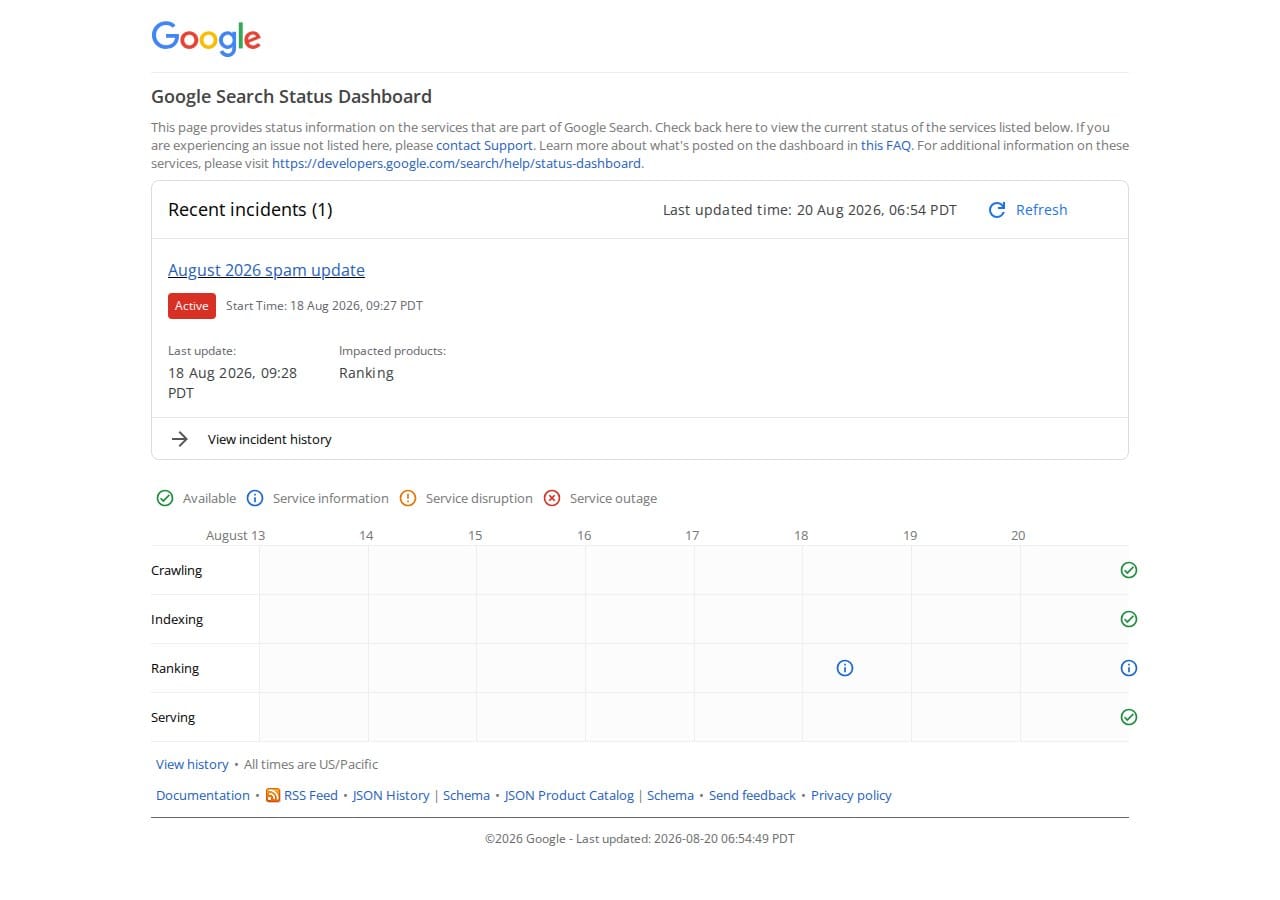
On the evening of August 18, 2026, Google announced via its official Search Status Dashboard that the August 2026 spam update had begun rolling out — the third spam update the company has shipped this year. The rollout is global, affecting every language and region simultaneously, and Google expects it to take "only a few days" to complete. At the time of writing, the update is still in progress. Google's standard framing applies: this targets sites that spam — but with any update of this kind, the company acknowledges, some collateral damage is possible.
Why should this specific update matter to you? Because Google's spam policies, last refreshed on May 15, 2026, now explicitly name mass-produced content generated with AI tools without adding value for users as a recognized form of scaled content abuse. If you're one of the millions of site owners, store operators, and bloggers who now use AI in some part of their writing workflow, this guide draws the exact line between the usage that's safe and the usage that could cost you your search visibility over the coming weeks.
What a spam update actually is — and how it differs from a core update
Google runs two main families of ranking updates. A core update rebalances how the system evaluates quality and relevance overall — after one, sites rise and fall without necessarily having done anything wrong. A spam update is far more surgical: it's a system specifically trained to catch deceptive techniques that game ranking algorithms instead of serving readers, with the stated goal of reducing such content in results or removing it entirely.
That's precisely why this update type is the dangerous one for a specific kind of site. Losing traffic after a core update can be simple redistribution; losing it after a spam update usually means the system classified something on your site as violating policy. The good news: recovery is possible, but it starts with understanding the full list of what Google officially considers spam — which is much longer than most people assume.
The complete list: 16 behaviors Google officially classifies as spam
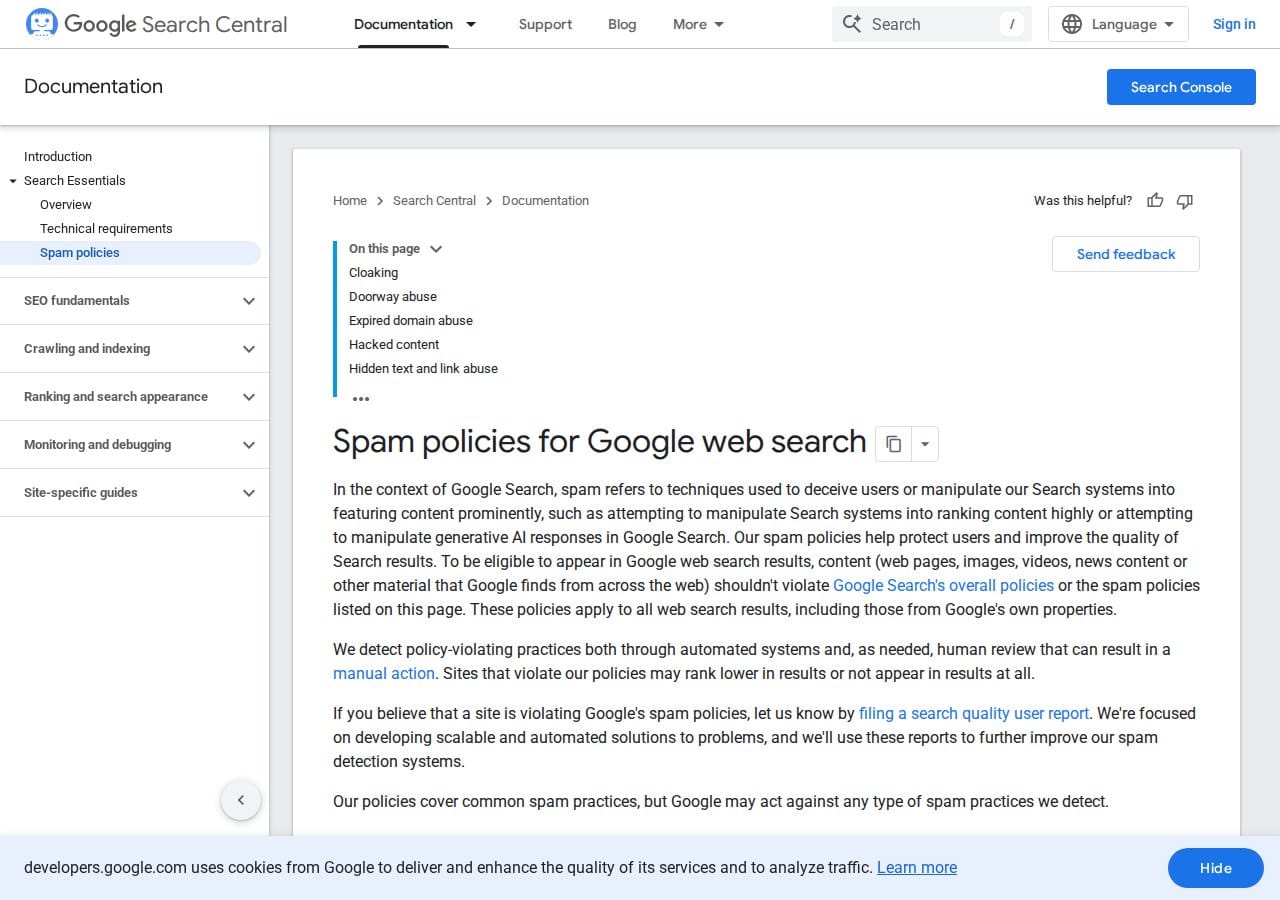
Per Google's official spam policies documentation for developers (last updated May 15, 2026), these are the categories the anti-spam system targets — ordered here by relevance to our audience:
1. Scaled content abuse — the category that matters most to AI users
Google defines it as creating large volumes of pages — regardless of the tool used, and AI tools are named explicitly — without adding value for users. The test isn't "did a human or a machine write this?" It's "does this page give a reader something worth reading?" Hundreds of near-duplicate articles that paraphrase whatever already ranks are the textbook example, whether they were produced by a low-wage content farm or a text generator.
2. Site reputation abuse — the borrowed-authority problem
Third-party content published on a trusted site mainly to exploit that host's ranking signals: an entire sponsored section inside a major news domain filled by an outside party, or commercial pages parked on a university or government domain. Google now treats that "invisible" content as if it lived on its own standalone merit.
3. Scraping and republishing
Republishing other people's content without added value — a category that also catches those who "skim" competitors' articles and rewrite them superficially. If what you offer is a restatement of what someone else already said, in different words, you're in this category's blast radius even if you "rewrote it yourself."
4. Expired domain abuse
Buying aged domains with strong search history and stuffing them with unrelated commercial content — a widespread practice in markets where "ready-made authority domains" are bought and sold.
5–16: the rest of the list, plainly explained
- Cloaking: showing search engines different content than visitors see.
- Doorway pages: pages built only to intercept similar queries and funnel users elsewhere.
- Hacked content: injected code, content, or malicious redirects on someone else's site.
- Hidden text and links: white-on-white text, zero-opacity text, or off-screen stuffing.
- Keyword stuffing: unnatural repetition that strips the text of meaning.
- Link spam: buying links, excessive exchanges, automated link building, advertorials passing ranking credit.
- Machine-generated traffic: automated queries against Google Search itself.
- Malicious practices: malware, unwanted software, back-button hijacking.
- Misleading functionality: promising services the site never delivers.
- Thin affiliate pages: reviews copying the merchant's descriptions with no original value.
- User-generated spam: fake accounts flooding comments, forums, and uploads.
If you write with AI: exactly where the line falls
This is the question we answer every single day, and the answer is unambiguous: Google does not penalize using AI — it penalizes the absence of value. The policy text doesn't ban the tool; it bans "pages generated at scale without adding value for users, regardless of how it's done." The distance between safe and risky is measurable:
On the safe side: A store owner who uses an AI writing tool to draft product descriptions, then adds actual measurements, real customer feedback, original photos, and shipping-and-returns specifics for their market. A blogger who has a model structure an article around a problem they've genuinely lived through — then adds their own numbers, steps, first-hand experience, and a complete human review. Users of ARWriter's Auto-Writer who review every draft and localize it for their Arabic-market readers before publishing. The common thread: added value exists, the voice is human, and the content would deserve to exist even if search engines didn't.
In the danger zone: Buying 500 "informational" articles in one click because the topics get searches, and publishing them as-is. Regenerating competitors' top-ranking articles with a "rewrite this differently" prompt. Sites producing dozens of pages a day about subjects their owners know nothing about. The common thread here is equally clear: the content exists for the engine, and the reader is an afterthought — which is Google's literal definition of scaled content abuse, tool-agnostic.
So the distinction isn't the tool; it's the workflow. The rule we've given our users for years: write for the reader first, and make your human pass over every piece a non-negotiable step before publishing. If you personally have nothing to add beyond what anyone else could generate from the same prompt, don't publish it — that's the entire test in one sentence.
What to do while the update rolls out: a practical hour-by-hour posture
- Make no impulsive changes today. Results fluctuate day to day during any rollout, and big mid-wave edits make it impossible to separate the update's effect from your own. Mark the date and start a simple daily note of your search traffic.
- After the rollout completes — not before — open Search Console's performance report and compare the last 28 days against the previous period, focusing on the ten pages with the steepest declines.
- Run the value test on every declining page: Does this page answer a real question better than any competitor? Does it contain information, experience, or numbers unavailable elsewhere? Any "no" points directly at your fix.
- Audit who writes for you and who publishes with you. If a freelancer or agency produces bulk content, request a raw sample: the original draft, its sources, and what was added on top. Many spam-update casualties paid the price for a vendor's practices they never examined.
- Review imported legacy content: old "guest post" sections or paid placements fall under site reputation abuse — clean out anything you wouldn't proudly show a Google reviewer, and for every old page ask the separating question: would you be proud to have a human reviewer open it tomorrow, or would you rather they never see it? Delete or rebuild from scratch what fails that test.
- Connect this update to your content calendar: pause any "bulk content site" project you've been evaluating until the wave settles, and redirect that energy into deepening your ten most important pages with exclusive numbers and first-hand experience — the investment every future update rewards.
- If you're hit hard after completion and you fix things: recovery isn't instant. Google needs to recrawl and reindex, and effects can stretch over weeks. Patience here is part of the treatment, not a luxury.
Quick check: where does your site stand?
| Signal | Safe side | In the update's crosshairs |
|---|---|---|
| Publishing cadence | Consistent with your human review capacity | Dozens of articles daily with no real human pass |
| Material source | Owner's expertise, first-hand experience, own numbers | Paraphrasing whatever already ranks |
| Depth per piece | Answers the full question with local specifics | Generic text that could be generated for any city on earth |
| Links | Earned naturally from real readers | Bought, heavily exchanged, or built by automation |
| Page purpose | Serve the searching reader | Capture the search visit and convert it by any means |
Lessons from this year's two earlier spam updates
August is the third spam update of 2026, and preparing for it means learning from the previous waves. The patterns that repeat almost every cycle since Google hardened its policies in late 2023 and added the reputation-abuse and expired-domain categories:
- The hardest hits land on "middleman sites," not the big names: networks of small lookalike sites producing the same article in different dresses across dozens of domains are the first to vanish, while the original source of the information holds its position.
- Stores copying manufacturer descriptions pay quietly: product copy duplicated verbatim from the supplier or a competitor is among the fastest ways to land in the thin-affiliate and scraped-content categories. The fix is not exotic: add actual usage experience, local shipping policies, sizing notes, and the questions your real customers ask.
- Recovery starts with deletion, not addition: the sites that recovered fastest after past waves began by removing or consolidating their weakest pages, then improving what remained — not by stacking new articles on top of an existing problem.
- Local numbers save sites: pages carrying market-specific data — prices in local currency, local regulatory steps, real purchase experiences — are rarely classified as spam even when AI-assisted, because the added value is obvious and easy to verify.
These lessons compress into one sentence veteran observers have used since the brutal May 2024 wave: quality isn't what you say about yourself — it's what a reader can get from your page and find nowhere else.
Honest limits of this coverage
- Google hasn't said what this specific update hunts. That's standing policy: the status dashboard announces timing and scope only. What this article maps is the officially published risk surface, not a guaranteed prediction.
- There's no public penalty list: nobody today — including us — can name the exact targets in advance; the real effects become measurable only after the rollout completes and site data accumulates.
- Collateral damage is real: Google itself acknowledges innocent sites can be affected temporarily during updates, and recovery runs through quality fixes, not panicked reconsideration requests.
- The rollout is still in progress as of this writing; final impact assessment is only possible after the dashboard marks it complete.
Frequently asked questions
What is Google's August 2026 spam update and when did it start?
It's a global update to Google Search's anti-spam system, announced August 18, 2026 on the official Search Status Dashboard, affecting all languages and regions, with a rollout expected to take just a few days. It's Google's third spam update of 2026.
Does the new Google update punish AI-written content?
It punishes the absence of value, not the tool. Google's policies target mass-produced pages that add nothing for users regardless of how they were made; AI-assisted content that is reviewed and enriched with genuine human expertise remains on the safe side.
How do I know if my site was affected?
After the rollout completes, review the performance report in Google Search Console, comparing average position and clicks for the last 28 days against the previous period, focusing on the steepest-declining pages and running the value test on each one.
How long does recovery take after a spam update hit?
There's no fixed timeline: after you remove the causes and improve the content, Google needs to recrawl and reindex your pages, with recovery typically showing over weeks depending on site size and the scale of your fixes.
Does the update apply to non-English sites?
Yes — it's global across all languages and regions per Google's announcement, so Arabic, French, Spanish, or any other language sites are equally subject, especially bulk-paraphrased content sites and stores copying supplier product descriptions without localization.
The bottom line: make this a quality week, not an anxiety week
Spam updates are, at their core, good news for anyone who takes their content seriously: every competitor flooding search results with costless paraphrased material will find the road harder, and every slot the system frees from that noise is an opening for well-crafted original content. Audit your archive, reinforce what's exclusively yours, and re-commit to the golden rule: reader value first, a visible human fingerprint on everything you publish. If you want a companion for the "fast draft, then human review" path, try ARWriter's Arabic writing tools — from idea to a draft ready for your eyes, not a search engine's. For the wider picture of Google's posture on AI and advertising, see our coverage of Google's AI labels for ads and our explainer on AI model watermarks.
Sources: Google's official Search Status Dashboard (status.search.google.com), Google's spam policies documentation (updated May 15, 2026), and Search Engine Roundtable and PPC Land coverage of the August 18, 2026 announcement.