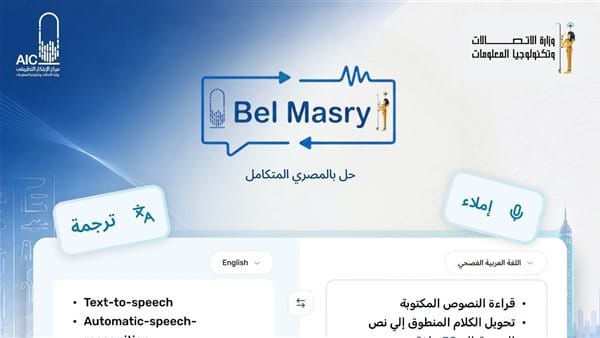
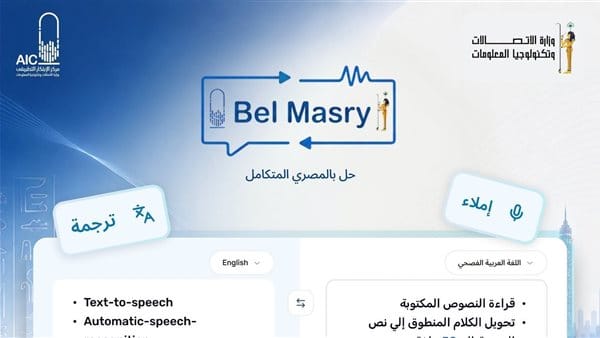
On August 19, 2026, Egypt's Ministry of Communications and Information Technology announced the trial launch of "BelMasry" — a fully free, government-built AI platform focused on something the global model market has chronically neglected: the Egyptian Arabic dialect. Developed by the Ministry's Applied Innovation Center (AIC), the platform bundles three integrated engines: speech-to-text, machine translation between Arabic and fifty languages, and text-to-speech in both Modern Standard Arabic and Egyptian dialect.
If you are an Arabic-speaking content creator — or a creator targeting Arabic audiences — this is not distant government news. It is a new, non-commercial entrant into a market where every comparable tool is sold in monthly dollars. This deep-dive explains exactly what the official announcement promised, what each engine means for a working creator's pipeline, how the platform compares with the commercial tools you may already pay for, and the honest limits you must understand before betting a real project on it.
What exactly is BelMasry?
BelMasry is not a single language model but a platform of three technologies built inside the Applied Innovation Center, the Ministry's research arm with a track record in national AI projects. The stated premise in the announcement is blunt: Arabic dialects are underserved by global AI tools, and Egyptian dialect — one of the most widely spoken varieties of Arabic on YouTube and social media — is treated as a second-class language by models trained mostly on Standard Arabic and English.
The platform is available to everyone, free of charge, at the official address belmasry.aic.gov.eg during the trial phase. The Ministry has not yet announced pricing tiers, usage caps, or a commercial roadmap; everything we know officially is that access is free "for all users" at this stage. That alone distinguishes it from every line item in your current tool stack.
The three engines, as stated in the official release
1. Speech-to-text for Egyptian dialects
This is the platform's centerpiece. The announcement describes a transcription engine that handles "Egyptian colloquial Arabic in its dialects" alongside Standard Arabic, with two advanced features that usually appear only in expensive commercial tools: speaker diarization — distinguishing who said which sentence, which is decisive if you transcribe podcasts or interviews — and background noise suppression, which raises transcription accuracy for field recordings. If you run an Arabic podcast, those two features are the difference between a transcript ready to publish and one that needs an hour of manual cleanup.
2. Machine translation between Arabic and fifty languages
The second engine translates from Arabic into fifty languages and back. Arabic creators know the inverted equation: most of the world does not read Arabic, and most machine translation tools stumble on dialect. An engine explicitly built on Egyptian data may produce better translations of colloquial Egyptian into English — the bilingual publishing scenario that many creators in Egypt and the Gulf already run, with Arabic videos carrying English versions for global search.
3. Text-to-speech in Standard Arabic and dialect
The third engine converts written text into spoken audio in both Modern Standard Arabic and Egyptian colloquial. A free, government-produced Egyptian voice opens an obvious door: voice-overs for short videos without hiring a voice actor or subscribing to commercial voice-cloning tools, audio versions of articles, and fast draft narration for ads before the final voice is locked. The open question — which we return to in the limits section — is the nature of the voices: multiple selectable voices or one unified voice.
What does this mean for you as a creator?
Let's translate the three engines into real daily tasks in a 2026 Arabic creator's workflow:
- Free video and podcast transcription: if you publish a weekly one-hour podcast episode, you are currently paying somewhere between $10 and $30 a month for a transcription tool, or transcribing manually. An STT engine built for Egyptian dialect with speaker diarization removes that budget line entirely — if its quality holds up.
- An article from every video: the universally recommended visibility play is converting every video into a written article that serves Google search. Free transcription makes this feasible across your entire back catalog — assets that search engines have been waiting for.
- Linguistic expansion without a translation agency: fifty languages means you can attach English or French translations of descriptions and captions, and test which markets respond to your content before investing in human translation.
- Fast Egyptian voice-over: for Reels and TikTok, where an Egyptian voice lifts engagement, a dialect TTS engine cuts an entire production step.
- A searchable archive: a library of transcripts for all your audio content becomes a database you can mine to reuse proven sentences and ideas in new content.
There is also a subtler, strategically more important angle: when an Arab government releases a model open to the public for local dialect, expectations rise for competitors too. Commercial players typically move to improve Egyptian dialect support within weeks of a launch of this scale — and you win in either case.
Quick comparison: BelMasry versus common commercial tools
| Criterion | BelMasry (government) | Whisper / commercial transcription | Global TTS tools |
|---|---|---|---|
| Egyptian dialect | The platform's primary target | Partial, undocumented support | Limited, often unnatural |
| Speaker diarization | Officially announced | Available in paid tiers | Not applicable |
| Price | Free during trial launch | Monthly USD subscription | Subscription or paid characters |
| Built-in translation | Arabic ↔ 50 languages | Requires a separate tool | Not applicable |
| Stability and documentation | Trial phase — unproven | Mature, documented | Mature |
| Usage limits | Not yet announced | Clearly published | Clearly published |
The practical takeaway from the table: do not throw away your paid tools today. Treat BelMasry as a free test bench. Run samples of your actual content — a noisy field recording, a two-speaker podcast episode, a fast-dialect Reels script — and measure the results against your current tool on the same samples. The data you collect in one week will settle the adopt-or-wait decision.
Why this launch is different from previous "Arabic AI" announcements
The past few years produced multiple Arabic-language AI initiatives, but most stopped at the research model, the competition, or the media promise. Three objective factors separate BelMasry from that pattern. First, the developing agency — the Applied Innovation Center — has an execution record in national AI projects, not just papers. Second, the product is announced as a public web platform on an official government domain, not a promise of a future launch. Third, the three-part scope (transcription, translation, speech) covers a creator's entire value chain rather than a single point solution.
There is a fourth factor that matters specifically for the Egyptian market: Egypt is one of the largest producers of Arabic content in the world, and its audience is what made Egyptian dialect the shared language of Arabic entertainment for decades. When the speaker base is this large, a model genuinely trained on it holds a data advantage global models cannot quickly copy — because the advantage is not the algorithm but the Egyptian field data underneath it.
Economically, too, exchange rates and dollar-denominated subscriptions have been a structural barrier for independent Egyptian creators: a transcription tool plus a translation tool plus a voice tool can together consume more than a full monthly internet bill. Removing that barrier — even temporarily — redistributes a small production budget toward what is always postponed: visual quality and marketing.
Honest limits and drawbacks before you depend on it
- Trial means trial: the launch is explicitly experimental. The service may pause, change its limits, or be restructured. Do not build an entire client-facing production line on it before it proves stable for weeks.
- Access from outside Egypt is uncertain: during our own checks of the platform from outside Egypt we encountered connection failures on the gov.eg domain — expected in a trial phase, but it means creators working from Europe or the Gulf may face waiting or network workarounds until the infrastructure matures.
- No published accuracy numbers: the announcement did not specify word error rates, training data size, or benchmark comparisons against models like Whisper. Official statements without numbers deserve personal testing, always.
- Long-term pricing is unknown: "free in the trial phase" is an open sentence. Decide in advance what you will do if a tariff appears later.
- No announced API: if you build automations — upload a video, auto-publish the transcript as an article — government platforms usually start with a human interface only. Until an API is announced, the work inside it is manual.
- Government data privacy: read the terms of service before uploading unpublished material or client content. The safe rule: test with public content first.
A suggested first-week testing workflow
A practical test plan that costs under two hours: pick three audio files representing your real cases — a clean studio recording, a noisy field recording, and a two-person conversation. Pass all three through the platform and log in one table: processing time, transcription errors per minute, and whether speakers were correctly separated. Then repeat the same test on your current tool. If BelMasry wins two categories out of three, you have saved a full monthly subscription; if it ties, having a free alternative alone gives you negotiating leverage at renewal time.
When you move from testing to production, place transcription at the head of your usual pipeline: the transcript is the raw material for the blog article, the English translation, the summary, and optimization tips. To speed up the stage that follows, Arabic-native tools like ARWriter's Auto-Writer turn a raw transcript into a structured draft article, while the free government transcription keeps its place as the intake tool. The two can be combined in a weekly publishing cycle, as we outlined in our analysis of X's Original Content Rewards program, where consistent written volume becomes the decisive factor in returns.
The recycling loop: one transcript into five content pieces
The real value of any free transcription engine is not the saved subscription fee — it is what becomes economically possible for the first time: recycling your archive. Take a one-hour podcast episode and run this loop:
- Raw transcript: upload the file, get the full text with speaker separation, and fix only the visible errors — no full proofread.
- Main article: reorganize the transcript into an article structure with subheadings, and add an introduction summarizing the episode in a hundred words for the impatient reader and the search engines.
- Quote cards: extract five strong paragraphs as publishable quotes on your social platforms with a link to the episode.
- The newsletter: summarize the episode in three points and send it to your email subscribers with a question that invites replies.
- The English version: pass the article summary through the translation engine, review it manually, and publish it as a market-expansion experiment.
Five pieces from one hour that would otherwise be consumed once and forgotten. This is the game professional creators play in 2026, and every tool that lowers the cost of any step in the loop multiplies the return of the whole loop.
Frequently asked questions about BelMasry
Is BelMasry actually free for creators?
Yes, in its current phase. The official statement is explicit that the platform is available to all users free of charge during the trial launch at belmasry.aic.gov.eg. But "trial" means the Ministry has not committed to a final tariff, so plan on the assumption that it is free today and watch for any later announcement.
Does the engine handle different Egyptian dialects, like Upper Egyptian or Alexandrian?
The statement says "Egyptian colloquial Arabic in its dialects" without detailing which dialects are supported or their accuracy rates. Practical testing with your own content is the judge; start with a short sample of your dialect before uploading long files.
Is the platform's translation good enough for professional multilingual publishing?
It is good enough for a first draft, video descriptions, captions, and market testing. For content that represents your brand in front of a new audience, human review to remove machine errors remains a mandatory step for the foreseeable future, no matter how good the engine gets.
Can the platform's voices be used commercially in videos?
No clear licensing clause for generated voices has been published yet. Waiting for the official terms of use is safer than risking a full video production being flagged for removal later.
What is the difference between BelMasry and current paid transcription tools?
The essential difference in BelMasry's favor is specialization in Egyptian dialect and the free price. The essential difference in the opposite direction is maturity: commercial tools have documentation, published usage limits, and stable APIs, while the government platform is at the start of its operational life.
Does the platform work on mobile, or does it need a computer?
The platform is announced as a web service on the official site, meaning any modern browser on mobile or desktop should theoretically suffice, with audio files uploaded from your device. No standalone app has been announced, and file sizes and upload limits are practical details that will become clear during actual use in the trial phase.
When will we know the platform has passed its trial phase successfully?
Three signs settle it practically: availability staying stable for several consecutive weeks without long outages, an announcement of clear usage limits and pricing, and published documentation or a developer API. When those signs are complete, the platform graduates from "promising test bench" to "a tool you can build a production line on" by professional standards.
The bottom line: BelMasry is the most important Arabic creator story of the week not because it outperforms everything today, but because it changes the rules of a market that sold in dollars — for the first time, there is a player offering transcription, translation, and Egyptian-dialect speech with no monthly invoice. Test it on your samples, record your results, and promote what proves itself into your pipeline. That is exactly what professional creators do with every new tool: data before emotions.
Sources
- The Ministry of Communications statement as carried by Egyptian press coverage on August 19, 2026.
- Official platform: belmasry.aic.gov.eg — Applied Innovation Center, Egypt's Ministry of Communications and Information Technology (note: the Egyptian government domain may be unreachable from some networks outside Egypt during the trial phase).