The short version: two weeks after landing in five major countries, OpenAI expanded ChatGPT Ads on August 18, 2026 to 31 European markets in one stroke — bringing the program to 35 countries total
On August 18, 2026, OpenAI announced the largest geographic expansion in the short history of ChatGPT's advertising program: 31 new European markets added in a single wave, raising the total to 35 countries where conversational ads now run — just six months after the first U.S. test in February. Among the European countries named in the coverage: Germany, France, Spain, Italy, Sweden, Norway, Denmark, the Netherlands, and Austria, with ads set to actually start appearing "next week" from the announcement date, according to specialist outlets reporting the company's rollout notes.
This is not a distant European story. If you run a store, market a product, or publish content that earns across borders, you're looking at the first genuinely new advertising platform of real scale in years — one where users sit in front of declared purchase intent, asking for product comparisons, trip planning, and tool recommendations. The marketers who learn the mechanics now, while competition is thin, take the best seats. This guide covers the complete verified timeline, exactly how the ads work, what changes for users and advertisers, and how to prepare starting this week.
The full timeline: from U.S. test to 35 countries in six months
The speed of this program is itself the story. The verified milestones:
- January 17, 2026: OpenAI announces plans to introduce ads for ChatGPT's Free and Go users in the U.S.
- February 9, 2026: The live test begins in the United States, for logged-in adult users on Free and Go plans.
- March 26, 2026: First expansion beyond the U.S.: Canada, Australia, and New Zealand.
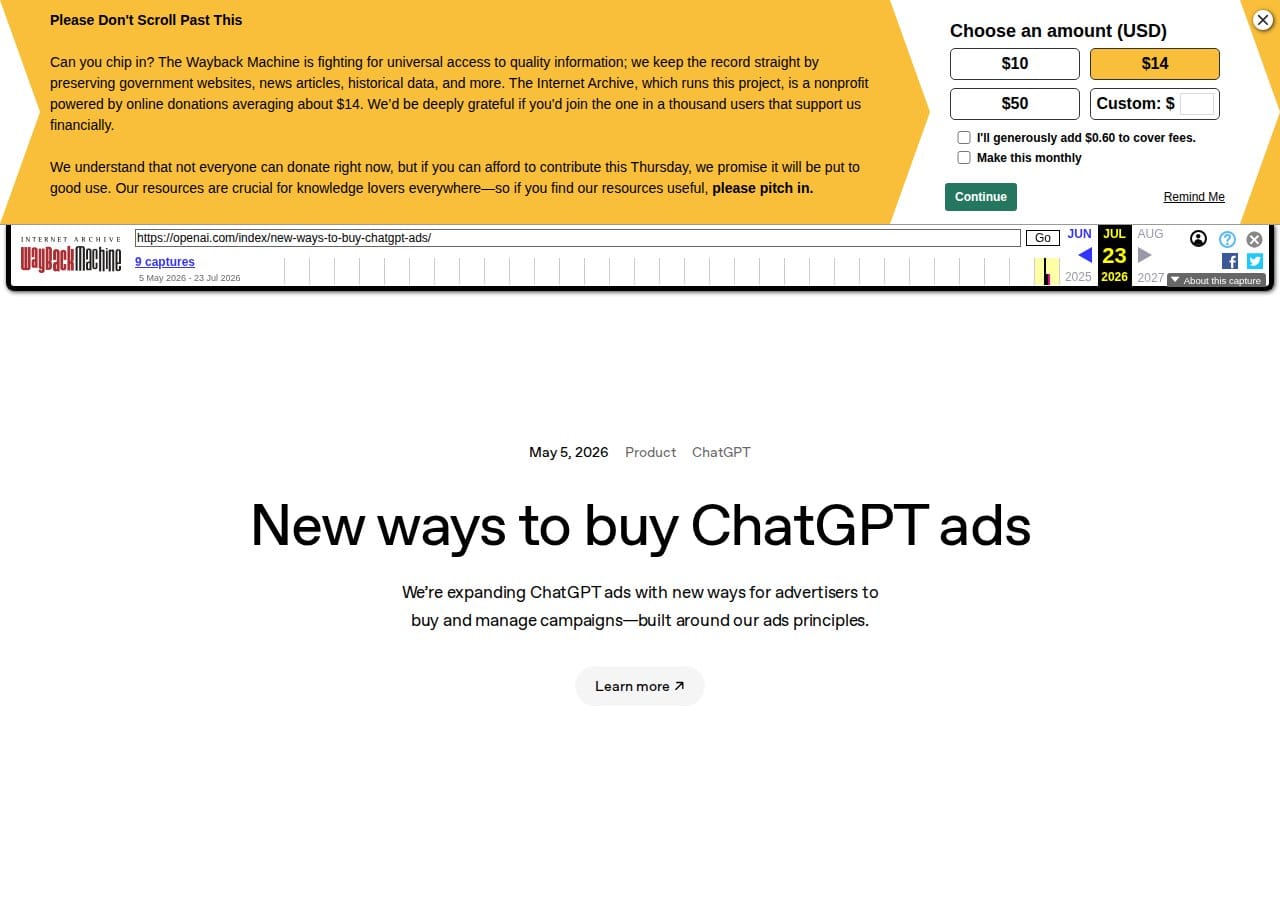
- May 5, 2026: "New ways to buy ChatGPT ads": cost-per-click (CPC) bidding begins rolling out, plus a beta self-serve Ads Manager, alongside a partner network including Dentsu, Omnicom, Publicis, WPP, Adobe, Criteo, Kargo, Pacvue, and StackAdapt.
- May 7, 2026: Plan announced to expand to five countries: the UK, Mexico, Brazil, Japan, and South Korea.
- August 11, 2026: The five-country launch goes live — we covered it in detail here.
- August 18, 2026: The big one: 31 European markets at once, for a 35-country total.
At this cadence, one question forces itself forward: when do the ads reach the Middle East and other regions? OpenAI has announced no dates beyond Europe as of this writing — but three expansion waves in six months makes early preparation a direct investment in that moment.
What the ads look like inside ChatGPT: what changes for users
The rules OpenAI has stated publicly have held constant across every market, and the company says they carry into the European wave:
- Who sees them: only Free and Go plan users. Plus, Pro, Business, Enterprise, and Education subscribers see no ads at all — a paid-subscription value proposition that strengthens with every expansion.
- Format: ads are "clearly labeled" as sponsored and visually separated from the answer text itself — never woven into the reply as if they were part of it.
- Answer independence: ads do not influence ChatGPT's answers, per the company's stated commitment; answers are optimized for what's most helpful to the question.
- Matching mechanics: the system matches available ads against the topic of your current conversation, your past chats, and your past interactions with ads. Researching recipes? You might see meal-kit advertising. Comparing writing tools? A platform's offer may appear.
- Privacy: advertisers get no access to your conversations, chat history, memories, or personal details — only aggregate performance indicators (impressions, clicks, and the like). OpenAI says it does not sell user data to advertisers.
- Opt-out: Free-tier users can turn ads off in exchange for fewer daily free messages.
What's available to advertisers in the European wave
The expansion isn't just new maps; OpenAI has upgraded the buying infrastructure underneath it. What matters to any marketer sizing this up:
- How to buy: there is still no fully open self-service door. Official entry runs through OpenAI's Ads Solutions team, agency partners (Dentsu, Omnicom, Publicis, WPP), or technology partners (Adobe, Criteo, Kargo, Pacvue, StackAdapt). Meanwhile the beta self-serve Ads Manager — where businesses register as advertisers, add payment methods, set budgets and pacing, upload creative, and launch campaigns — has been gradually opening to more businesses since May, with broader self-service access signaled for later in the summer.
- Bidding models: from CPM (cost per thousand impressions) to CPC (cost per click) to conversion-optimized buying — meaning the platform now supports purchases at different stages of the funnel, not just raw reach.
- Targeting: geo-targeting and custom audiences have joined the stack.
- Measurement: the OpenAI Pixel and Conversions API for beyond-click measurement, plus third-party measurement integrations — the same measurement muscle Google and Meta marketers already know, which lowers the learning curve considerably.
- Demand scale: reporting on the expansion notes "tens of thousands of marketers" have already advertised on the platform — a signal that the door is no longer as narrow as in the program's first months.
Why does OpenAI believe advertisers will come? Its stated pitch: a ChatGPT user doesn't type two keywords — they "explain what they want to accomplish, what matters to them, and the constraints they face." The ad lands in front of someone mid-decision rather than mid-scroll. It's the same intent-timing advantage that made search ads profitable for two decades, transplanted into a conversational interface with far richer context.
Why Europe first? Reading the timing strategy
It might look odd for an ads platform to expand into Europe — the world's toughest data-protection region — before easier regulatory territory. From OpenAI's angle, though, the logic is threefold:
First, audience mass. Europe holds one of the largest blocks of ChatGPT users outside the United States, and its collective ad market is among the biggest anywhere. Any ads platform that wants to prove itself to global advertisers needs a European presence — the European stop is the true maturity test, and success there unlocks the rest of the map faster.
Second, regulatory groundwork already laid. The company didn't arrive in Europe empty-handed: it had published its ads principles, committed to answer-independence and clear labeling, launched European data residency offerings, and joined the EU's code of practice on AI content transparency. The expansion is a message to regulators as much as to advertisers: the infrastructure was built for your environment.
Third, a signal for every market that comes next. When the platform works in the hardest regulatory climate, entering lighter regimes becomes a business decision rather than an engineering problem. With the Middle East's enormous digital-consumption market and exceptional AI-tool adoption growth, the Middle East is a natural candidate in the waves after Europe consolidates — which alone justifies building your knowledge and creative assets now.
What this means for you: five practical moves this month
- Audit how ChatGPT describes your product today. Before paying any platform a cent, learn what the model says about your product and category when users ask. The new ad sits beside an answer that frames your competitors — and appearing well inside that answer is its own discipline, which we cover in our guide to showing up in AI answers.
- Europe contains your Arabic-speaking audience. Millions of Arabic speakers across Germany, France, the Netherlands, and Sweden ask ChatGPT in Arabic about products and services that matter to them. If your product ships to Europe or serves digital audiences there, the new geo-targeting opens that audience early, with far less competition than Google or Meta auctions.
- Write conversational-toned creative. An ad here doesn't win with visual fireworks but with a useful sentence inside a discussion. Draft copy that answers the user's actual question ("best Arabic writing tool?") rather than shouting "buy now."
- Use a partner if speed matters; wait if budget is small. Partner agencies manage campaigns for their clients on the platform. If your spend is modest, waiting for the self-serve door is cheaper and simpler — register your interest on the official advertisers page now.
- Measure with the tools you already run. If your store uses Pixels and conversion APIs, connecting them here will rhyme with what you know. Document one clear conversion event (sale, signup, subscription) before launching anything — and when your seat opens, enter with a small, isolated test budget, one goal (qualified visits, not "general awareness"), and a full two weeks of patience. New-market auctions take time to settle their prices, and the first advertiser to quit early hands the opportunity to whoever waits behind them.
Quick comparison: ChatGPT Ads vs. Google vs. Meta
| Dimension | ChatGPT Ads | Google Search Ads | Meta Ads |
|---|---|---|---|
| Intent state | Declared intent inside a decision conversation | Very high search intent | Low intent (discovery) |
| Reach today | 35 markets, hundreds of millions of users | Near-total global coverage | Near-total global coverage |
| Advertiser entry | Managed/partners + expanding beta self-serve | Fully self-serve | Fully self-serve |
| Auction competition | Relatively low (young program) | Typically high | High in consumer verticals |
| Targeting source | Conversation topic + in-platform history | Search query | Demographic interest profile |
| Measurement | Pixel + Conversions API + third-party | Mature for two decades | Mature for two decades |
Honest limits and weaknesses before you dream about the wave
- The full 31-market list hasn't been published in detail in the available announcement; nine countries are named, and the rest will become clear as ads actually appear per market. Don't build a plan on an unconfirmed market.
- Self-serve isn't open to everyone yet: unless you're a sales-team client or partner, your seat is in the beta Ads Manager queue.
- No public pricing: OpenAI has published no rate card; costs will be set auction-by-auction per market and vertical. Any number you hear today is a guess.
- Interface sensitivity: ChatGPT users are used to a clean experience. Any breach of the ad-vs-usefulness balance could trigger a backlash that forces tightening — this program can change faster than any established ads platform.
- Legitimate privacy questions: despite OpenAI's commitments that advertisers never see conversations, matching ads against past chat history is a live regulatory debate — especially in Europe — and the mechanics may be adjusted post-launch.
- Performance data is still scarce: there are no reliable sector benchmarks yet for click-through or conversion rates comparable to your existing channels.
Frequently asked questions
Which European countries are getting ChatGPT Ads?
The expansion covers 31 European markets announced August 18, 2026, including Germany, France, Spain, Italy, Sweden, Norway, Denmark, the Netherlands, and Austria, with ads beginning to appear within a week of the announcement — bringing the program's total to 35 countries.
Do paid ChatGPT subscribers see ads?
No. Ads appear only for Free and Go plan users. Plus, Pro, Business, Enterprise, and Education plans stay ad-free, and Free-tier users can opt out of ads in exchange for fewer daily free messages.
How do I advertise inside ChatGPT?
Currently through OpenAI's Ads Solutions team or accredited agency and technology partners, with a beta self-serve Ads Manager gradually opening to more businesses — registration, payment setup, campaign launch, and performance tracking all run through that portal once accepted.
Do ads influence ChatGPT's answers?
Per OpenAI's stated commitment: no. Answers are optimized for what's most helpful, ads are clearly labeled and visually separated from the answer, and advertisers receive only aggregated performance data — never conversation content.
When will ChatGPT Ads reach the Middle East?
OpenAI has announced no date for Middle Eastern markets as of publication. With three expansion waves in six months (Canada/Australia/NZ, then five major countries, then 31 European markets), the trajectory is accelerating — preparing your knowledge and creative now is the actionable move.
How much does a ChatGPT ad cost?
There's no published rate card; buying runs on CPM, CPC, and conversion-optimization models, with actual costs set by auction per market, vertical, and competition — exactly like the other major ad platforms.
The bottom line: a platform being built in public
Every major ads platform passed through its "cheap gold" era: the early years when advertisers are few and costs are low, before everyone learns the way in. Search ads did it in the early 2000s, Meta after them. ChatGPT Ads stands at that moment today — with a defined frame (35 markets), familiar measurement tooling, and a door that widens by the month. The marketer who masters the mechanics now, and sharpens how their product shows up inside the answers themselves — through genuinely useful content, the kind Arabic-first teams produce with tools like ARWriter — will sit closer to the front than their competitors when the wave completes, in the paid channel and the organic one alike. For the program's full backstory, read our coverage of the five-country launch and our explainer on Google's AI ad labels for the wider advertising picture.
Sources: OpenAI's official announcement "ChatGPT Ads expands across Europe" (August 18, 2026) via its official news feed; the official "Testing ads in ChatGPT" page with updates through August 11, 2026; "New ways to buy ChatGPT ads" (May 5, 2026); and Search Engine Land and Neowin coverage of the European expansion.