On August 11, 2026, OpenAI quietly updated its official announcement about advertising in ChatGPT with a sentence that marks a turning point: “ChatGPT Ads has now launched in the United Kingdom, Mexico, Brazil, Japan, and South Korea. We’re continuing to expand to more markets this year.” With those words, advertising inside the world’s most-used AI assistant graduated from a limited U.S. experiment into an international revenue channel — one that is moving quickly toward the rest of the world’s marketers, agencies, and content creators. This in-depth guide breaks down exactly what OpenAI announced, how the ads actually work, who sees them and who doesn’t, how the privacy model is structured, and — most importantly — what this shift means for your marketing workflow whether you run a small business, an agency, or a personal brand.
The full timeline: from U.S. test to international launch
Advertising in ChatGPT did not appear out of nowhere. In January 2026, OpenAI published a foundational piece titled “Our approach to advertising and expanding access to ChatGPT,” laying out its philosophy: ads are a way to keep broad access to ChatGPT sustainable without loading every cost onto subscribers — provided they never compromise answer quality or user trust. Then, on February 9, 2026, the actual test began in the United States, scoped to logged-in adult users on the Free and Go tiers, while Plus, Pro, Business, Enterprise, and Education remained completely ad-free.
From there the program accelerated fast. On March 26, 2026, the company reported encouraging early signals: no measurable impact on consumer trust metrics, low dismissal rates, and steadily improving relevance. That unlocked the first international expansion into Canada, Australia, and New Zealand. On May 7, 2026, OpenAI announced plans for the next wave: the United Kingdom, Mexico, Brazil, Japan, and South Korea. The decisive step came on August 11, 2026, when the company confirmed the official launch in all five of those markets at once, with an explicit promise of more markets before year-end.
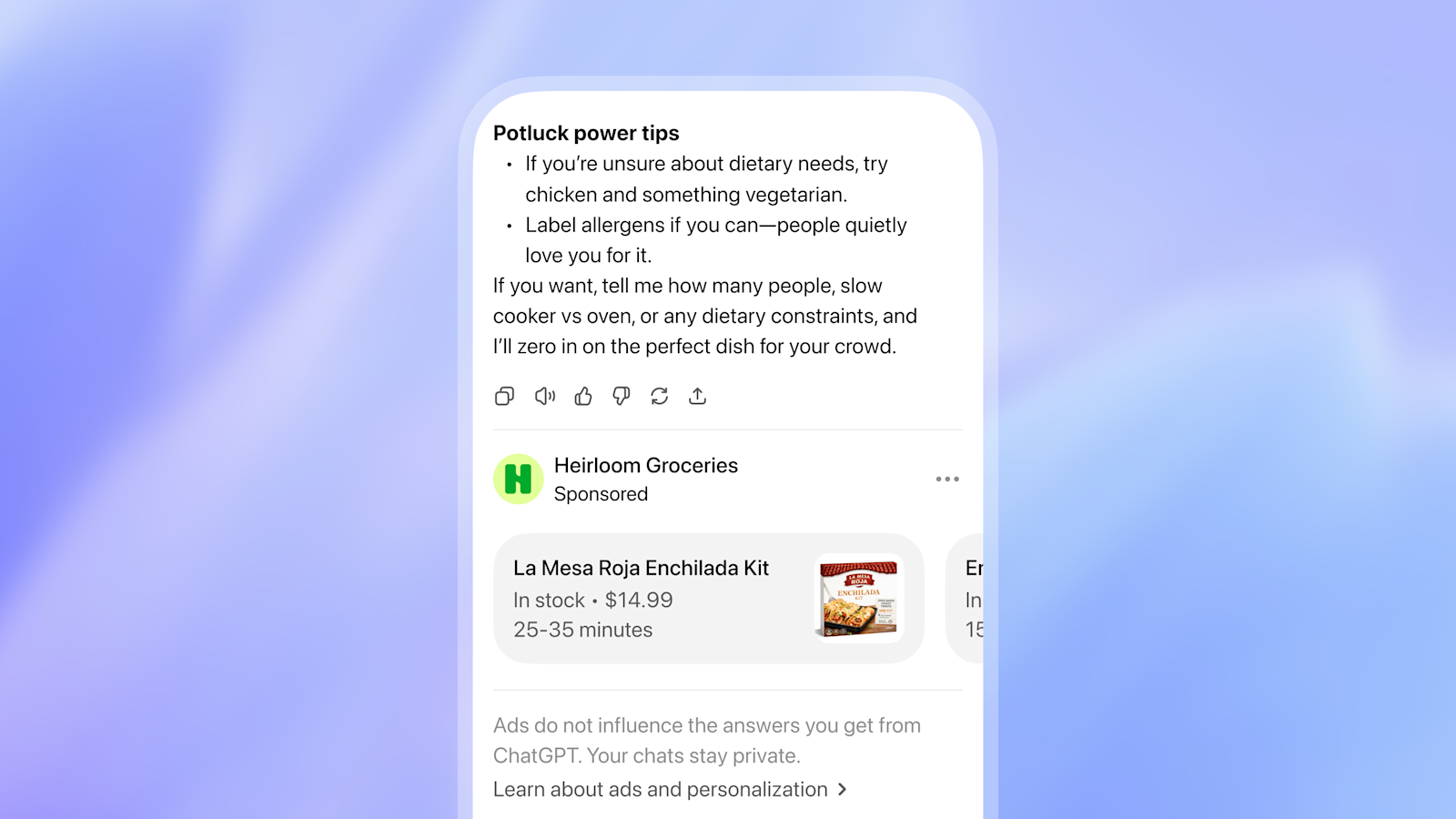
That sequence matters because it answers the question every marketer is asking. Ads in ChatGPT are no longer an “if” — they are a “when does my market open?” In less than seven months, the idea moved from a principles document to a live advertising product operating in at least eight major markets, echoing the early expansion speed of Google and Facebook ads in their first decade — except this time inside a conversational interface where people actively make purchasing decisions.
How ChatGPT ads actually work
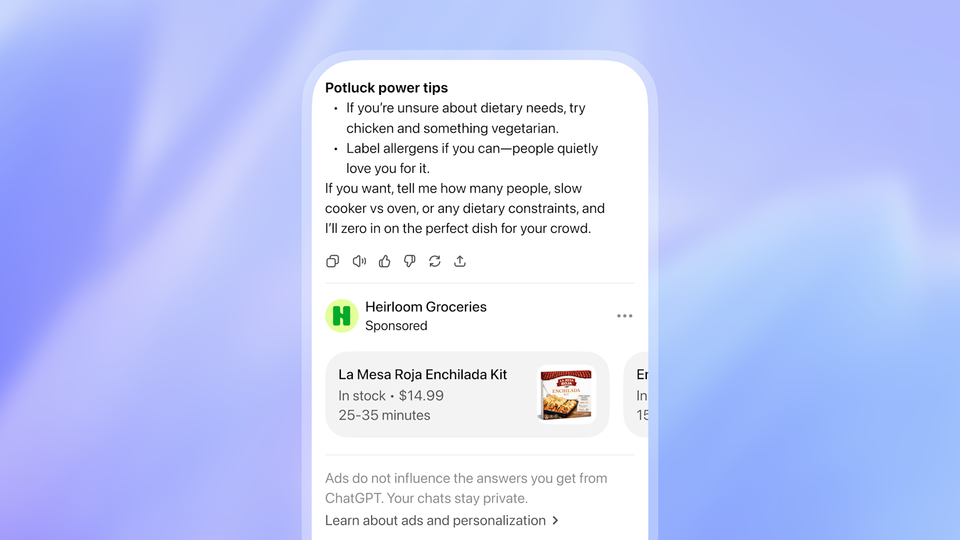
According to the official announcement page, ads are designed to appear naturally within the conversation without interfering with the answers themselves. OpenAI repeats one golden rule in several forms: “ChatGPT’s answers remain independent and unbiased, conversations stay private, and people keep meaningful control over their experience.” Practically, that means an ad does not modify what the model says, nor does it buy placement inside an analytical answer. Instead, it appears as a visually distinct element in moments when the user is exploring options or comparing choices — the exact moments when commercial intent is highest.
On the targeting side, the system draws on conversation context and accumulated user interests, with a strict separation — as the company describes it — between what the platform sees and what the advertiser gets. Advertisers do not receive access to your chats, chat history, memories, or personal details; they receive only aggregate performance data such as view and click counts. The platform also blocks ads from appearing in accounts where the user has said they are under 18 (or where systems predict they are), and keeps ads away from sensitive and regulated topics including health, mental health, and politics.
Who sees the ads — and who never will
The distribution is explicit and public. Ads apply only to the Free and Go tiers for adults, while Plus, Pro, Business, Enterprise, and Education accounts are entirely exempt. That structure is the heart of the new business model: the casual user enters for free and sees ads, the committed user upgrades and escapes them, and organizations get a clean environment. For background, we previously covered ChatGPT’s move to unlimited free text chats with the Luna model — and advertising is the other side of that generosity: nothing is truly free in the attention economy.
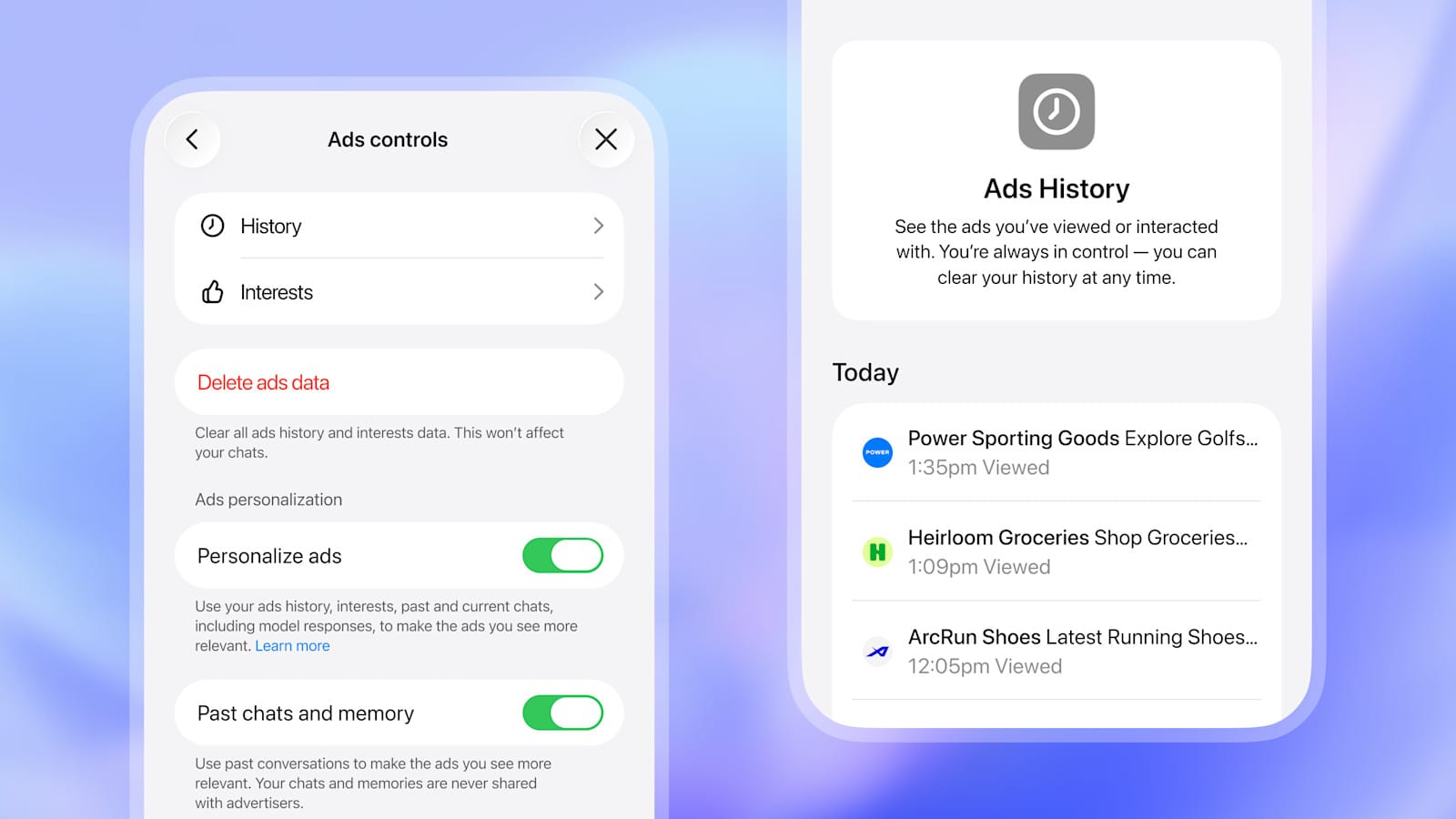
On the control side, the app gives every user real tools, documented on the official page: dismiss any ad, send feedback about it, learn “why you’re seeing this ad,” delete your ad data with one tap, and manage ad personalization at any time from the settings screen shown above. Whether all of this holds up at scale is a fair question — but on paper, it places ChatGPT among the more transparent ad platforms from day one.
What this means for you as a marketer or content creator
Here is the part that actually matters to your work. First, none of the eight open markets is in the Middle East or North Africa yet — but “more markets this year” means the question is a matter of months, not years. Markets with strong ad spend (the Gulf, Egypt, the wider region) typically enter the second or third wave of any global ad product. Preparing today is dramatically cheaper than catching up later.
Second, ads inside ChatGPT redraw the discovery map. Your audience now asks the model things like “best scheduling tool for small teams?” or “affordable Arabic copywriting app?” — and the answer it returns is effectively a search result of the new generation. Once ads are woven into those moments, your brand can compete in two positions: being mentioned organically in the answer because your content is trusted and useful, or appearing as a paid ad at the right moment. That is exactly why we published a full guide on getting cited by ChatGPT and AI search engines — investing in content that models use to answer your audience’s questions is the free side of the coin; ads are the paid side.
Third, for those ready to advertise the moment the platform opens in their region: register your interest now through the official advertisers page OpenAI linked in its August 11 update, and get your assets ready — fast landing pages, clear offers, and genuine content that answers purchase intent. Early market experience in the U.K., Japan, and Korea, followed by Latin America, suggests that small and mid-sized advertisers have found customer acquisition costs below saturated channels — with one important nuance: the conversational ad format differs from social ads. Short, clear copy that answers an explicit intent beats heavy visual production.
Quick comparison: ChatGPT ads vs. what you use today
| Criterion | ChatGPT Ads | Meta Ads (FB/IG) | Google Search Ads |
|---|---|---|---|
| Moment of appearance | Inside an active conversation (exploration/purchase intent) | Social browsing (usually low intent) | Direct search query |
| Open markets today | US, CA, AU, NZ, UK, MX, BR, JP, KR | Worldwide | Worldwide |
| Advertiser data model | Aggregate only (views/clicks), no chat access | Broad demographic and behavioral targeting | Keywords and search intent |
| Competitive density | Low (new channel) | Very high, rising costs | High in commercial verticals |
| Maturity for Arabic content | Not open in MENA yet | Fully mature | Fully mature |
The practical takeaway from the table: don’t abandon Meta or Google today, but allocate 10% of your marketing attention to tracking ChatGPT Ads’ arrival in your market and preparing for it — young channels reward early movers with cheap reach before they get crowded.
What the ads actually look like inside a conversation
The first practical question any marketer asks: where and when does my ad show? Per the official page, placement is tied to moments of exploration, not to moments of answers. An ad does not interrupt a long analytical reply or carve a sentence out of the model's response — it surfaces as a visually distinct element at the edges of the conversation, precisely when the user is comparing options or investigating alternatives to a product they asked about. That distinction is the heart of the product: the conversation stays clean in principle, and the commercial interruption happens at the rim of purchase intent.
Because a language model is what writes the answers, OpenAI repeats its golden rule in several forms: answers remain independent and unbiased, conversations stay private, and users keep meaningful control. In practice, this means an advertiser buys "a spot next to the conversation," not "a clause inside the answer" — a distinction the coming months will test publicly, because any blurring between the two would undermine the trust the entire ads model rests on.
Three practical scenarios: how to prepare for your situation
The small business owner: you don't need an agency retainer or a big test budget. You need one fast landing page that states your offer plainly, and short ad copy that answers a specific purchase intent ("looking for an invoicing tool for freelancers"). Register interest on the advertisers page, watch for your market to open, then start with a small test budget and measure before scaling.
The agency: your position is stronger than most because you serve clients across markets. Add "conversational ads readiness" to client plans now: which clients already sell into the eight open markets? Prepare draft ad angles for each, ready to activate the day the next market opens — and be the first to explain to clients what conversational interfaces change about their customers' path to purchase.
The creator and personal brand: your plan starts on the free side, not the paid one. Authentic content that answers your audience's real questions is what makes you present in the organic answers, while ads serve specific campaigns and expansion pushes. The two meet in one place: whoever writes content that answers a clear intent earns both positions — organic mentions in the answer, and higher relevance for any paid placement later.
A 30-day preparation plan
Week one: register interest on the official advertisers page, then audit your audience's recurring questions and identify the purchase intents that repeat most. Week two: write two or three short ad drafts per intent — copy that answers a question rather than decorating it. Week three: prepare the matching landing pages — fast to load, one clear offer, one call to action — and test them on mobile first. Week four: settle a simple measurement plan before spending anything: which metric decides continuation (a booked call? a signup? a pricing-page visit?), and what test amount you're comfortable paying to learn. Then meet your market's opening day halfway prepared, instead of watching from the sidelines.
Honest limitations you should know before getting excited
The picture is not all rosy, and honesty matters. First, the product is still an “expanded test” even in the eight open markets: ad formats are limited, buying mechanics are still evolving, and there are no fully public, self-serve price lists the way mature ad platforms offer — onboarding is gradual through the advertisers page. Second, performance measurement remains far simpler than what you are used to on Meta or Google; trade press covering the rollout notes measurement gaps that buyers have flagged — a challenge we analyzed in depth in our attribution-crisis guide — normal for a product that is months old, but a real constraint for ROI-driven teams. Third, there is genuine controversy in the publishing world over how OpenAI’s crawlers interact with news content, with recent coverage describing the crawler bypassing some publishers’ block settings — an open dispute that could reshape the platform’s relationship with the content industry. Fourth, as an advertiser you depend on a platform where a third party (OpenAI) fully controls when your ad appears, inside conversation contexts you cannot see — the level of trust required is higher than in any previous channel.
Frequently asked questions about ChatGPT ads
Which countries have ChatGPT ads right now?
As of August 16, 2026: the United States, Canada, Australia, New Zealand, the United Kingdom, Mexico, Brazil, Japan, and South Korea. The last five launched officially on August 11, 2026, and OpenAI has committed to expanding to more markets before the end of the year.
Can I advertise on ChatGPT outside those markets?
Not yet for most regions. If you serve audiences in the open markets you can register interest at the official advertisers page (openai.com/advertisers). Direct targeting of other regions will become possible as those markets open.
Will Plus or Pro subscribers see ads?
No. According to OpenAI’s official announcement, ads appear only for logged-in adult users on the Free and Go tiers. Plus, Pro, Business, Enterprise, and Education are completely ad-free.
Do advertisers see my ChatGPT conversations?
No, per the official page. Advertisers receive only aggregate performance data such as the number of views and clicks — never your chats, history, memories, or personal details — and you can delete your ad data from settings at any time.
How do I prepare before ads reach my country?
Three practical steps: register interest on the advertisers page to receive market-opening updates, prepare short ad copy that answers a clear purchase intent with fast landing pages, and invest in authentic content that answers your audience’s real questions so you show up in the organic answers alongside — or instead of — paid placement.
What to do this week
The launch of ChatGPT ads in five new countries on August 11, 2026 is not just another tech news item; it is a clear signal that the conversational interface has become a first-class advertising surface, and that the race to “show up where people ask” has intensified. The smart marketer doesn’t wait for the channel to arrive in their region before thinking about it — they prepare content, assets, and measurement today. And if you build genuine, well-structured content — articles, pages, and posts that answer your audience’s real questions — you are simultaneously building presence in the model answers that ads will sit beside. A tool like ARWriter helps you produce, schedule, and publish that content from one place while the new ad channel matures. Watch for the next market openings, and be there early.
Primary source: OpenAI’s official announcement “Testing ads in ChatGPT” with its update trail (February 9 – August 11, 2026) on openai.com. The international expansion was also tracked in independent coverage by gHacks, Business Insider, and Ad Age during August 2026.