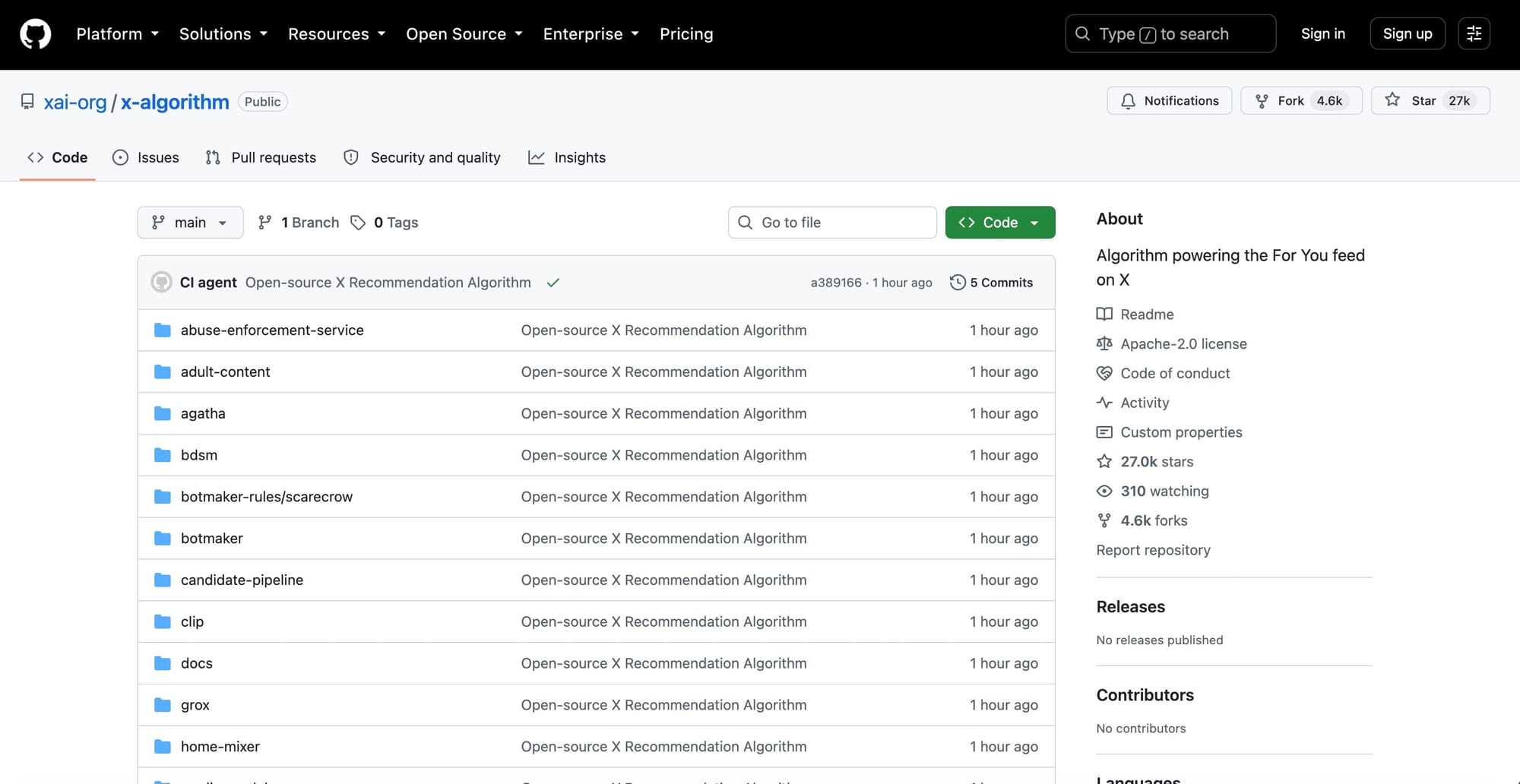
On Thursday, August 13, 2026, X (formerly Twitter) announced what trade press quickly called the boldest transparency move in the platform’s history: publishing the source code of the ranking system behind the default “For You” feed for everyone on GitHub, and launching a new in-app tool that lets users see, for the first time, whether their account or posts have been affected by any of X’s ranking systems — including the labels popularly described as “shadowbans.” For content creators who spend hours analyzing why today’s post “only reached three hundred people,” this isn’t niche developer news. It changes the rules of a game that, until yesterday, was played blind.
What exactly did X announce?
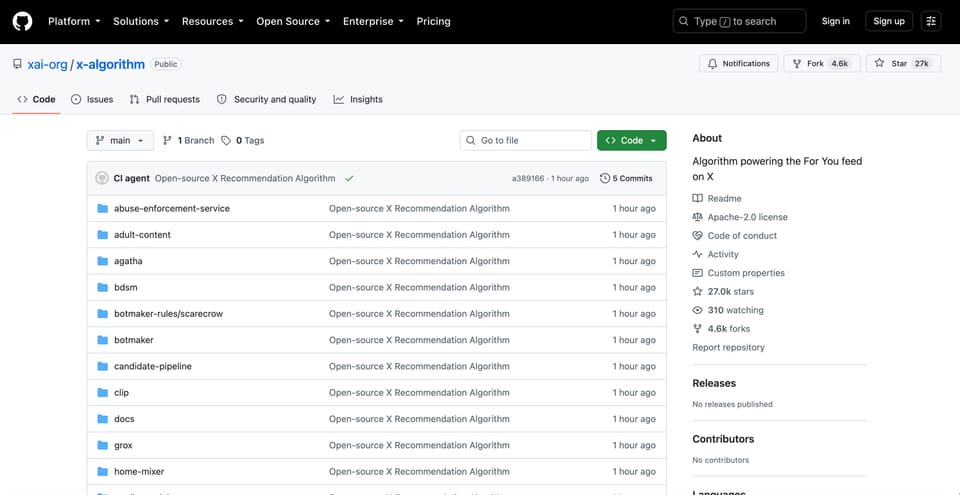
According to the company, explained by VP of Product Keith Coleman in a detailed interview with TechCrunch ahead of the launch, the move has three connected parts. Part one: the source code for the “For You” timeline and its core ranking engine is now public on GitHub under the Apache v2 license — and it includes details never disclosed before, such as the model configuration, the filters, and the parameters used to weight different signals. In Coleman’s words: “You’ll get the core ranking code that pulls posts and ranks them for any given user and assembles the feed,” adding that some of those systems, like the ranker and the scorer, “you can even run yourself outside the company.” The company says the newly open codebase is roughly 10 to 15 times larger than its previous open-source effort.
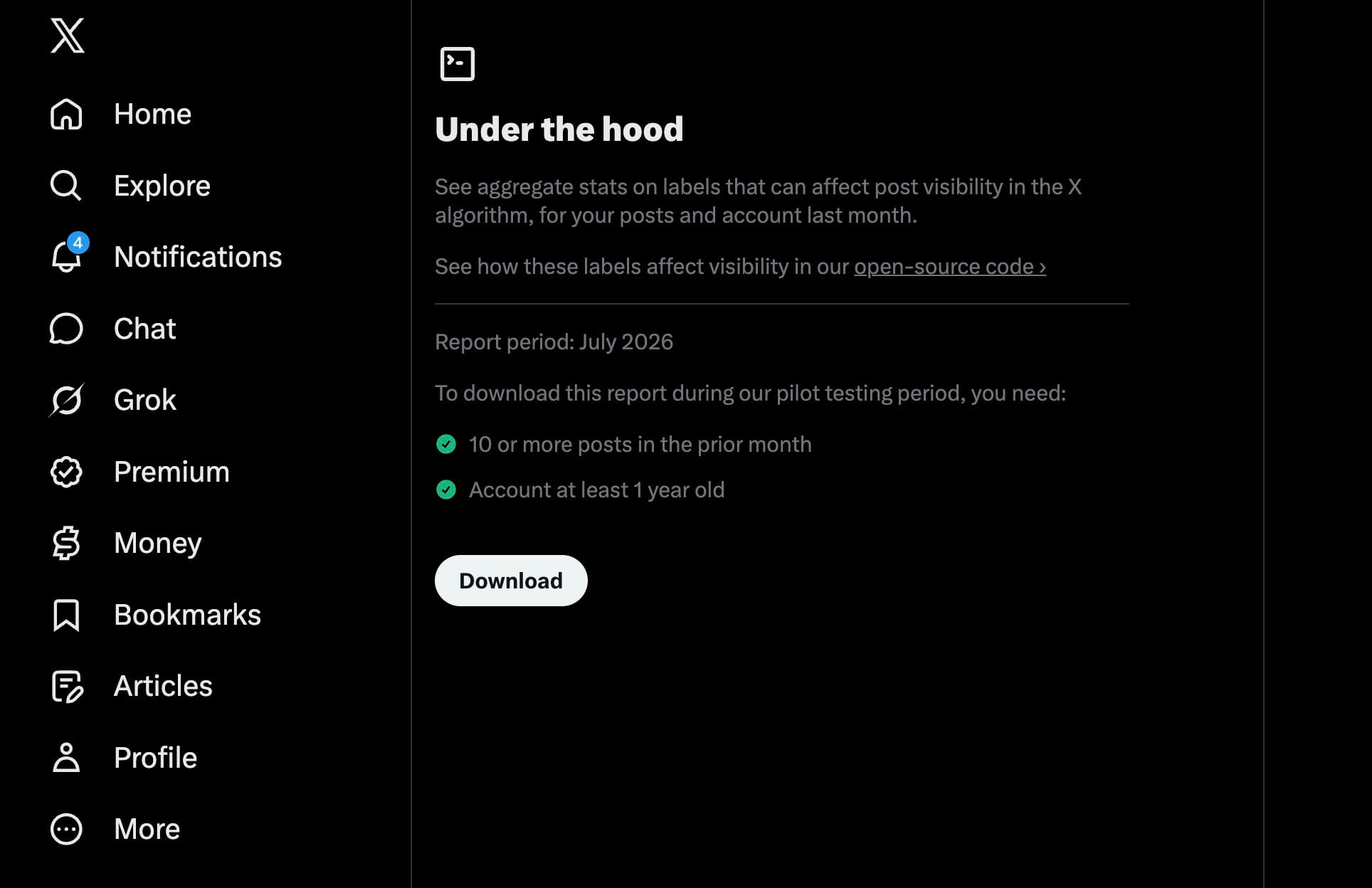
Part two: transparency tools for regular users. A new “Under the Hood” page in the app’s settings lets any user who has posted 10 or more times in the past month download a JSON file of their aggregate stats, showing whether any labels have been applied to their account or posts over the past calendar month. That file is the closest thing to a secret vault swinging open: the ranking labels that made posts quietly disappear from feeds without explanation. Part three: community contributions. Any developer can submit pull requests to the repository, and X engineers will consider incorporating them into the algorithm. “That would be amazing, to have people submitting code that improves the algorithm… I mean, how cool would it be for the X algorithm to be not just visible to the public, but also, like, by the public?” Coleman said.
Why this matters specifically for content creators
Ask any successful creator on X about their single biggest daily anxiety and you will hear one word: reach. What you see on X is governed by a ranking algorithm that orders posts using complex signals, and when your reach dips, the guessing begins: Am I flagged? Is my account restricted? Is shadowbanning real or a myth? Before August 13, there was no official way to answer — only forum theories and contradictory anecdotes. Now you hold an official file from the platform itself that states plainly: yes, a label was applied to your post or account, or no, nothing happened.
Even more important than the direct answer: opening the weighting parameters means that for the first time in the history of major social platforms, a non-engineer can read — or ask an AI model to read for them — how the algorithm actually weighs recency, engagement, replies, and clicks. The company itself hinted at this use case, noting that non-technical users can drop their JSON file into a large language model of their choice, point it at the official GitHub repository, and ask for an interpretation. Imagine uploading your file and asking, “Why did my reach drop in July?” — and getting an answer built on the actual code, not on superstition.
How to use the new tool, step by step
The steps as announced are simple, with conditions. First, confirm you’re eligible: your account should have posted at least 10 times in the past month, and be at least one year old — the company says the tool starts as a pilot for a test group of older accounts before a broader rollout. Second, open Settings and look for the new “Under the Hood” page. Third, download the JSON file with your aggregate stats and the labels applied over the past month. Fourth — the clever part — open any AI assistant you trust, upload the file, ask for an analysis tied to the open algorithm repository, and add your specific question about the period of declining reach. You’ll get a reading based on your actual numbers and the published ranking rules.
A practical tip from our experience analyzing Arabic and English content performance: store the JSON file monthly in a dedicated folder. The comparison between two months is what reveals the pattern — a one-week passing label is one thing; a label that keeps appearing alongside a specific type of post is something else entirely, and it calls for changing that content category or reviewing how you use links and hashtags.
What this means for you as a creator — the practical takeaway
First, the end of the guessing era means the start of the accountability era: when you know there are no labels on your account, “I’m shadowbanned” is no longer an excuse for weak performance — you need to look hard at the content itself, its timing, and its fit for your audience. Second, an early competitive edge: the overwhelming majority of creators, even internationally, will not bother understanding the published weights. Those who do it now own a genuine knowledge advantage, similar to those who understood Google’s algorithm in 2005 or TikTok’s in 2019. Third, this decision redraws trust between the platform and creators: opening source code is a rare step in an industry built on secrecy — external researchers were even able to train and run X’s Phoenix scoring system using the open code ahead of launch, which Coleman described as a major milestone for transparency efforts. Fourth, if you’re building an integrated multi-platform strategy, this is the right moment to audit your X performance with data rather than gut feeling — and producing authentic content scheduled for the hours when your audience actually engages remains the foundation every algorithm works on top of. The same data-first logic applies to the new AI search surfaces, which we covered in our guide on getting cited by ChatGPT and AI search engines, and it’s exactly the workflow ARWriter is built for: writing, scheduling, and publishing your content from one place.
Quick comparison: X transparency vs. other platforms
| Criterion | X after Aug 13, 2026 | Instagram/Facebook (Meta) | TikTok |
|---|---|---|---|
| Algorithm source code | Open on GitHub (Apache v2) with weighting parameters | Closed; general technical papers only | Closed; general signal explanations |
| Official restriction-check tool | Yes — “Under the Hood” with a labels JSON file | Account status only, no ranking detail | No equivalent announced tool |
| Community code contributions | Yes — PRs reviewed by X engineers | No | No |
| Tool eligibility | 10+ posts monthly, account 1yr+ (pilot) | Not applicable | Not applicable |
What "open weighting parameters" means in practice
The phrase sounds technical, but its practical meaning is simple and quietly revolutionary. A ranking algorithm collects many signals — recency, engagement, replies, clicks — and multiplies each by a numeric "weight" that determines its relative importance in the final ranking. Those weights were always the deepest trade secret on every platform. Now, for the first time, they are published numbers anyone can read, alongside the model configuration and filters. In practice, the endless debate over "what does the algorithm prefer?" moves from guesswork and personal anecdotes to a citable reference.
And if you're not an engineer, you don't have to read the code yourself. The platform spelled out the practical path: take your JSON file, open any large language model, point it at the official repository, and ask what those weights mean for your numbers. It's the same data-first mindset behind our guide on getting cited by ChatGPT and AI search engines — understanding beats superstition, every time.
How to read your JSON file, step by step
The file, as the company describes it, holds two categories of information. First: your aggregate stats for the past calendar month — overall performance numbers with no user-identifying detail. Second, and far more important: the labels applied by ranking and filtering systems to your account or posts. When you open it, start with three questions: are the labels at the account level or attached to specific posts? When was each label applied, and has it expired? And do they cluster around one category of your content?
Save a copy at the end of every month in one consistently-named folder. The real value isn't in any single file but in the sequence: a label that appears for one week and vanishes is transient; a label that shows up in three consecutive files alongside, say, your link posts is a systemic signal — one that calls for changing the content strategy itself, not for complaining about the platform.
Three scenarios: clean account, labeled post, repeated pattern
Scenario one — no labels at all: congratulations, but it's not entirely good news; it permanently retires the "I'm shadowbanned" excuse. If your reach is weak and the account is clean, the problem is content quality, timing, or audience fit — which is actually the good kind of problem, because all of those are in your hands, not the algorithm's.
Scenario two — a label on one post: check the flagged post against platform rules: suspicious links, artificial engagement, or a formatting violation? Fix the cause, delete or correct the post if needed, then watch next month's file to confirm it doesn't recur. One label is not a permanent penalty.
Scenario three — a repeating pattern: labels keep accumulating on one category of your posts. Now the decision is strategic: either modify that category (how you use links, hashtags, or post length) or retire it and double down on what works. The data now settles arguments that used to be fought over impressions.
Honest limitations you should know
The excitement is justified, but keep expectations calibrated. First, the tool is still a pilot for a limited group of older accounts; you may wait weeks before it reaches you. Second, the JSON file covers only the past calendar month — no long historical archive — so start archiving now if you want time comparisons. Third, open code does not mean easy code: modern ranking systems are complex, and their parameters need engineering context that an AI model can compress for you but cannot guarantee perfectly. Fourth, parts of the system remain outside the repository (production infrastructure and private data), so the openness is broad but not total. Finally, opening the code doesn’t change the truth that content quality remains the biggest variable in the equation — ranking labels penalize violations and boost good material, but they don’t create content worth watching.
Frequently asked questions
How do I know if I’m shadowbanned on X now?
Open Settings and look for the new “Under the Hood” page. If you’re eligible (10+ posts in the past month, account at least one year old), download the JSON file that shows whether labels were applied to your account or posts in the past month. If the tool hasn’t reached you yet, you’re in the waiting group — the rollout is gradual.
What’s the difference between shadowbanning and the labels this tool reveals?
“Shadowban” is the popular term for reduced reach without notification. What the tool officially reveals is the set of labels that X’s ranking and filtering systems applied to your account or posts — the documented cause of that reach drop, if one exists, replacing guesswork.
Can I understand the JSON file if I’m not technical?
Yes, indirectly: X itself suggested uploading the file to any large language model, pointing it at the official GitHub algorithm repository, and asking for an interpretation, giving you a simplified reading grounded in the open code.
Is X’s algorithm fully open source now?
What’s open is the core ranking code for the “For You” timeline, including model configuration, filters, and weighting parameters, under Apache v2. Production infrastructure and private data remain outside the repository, so the openness is wide but not complete.
Can anyone actually change the algorithm?
Any developer can submit pull requests to the repository, and X says its engineering teams will consider incorporating suitable ones. Not every suggestion will merge, but this is the first time a major platform has opened community contribution to its ranking algorithm.
The bottom line: from guessing to data
August 13, 2026 won’t be remembered as a technical footnote, but as the day the biggest question haunting creators — “why isn’t my content reaching anyone?” — turned from a debatable conspiracy theory into a downloadable file. Do two things this week: open your account settings and look for “Under the Hood,” and archive the first JSON file you get. Then refocus your energy on what no algorithm does for you: authentic content that answers your audience’s real questions, in natural human phrasing, published on a smart schedule. Platforms change; your reader stays. Building a library of repurposable content across X, Instagram, and your blog is the real insurance policy — and it starts with the first words you write today.
Primary source: X’s official announcement via VP of Product Keith Coleman’s interview with TechCrunch (August 13, 2026) and the official open-source repository at github.com/xai-org/x-algorithm under Apache v2.