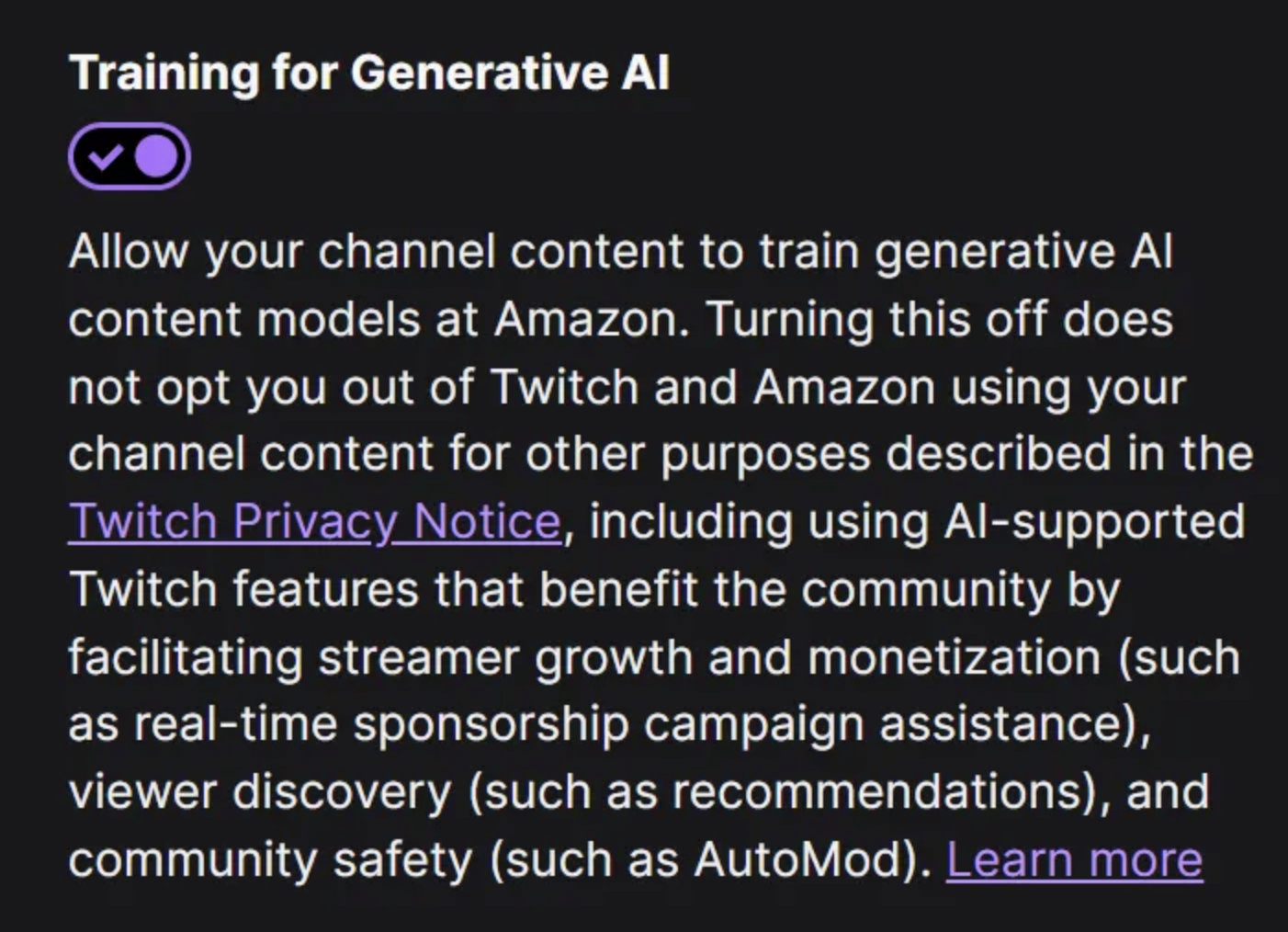
On August 12, 2026, hundreds of thousands of Twitch streamers woke up to a reality none of them had asked for: every channel was now — by default — training material for Amazon’s generative AI models, the platform’s parent company. The decision didn’t arrive as a polished blog post, but through a new setting announced on an official livestream, framed in wording that observers called a strikingly pragmatic rollout: Twitch described it as “adding a setting that lets you opt out of having your channel content used to train generative AI content models across Amazon.” Notice the difference: not “we will start training on your streams,” but “we added a way to switch it off” — with the switch already in the “on” position. This in-depth guide explains exactly what happened, why the streamer community erupted, and what it means for you — whether you stream on Twitch or create content on any other platform that will follow the same path sooner or later.
What exactly happened on August 12?
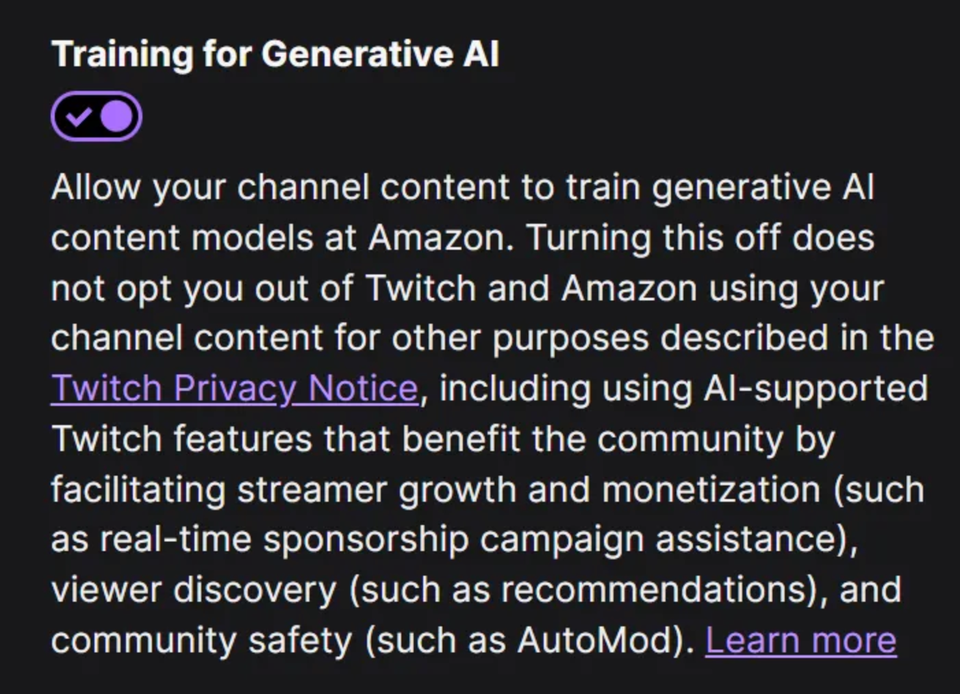
Twitch added a new setting in the streamer dashboard that lets creators stop the use of their “channel content” for training “generative AI content models across Amazon.” Problem number one: the setting is enabled by default for everyone, which means anyone who doesn’t go in and manually disable it stays in the program. Problem number two: it’s unclear whether content was already used before. When a user asked during the official broadcast whether their videos had already fed Amazon’s models, Twitch Chief Product Officer Mike Minton answered with disarming candor: “I don’t actually know the answer to that question because I don’t know what Amazon […] has done in terms of model training and what they’ve used and not used.”
The announcement came during a live stream on the official channel featuring Mary Kish, Twitch’s Head of Community, and Mike Minton, in front of nearly three thousand aggrieved live viewers, as documented by TechCrunch’s coverage of the session. And because the community knows how to read the moment, the most uncomfortable question poured in: why wasn’t this opt-in instead of opt-out? The answer that followed is destined to become a case study in corporate honesty. Minton said, verbatim: “Why is it not opt-in? That’s what everybody’s spamming in chat. I get it. ‘Let me opt in versus making me opt out.’ Well, there’s an honest answer… If this was opt-in, nobody would opt in. That’s honestly the answer.” One sentence laid bare the entire commercial logic: default enrollment delivers what voluntariness never will.
Why streamers’ broadcasts are a strategic goldmine for Amazon
Behind the anger sits simple economics. Live content on Twitch offers any model-training program something rare: thousands of hours of synchronized audio and video, tied to live emotion, real-time interaction, body language, and unscripted natural speech — “human” data in the truest sense, hard to replicate from curated text. A streamer records their voice and face for hours every week, which is precisely the asset class next-generation video, audio, and virtual models need. From Amazon’s perspective, the platform it has owned since 2014 is a ready-made data field. From the streamer’s perspective, their voice, face, and style — their personal capital — just became raw material extracted under consent that was never explicitly requested.
For context, Mary Kish noted in the same broadcast that Twitch is not unique: Meta, for example, uses public content from its platforms to train its own models. That’s true, and we’ve covered this wave before — including Instagram leadership’s stance on AI content, analyzed in our piece on Mosseri’s comments on AI feeds, and our analysis of Snapchat’s Spotlight policy for fully-AI videos. The difference today is that the industry has moved from “how do we label AI content?” to “how do we use humans’ content to manufacture it?” — a full-scale rights turning point for creators.
How to stop the training on your streams — practical steps
The good news: opting out is possible and the steps are short. First, open the Twitch streamer dashboard from a desktop browser (new settings don’t always appear immediately in the mobile app for every account, so the browser is safer). Second, open the settings section and look for the new toggle about using your channel content for training Amazon’s generative AI models — it appeared among channel/privacy settings after the August 12 announcement. Third, disable the toggle, make sure the change saves, then reload the page to confirm it didn’t revert. Fourth, if you manage more than one channel or run accounts for others, repeat for each channel — the setting is per-channel, not per-admin-account. Fifth, take a screenshot of the disabled setting; in an environment where policies change weekly, proof beats memory.
Two important caveats. First, disabling training doesn’t switch anything else off: the platform has announced no link between this option and revenue, the Partner Program, or recommendation visibility, and nothing in the announcement suggests any penalty for opting out. Second, opting out protects what’s ahead — as for your content’s past, the question remains open with no clear answer from executives, as Minton’s reply above shows. Anyone who wants full certainty about their archive should simply ask themselves: does this content even live on the platform? Whatever you upload keeps the platform as a stakeholder in its decisions.
What this means for you as a creator — even if you never stream
This story is bigger than Twitch, and it carries three lessons for every working creator. Lesson one: “the default” is king. When a policy is built on manual opt-out, the silent majority — the people who don’t read tech news — stays enrolled without knowing. The new practical rule for every platform you belong to: with every major update, open your settings and scan for what’s new, especially privacy and AI clauses. Lesson two: the value of your exclusive content is rising. In the model-training economy, your content no longer only serves your audience; it’s a data asset corporations compete over. That means your archive and original material have value beyond views — protect it consciously: think hard about what you publish exclusively on platforms you don’t own versus what lives on your site and your mailing list. Lesson three: own a distribution layer of your own. The creator who writes an original article on their own blog, then repurposes it into social posts on a smart schedule through a tool like ARWriter, is building an asset that works for them alone — whatever the platforms decide next week.
Quick comparison: who trains on what?
| Platform | Uses content for AI training? | Default state | Manual opt-out? |
|---|---|---|---|
| Twitch (Amazon) | Yes — generative AI content models across Amazon | Enabled (since Aug 12, 2026) | Yes — streamer dashboard setting |
| Facebook/Instagram (Meta) | Yes — public content for Meta models | Enabled for public content | Limited — available where local law requires |
| Snapchat | Different policy: restricts AI-generated content in Spotlight | — | — |
| YouTube | Labeling requirements for AI-generated content; disclosure to viewers | — | — |
The table shows the general direction: platforms are moving toward using user content for training, with different degrees of transparency and opt-out availability — Twitch is neither the first nor the last.
What exactly falls under "channel content"? Reading the ambiguity
The most practical question worrying streamers still has no clear answer: what is the actual scope of the "channel content" the setting covers? The open possibilities include recorded broadcasts (VODs), short clips, the accompanying text chat, the audio track separated from video, and even live interaction data. Each carries a very different weight: chat is raw behavioral text that says more about the audience than the streamer; the separated audio track is the true gold for speech-generation models; and synchronized video-plus-audio is the most valuable asset of all for generative video models. Whichever combination actually entered training changes the scale of the "footprint" your voice and style could leave in model outputs later.
That ambiguity is not a passing legal footnote — it is part of why the community erupted. When the details live only inside a dashboard setting and a Terms of Service page rather than a dedicated official document, every essential question stays open to interpretation. Minton's retrospective answer ("I don't know") made it worse. An undefined scope combined with an unguaranteed past is the worst possible combination for anyone trying to assess their actual risk — and it is exactly why the manual opt-out, however simple, is a necessity rather than an option.
If you manage multiple channels or run an agency
For anyone managing channels for others or working within a team, opting out is not "one setting" — it's a full audit. The setting is per-channel, not per-admin-account, which means manager permissions don't translate into automatic coverage: list every channel you manage, check each one individually, and screenshot the disabled state with the date visible. Then add the item to your client agreements: who is responsible for monitoring platform setting changes, and what approvals are required when a new default-on policy appears? An agency that can't answer those two questions will one day discover a client's content entered a program nobody consented to — and defending that oversight is far harder than doing it right the first week.
Five questions to ask any platform you publish on
The Twitch story works as a ready-made template for auditing any platform you use. One: which settings are enabled by default on my account right now — and when did I last check? Two: does any content-usage program cover my past archive or only the future? Three: what exactly does "content" mean here — text, audio, video, interaction, behavioral data? Four: does the opt-out connect in any way to revenue, visibility, or partner programs? Five: can I export my full archive and leave the platform without losing it? If you can't answer these for a platform your livelihood depends on, you're paying an unlisted price — and this week proved that price can be your voice and face themselves.
Honest limitations and open questions
Fairness requires naming what we don’t know, too. First, Twitch has not — as of this article’s writing — published a separate official blog post detailing the scope of “channel content”: does it include VODs, clips, chat, and audio separately? The fine print lives in the setting itself and the Terms of Service, and that ambiguity is part of the anger. Second, Minton’s answer about the past (“I don’t know”) means there are effectively no retroactive guarantees. Third, the practical objection window was small: between the broadcast announcement and your decision, days of streams may already have entered the system. Fourth, the discussion continues about how easy the toggle is to find in the interface, with some users complaining about unclear labeling. And finally, a philosophical question remains open: is “manual opt-out” in a quasi-monopolistic platform environment genuine consent at all? The current institutional answer — as Minton himself stated — doesn’t pretend otherwise.
Frequently asked questions
How do I stop Twitch from using my streams to train AI?
Open the streamer dashboard in a desktop browser, go to settings, find the new toggle about using your channel content for training Amazon’s generative AI models (added with the August 12, 2026 announcement), disable it, save, and confirm it stays disabled after a reload.
Is the setting enabled automatically for all streamers?
Yes. The training permission is on by default for streamer channels, which is why coverage described the decision as “default-on training with manual opt-out” — anyone who doesn’t disable it themselves remains enrolled.
Did Amazon already use my streams before this announcement?
There is no clear official answer. When Twitch CPO Mike Minton was asked whether users’ content had already fed Amazon’s models, he said: “I don’t actually know the answer to that question” — so treat your archive as potentially included.
Does opting out affect my revenue or channel visibility?
Twitch has announced no link between the setting and revenue, the Partner Program, or recommendations, and nothing in the announcement suggests any penalty for opting out. The setting governs content use for training only.
What’s the difference between Twitch’s policy and Meta’s?
Both presume permission and require user action, but Meta uses public content from its platforms to train its own models, while Twitch’s setting controls the use of your channel content across Amazon’s generative AI content models — as platform executives explained in the official broadcast.
The bottom line: check your settings today, rethink your assets tomorrow
The Twitch story isn’t the end of the world, but it’s a wake-up call. Platforms will keep converting user content into model fuel as long as the default favors them — the proof came straight from the CPO’s mouth: “If this was opt-in, nobody would opt in.” Your job is to decide consciously: open your settings now and switch off what you don’t want, then take the more important step — rebuild your strategy so your entire livelihood isn’t hostage to a default toggle on a platform you don’t own. Content you write and publish yourself, on your blog and your owned channels, with smart repurposing into social platforms for reach rather than combustion, is the model that makes news like today’s a nuisance rather than a catastrophe. Start with one original post today, one that serves your audience and feeds your own assets.
Primary source: the official Twitch broadcast (August 12, 2026) with statements by Mary Kish and Mike Minton as documented in TechCrunch’s full coverage, with independent confirmations from BBC, The Verge, Engadget, IGN, Decrypt, Quartz, and Currently dated August 12–13, 2026. Twitch had published no separate official blog post about the decision as of this article.