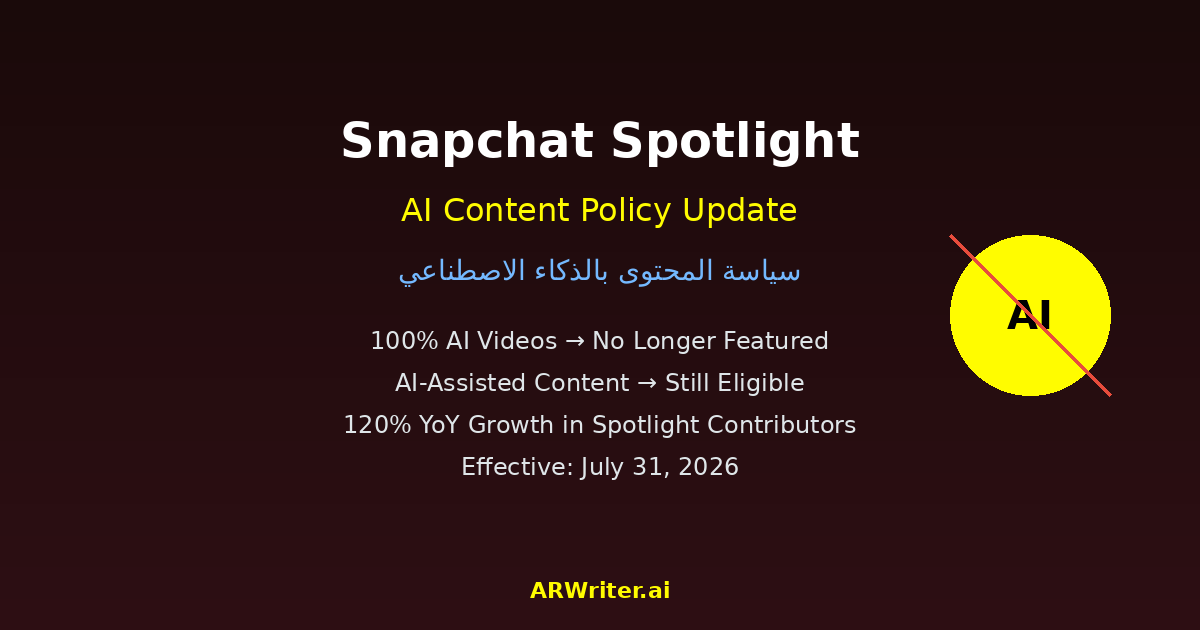
On July 31, 2026, Snap Inc., the company behind Snapchat, announced a fundamental change to the content policy for its Spotlight platform: wholly AI-generated videos will no longer be eligible for recommendation. The announcement, made via the company's official newsroom (newsroom.snap.com), represents one of the most significant policy shifts by a major social media platform regarding AI-generated content.
Snapchat's decision doesn't come in a vacuum. With the rapid advancement of AI video generation tools like OpenAI's Sora, Runway Gen-3, and Pika Labs, producing fully realistic AI-generated video has become easier than ever. But this progress has raised legitimate concerns about content quality, creative authenticity, and platforms' ability to maintain user trust. In this article, we analyze the decision from every angle that matters to content creators worldwide.
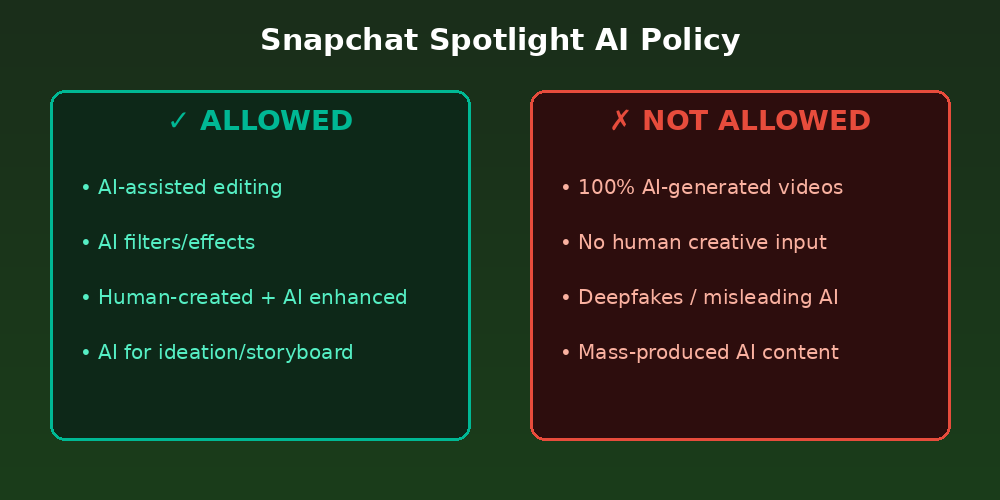
What Exactly Does the Decision Say?
The official announcement is clear and direct. It states that "wholly AI-generated videos will no longer be eligible for recommendation on Spotlight." The emphasis here is on the word "wholly" — this is a crucial distinction we'll explain in detail. The company also confirmed that this decision "is not about rejecting AI", but about protecting content quality and supporting genuine content creators.
The decision applies to Spotlight's recommendation system — the algorithm that determines which videos reach users through the Spotlight feed. Videos that aren't eligible for recommendation aren't necessarily deleted, but they lose their opportunity for organic reach, effectively making them invisible to a wide audience.
The Crucial Distinction: "Wholly AI" vs. "AI-Assisted"
Here lies the core of the new policy. Snapchat distinguishes between two types of content:
Wholly AI-generated content: This refers to video where there was no meaningful human creative input. A user wrote a prompt in an AI video generation tool, received a finished video, and posted it directly. No filming, no directing, no creative editing. This is the type of content targeted by the decision.
AI-assisted content: This refers to video created by a human — filmed, directed, or edited — who used AI as a supporting tool in part of the process. This includes AI filters, AI-powered editing tools, or visual effects. This type of content remains fully eligible for Spotlight recommendation without restrictions.
This distinction is smart and practical. It doesn't penalize creators who leverage AI to speed up their work or improve quality — it targets those using the tool as a complete replacement for human creativity.
Why Did Snapchat Make This Decision Now?
Several converging factors explain the timing of this decision:
1. Flood of generated content: With the proliferation of AI video generation tools, the volume of wholly generated videos on platforms has grown explosively. This puts pressure on recommendation algorithms and drowns out genuine human content. Snapchat competes for user attention time, and flooding the platform with low-quality generated content harms the user experience in the long run.
2. Preserving platform identity: Snapchat was built from the ground up on authentic, user-created content. Unlike other platforms that might be more tolerant of generated content, Snapchat considers content authenticity part of its commercial identity.
3. User and advertiser pressure: Market research shows growing user concern about AI-generated content, especially when it's not clearly labeled. Advertisers also prefer to place their ads alongside authentic human content. These are commercial considerations that cannot be ignored.
4. Global regulatory evolution: The European Union and other regulatory bodies worldwide are moving toward mandating transparency rules for AI-generated content. Getting ahead of regulation protects the company from future legal problems.
The Numbers: Scale of Change in Spotlight
Snapchat announced that its Spotlight platform saw 120% year-over-year growth in active content creators. This is a massive number indicating that the platform is continuously attracting new creators. The new decision can be read as an attempt to protect these creators — who invest time and effort in producing authentic content — from unfair competition with machine-generated content.
For content creators worldwide, this is positive news. It means Snapchat is committed to supporting authentic human content, and that your investment in producing real content will be rewarded long-term. You don't need to worry about your carefully crafted video being drowned in a sea of machine-generated clips.
What Does This Mean for You as a Content Creator?
Let's break down the practical impact on your workflow:
If you create videos traditionally (filming, directing, editing) and use AI only as a supporting tool — effects, filters, quality enhancement — your content is completely unaffected. Your content remains fully eligible for recommendation, and you might actually benefit from reduced competition from machine-generated content.
If you rely on AI video generation tools to create complete content (like Sora or Runway videos), you need to rethink your strategy on Spotlight. You can either: move to other platforms more tolerant of generated content, or modify your workflow to add clear human value (voiceover, storytelling, personality).
If you use AI to generate elements (backgrounds, transitions, effects) that you then integrate into your own production, you're in the safe zone. Mixed content that shows clear human creativity is still welcome.
If you're a digital marketer or work in social media advertising, you should review your strategy. Marketing content using wholly generated videos may lose its organic reach on Spotlight. This doesn't directly affect paid advertising, but it does affect organic marketing content.
How Will Snapchat Detect Generated Content?
A fundamental question: how will Snapchat enforce this policy practically? The company explicitly acknowledged that its detection system is "imperfect." This is a frank and important admission. Detecting AI-generated videos is a difficult technical problem, and generation technology evolves faster than detection capabilities.
The company likely uses a combination of: automated detection technologies (watermarking, pattern analysis), community reporting (user flags), and human review. But there are inevitable gaps: some generated videos may escape detection, and some human videos may be incorrectly classified as generated.
This reality has practical implications for content creators. If you create authentic human content that gets incorrectly flagged as AI-generated, you'll need a mechanism to appeal the classification. Make sure to keep your original project files (raw footage, editing files) as evidence that your content is human-made.
Monetization Impact on Spotlight
Snapchat runs a monetization program that rewards content creators on Spotlight based on their content's performance. With the new policy, the fundamental question becomes: how does this affect your earnings? The answer depends on the type of content you produce.
If you've been relying on wholly generated videos to earn money from Spotlight, the decision is a direct hit. Your content won't reach audiences, and therefore won't generate the views needed for earnings. This income source will practically stop unless you change your approach.
If you produce authentic content, the decision works in your favor. By removing competition from machine-generated content, your content's chances of reaching audiences increase. With 120% growth in content creators, competition also increases, but it's fair competition among genuine creators rather than an unequal battle against the machine.
Comparison with Other Platforms' Approaches
Snapchat isn't the only platform moving in this direction. Here's how major platforms compare:
| Platform | Stance on Wholly AI Content | Required Transparency |
|---|---|---|
| Snapchat Spotlight | Not eligible for recommendation | Automatic classification |
| TikTok | Allowed with AI label | Mandatory |
| Instagram Reels | Allowed with "Made with AI" tag | Mandatory for obvious AI |
| YouTube Shorts | Allowed with disclosure | Required in description |
| X (formerly Twitter) | Allowed | Voluntary |
As we can see, each platform takes a different approach. Snapchat is the most aggressive — it doesn't just demand transparency, it actively excludes wholly generated content from recommendation. This could become a model other platforms follow in the future.
The Competitive Context: TikTok and Instagram
One cannot look at Snapchat's decision in isolation from the fierce competition in the short-form video space. TikTok, which remains the largest platform in this space, chose a different approach: AI-generated content is allowed but must be clearly labeled. Instagram Reels follows a similar approach with the "Made with AI" tag.
The difference in Snapchat's approach is that it doesn't just request transparency — it penalizes wholly generated content by removing it from the recommendation system. This is significantly stricter than competitors. This could be a selling point for users seeking more "authentic" content, or it might push some creators toward more tolerant platforms.
How to Adapt to the New Policy
Here are practical steps for adaptation:
1. Audit your current content: Review your previous videos on Spotlight. Are any of them wholly AI-generated? If so, consider recreating them with human or mixed content.
2. Add your human fingerprint: Even if you use AI in production, ensure there's a clear human element: your voiceover, appearing on camera, or adding personal perspective. This transforms content from "wholly generated" to "AI-assisted."
3. Document your creation process: Keep project files, screenshots from the editing process, and anything proving your content includes genuine human work. This is important in case your content is incorrectly flagged.
4. Invest in human creativity: Expertise, personality, real stories — these are elements that AI cannot replicate. Focus on them and make them your competitive advantage.
5. Diversify across platforms: Don't rely on one platform. While Snapchat bans wholly generated content, you might find other platforms more tolerant. But don't use this as an excuse to abuse AI tools — make your content authentic everywhere.
6. Leverage Snapchat's unique features: Snapchat has features not found on other platforms, like Lenses, AR, and Snap Maps. These tools enhance human content and add an interactive layer that machine-generated content cannot provide. Invest in learning these tools and integrating them into your content.
7. Build relationships with your audience: Strong human content isn't just about visual quality — it's about audience relationship. Responding to comments, engaging with followers, creating content that responds to audience interests — these human elements are what distinguishes your content from any machine-generated video, no matter how polished.
For brands and businesses using AI content tools, this is an important moment to reassess how AI fits into your content strategy. Using AI for planning, writing, and editing is fundamentally different from using it to generate the final video product.
Frequently Asked Questions
Will my AI-generated videos be deleted?
Not necessarily. The decision targets the recommendation system — wholly generated videos won't be recommended to users, but they may not be deleted. However, they will lose their opportunity for organic audience reach.
Are AI filters and effects banned?
No, AI filters, effects, and beauty enhancements are all classified as "AI-assisted content" and remain fully allowed. The ban specifically targets videos generated entirely from scratch by AI tools.
How do I prove my content is human-made?
Keep your original project files (raw footage, editing files, screenshots). If your content is incorrectly flagged, you can submit an appeal with this evidence. Snapchat acknowledged that its detection system is "imperfect," so appeals are possible.
Is this decision permanent or temporary?
Snapchat didn't specify a duration for the decision. It appears to be a permanent policy that evolves with AI technology and detection systems. Details may change, but the overall direction toward protecting human content is clear.
Does this affect paid advertising?
The decision targets organic reach on Spotlight, not paid advertising directly. However, organic marketing content using wholly generated videos will be affected.
Conclusion
Snapchat's decision to ban wholly AI-generated videos from Spotlight's recommendation system is an important signal for all content creators: major platforms have started taking a clear stance on machine-generated content. Snapchat chose to be at the forefront of this trend, while emphasizing that AI as a supporting tool remains welcome.
For content creators worldwide, the message is clear: invest in your human creativity, use AI as a supporting tool rather than a replacement, and diversify across platforms. The future doesn't belong to those who produce the largest volume of machine-generated content, but to those who add genuine human value that machines cannot replicate. Platforms that protect authentic content will earn audience trust in the long run. The question isn't whether AI will be part of content creation — it absolutely will be — but whether human creativity remains at the center of the creative process. Snapchat has answered that question with a clear yes, and the rest of the industry will eventually have to answer it too. For content creators who have built their audience through genuine creativity and authentic storytelling, this policy validates the effort they've put into their craft. For those who have been cutting corners with fully automated content generation, it's a wake-up call to reconsider their approach and invest in the human elements that make content truly compelling and irreplaceably personal.