On August 7, 2026, the design world received a jolt of unwelcome news. Canva, the Australian-born design platform that has grown into a global powerhouse with over 220 million monthly active users, slashed its 2026 revenue forecast by approximately a third. The announcement, first reported by The Verge and Startup Daily, sent ripples through the creative community, small business sector, and the broader tech industry. For the millions of content creators, social media managers, and small business owners who rely on Canva daily, the news raises pressing questions about the platform's future, the sustainability of its AI features, and whether subscription prices will climb even higher.
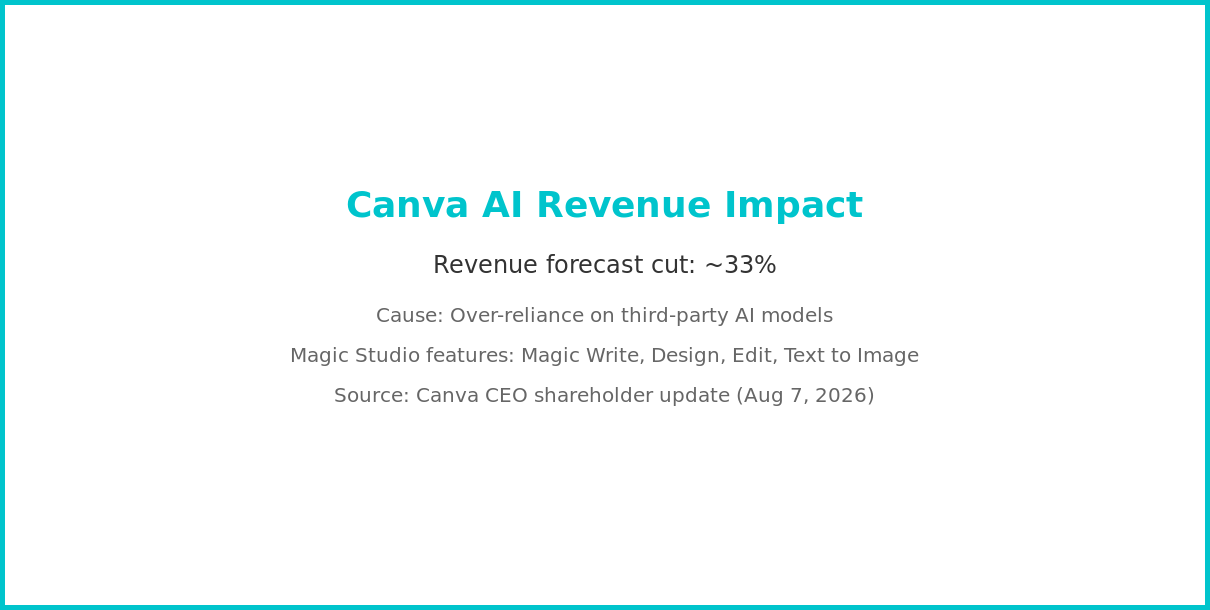
The core of the problem is both technical and financial. Canva bet heavily on artificial intelligence to differentiate its platform, rolling out an ambitious suite of tools under the Magic Studio banner. But the company leaned too much on expensive third-party AI models rather than building its own infrastructure quickly enough. The result: unsustainable AI costs that have forced a painful financial recalibration.
What Happened: The Revenue Forecast Cut
Canva's downward revision of its 2026 revenue forecast by roughly a third is not a minor accounting adjustment — it is a significant corporate event that signals deeper structural challenges. The cut was revealed in a shareholder update distributed in early August 2026, with The Verge and Startup Daily breaking the story on August 7.
CEO Melanie Perkins addressed the situation with unusual directness in her communication to shareholders. She acknowledged that the company had misjudged both the readiness of its own AI technology and the financial mechanics of delivering AI-powered features at massive scale.
"Several of our first-party models were not yet ready for release, and our pricing, consumption model and usage controls had not caught up with the outsized demand we were seeing," Perkins wrote. This admission is striking for its candor. Rather than deflecting blame or pointing solely at macroeconomic headwinds, Canva's leadership owned the specific operational missteps that led to the forecast reduction.
The timing is particularly painful for Canva. The company has been positioning itself as a serious competitor to Adobe, having acquired Affinity in 2024 and continued aggressive expansion of its feature set. A revenue forecast cut of this magnitude — roughly 33% — will inevitably affect valuation discussions, especially given Canva's long-rumored IPO ambitions. Investors who priced in aggressive growth powered by AI differentiation now face a significantly reduced outlook.
Why Canva Stumbled: The Third-Party AI Trap
To understand what went wrong, it helps to look at how Canva built its AI features. When the generative AI boom accelerated in 2023 and 2024, Canva moved quickly to integrate AI capabilities into its platform. The company launched Magic Studio, a collection of AI-powered tools designed to help users generate text, create designs from scratch, edit images intelligently, and produce artwork from text descriptions.
The problem is that Canva powered many of these features using frontier AI models from third-party providers — primarily OpenAI and Google. Every time a user clicked "Magic Write" to generate a paragraph of marketing copy, or used "Text to Image" to create a custom illustration, Canva was effectively paying for an API call to one of these external providers. At Canva's enormous scale, with hundreds of millions of users, those per-request costs added up to a staggering sum.
This is a classic pitfall in the AI business. Third-party frontier models like GPT-4o or Google's Gemini deliver impressive results, but their API pricing is designed to be profitable for the model provider — not necessarily sustainable for a downstream consumer like Canva. When usage scales faster than revenue from that usage, the unit economics break down. You end up in a situation where each additional AI interaction costs more than it earns, and growing your user base actually deepens your losses.
Canva's own first-party AI models — the ones that would have allowed the company to control costs and margins — were not ready for production deployment. Perkins was transparent about this: the models were still in development when the company needed them most. This created a dependency gap. Canva could either limit AI features and risk losing competitive ground, or continue offering them and absorb the losses. They chose the latter, and the financial pressure eventually became unsustainable.
The pricing and consumption model also lagged behind reality. Canva did not have granular enough controls to manage how much AI compute individual users consumed. A free-tier user generating dozens of AI images was costing the company real money with no corresponding revenue. The "usage controls" Perkins referenced — mechanisms like rate limiting, tiered access, and per-feature pricing — simply had not been built out to match the demand curve.
What This Means for You as a User
If you are one of Canva's 220 million-plus monthly active users, you are probably wondering how this news affects your workflow, your wallet, and your tooling decisions. Here is a practical breakdown.
Price increases are likely. Canva already raised prices significantly in late 2024 — some plans saw increases of up to 300%. Those hikes were partly justified at the time as funding for AI feature development. With the revenue forecast now slashed and AI costs remaining high, there is a credible risk of further pricing adjustments. If you are on a Canva Pro or Canva Teams plan, budget for potential increases at your next renewal cycle.
Feature reliability could shift. As Canva transitions from third-party models to its own first-party AI infrastructure, some features may behave differently. The output quality of tools like Magic Write or Text to Image could temporarily fluctuate as the underlying models change. This is not necessarily a degradation — Canva's own models could eventually be better-tuned for design-specific tasks — but during the transition, users may notice inconsistencies.
Usage caps may tighten. To control costs, Canva is likely to introduce or enforce stricter limits on AI feature usage, particularly for lower-tier subscribers. If you have been using AI generation tools extensively, expect to encounter rate limits or credit-based systems that did not exist before.
It is worth evaluating alternatives. This is not alarmist advice — it is simply prudent. When any single tool shows financial strain, diversifying your toolkit protects your workflow continuity. For AI-powered writing specifically, dedicated platforms like ARWriter.ai offer specialized capabilities that general-purpose design tools cannot match. Having a backup option means you are never locked into a single provider's pricing decisions.
Which Canva AI Features Are Affected
Canva's Magic Studio is the umbrella brand for its AI-powered tools, and it is the epicenter of the current financial challenge. Here is a breakdown of the key features and how they fit into the cost problem.
Magic Write: This is Canva's AI text generation tool, embedded across the platform to help users write captions, headlines, body copy, and more. It functions similarly to a built-in ChatGPT, which makes sense given that it has historically relied on external language models. Every text generation request involves an API call to a frontier model, and those costs scale linearly with usage. This is likely one of the most expensive features for Canva to operate.
Magic Design: This tool generates complete design templates based on a user's text prompt or content description. It combines layout intelligence with AI generation to produce starting points for presentations, social media posts, and other visual content. The computational cost of generating multi-element designs is substantial, especially when the underlying model is a third-party API.
Magic Edit: An AI-powered image editing tool that allows users to modify specific elements of a photo — removing objects, changing backgrounds, or adding new elements — using natural language instructions. Like Text to Image, this feature depends on expensive image generation and editing models.
Text to Image: Canva's text-to-image generation tool creates custom illustrations and artwork from written descriptions. This is perhaps the most computationally expensive feature in Magic Studio, as image generation requires significantly more processing power than text generation. At Canva's scale, millions of image generation requests translate into massive API costs.
All of these features are valuable to users — that is precisely why demand has been so high. But the gap between what users expect (unlimited, high-quality AI generation) and what Canva can afford to deliver (metered, cost-controlled access) is the fundamental tension that led to the current situation.
Quick Comparison: Canva vs. Alternatives
With Canva's AI strategy under pressure, it is worth understanding how the platform compares to alternatives in the market.
Canva vs. Adobe Express: Adobe Express is Adobe's answer to Canva, offering template-based design with integrated AI powered by Adobe's own Firefly models. Unlike Canva, Adobe owns its AI infrastructure — Firefly was trained in-house and is designed specifically for commercial creative use. This means Adobe does not face the same third-party API cost problem. However, Adobe Express has a smaller template library and a smaller community of casual users compared to Canva's 220 million. Adobe's pricing is also generally higher for comparable feature sets.
Canva vs. Dedicated AI Writing Tools (like ARWriter): Canva's Magic Write is a generalist text tool bolted onto a design platform. For users who need serious AI-powered writing — whether for blog posts, academic papers, marketing copy, or SEO content — a dedicated writing platform will almost always deliver better results. ARWriter.ai's suite of writing tools is purpose-built for text generation with features like source citation, research mode, multi-language support, and content optimization that a design-first platform simply cannot match. The lesson here is that specialized tools outperform generalist platforms for specialized tasks.
Canva vs. Midjourney / DALL-E for image generation: For pure image generation quality, dedicated tools like Midjourney still lead the pack. Canva's Text to Image is convenient because it is integrated into the design workflow, but users who need the best possible AI-generated artwork may find standalone tools more capable.
Honest Limitations and Caveats
It is important to be clear-eyed about what this news does and does not mean. A revenue forecast cut of a third is serious, but it is not a death sentence. Here is a balanced assessment.
This does not mean Canva is dying. Canva has over 220 million monthly active users, a massive template library, deep integrations with other platforms, and a brand that is nearly synonymous with easy design for non-designers. The core value proposition of Canva — making design accessible to everyone — remains intact regardless of AI cost challenges. The platform is not going away.
The forecast cut is a warning sign, not a collapse. Revenue forecasts are predictions, not actuals. Canva is still generating substantial revenue — the forecast reduction means the company expects less revenue than previously projected, not that revenue is declining in absolute terms. This is a growth story hitting a speed bump, not a company in freefall.
Canva can fix this. The path forward is clear: finish developing first-party AI models, implement proper consumption-based pricing, and introduce usage controls that align costs with revenue. None of these are easy, but they are all well within the capability of a well-funded company with deep engineering talent. The timeline for this fix is the open question — it could take quarters, not weeks.
The broader industry context matters. Many companies that integrated AI features using third-party models are facing similar cost pressures. Canva is one of the most visible examples, but it is far from alone. This is an industry-wide reckoning with the economics of AI delivery, and the companies that solve it first will have a significant competitive advantage.
We do not have full financial details. Canva is a private company, and the shareholder update provides limited visibility into the exact numbers. The "approximately a third" figure is significant, but without knowing the original forecast and the revised one, it is hard to assess the precise financial impact. Treat early reports as directional rather than definitive.
Frequently Asked Questions
Will Canva shut down because of this? No. A revenue forecast reduction is a financial recalibration, not a sign of impending shutdown. Canva has a massive user base, strong brand equity, and substantial funding. The company will need to adjust its AI strategy and cost structure, but there is no indication that Canva's survival is at stake.
Should I cancel my Canva subscription? That depends on your usage. If Canva is central to your design workflow and you are satisfied with the features, there is no urgent reason to cancel. However, if you have been considering alternatives or if you rely heavily on AI features that might see usage caps, this is a good time to explore complementary tools. Diversification is always smart, panic is not.
Will Canva's AI features get worse? Not necessarily. During the transition from third-party to first-party models, there may be temporary quality fluctuations. However, Canva's own models could ultimately be better optimized for design-specific tasks than generic frontier models. The short-term picture is uncertain; the long-term picture could actually be better for users.
Are other platforms facing the same AI cost problems? Yes. Any platform that relies heavily on third-party frontier models for AI features is dealing with similar cost pressure. This is one of the defining business challenges of the current AI era — how to deliver AI features that users love at a cost that makes business sense.
What is the best alternative for AI writing if Canva's Magic Write gets capped? For dedicated AI writing, consider a purpose-built platform. ARWriter.ai offers specialized writing tools designed for content creators, marketers, and researchers, with features that go well beyond what any design platform can provide. If writing is a core part of your work, a specialized tool will serve you better than a generalist one.
Conclusion: Navigating the Changing AI Design Landscape
Canva's revenue forecast cut is a significant moment in the evolution of AI-powered creative tools. It reveals a fundamental truth that the industry is still grappling with: building AI features on someone else's infrastructure is a risky long-term strategy. The companies that invest in their own AI capabilities — or partner with providers under sustainable terms — will be the ones that can deliver reliable, affordable AI features over the long haul.
For users, the practical takeaway is simple. Do not panic, but do pay attention. Canva remains a powerful and valuable tool, and its core design functionality is unaffected by the AI cost challenges. At the same time, the era of unlimited, free-feeling AI generation is ending across the industry. Expect more metering, more tiered access, and more pricing adjustments — not just from Canva, but from every platform that offers AI-powered features.
The smartest move you can make right now is to audit your creative toolkit. Identify which tools you depend on most, evaluate whether alternatives exist, and make sure no single platform has a stranglehold on your workflow. If AI-powered writing is central to what you do, explore ARWriter.ai as a dedicated solution built specifically for content creators. If design is your primary need, Canva remains an excellent choice — just be prepared for the pricing and feature landscape to evolve as the company works through its AI cost challenges.
The AI revolution in creative tools is far from over. It is simply entering a more mature phase where the economics have to work — not just for users, but for the companies building the tools. Canva's stumble is a speed bump on that journey, not the end of the road.