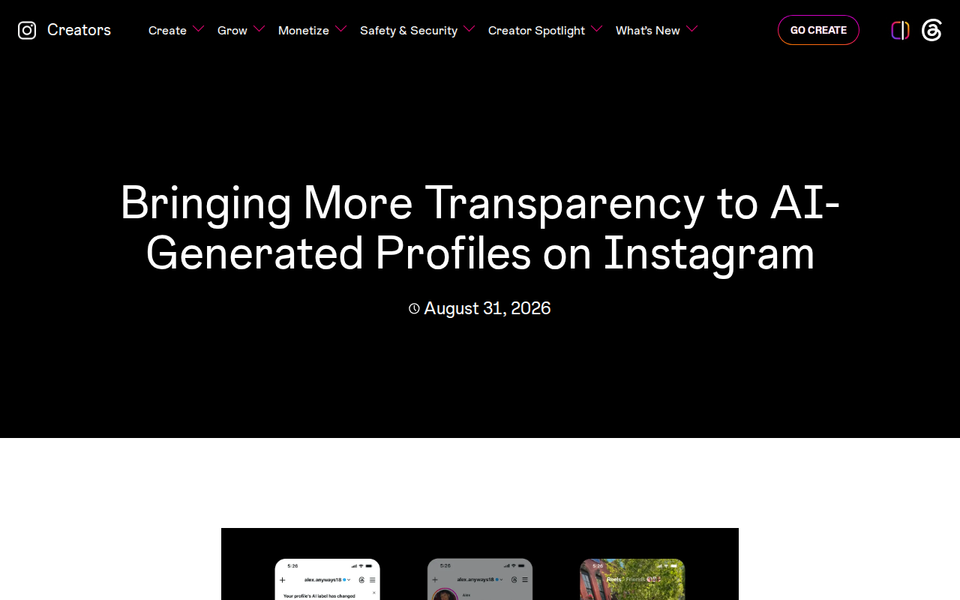
Instagram drew a line in the sand on August 31, 2026, and if you run any kind of account there, the line runs straight through your growth strategy. The platform renamed its "AI creator label" to an "AI-generated profile" label — and paired the rebrand with an operational decision stated in plain words: profiles that feature an AI-generated person and don't apply the label will have their reach limited. The question "should I label or not?" stopped being cosmetic. It now decides how much of your audience sees your posts at all.
This guide walks through the change exactly as Instagram and Meta announced it: who must apply the label, who is explicitly exempt, how detection and notification work, what recovery looks like if you get flagged, and how to protect your account's reach through the transition. Everything here is grounded in the official announcements and help center pages — not in the wave of speculation the change triggered.
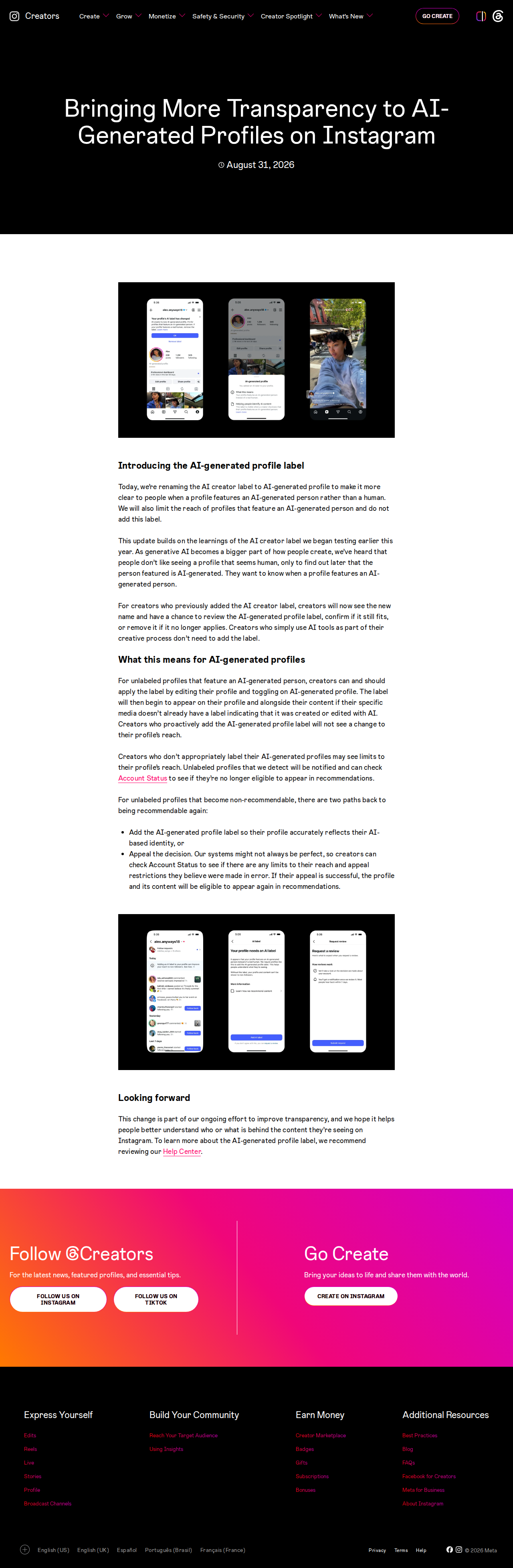
What exactly changed? Three things from the official post
First: the name and the scope. The label formerly known as the "AI creator label" is now the "AI-generated profile" label. The rename isn't administrative fluff: the old label described an activity, the new one describes an identity. It attaches at the profile level and also appears alongside content where the media-level AI label hasn't already been applied.
Second: the crucial distinction between an AI persona and an AI-assisted creator. This is the most important sentence in the announcement and the most misunderstood: creators who simply use AI tools as part of their creative process do not need to add the label. The label targets profiles presenting an entirely generated persona to the audience as if it were a human being. If you are the face of your content and AI works behind the scenes — editing, ideation, thumbnails, scripts — you are outside the label's scope entirely.
Third: the penalty for non-disclosure. The official text is unambiguous: profiles featuring an AI-generated person without the label will have their reach limited. Conversely, per the same announcement, creators who proactively apply the label see no change to their reach. That asymmetry — transparency is free, concealment is taxed — is the entire policy in one line.
Why is Meta doing this now?
Over the past two years, accounts presenting fully generated "people" multiplied across the platform: virtual influencers promoting products, lifestyle and travel accounts whose photos belong to no existing human, and outright scam operations using generated faces to manufacture trust. The platform faces a genuine dilemma: this content is part of its creative present, but unlabeled it functions as quiet deception — audiences engaging with what they believe is a person.
Instagram's announced solution pushes the choice onto creators while pricing the two options differently: label and operate as before, or skip the label and lose part of your distribution. The label builds on the AI creator label the platform tested earlier this year; the new version widens it and attaches real consequences. For now, per multiple press reports, the measure is Instagram-only and does not extend to Facebook or Threads — a point that matters if you operate a presence across Meta's family of apps.
How to apply the label: the setup steps
- Open your profile and enter edit mode (Edit profile).
- Find the AI label toggle in the settings — the new label is switched on here at the account level.
- Once enabled, the label appears on your profile, and alongside your content where the per-post AI media label hasn't already been applied.
One practical note: the profile label doesn't replace content-level labeling. Keep applying the AI media label to individual generated posts as before — the new label is an identity layer above the content layer, not a substitute for it.
What happens if you skip the label and the system catches you?
The announced system is detection-and-notification before punishment: profiles presenting a generated persona without the label that the system detects get notified, pointed to an Account Status review showing the reason and the resolution path. From there, two official routes exist:
- Add the label: resolves the issue at its root — enable the label and your account returns to standard reach rules.
- Appeal: if you believe the detection was wrong — for instance, you're a real human using tools, not a generated persona — the platform provides a formal appeal route through the help center with human review of the case.
Advice for staying ahead of this entirely: audit your profile now, before the system audits you. If your content leans on a fully generated host or persona, proactive labeling is far cheaper than a week of throttled reach you discover through collapsing view counts. And if you produce Instagram content with production tools — like the first-draft and Reels editing features we covered in our piece on Instagram's creator tooling this year — the official distinction makes clear that your usage requires no label as long as a real human is the face of the equation.
What this means for growth: a practical read
Translating the policy into distribution mechanics: "limited reach" means the platform shrinks your appearance in recommendations — Explore and suggested Reels — which is the primary discovery engine for new audiences. An unlabeled generated-persona account loses its most important growth fuel, while its existing-follower reach typically degrades more slowly in systems of this kind. The practical outcome: an unlabeled virtual-persona account doesn't die suddenly; it suffocates gradually at the source of new growth.
For the inverse worry — does the label itself hurt? — the announcement closes that door directly: proactive labeling brings no reach change. And the early pattern across platforms suggests audiences engage better with clearly labeled content they chose than with suspicious unlabeled content whose comments fill with doubt. Honesty, it turns out, is also a content strategy.
Strategically, the decision belongs to a broader reshuffle in Meta's creator economy — from the unified Meta One subscription we covered earlier to the podcast toolkit rolling out on Threads. The connecting thread is visible: Meta is building an economy that rewards transparency and professionalism, and creators who play by its stated rules find themselves on the supported side of it.
Quick reference: does the label apply to you?
| Your account type | Label needed? | Expected reach impact |
|---|---|---|
| You're a real human on camera, using AI tools for editing, ideas, thumbnails | No — explicit in the announcement | None; tool usage is outside the label's scope |
| A fully generated virtual persona presented as a human host | Yes | Unlabeled: reach limits with notification and review; labeled: no change |
| A brand account with no human face (products, graphics, logos) | No — the label concerns generated "person" identities | None |
| A hybrid: sometimes you, sometimes a generated character | Gray zone — labeling is advisable whenever the persona presents as human | Check Account Status periodically; enable the label when in doubt |
| Wrongly detected as generated while you're human | No — use the appeal route | Temporary until review completes; don't accept the restriction as final |
A ten-minute self-audit for your account
Before any notification reaches you, run this check on your account or your brand's today:
- Open your last ten posts and tag the face in each: you? A generated character? No face at all? The answer maps your exposure to the label.
- View your profile with a stranger's eyes: could a first-time visitor conclude the "presenter" is human when it's generated? If yes, you're inside the label's territory in practice.
- List the tools you use: editing, captions, ideas, scripts = assistive tools that obligate nothing. Generating a full virtual presenter who speaks as a confident human = label territory.
- Open Account Status right now: confirm there are no pending notices, and learn the page's layout before you need it under pressure.
- Document your decision: one line in your planning file — is your account subject to the label or not, and why. A documented decision spares you re-litigating it with every future policy tweak.
If the notice arrives: a step-by-step response plan
Assume the worst — a notification lands saying your account is among detected profiles. The ordered response:
- Don't delete anything or scramble to change your name and photo. A panicked reaction muddies the review record and lifts nothing. Read the notice completely and understand what was actually flagged.
- Open Account Status and identify the restriction's reason. The page shows current standing and available remedies per issue — it is your only official reference. Skip the "quick fix" videos circulating on the platform itself.
- Choose between the two routes on your account's logic: if your account genuinely presents a generated persona, labeling is the honest, permanent fix — enable it in profile settings and track the restriction lifting. If you're a human wrongly caught, file the appeal immediately through the help center, attaching evidence the face and voice are yours — behind-the-scenes footage or any prior material featuring you in the same persona.
- Document every step: screenshots of the notice, the status page, and each appeal message. If review drags on or an appeal is wrongly rejected, this file anchors your follow-ups with support.
- Watch reach after resolution: track views and recommendations for a week after the restriction clears to confirm recovery; any residual anomaly goes back through the same status page.
The useful mental model: the system is built to resolve cases, not to fight them. A notification is not a final verdict but an invitation to bring your account in line with a published rule — most accounts that respond through the two official routes return to their normal standing.
The audience side of the equation
The dimension creators tend to miss is viewer experience. Over the past two years audiences have been flooded with "virtual celebrity" accounts and products promoted by faces that don't exist, and trust has eroded to the point where the standard comment under any successful account asks, "is this a real person or AI?" A clear label restores the audience's ability to choose: those who want to follow a virtual persona knowingly can, those who don't can scroll past, and attention gets allocated honestly instead of by illusion.
For the human creator, this is a better environment than before: the competitor who exploited ambiguity for inflated engagement now faces two options — transparency or fading distribution. And the value of your authentic presence rises automatically as distinguishing real from generated gets easier. In one line: the change amplifies the advantage of your real face if you show it, and prices the ambiguity if you were selling an illusion.
A label-proof strategy: human front, AI depth
The decision accelerates a shift already underway: value is migrating from the impressive face to the craft behind it. The model most resistant to future policy turbulence is a real human in front — your voice, your face, or both — with AI tools working in the background where they deliver the most: generating ideas, drafting scripts, editing Reels, producing voiceovers in multiple languages, analyzing what performed — the production layer a bilingual platform like ArWriter exists to run. This model sits outside every label regime and benefits from every new tool launch without rebuilding its identity at each policy update.
The strategic rule to close on: don't build your account's core asset on something a platform can confiscate with one decision — the algorithm, distribution, or even a persona's identity. Build it on what can't be confiscated: your content, your archive, and your direct relationship with your audience. Treat everything else as swappable tooling.
Honest limits of the policy and open questions
To be fair about what nobody knows yet: the announcement doesn't explain the detection mechanics — how does the platform distinguish a fully generated persona from heavy filters and retouching on a real human? That question stays open until appeal cases accumulate and the boundaries become visible. The announcement also specifies no numeric severity for the reach reduction and no timeline for appeal reviews; figures circulating on this point are guesses, not statements.
Rollout coverage is another unknown: systems like this typically phase in across regions and accounts, so the change not touching your account today says nothing about tomorrow. The safe rule is to comply with the published rule from today, not to wait for it to reach you. And anyone building a full "virtual personality" as the face of a brand should re-run the math: is the account's value in the persona, or in the content behind it? Many accounts will rebalance toward a real human presenter wielding the tools — a shift that makes content skills themselves — the idea, the script, the voice — matter more than the face delivering them.
Frequently asked questions
Does everyone using AI in their content need the label?
No. The official text is explicit: creators who simply use AI tools as part of their creative process don't need the label. It applies to profiles presenting an AI-generated person as if human.
What's the penalty for not labeling a generated-persona account?
Limited reach. The platform states it will limit the reach of profiles featuring an AI-generated person without the label. The account is notified first, with the case visible in Account Status and two resolution paths: add the label or appeal.
Does proactively adding the label hurt my reach?
No. The platform officially confirms no reach change for creators who add the label proactively. The penalty applies only to non-disclosure.
Where does the label appear once enabled?
On the profile itself, and alongside content that doesn't already carry the AI media label. It's an account-level identity layer on top of individual post labels.
Does this extend to Facebook and Threads?
The Instagram announcement doesn't extend it, and press coverage reports the measure is Instagram-only for now. Watch Meta's official channels for any expansion.
Sources
- Instagram's official creator blog: the AI-generated profile label — primary source for the rule, exemptions, and reach policy
- Instagram Help Center page on the label — setup steps and where the label appears
- Instagram Help Center appeal route — the official path for reviewing detected cases