On the evening of October 28, 2026, Google used its official blog to announce Gemini 4 Carbon, calling it "our next frontier model" and its strongest ever built. Before the benchmarks and the pricing table, one fact matters more than anything else: you cannot use this model yet. Not in the Gemini app, not through the open API. Google is deliberately staging this rollout, and this piece breaks down exactly what was announced, what it will cost when it arrives, and why the announcement still matters if you write, design, or publish for a living.
What Google actually announced
In a post authored by chief research officer Koray Kavukcuoglu, Google positioned Carbon as its most capable model, with an unprecedented focus on cybersecurity and long-horizon tasks — engineering problems the model can chase for days without losing the thread. The new model builds directly on Gemini 4 Argon, launched just two weeks earlier, which says something about the pace Google is now shipping frontier models at.
Two quieter details in the announcement deserve attention. First, Google says it is participating in the U.S. government's voluntary pre-release model testing process. Second, access is starting with a subset of cyber defenders this week, expanding gradually to trusted partners through the Fairwind Program, before reaching "developers, businesses, and consumers" — in Google's literal wording — "as soon as possible." No date was given.
The numbers Google published
The headline figure: Carbon debuts at #1 on the Artificial Analysis Intelligence Index v5.0 with a score of 59, the top spot among all frontier models at publication time. The rest of the announcement splits between security and engineering results:
- 88.2% on SEC-bench Pro for autonomously finding real vulnerabilities in production software.
- 54.8% on ExploitGym for validating which flaws are actually exploitable.
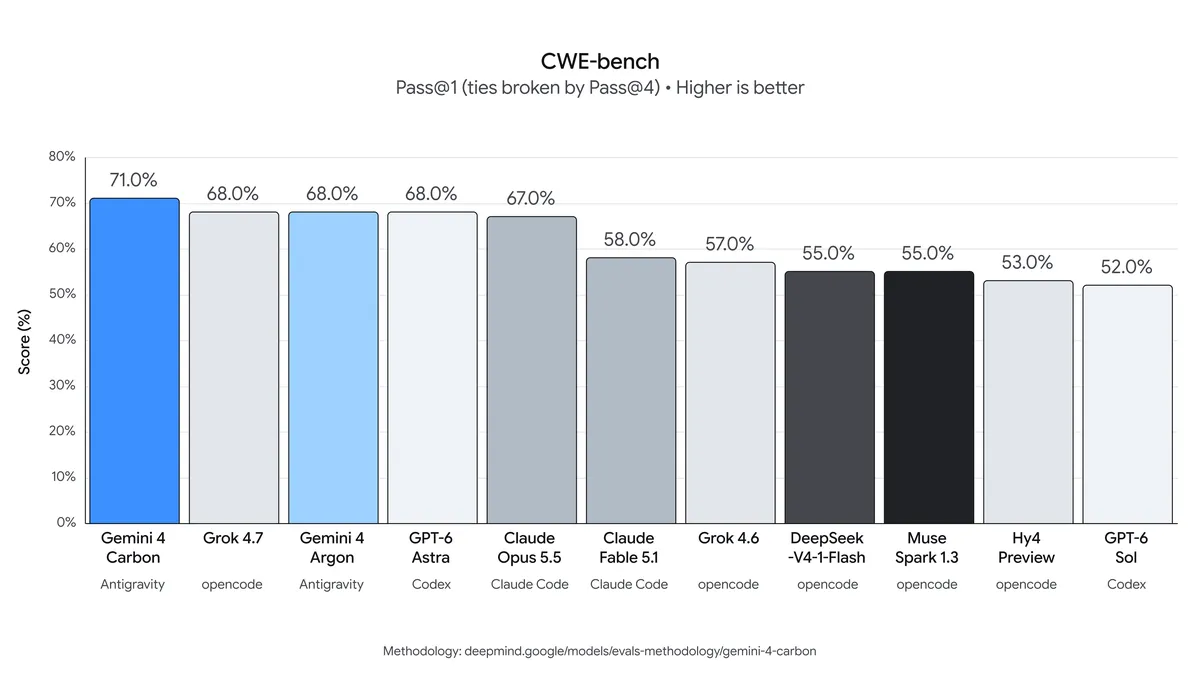
- 71.0% on CWE-bench for patching vulnerabilities at the root cause.
- A jump of 89 Elo points on WebDev Arena to #4 with a score of 1768.
- Twice the rate of secure-code generation versus Argon, and — per Google's own Chrome team — patch quality described as more than 10x better than another lab's large frontier model.
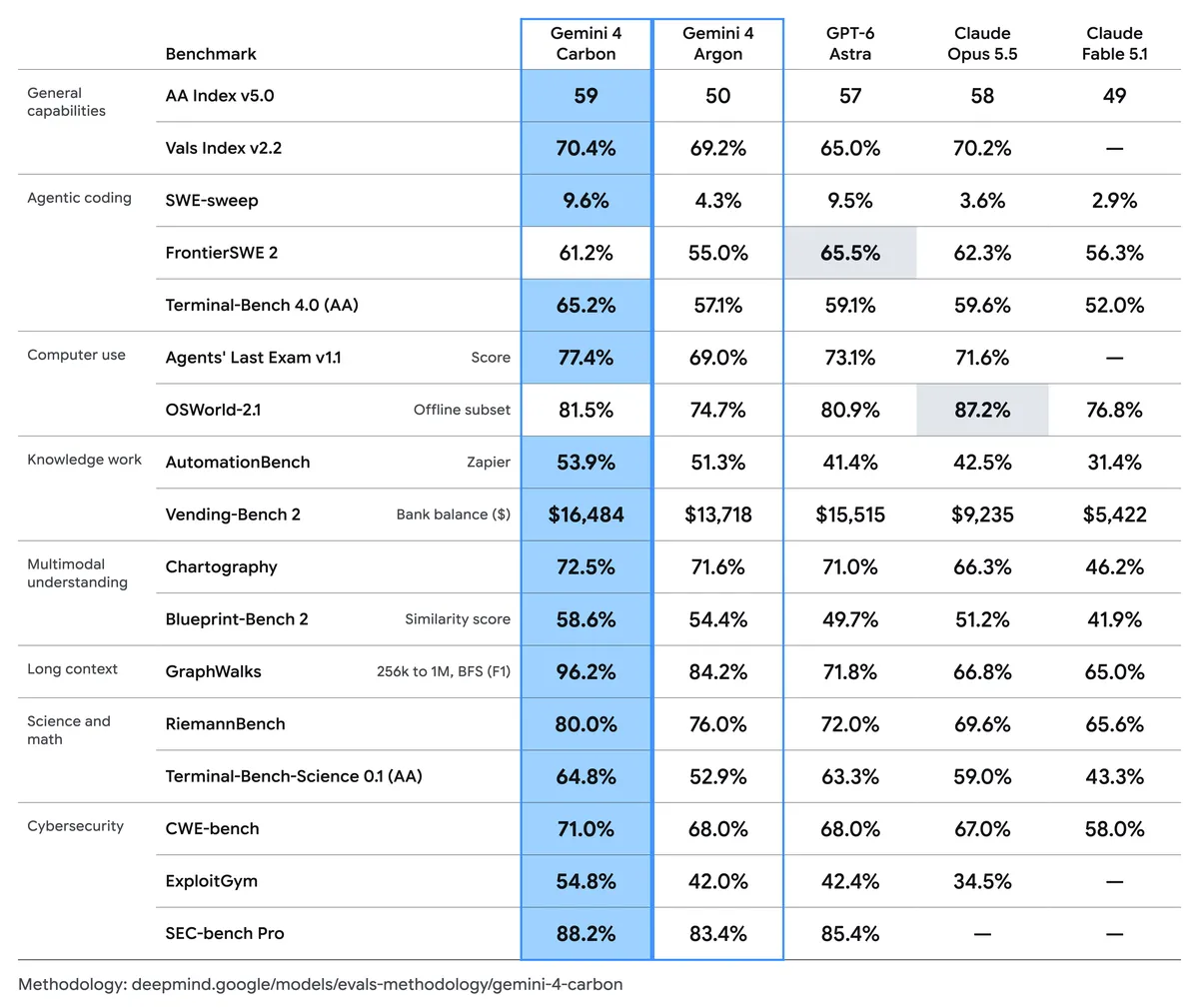
A second block of numbers concerns honesty and discipline — and for anyone who uses these models for daily work, they are the most interesting part. Carbon roughly halved unsupported claims compared to Argon, reduced overreach by 26% and under-service by 29% when executing multi-step plans, resisted every prompt-injection attempt in Gray Swan's IPI benchmark for a 0.0% attack success rate (Argon scored 0.7%), and recorded a 0.0% successful-cheating rate on Terminal-Bench 4.0.
Pricing: what Gemini 4 Carbon will cost
This is the clearest part of the announcement. Carbon launches at exactly the same introductory price as Argon:
- $2 per million input tokens.
- $10 per million output tokens.
- Cached input tokens at 95% off the input price.
In practical terms: if you run an app or a workflow on the Gemini API, trying the new #1 model on the Artificial Analysis index will not raise your bill versus Argon. That is a meaningful pricing decision in a market where price has become the primary weapon — the same logic OpenAI applied with GPT-6.1 Terra, which brought the mid-tier down to $1 per million input tokens.
Availability: who can use it right now?
The rollout plan, exactly as stated on the Google blog, has three stages:
- Now: a selected group of cyber defenders, via the Fairwind early-access program, while Google gathers feedback and tightens guardrails.
- Next: a gradual expansion to additional trusted partners.
- Later, "as soon as possible": developers, businesses, and consumers across Google's product surfaces — wording that simply means no public date exists yet.
So if you see a claim that Carbon is "available now in the Gemini app," it is inaccurate. The model in your app today remains Argon and its variants.
What this means for content creators
A story about a security-focused model for engineers can feel distant from writing and publishing work. Three practical angles say otherwise:
First, honesty metrics are content-quality metrics. The biggest failure mode for anyone producing articles, scripts, or research with AI is fabricated claims and phantom sources. When Google makes "unsupported claims cut by half" an announced design goal, the next generation of Gemini models reaching consumer surfaces will be materially safer for factual work. If you draft with Gemini inside a unified workspace like ARWriter's writing tools, every gain in model honesty flows straight into your output.
Second, price stability protects your workflow math. Anyone building automation on the Gemini API knows the planning nightmare of price jumps at every launch. A steady $2/$10 means trying Carbon when it lands will not blow up your budget.
Third, the specialist-model era is now official. Carbon is not a bigger Argon; it is a model aimed at a specific job. The market is consolidating into model families with per-task pricing, and understanding that shift early helps you match the tool to the task instead of paying for capability you never use. That is exactly how we recommend working: pick the tool by the task, not by the noise around it.
Quick comparison: Carbon vs Argon vs GPT-6.1 Terra
| Model | Standout strength | API price per million tokens | Available to whom right now? |
|---|---|---|---|
| Gemini 4 Carbon | #1 on the Artificial Analysis Intelligence Index (59), record security results | $2 input / $10 output | Cyber defenders only (Fairwind preview) |
| Gemini 4 Argon | The everyday general model in the Gemini app and AI Mode | $2 input / $10 output (same introductory price) | Everyone — app and API |
| GPT-6.1 Terra | Economical mid-tier with a context beyond one million tokens | $1 input / $5 output | ChatGPT Work subscribers and API users |
Honest limitations to keep in mind
- It cannot be tested today — any "instant access" offer you encounter is not official.
- The announced focus is security and coding. Google announced no new writing, image, or video capabilities in Carbon — relevant if you were waiting for a creative upgrade.
- The benchmarks were chosen and run by the lab itself (some "without guardrails," per the announcement's own wording), and internal figures like the 80% drop in misalignment alerts come from Google's own teams.
- A launch-day #1 ranking guarantees nothing weeks later in a market where leaderboard positions move weekly.
- The announcement says nothing about language coverage, so no one can honestly claim how Carbon handles specific languages before general availability — the family supports them broadly, but Carbon itself is untested in public.
The bottom line
Gemini 4 Carbon is a statement of power more than a product in your hands: first place on the most-watched model index, an API price that refuses to climb, and a cautious rollout that starts with security teams. For creators, the practical read is simple: keep working with Argon and your current stack, and watch for the moment Carbon opens to the public — that is when its honesty gains can start flowing into more trustworthy content. Until then, you can run your entire production workflow — writing, design, scheduling — from one place on ARWriter.
Frequently asked questions
Is Gemini 4 Carbon available in the Gemini app for free users?
No. Current access is limited to a group of cyber defenders in the Fairwind program, and Google has only promised availability to developers, businesses, and consumers "as soon as possible," with no date or pricing tier specified.
How much does Gemini 4 Carbon cost via the API?
The announced introductory price is $2 per million input tokens and $10 per million output tokens, with cached input at 95% off — identical to Argon's launch pricing.
Does Carbon replace Gemini 4 Argon?
No. Argon remains the everyday model available to everyone in the Gemini app, while Carbon is a security- and long-horizon-focused model rolling out in stages within the same Gemini 4 family.
How good is Gemini 4 Carbon at languages other than English?
The announcement contains no language-coverage details for Carbon specifically. The Gemini family supports a wide range of languages, but a fair judgment on Carbon will only be possible after public availability and real-world testing.
Why should a writer or publisher care about a security model?
Two reasons: the halving of unsupported claims points to more reliable future Gemini models for factual content work, and the unchanged $2/$10 pricing means the eventual upgrade will not raise the cost of Gemini-based tools.