A Week-Old Announcement That Still Deserves Your Full Attention
On August 31, 2026, OpenAI announced that ChatGPT Ads had crossed $1 billion in annualized revenue run rate less than 200 days after launch. Impressive, but not the part that matters most to most working marketers. One line further down sat the real news: self-service access to ChatGPT Ads went live across India, Europe, the Middle East, and North Africa — effective that same day. For the first time, an advertiser in Riyadh, Dubai, Cairo, Doha, or Amman could sign up directly through Ads Manager, without a managed-sales relationship, without an agency mandate, and without waiting for an invitation.
A week has passed since that announcement, which is exactly enough distance for something more useful than hot takes: agency reactions have landed, regional trade press has digested what MENA availability actually means, and the early performance chatter — positive and skeptical — is on the record. This piece is not breaking news; it is the practical briefing we wish every advertiser read before allocating a single dollar to the newest major ad channel on the internet.
What OpenAI Actually Announced
Three facts, stated verbatim in the official post on OpenAI's blog:
- A $1 billion annualized run rate. ChatGPT Ads reached this milestone in under 200 days. Note the wording carefully: "annualized revenue run rate" is a projection derived from current performance multiplied out over twelve months — a velocity metric, not cash collected. It signals momentum, and it also implies the business is still young.
- Availability in more than 40 countries through the OpenAI Ads Solutions team plus its agency and technology partners — the managed layer that has existed since the early months.
- Self-service expansion. Starting the day of the announcement, self-service access launched across India, Europe, the Middle East, and North Africa — the structural change that turns ChatGPT Ads from an enterprise sales channel into a platform any business can join directly.
"In less than 200 days after launch, ChatGPT Ads has reached $1 billion in annualized revenue run rate. The platform is now available in over 40 countries […] Starting later today, self-service access to ChatGPT Ads is launching across India, Europe, the Middle East, and North Africa." — OpenAI, August 31, 2026
The regional press confirmed the MENA angle explicitly: Campaign Middle East covered the arrival of ChatGPT Ads in the region, Communicate framed it for Gulf marketers, and Pulse2 reported that the platform now serves tens of thousands of advertisers worldwide.
The Quick Facts
| Item | Detail |
|---|---|
| Event | ChatGPT Ads hits $1B annualized run rate; self-service opens to MENA, India, and Europe |
| Official announcement date | August 31, 2026 |
| New self-service markets | India, Europe, Middle East, North Africa |
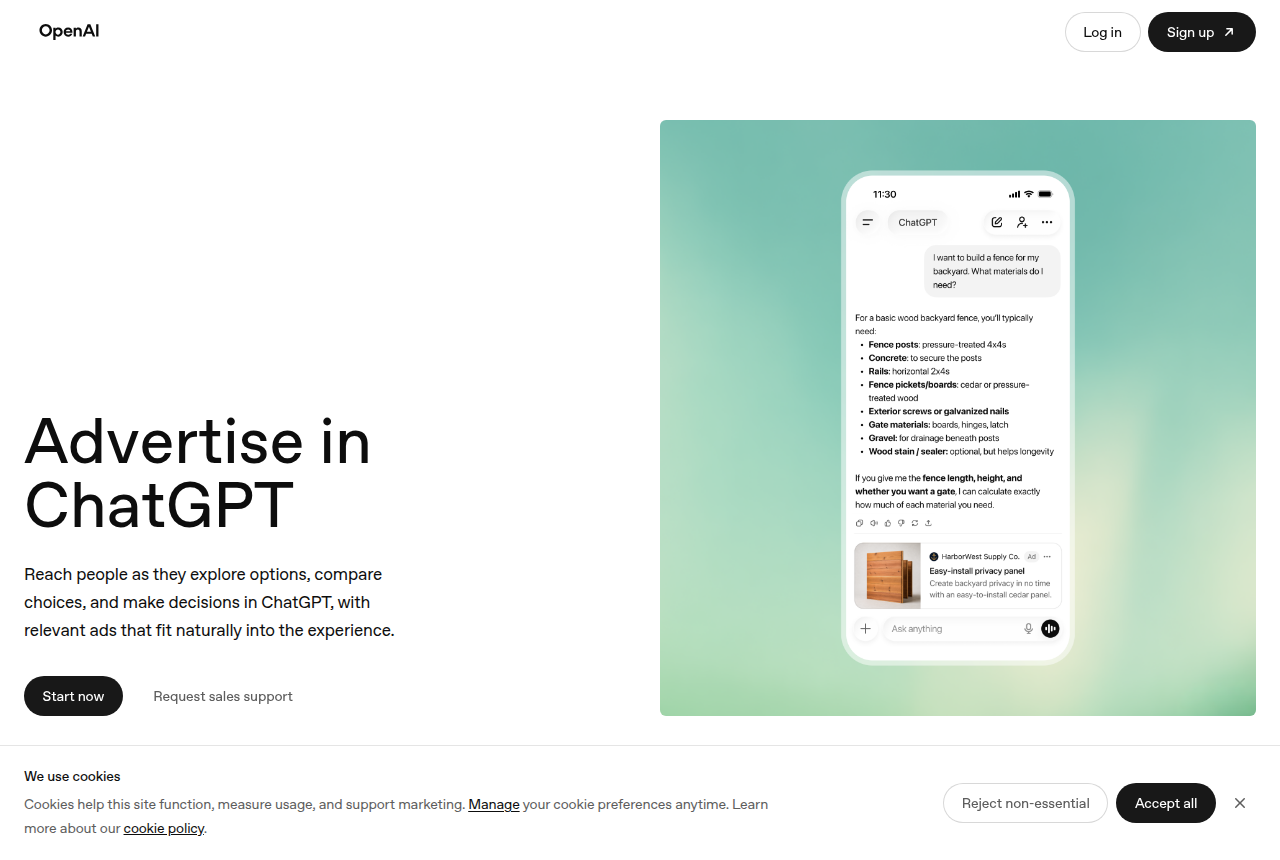
| Entry point | ads.openai.com — "Start now" for self-service, "Request sales support" for managed |
| Best suited for | Ecommerce, apps, services, and agencies hunting early-mover inventory in high-intent conversations |
| Channel maturity | Under 200 days old — real opportunity, real rough edges |
Why Self-Service Changes Everything for the Region
When an ad platform enters a market through managed sales only, the big players arrive first: global agencies and major brands with the budgets and legal teams to justify a direct deal. Opening self-service rearranges the field for three groups specifically:
Small and mid-sized ecommerce operators. A boutique in Riyadh, a perfume store in Dubai, or a D2C brand shipping from Cairo can now open an account the same way they would on any other ad platform — no intermediary required. OpenAI itself noted that SMBs have become a "material share" of the ads business since Ads Manager opened up in May.
Regional agencies. Marketing agencies across the GCC, Levant, and North Africa can add ChatGPT Ads to their service decks now, months before most local competitors touch it. Early channel expertise is a sellable asset, and the knowledge curve is still shallow enough to climb quickly.
Independent creators and solopreneurs. Anyone promoting a course, a subscription product, a community, or a tool now has a fifth major channel to test — one where the audience is actively describing what they want to buy.
How the Ads Actually Work
The core mechanic separating this channel from everything that came before it is conversational context. A Google user types a terse query. A ChatGPT user explains their situation in full sentences: "I'm looking for invoicing software for a small retail shop, my budget is tight, and Arabic support matters." That richer signal is what OpenAI's own landing page means when it promises to "go beyond keywords with richer context signals."
On the safeguards side — the part both advertisers and their audiences worry about — the announcement committed to four explicit rules:
- Ads are always clearly labeled and separate from ChatGPT's answers. They never disguise themselves as organic responses.
- Advertising does not influence the answers ChatGPT provides.
- Advertisers never receive access to people's private conversations.
- Users control how their ad experience is personalized, with behavior varying by country and settings.
The advertising toolkit itself has matured quickly. CPC and outcome-optimized bidding now account for the majority of campaigns; a Pixel and a Conversions API anchor measurement and optimization; and product feeds, platform and geographic targeting, and custom audiences round out a feature set that will feel familiar to anyone who has run campaigns on the major networks. The plumbing is standard. The environment is not.
What This Means for You as a Marketer or Creator
Four practical shifts in your workflow, in order of impact:
1. A genuinely new distribution layer. Your mix has lived inside Google, Meta, TikTok, and Snap for years. This is a fifth channel with far fewer advertisers competing for attention — and an audience of more than a billion weekly active ChatGPT users (OpenAI's own figure) sitting in moments of genuine intent: comparing options, weighing trade-offs, preparing to buy. For ecommerce and commercial content, early reach like this is rare.
2. Ad copywriting for conversations is a different craft. Search ads match short phrases; conversational ads surface inside a rich, purposeful discussion. The winners will be advertisers whose creative delivers real value against the user's actual question — a clear offer, specific numbers, a verifiable promise. This is a writing skill, and in Arabic-speaking markets specifically it is an open field: most competitors will arrive with stiff translated English, while copy written in natural, persuasive Arabic will stand out immediately. If producing that volume of Arabic-first campaign and supporting content is the bottleneck, a platform like ARWriter's Arabic AI writing suite exists precisely to close that gap.
3. The ad-supported free tier reshapes your audience, too. OpenAI was explicit that advertising is what keeps ChatGPT free for its billion-plus weekly users. For creators, that cuts both ways: a larger free audience can access the platform (good), while ads now appear inside the user experience your audience growth has relied on (a shift worth factoring into how you build presence there).
4. Measurement is the double-edged sword. The Pixel and Conversions API exist, but — as you'll see in the limits section below — advertisers in the older markets report that measurement depth still trails Google and Meta. Plan a contained, evaluable test before committing serious budget.
How to Get Started, Step by Step
- Go to ads.openai.com and click "Start now" for a self-service account. If you run large budgets or need contractual hand-holding, "Request sales support" connects you with the sales team instead.
- Create your advertiser account with real business details — name, country, currency. Use a professional domain, not a throwaway personal address; verification standards across ad platforms have only gotten stricter.
- Install the Pixel or set up the Conversions API before your first campaign goes live. Early measurement is what turns your next decision into arithmetic instead of vibes.
- Upload your product feed if you're an ecommerce advertiser — feeds power product ads inside shopping-oriented conversations.
- Start with a small test budget on one audience and one objective (visits or conversions), then judge across two full weeks. OpenAI cited one ecommerce advertiser reaching 3x return on ad spend across 28 days — but results vary by offer, market, and creative, so treat anyone else's numbers as orientation, not promise.
Payment logistics in the region work like any global ad platform: an internationally accepted credit or debit card covers the major Gulf markets comfortably, and invoicing options open up through the sales-supported track for larger commitments.
Quick Comparison: ChatGPT Ads vs. What You Already Use
| Dimension | ChatGPT Ads | Google Ads | Meta Ads |
|---|---|---|---|
| Audience mindset | Actively comparing options inside a conversation | Explicit search intent, terse queries | Browsing/social discovery mode |
| Targeting richness | Conversation context + user settings | Keyword + intent | Demographics, interests, behavior (richest historically) |
| Measurement maturity | Young — Pixel + CAPI, deeper tools still developing | Most mature in market | Very mature, under tightening privacy constraints |
| Competitive density | Relatively low — new channel | High in most sectors | Very high and rising |
| Current sweet spot | Early testing; products "under comparison" | Explicit direct demand | Awareness and latent demand |
The practical read: this channel doesn't replace your existing stack — it inserts a layer of rich intent between explicit search and passive browsing. For a worked example of building campaigns on top of modern AI tooling, see our guide to automating Meta ads with GPT-6 Astra.
Early Results: What Advertisers Are Actually Saying
The numbers OpenAI published alongside the announcement include an ecommerce advertiser achieving 3x return on ad spend across campaigns over 28 days, and a technology partner reporting that more than 80% of ad-driven ChatGPT traffic came from new customers. The platform also disclosed that its advertiser base has moved beyond the original managed-sales model into a hybrid ecosystem of more than 50 technology and measurement partners, and that advertisers outside the United States represent a growing revenue share — now including, for the first time in a structural way, the MENA region.
On the regulatory side, The Next Web noted that the European Commission designated OpenAI under the Digital Services Act framework on the same day as the announcement — meaning stricter European scrutiny of ad transparency, directly relevant to any regional business that also sells into Europe.
Honest Limits to Know Before You Spend
- Measurement is the number-one complaint. AdExchanger's follow-up, three days after the milestone, was blunt: advertisers want to spend more, but they're waiting on stronger measurement solutions. If you're used to Google's or Meta's reporting depth, temper expectations.
- Agencies reported uneven performance. In the days before the announcement, agencies openly discussed disappointing early results on LinkedIn. Performance varies — by market, language, and offer — and nothing in the milestone changes that.
- $1 billion is a run rate, not revenue banked. Annualized figures project current momentum across twelve months. Per heise's reporting, the stated annual target is higher still — the journey is closer to its start than its end.
- No full Arabic interface yet. There has been no official announcement of a complete Arabic Ads Manager UI at the time of writing. Expect English admin workflows with Arabic-facing creative — plan both.
- Regional audience size is undocumented. OpenAI has not published per-market user figures for the region. Your own two-week test data, not press releases, is the evidence that matters for your market.
What Comes Next
OpenAI's stated roadmap for the next phase: more markets, additional formats, objectives, buying options, and measurement capabilities — plus "more native ways" for businesses to interact with consumers inside the conversation. Read that as: today's version of ChatGPT Ads is the floor, not the ceiling, and early entrants are accumulating learning and measurement history before auction density rises. We documented the platform's expansion across 31 European markets earlier this quarter — the pace since then confirms this is a strategic pillar of the business, not an experiment.
The Practical Bottom Line
ChatGPT Ads reaching $1 billion is not a vanity metric for a Silicon Valley slide deck — it is evidence that advertising inside AI conversations has graduated from experiment to industry, and the door to it opened for MENA advertisers a week ago. Our recommendation: enter early with a contained test budget, ruthless measurement, and creative written for how your audience actually speaks. In new channels, the compounding advantage always belongs to the advertisers who learn the game before the field gets crowded.
And when you need help producing the content that feeds these channels — campaign copy, supporting articles, landing pages, in polished Arabic or English — ARWriter's article and research writer handles it from one place. Plans start at $4.99 (Plus), with Pro at $9.99 and Premium at $24.99 per month.
Frequently Asked Questions
Is ChatGPT self-service advertising available in the Middle East and North Africa?
Yes. The August 31, 2026 announcement opened self-service access across the Middle East and North Africa, alongside India and Europe. Sign-up is direct at ads.openai.com via the "Start now" button.
How much does it cost to advertise on ChatGPT?
There is no fixed rate card. Pricing is auction-based — cost-per-click or outcome-optimized — and daily budgets are set by the advertiser. Start small, measure, then scale what works.
Do ads influence ChatGPT's answers?
No. Per OpenAI's stated commitments: ads are clearly labeled and kept separate from answers, they do not influence the model's responses, and advertisers never see users' private conversations.
ChatGPT Ads vs. Google Ads — what's actually different?
Context depth. A Google searcher types a short query; a ChatGPT user explains their need in detail inside a conversation, giving richer intent signals. The trade-off: measurement maturity still trails Google's.
Do I need an agency to run ChatGPT Ads?
No. Self-service access through Ads Manager is open to small and mid-sized businesses directly. Agencies add value for multi-market campaigns or advanced measurement needs.
Sources
- OpenAI — A milestone in expanding access to AI (August 31, 2026, primary source)
- Official OpenAI Ads page — ads.openai.com
- Campaign Middle East — ChatGPT Ads arrive in MENA
- Communicate — OpenAI expands ChatGPT advertising to MENA
- AdExchanger — ChatGPT Ads Hit A $1 Billion Run Rate
- The Next Web — ChatGPT Ads hits $1B annualised
- Pulse2 — ChatGPT Ads Reaches $1 Billion Annualized
- heise — OpenAI estimates ad business at $1 billion