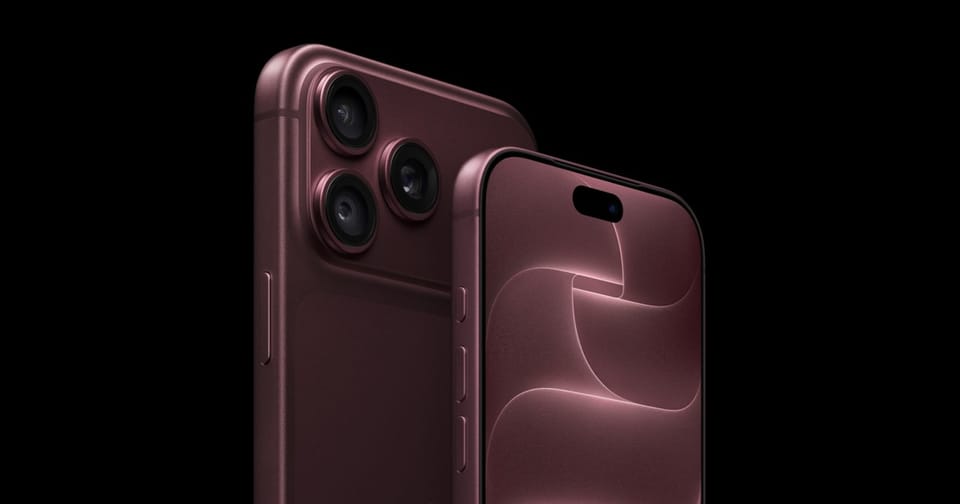
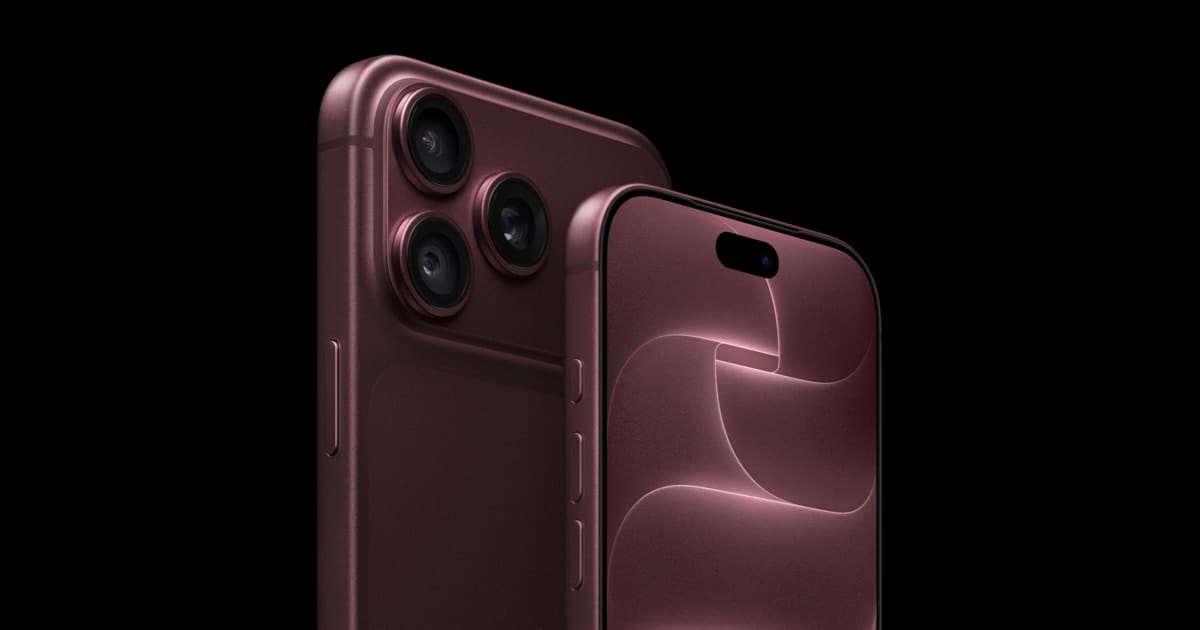
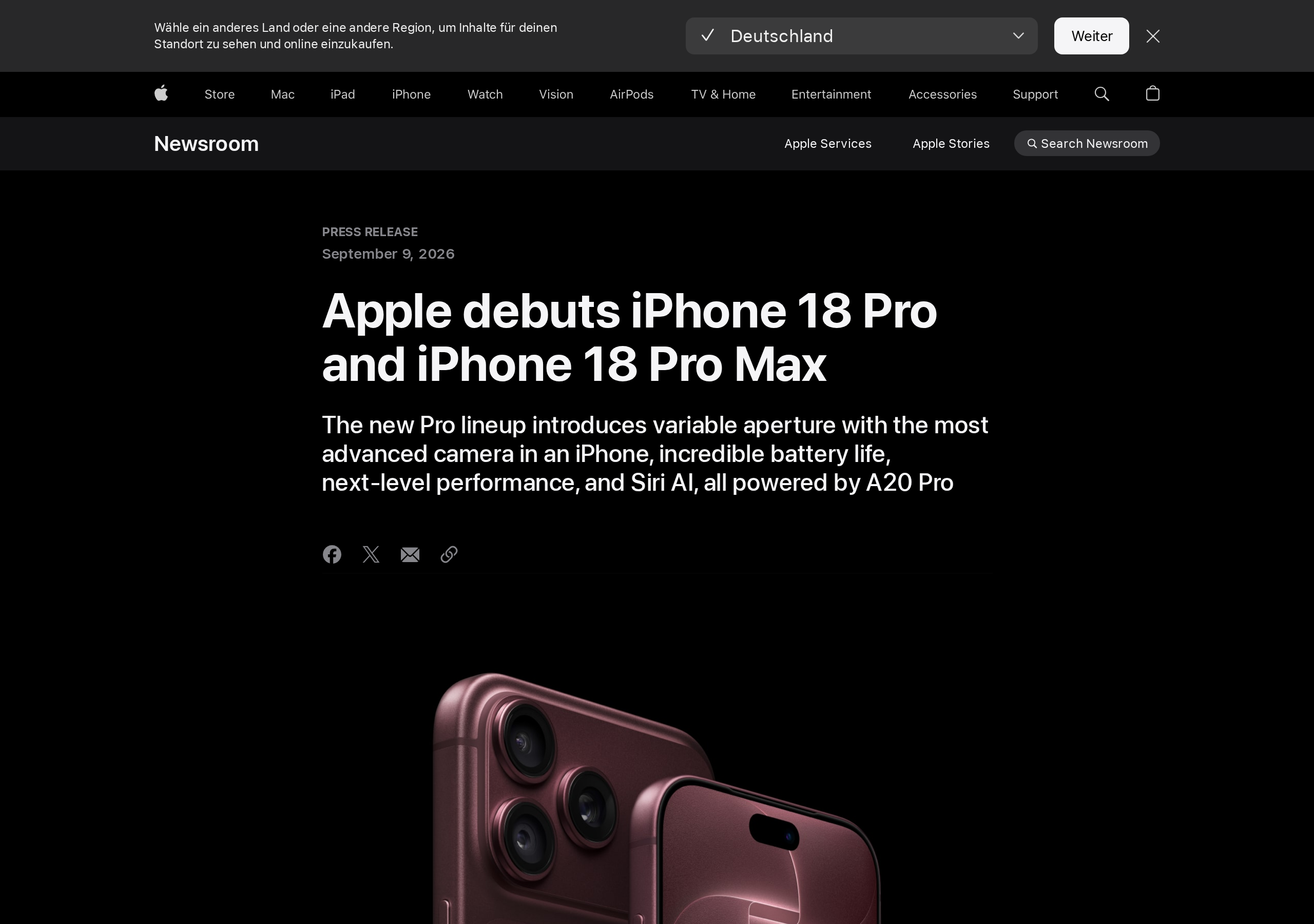
Apple has quietly built the first mass-market answer to a question that keeps getting harder every week: how do you prove a photo is real? At its fall event on September 9, 2026, alongside the iPhone 18 Pro and Pro Max hardware reveal, the company introduced Apple Reference Image — a system that lets an iPhone 18 Pro owner demonstrate, cryptographically, that a photo came off the camera sensor and not out of a generative model. For anyone whose livelihood depends on believable visuals — press photographers, newsroom editors, e-commerce sellers, brand marketers — this is the most consequential announcement of the event.
In one sentence: the new Main camera sensor signs every pixel it captures; shooting in the new Reference mode produces signed sensor data that Apple's Private Cloud Compute turns into an unalterable reference image you can compare against the published photo — a digital negative for the synthetic-media era. Pre-orders open Saturday, September 12, availability starts Friday, September 18, and US pricing begins at $1,199 for the 18 Pro.
What Apple actually announced
The mechanics matter more than the marketing. Instead of relying on editable metadata — which any tool can strip or forge in seconds — Apple moved the proof into silicon. The redesigned Main camera sensor in the iPhone 18 Pro models signs every pixel it sees at the moment of capture. When you shoot in the new Reference mode, the camera records that signed sensor data, and Private Cloud Compute — the privacy-focused cloud infrastructure Apple built for its AI features — develops it into a reference image that cannot be altered.
The verification experience is deliberately simple: the reference image sits in the Photos app alongside the main image, like a digital negative, so anyone can visually compare the two assets and determine whether edits were made after capture. Crucially, Apple is not keeping this inside its own apps: APIs are available in iOS, iPadOS, and macOS 27 for third-party apps to enable viewing of reference images, which is the doorway through which publishing tools, newsroom CMSs, and marketplace platforms could adopt verification.
A second layer rounds out the system. Apple says image metadata and upcoming support for the SynthID standard — the provenance/watermarking approach developed by Google — will help users identify images that were generated or edited with AI. Put together, Apple describes the bundle as a "multifaceted approach to image authenticity," one it explicitly calls vital for photojournalists, photographers, and everyday viewers. That framing is a direct acknowledgment of where the industry has been heading: verification is becoming a default expectation, not a niche add-on.
Why this lands at exactly the right moment
The timing is not accidental. Over the past months, social platforms have been mislabeling real photos as AI-generated because a single AI-assisted edit — a background removal, a sky replacement — trips their detection heuristics. We documented this wave in detail in our piece on why Instagram labels your real photos as AI content. Meanwhile generation tools keep improving: as we covered in our ChatGPT Images 2.5 report, AI images are now routine parts of professional content workflows. The result is a trust vacuum: audiences discount everything, platforms mislabel indiscriminately, and the people producing genuine work pay the price.
For working professionals, the stakes are concrete. A news photojournalist needs defensible proof that a conflict or disaster image is untouched. An e-commerce founder needs product shots that read as authentic in a market increasingly suspicious of perfect renders. A stock contributor or brand agency needs to answer client questions about provenance without a forensic lab. Until now, none of them had a consumer-device answer; they had agency procedures, or nothing.
How to put it to work: a practical path
- Get the hardware decision out of the way early. Reference Image works on iPhone 18 Pro and Pro Max only. Pre-orders open September 12 and units ship September 18, with US pricing from $1,199 (18 Pro) and $1,299 (18 Pro Max), in 256GB to 2TB configurations and four finishes including the new burgundy.
- Reserve Reference mode for evidentiary shots. The feature is designed for photos where authenticity is the point — event documentation, product photography, deliverables under contract — not for your entire camera roll.
- Shoot, then verify in Photos. The reference image appears next to the main photo; comparing the two exposes any post-capture edit instantly, no specialist software required.
- Watch the third-party ecosystem. With verification APIs in iOS, iPadOS, and macOS 27, expect publishing and workflow tools to announce support first; plan your delivery pipeline around whichever tools your clients trust.
- Pair verification with better capture. The same announcement brought the first variable-aperture lens in an iPhone — six laser-cut blades, automatic depth-of-field and lighting adjustment, plus manual pro controls for shutter speed, white balance, aperture, and a live histogram. A stronger original shot is the cheapest credibility upgrade there is.
What this means for you as a creator
Three practical implications. First, if authenticity is part of your professional value — journalism, documentary, product, or contract photography — the iPhone 18 Pro just became the first phone with a built-in receipt for your work, and that is a legitimate line in your services pitch. Second, manage expectations: nothing in Apple's announcement says Instagram, TikTok, or any other platform will read Apple reference images and lift AI labels automatically. Treat this as proof you can present in a dispute, not as immunity from platform heuristics. Third, this is a Pro-tier, $1,199+ purchase; if verified capture is not central to your income, the honest advice is to wait for the ecosystem — SynthID support, platform adoption, third-party verification — to mature before spending.
There is a parallel lesson for the text side of your work. Transparency is becoming the durable strategy across formats: disclosing AI involvement in generated images and drafts protects accounts from the disclosure crackdowns platforms have started, while original, well-crafted writing remains the strongest signal of a genuine brand. If you produce bilingual or multilingual content at volume, tools like ArWriter exist precisely to keep that production in one manageable place.
Quick comparison: the image-authenticity landscape today
| Approach | What it does | Who provides it | Where it works | Main limitation |
|---|---|---|---|---|
| Apple Reference Image | Per-pixel sensor signing; unalterable reference image for comparison | Apple (built into the camera) | iPhone 18 Pro / Pro Max; Photos app; third-party apps via iOS/macOS 27 APIs | New Pro hardware only; per-shot Reference mode |
| Metadata + upcoming SynthID support | Helps identify AI-generated or AI-edited images | Apple support; Google's standard | Apple ecosystem; availability described as "upcoming" | Not live at announcement |
| Platform AI labels | Auto-labels media when AI involvement is detected | Instagram and other platforms | Social platforms | Frequently mislabels real work; misses generated content |
| Manual creator disclosure | You state plainly what was generated or edited | You | Any platform, any caption | Depends on your consistency; does not prove real photos |
| Agency-level forensics | Traditional technical verification for editorial imagery | Agencies and independent labs | Outside the phone entirely | Costly, slow, inaccessible to independent creators |
Honest limits you should weigh before buying
Start with exclusivity: two phones, both Pro-branded, starting at $1,199 — an iPhone 17 owner or an Android user gets nothing today, and Apple announced no plans to extend the sensor-signing to older devices. The feature is also strictly forward-looking: reference images exist only for photos shot in Reference mode on the new hardware, so your existing archive cannot be retroactively certified. Verification depends on Apple's Private Cloud Compute, which means third parties are being asked to extend a measure of trust to Apple's infrastructure; expect newsroom technology teams to take their time before treating it as conclusive. Platform adoption is the open question — no social network has said it will read these reference images, so the immediate value is evidentiary, not preventive. And the SynthID layer Apple mentioned is explicitly "upcoming," with no date attached, which tells you the cross-industry provenance stack is still under construction.
By the way: if your content strategy mixes verified photography with original writing and AI-assisted production, ArWriter keeps drafting, image prompting, and bilingual publishing in one workspace — from $4.99/month.
Frequently Asked Questions
Does Apple Reference Image work on older iPhones?
No. It requires the new Main camera sensor that signs every pixel, available only in the iPhone 18 Pro and Pro Max announced on September 9, 2026. Apple has not announced plans to bring it to earlier models.
Will this remove the AI label from my photos on social platforms?
There is no confirmation of that. It gives you comparable, tamper-evident proof of capture, but platforms have not announced that they will read Apple reference images when applying AI labels, so manual disclosure remains necessary.
How is a reference image different from normal photo metadata?
Metadata is sidecar text that tools can edit or strip; a reference image is developed from the sensor's per-pixel signatures via Private Cloud Compute into an unalterable asset, stored next to the main photo for direct visual comparison.
When can I buy the iPhone 18 Pro and what does it cost?
Pre-orders open September 12, 2026, with availability from September 18. US pricing starts at $1,199 for the iPhone 18 Pro and $1,299 for the Pro Max, across 256GB to 2TB storage options.
Does the feature also prove videos are unedited?
Apple's announcement covers photo authenticity via Reference mode; it makes no claim about certified video capture. Watch for follow-up announcements rather than assuming parity.
Our verdict
This is the moment consumer photography started pushing back on synthetic media. Apple turned the sensor into a notary and gave creators the first built-in way to certify that a frame is real — not because it solves platform mislabeling today, but because it sets the direction: provenance is becoming a checkbox, and the creators who can prove their work is real will hold a trust advantage those who cannot. Verify where it matters, disclose where you generate, and build the habit now, because the verification economy is only going to expand from here.
Sources
- Apple's official announcement: Apple debuts iPhone 18 Pro and iPhone 18 Pro Max — Apple Newsroom, September 9, 2026
- Apple Newsroom — full event coverage
- Follow-up coverage: The Verge, TechCrunch, and Nieman Lab on Apple's photo-authenticity feature (September 9-10, 2026)
- Related reading on ARWriter: Why Instagram labels your real photos as AI content