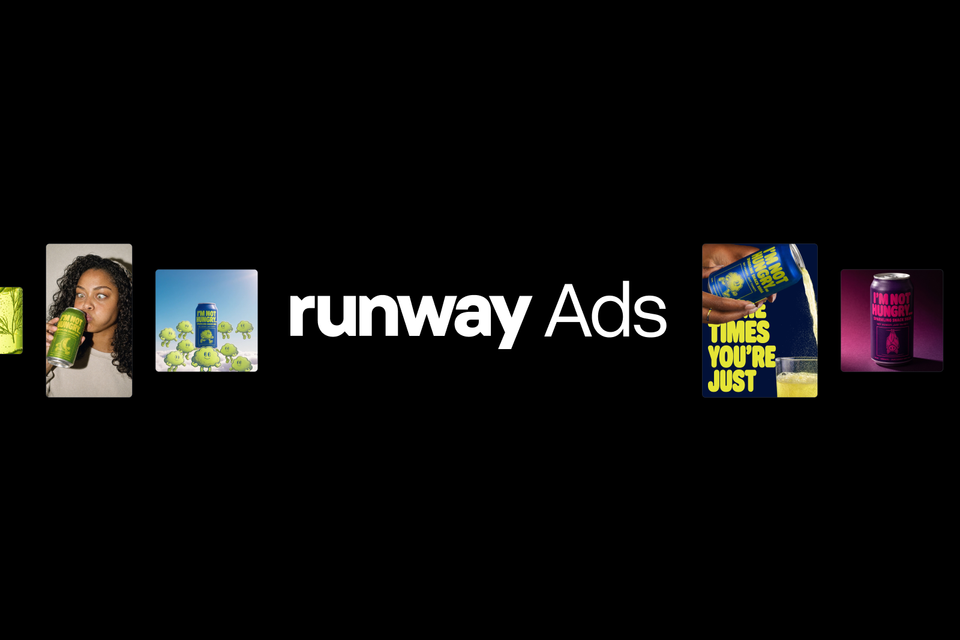
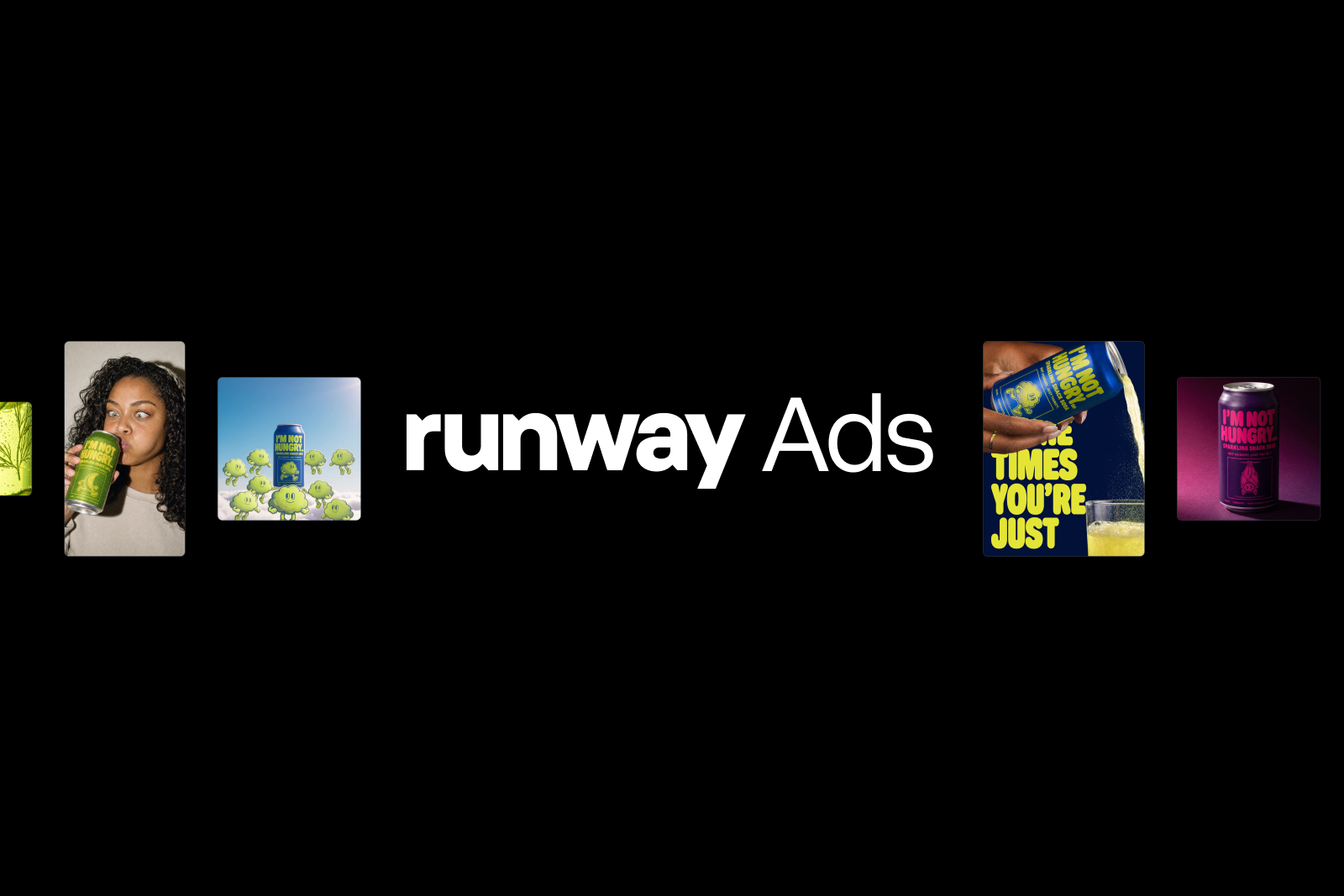
On September 30, 2026, Runway announced Runway Ads, a product that runs the creative side of paid advertising programs end to end: it generates the video and image ads, publishes approved variants straight to Meta, Google and TikTok, reads performance back from those platforms, and then produces the next round of creative built around whatever actually earned spend. If you run paid social for a brand, an agency, or your own store, this is not another template tool. It is an attempt to remove the single biggest bottleneck in performance marketing — the number of ad variations a team can physically produce.
This guide breaks down the official announcement exactly as Runway published it: what the product actually does, how the loop works, where the human sits in it, what it means for small teams and solo marketers, and the honest limitations the announcement does and does not answer.
The problem Runway Ads is built around
Runway's own framing is blunt: performance advertising rewards volume, yet most advertisers put meaningful spend behind only a small fraction of the ads they create. Teams are capped by their ability to produce enough creative — not by their analytics, and not by their judgment. Finding the ads that work is less a matter of taste and more a matter of how many variants a team can generate and test.
Anyone who has managed a Meta ad account knows the pattern. You launch three creatives, one outperforms, and then you wait a week for the designer to iterate on the winner while the audience fatigues. The winning hook exists somewhere in your audience's head; you simply cannot afford the production cycles to find it. Runway Ads is aimed directly at that gap.
How the loop works, step by step
According to the announcement, the workflow runs like this:
- Connect once. Link your ad account and assemble a brand kit — brand guidelines, past ads, and product imagery become the model's reference material.
- Generation. The engine produces on-brand video and image ads from those inputs, not generic stock-style creative.
- Brand check and approval. Every variant passes an automated brand-safety check before it reaches the approval queue. Human approval is on by default; teams can shift to automated publishing per campaign or variant type as confidence grows.
- Direct publishing. Approved variants publish straight to Meta, Google and TikTok — the three platforms that dominate paid social spend.
- Performance read-back. The product reads results from those same platforms rather than asking you to export reports.
- Next round. It generates the following batch of creative around what earned spend, closing a loop that previously ran across three or four separate tools stitched together by hand.
The localization layer deserves more attention than it gets
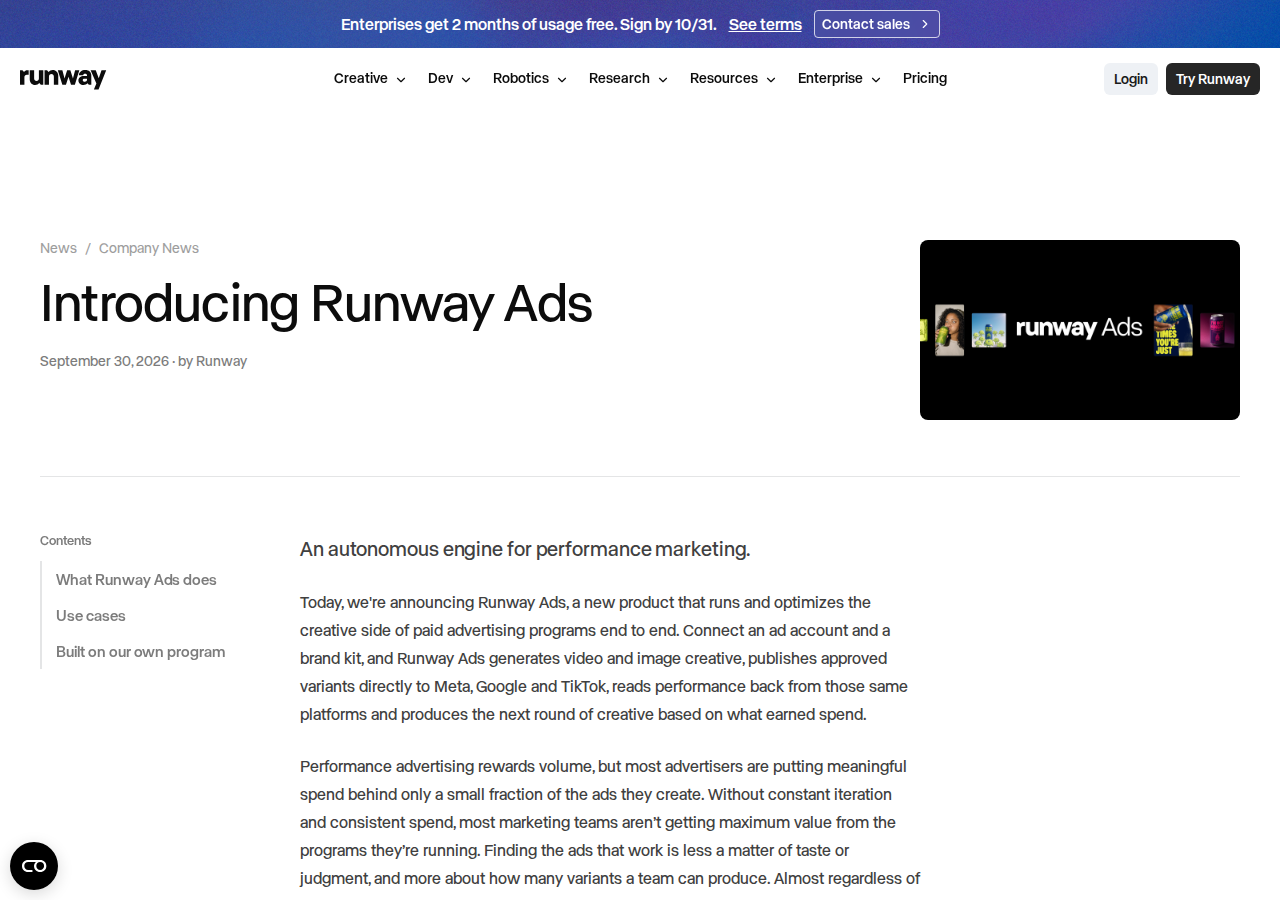
Buried under the headline feature is the detail international marketers should care about most. Runway Ads localizes every asset based on rules your team sets — for example brand voice, or a list of terms you never want translated. Crucially, that localization covers on-screen text and product screenshots, not just the voiceover.
That distinction matters. Most "AI localization" for ads today means swapping an audio track or subtitles while the on-screen English text stays frozen into the video. Here, the visible layer of the ad is treated as localizable content. For a brand running the same campaign across English, Arabic and German markets, that is the difference between a localized ad and an ad with a translated caption.
The engine also resizes and reformats every variant automatically across aspect ratios and channel specs — square for feed, vertical for Reels and TikTok, horizontal for YouTube — so a single creative decision propagates into a full matrix of placements without manual exports.
Budget guardrails: automation with a leash
Handing creative iteration to an engine is only sane if spending is fenced. The announcement specifies that Runway Ads adheres to your team's budget limits automatically, and names three guardrail types: a maximum daily change, a minimum net-new audience share, and retargeting caps. In practice that means the engine cannot double down on a winner overnight beyond the pace you allow, and it cannot quietly grind the same retargeted audience into fatigue.
What this means for small teams and solo marketers
The announcement explicitly addresses scale: large enterprises get faster testing, more variety and consistent localization across global campaigns, while small teams "can now compete at any scale, running thousands of ads per week and shifting daily based on what's working." For individual creators and small businesses, Runway's claim is access to new ad channels without taking time away from the core business.
- If you run an e-commerce store: the announcement describes generating ads at the scale of thousands of SKUs directly from existing product feeds, instead of briefing creative listing by listing.
- If you manage always-on prospecting: the example given is moving from a handful of hero ads to dozens of hook-and-format variants in the time it used to take to brief one — with the engine watching which combinations earn spend and building the next batch around them.
- If you are a freelancer serving ad clients: your leverage shifts from production speed to strategy — defining the brand kit, the guardrails and the approval standards becomes the billable work.
One step remains stubbornly human even in this loop: the message angle itself. Engines iterate on hooks you feed them, so the craft of writing distinct angles and hooks is becoming more valuable, not less. If you want a workspace for that part of the job, ARWriter's AI writing tools are built exactly for drafting and comparing campaign angles before they enter production.
How to prepare starting today, before pricing exists
Whenever signups open, engines like this one perform at the quality of their inputs — and the announcement is explicit that the generation material is your brand guidelines, your past ads, and your product imagery. That makes right now the cheapest moment to prepare. A practical checklist:
- A written brand voice file. Tone in every market language, banned words, and the core promise of the brand in two sentences. Shorter and clearer files produce more faithful output than 40-page brand bibles.
- A classified ad archive. Separate your best historical performers from the failures, with a one-line reason per classification where possible. This archive is the taste-memory the engine learns from.
- Clean product imagery. Consistent backgrounds, multiple angles, uniform resolution. Sloppy inputs produce sloppy variants — faster.
- A locked-terms list. Brand names, product names, and any commercial term that must never be localized, exactly the feature the announcement highlights.
- Written budget guardrails. The daily-change ceiling and new-audience share you can live with, decided now rather than in launch-week excitement.
None of this preparation is wasted even if you never subscribe: it is the same checklist any competent creative-automation tool will demand, from this vendor or the next.
What it means for freelancers and small agencies
The segment most affected by a product like this is not enterprises — they already staff entire creative teams — it is the solo media buyer running ads for three clients with a hard production ceiling. If the ceiling moves from five test variations a month to fifty, the pricing conversation changes category: from "design me an ad" to "I run a continuous testing program for you." That is a different service, at a different price point, and freelancers who understand the shift early will outposition local markets still billing per design. The honesty requirement cuts both ways: AI-generated ads still need human review, and the freelancer — not the engine — owns final quality in front of the client.
An illustrative example of the guardrails at work
To make the mechanism concrete, consider a hypothetical store — no official numbers implied. The owner sets a modest maximum daily change and requires at least half of targeting to reach net-new audiences. One variant starts earning spend dramatically. The engine cannot triple the budget behind it overnight, and its new-audience commitment prevents it from hammering the same retargeted circle into fatigue. Expansion happens at the pace the rules allow — rules a human wrote calmly, two weeks before the campaign, not decisions an algorithm makes in the heat of a Tuesday.
Quick comparison: your current stack vs Runway Ads
| Stage | Typical manual stack | Runway Ads |
|---|---|---|
| Creative production | Brief, wait, revise with a designer | Generated from brand kit, past ads, product imagery |
| Review | Manual round-trips over chat and email | Automated brand check, then a single approval queue |
| Publishing | Manual upload per platform | Direct to Meta, Google and TikTok |
| Localization | Voiceover swap; on-screen text re-designed by hand | Rule-based, covers on-screen text and screenshots |
| Formats | Export each aspect ratio separately | Automatic resizing per channel spec |
| Iteration | Read reports, write new brief | Next batch generated around what earned spend |
Honest limitations to weigh before you depend on it
- No pricing was announced. The launch post contains no tiers, no trial terms and no signup mechanics. Treat any pricing numbers circulating elsewhere as speculation until Runway publishes them.
- Three platforms, not the whole map. Integration covers Meta, Google and TikTok. Snapchat, Pinterest, X and programmatic remain outside the announced loop.
- Garbage brand kit in, generic ads out. The engine's grounding is your guidelines and past ads. Brands without a coherent visual identity will get volume, not direction.
- Automation is opt-in, and should stay that way for a while. Auto-publishing exists as a capability, but enabling it before the engine has a track record on your account is how brands end up with tone-deaf variants live at 2 a.m.
- Platform concentration risk. Moving the whole creative cycle into one vendor's loop makes future migration harder. Keep your brand assets and winning-creative archive exportable.
Context: Runway's steady move from model lab to production stack
Runway Ads does not arrive in isolation. Through 2026 the company has been assembling a full production stack around its video models: unified credit-based pricing, utility models such as the frame-rate enhancement tool, an OpenAI Marketplace listing that lets enterprises buy Runway through existing OpenAI commitments, and now an advertising engine that consumes the whole pipeline. The strategic read: Runway is competing less with other generative model vendors and more with the creative-automation machines inside Meta and Google themselves — with the difference that a neutral engine can optimize across all three ad platforms instead of locking spend into one.
For anyone tracking how fast AI video is becoming commercial infrastructure, this pairs with other recent milestones, such as AI-generated video crossing the ten-minute mark. The technology has moved from demo territory into the machinery of everyday advertising.
Frequently asked questions
How is Runway Ads different from a normal AI ad generator?
A generator produces one video or image and stops. Runway Ads closes the loop: it publishes approved variants directly to Meta, Google and TikTok, reads performance back from those platforms, and generates the next round of creative around what actually earned spend.
Does it publish ads without human review?
No. Human approval is on by default, and every variant passes an automated brand check before reaching the approval queue. Fully automated publishing is an option you enable gradually, per campaign or variant type, as you build confidence.
How much does Runway Ads cost?
The September 30, 2026 announcement did not include pricing, trial terms or signup details. Any numbers circulating before Runway publishes official pricing should be treated as unverified.
Can it handle non-English campaigns?
Yes, through its rule-based localization system. You define brand voice and terms that must never be translated, and the engine localizes on-screen text and product screenshots, not only the voiceover — which is what multilingual campaigns usually need.
Do I need a data team or ad-ops background to use it?
The product is designed around connecting an ad account and a brand kit, and the announcement explicitly targets small teams and individual creators, not only enterprises. You still need to understand your audience and campaign goals, because you are the one setting the rules and budget guardrails the engine obeys.
How is this different from the creative-automation tools inside Meta and Google themselves?
Platform-native tools optimize within each platform's own ecosystem. Runway Ads is neutral across the three: it generates once and distributes to Meta, Google and TikTok together. That neutrality is its core advantage for multi-platform advertisers — and simultaneously the reason you are trusting a third party with a sensitive part of your operation.
What is the safest way to start once it is available?
One small campaign, strict budget guardrails, human approval on for every variant. Watch for at least two weeks: is brand compliance holding up? Is the on-screen localization actually accurate? Only then consider enabling gradual automation for the specific variant types that proved themselves.
The bottom line
Runway Ads is a serious attempt to industrialize the creative loop of performance marketing while keeping a human finger on the trigger. For small teams, the promise is competition at a scale that previously required an agency; for enterprises, it is consistent localization and relentless iteration. The open questions — pricing, availability, real-world quality at scale — will decide how fast it is adopted. Until then, the smart move is preparing the inputs the engine needs: a sharp brand kit, disciplined guardrails, and a backlog of genuinely different message angles. The angle-writing part remains yours — a workflow you can run today with ARWriter's Arabic-first writing platform while the ad engine question settles.