On August 20, 2026, Google quietly handed publishers a new lever in the fight for attention: an embeddable "Preferred Sources" button that lets readers favorite a website with one tap, plus an AI-driven way to tune the Discover feed in plain language. If you run a blog, a news site, or any content business that depends on search traffic, this is not a minor interface update — it is Google rebuilding the reader-publisher relationship inside its own ecosystem, and early movers get the advantage.

The announcement, published on Google's official blog under the title "Personalize the content you see on Search, Discover, and News," arrived at a moment of genuine tension. Publishers worldwide have watched referral traffic thin out as AI-generated answers resolve questions before a single link gets clicked. Google knows the pressure is real; this package is the company's most concrete olive branch to the publishing side so far.
Part one: the embeddable Preferred Sources button
The mechanics are simple, which is precisely the point. Until now, a reader who trusted your site had to dig into Google's personalization settings and add you manually — a journey almost nobody completed. The new feature flips the burden: publishers can now embed an interactive "Preferred Sources" button directly on their pages. One tap, and the reader's Google account registers the site as a preferred source; the reader is then returned instantly to the exact spot on the page where they left off. No settings menus, no context switching, no lost reading position.
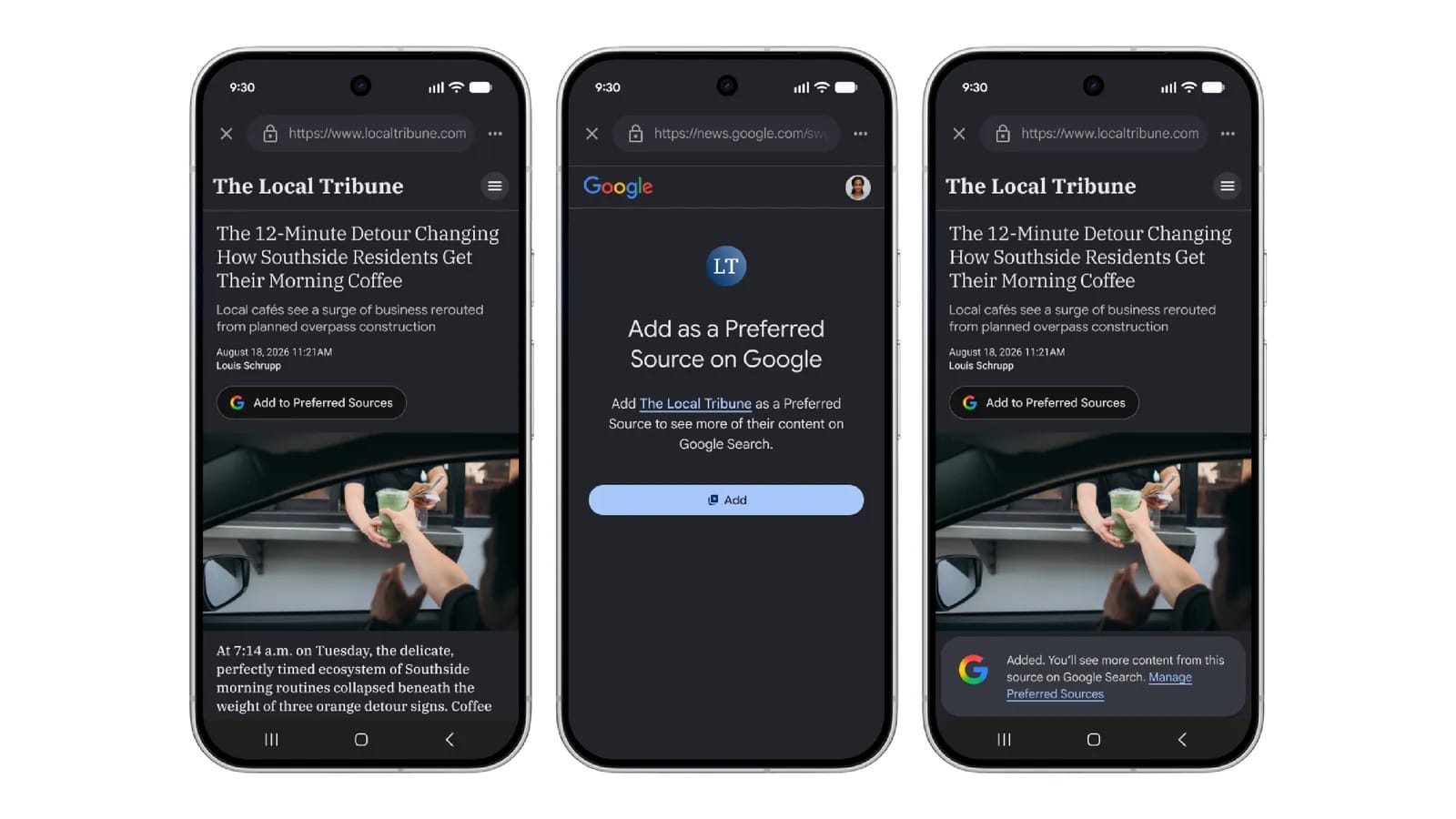
Why does a single tap matter so much? Because preferred sources get visually distinguished across Google's highest-value surfaces: the Top Stories section in Search results, AI Overviews — Google's generated-answer experience — and the newer AI Mode. Your link doesn't just compete in a list; it carries a "Preferred" label inside the AI-generated response itself. In a world where the answer increasingly lives on Google's page rather than yours, being flagged inside that answer is the closest thing to a homepage link the new era offers.
The adoption numbers Google disclosed are worth pausing on. As of the August 20 announcement, people have already selected more than 600,000 unique sources. Compare that with the figure from May 27, 2026 — 345,000 sources — when Google first brought Preferred Sources into its AI experiences, and the trajectory is obvious: adoption nearly doubled in under three months. Google also stated in its May post that people are twice as likely to click through to a Preferred Source when one is available.
How to actually add the button
- Fetch the embed snippet from the Preferred Sources documentation in Google Search Central — the same hub you already use for Search Console and structured data.
- Place the button where trust peaks: end of article, sidebar, or your About page — after the reader has just experienced your best work, not before.
- Confirm your site qualifies: Google's stated eligibility rule is simply that the website publishes fresh content. There is no application committee.
- Invite readers explicitly, the same way you invite newsletter signups — a quiet button nobody explains is a button nobody presses.
Part two: Discover gets a chat-style personalization layer
The second half of the package targets the reader side. In the Google app, "in the coming days," users will be able to tap any three-dot menu in the Discover feed and describe what they want — in their own words. Google's own example: kitchen renovation ideas, "eco-friendly only," or road trip videos minus the camping. A chatbot-style interface confirms the request, lays out the content types it will prioritize, accepts corrections, and then refreshes the feed on demand. Crucially, Discover remembers those instructions for future visits.
This pattern will feel familiar to anyone tracking recommendation systems: YouTube, Instagram, Bluesky, and X have all been experimenting with AI-assisted feed tuning. The difference is scale and context. Discover is not a social network; it is the default content discovery surface for hundreds of millions of people who open the Google app without a specific query — a behavior especially common across mobile-first markets in the Middle East, South Asia, and Latin America.
For publishers, an explicitly-tuned feed cuts both ways. Content that genuinely matches a reader's stated interest gains a sharper path to visibility than generic algorithmic guessing ever provided. But content with no clear identity — the everything-for-everyone publication — becomes easier to filter out than ever. Explicit preferences are brutal to content that deserves indifference.
Part three: customizable audio briefings in Google News
The quietest of the three updates may matter most over time: Android users can now curate their daily audio briefings in the Google News app by choosing specific topics, with clear source attribution and links out to full articles. Audio is a habit-builder — a commuter who hears your brand every morning is accumulating familiarity that a skimmed headline never earns. For publishers, being a voice in someone's morning routine is premium real estate.
The full backstory: how we got here
Preferred Sources did not appear out of nowhere. The feature began as a modest option inside Top Stories, letting users elevate favorite outlets in breaking-news coverage. On May 27, 2026, Google extended it into AI Overviews and AI Mode, added a perspectives carousel for developing topics, and disclosed the 345,000-source milestone alongside the two-times click-through finding. The August 20 announcement completes the arc: instead of hoping readers find a buried setting, Google now lets publishers carry the setting to the reader.
Tech press coverage framed the package without pretense. TechCrunch ran it under a pointed headline about giving publishers "a new way to fight AI-driven traffic losses," explicitly connecting the new tools to the damage AI-powered search features have inflicted on traffic-dependent businesses. The Verge focused on the chatbot-style Discover tuning and what it says about Google borrowing playbook logic from social platforms. Both readings converge on the same conclusion: the reader-publisher relationship inside Google is being actively redesigned.
What this means for you as a content creator or publisher
- You can now build a "following" inside Google itself. The button converts an anonymous drive-by visitor into a persistent preference that travels with that reader across Search, Discover, News, and AI experiences — no social account required as an intermediary.
- It is a hedge for the AI-search era. As more queries resolve in AI Overviews and AI Mode, preferred placement inside those answers is how your brand stays visible when the classic "ten blue links" fade.
- It works from anywhere, including non-English markets. The button and its documentation are globally available through Search Central; there is no regional allowlist. An Arabic-language site, a Hindi blog, or a Spanish magazine can implement today.
- It is an early loyalty signal. Readers who deliberately select you have self-identified as your highest-intent audience — a more honest metric than social followers, which are cheap to give and cheaper to ignore.
And if AI assists your writing workflow, the strategic logic only sharpens: an explicitly personalized feed rewards content with a distinct editorial voice. Tools like ARWriter's article and research writer exist precisely for that middle path — machine-assisted structure and drafts that keep a human editorial signature, which is what both readers and recommendation systems now reward.
Quick comparison: audience-building channels
| Channel | Where the reader lives | Practical note |
|---|---|---|
| Google Preferred Sources button | Inside Google (Search, Discover, News, AI) | New — early-adopter advantage is real |
| Email newsletter | Reader's inbox | Strongest ownership, but list-building takes effort |
| Social platform follows | Inside each platform's algorithm | Reach fluctuates with ranking changes — see our X algorithm coverage |
| Chatbot presence (ChatGPT etc.) | Inside AI assistants | Fast-growing but hard to influence — explained here |
Why now? The AI pressure on publisher traffic
Google's own framing is diplomatic: the new features "give you even more control over your experience, while helping publishers build stronger, direct connections with their readers." Translate that, and it acknowledges the underlying problem — every question answered on the results page is a potential visit that never reaches a publisher's site.
The trade press did not soften the connection. TechCrunch's report explicitly positioned the button as Google trying "to assuage the damage that the rapid growth of AI-powered search features has had on traffic-dependent businesses." Whether the olive branch is sufficient is debatable; that it was necessary is not in dispute.
For publishers, the competitive question has shifted. It is no longer only "do I rank?" but "am I inside the reader's hand-picked circle?" That circle is built one tap at a time, and it compounds: every month that passes before competitors adopt the button is a month of accumulated reader preferences flowing to whoever moved first.
Honest limitations to weigh before you celebrate
- The button does not restore lost traffic by itself. It is a preference channel inside Google's ecosystem, not compensation for the structural click-through decline generated answers have caused.
- It requires reader action. Most visitors will never tap any button. Placement, timing, and an explicit invitation do the heavy lifting; a decorative button gathers dust.
- Rollout is staged. Discover's language-based tuning arrives "in the coming days" per Google — phased rollouts can lag in specific markets, and the customized audio briefings are Android-only for now.
- No dedicated analytics yet. Google has not announced a Preferred Sources dashboard, so attribution will be inferential — watching aggregate performance reports before and after adoption.
- Advantage decays. A free, powerful feature gets adopted by thousands of sites within months. The durable edge belongs to those who build the reader-invitation habit early, not to those who merely paste the snippet.
A five-step implementation plan
- This week: embed the Preferred Sources button in your article template from the Search Central snippet, and test it on mobile and desktop.
- Add a one-line invitation below new articles: ask readers to add you to their Preferred Sources so your coverage reaches them in Search and Discover.
- Audit your editorial identity: a feed that readers tune in words rewards a sharp, consistent angle and discards generic output.
- Track performance weekly after embedding, looking specifically at Discover and News impressions and clicks versus your prior baseline.
- Combine channels into a distribution triad — newsletter, social, and Preferred Sources — because no single channel should own your future.
Frequently asked questions
What is Google's Preferred Sources button?
An interactive button announced by Google on August 20, 2026, that publishers can embed on their sites. When a reader taps it, the site is added to their Google Preferred Sources and the reader returns to the page they were reading. The site is then highlighted in Top Stories, AI Overviews, and AI Mode.
How do publishers add the Preferred Sources button?
Through embed code published in Google Search Central's documentation. Sites that publish fresh content are eligible; there is no separate application process.
Does being a Preferred Source actually increase traffic?
Google's published data says people are twice as likely to click a Preferred Source, and over 600,000 unique sources had been selected as of August 20, 2026. Individual results depend on your audience size and how actively you invite readers to choose you.
What is new about Discover feed customization?
In the coming days inside the Google app, users will be able to open the three-dot menu on any Discover card and describe what they want more or less of in plain language. The feed updates immediately and remembers the preferences for future sessions.
Are these features available outside the United States?
The button and its Search Central documentation are globally available, Discover's language-based tuning rolls out through the Google app without an announced geographic exclusion, and customizable audio briefings are available in Google News on Android.
Is the button a replacement for a newsletter?
No — they compound each other. A newsletter gives you an owned list and direct reach; the button gives you distribution preference inside the world's largest discovery ecosystem. Running both, with consistent invitations to each, is the resilient strategy.
The bottom line: on August 20, Google opened a new door for publishers — but a door does not open itself. The sites that embed the button now, teach their readers to use it, and double down on a recognizable editorial voice will be inside the new distribution circle as it forms. The ones waiting for perfect clarity will find the circle closed around them.